How the Romans Built Aqueducts That Still Carry Water
Across the Roman world, aqueducts carried water through hillsides, across valleys, and into crowded cities that couldn't survive on local sources alone. They were built for daily use, yet some became among the longest-lasting works of Roman engineering. Aqueducts moved fresh water across miles of countryside, often through channels hidden beneath the ground. Their builders relied on science and ingenuity, using the slope of the land, durable materials, and regular repairs to keep water moving. Some Roman aqueducts collapsed or fell out of use, but others proved far more lasting. Several are still in use today. Their survival shows how carefully Rome turned a simple natural force into infrastructure that could endure for centuries.
The Problem the Romans Needed to Solve

As Rome grew, so did its demand for water. Early residents relied on wells, springs, and rainwater collected in cisterns, but those sources could only provide so much. Public baths, fountains, and workshops placed additional pressure on existing resources.
The problem wasn’t simply finding water. Rome was near several water sources, but many lay miles from the areas where people lived and worked. Moving large amounts of fresh water into the city required a system that could operate every day without constant human labor. Roman engineers addressed that challenge with aqueducts, which brought water from distant sources into the city using gravity.
The Science Behind the Aqueduct

Roman aqueducts worked because water doesn’t need a pump if its path is carefully planned. The source had to stand higher than the place where the water was delivered. From there, the channel needed to descend at a steady rate, allowing gravity to pull the water forward without letting it rush out of control.
That balance was the key. Earlier Mediterranean systems had already shown that distant sources could be channeled toward cities. Rome adapted that idea to its own needs. A steep drop could make the current too forceful and wear down the channel. A flat route could slow the water until it became unreliable. The aqueduct wasn’t simply a pipe or a bridge. It was a long, measured descent from source to city.
How the Romans Constructed Their Aqueducts

Building an aqueduct began long before stone was cut or trenches were dug. Roman engineers first had to understand the land between the water source and the city. Every later decision depended on that early planning, because even a strong channel would fail if the route couldn’t keep water moving at the right pace.
Finding the Source and Planning the Route
The first step was choosing a dependable water source. Springs were especially useful because they could provide fresh water away from the crowded city. Once a source was selected, engineers had to determine whether it stood high enough above Rome to allow water to flow by gravity. A source that was too low couldn’t supply the city through a normal aqueduct.
Surveyors then studied the land between the source and the delivery point. The shortest route wasn’t always the best one. A direct path might cross ground that was too steep, too low, or too difficult to cut through. Roman builders could follow a longer route if it allowed the channel to descend more gradually.
Surveying the Slope

Once the route was chosen, Roman engineers had to measure it with care. The channel needed to drop slowly from the source toward the city, but the change in height could be slight over long distances. A mistake in measurement could leave the water moving too fast in one section and too slowly in another.
Surveyors used instruments such as the chorobates, a long leveling frame with plumb lines and a water groove, to compare points across the landscape. Other tools, including the dioptra and simple water levels, could also help mark alignments and check changes in elevation. This work helped builders decide where the aqueduct could stay underground, pass through a hill, or require extra support.
Cutting Channels and Tunnels
After surveyors marked the route, crews began shaping the passage that would carry the water. Much of a Roman aqueduct ran underground, where the channel was protected from weather, damage, and debris. Workers could dig an open trench, build the water channel inside it, and cover it again once the masonry was complete.
When the route met a hill, builders would cut through the rock instead of sending the aqueduct far around it. Tunnels allowed the channel to keep its measured descent without losing the height needed to reach the city. Vertical shafts opened from above gave workers access to the tunnel and helped remove earth or stone during excavation.
This underground work was less visible than the arches often associated with Roman aqueducts, but it was central to their success. A hidden channel could protect the water for miles before it crossed a valley or entered the city.
Lining and Protecting the Channel

Once the channel was cut, it had to be built to hold water over long distances. Roman workers shaped the passage with masonry and lined the inside with waterproof mortar. One common material was opus signinum, a mixture that often combined materials like crushed tile or pottery with lime mortar. It helped seal the channel so water could move through without quickly leaking into the surrounding ground.
Covered sections kept debris from reaching the water. This helped preserve a supply meant for public use and made the system more reliable over time. The interior also had to be strong but smooth enough to keep water flowing. If mineral deposits built up or cracks formed, the flow could weaken.
Raising Arches and Aboveground Supports
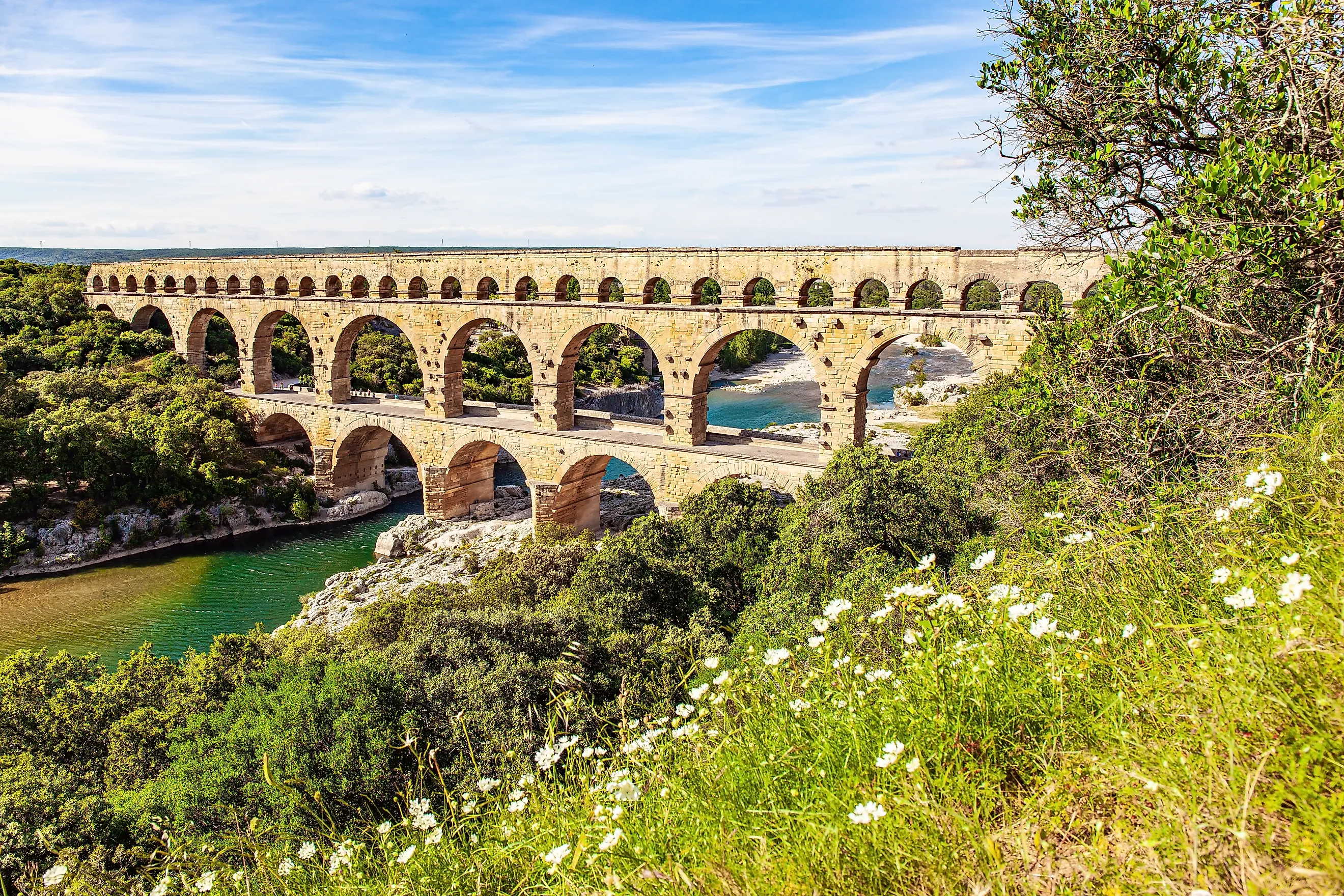
Although arches are the most recognizable part of Roman aqueducts, they weren’t used everywhere. Roman builders preferred to keep channels underground or close to the surface when the land allowed it. Arches became necessary when the route crossed valleys, low ground, or other breaks in the landscape.
Workers built piers from stone, brick, or concrete, then connected them with arches that spread the weight across the structure. The water itself still ran through a narrow channel at the top. The arches weren’t the aqueduct, but the support that kept the aqueduct at the proper height.
Where the ground fell away, arches gave the water a level path across open space. They allowed the system to continue toward the city without losing its carefully measured slope.
Delivering Water Into the City
After traveling across the countryside, the water had to enter the city in a controlled way. Aqueducts usually fed into receiving tanks or distribution basins, where the flow could be slowed and directed toward different parts of Rome.
From these points, water moved into public fountains, baths, and other parts of the urban supply. Pipes could carry it into specific areas, while overflow and drainage helped keep the system from backing up.
How Maintenance Kept Aqueducts Working

Roman aqueducts were durable, but they weren’t self-sustaining. Water could leave mineral deposits along the channel, especially where the flow slowed or changed direction. Cracks, blockages, and damage from shifting ground also had to be repaired before they weakened the system.
Maintenance workers cleaned channels, removed buildup, and repaired damaged masonry. Access points along underground sections made that work possible. These openings allowed crews to reach parts of the system hidden beneath fields, roads, or hillsides.
This long-term care helps explain why some aqueducts survived for centuries. Their strength came from the Romans' engineering, but also from inspection, repair, and restoration.
Aqueducts Still in Use Today

The clearest surviving example is the Aqua Virgo, built in 19 BCE under Marcus Agrippa. Its modern form, known as the Acqua Vergine, still carries water into Rome. It’s closely associated with the Trevi Fountain, though the system has been repaired and altered many times since antiquity.
The Aqua Virgo’s long life shows how a Roman aqueduct could remain useful when later generations continued to maintain it. Its survival doesn’t mean every ancient section remains unchanged. But it does show that the original system was built around a practical principle that could be repaired and kept in service.
An Ancient System Built to Last

Roman aqueducts endured because they were built around a clear understanding of water and land. Their builders didn’t need modern engines to move water across long distances. They needed dependable sources, careful measurements, and channels that could hold a steady descent from the countryside into the city.
Their survival also depended on continued care. Cleaning, repairs, and later restorations kept some systems useful long after their first construction. Aqueducts such as the Aqua Virgo show that Roman water systems could remain practical across centuries when later societies chose to maintain them.