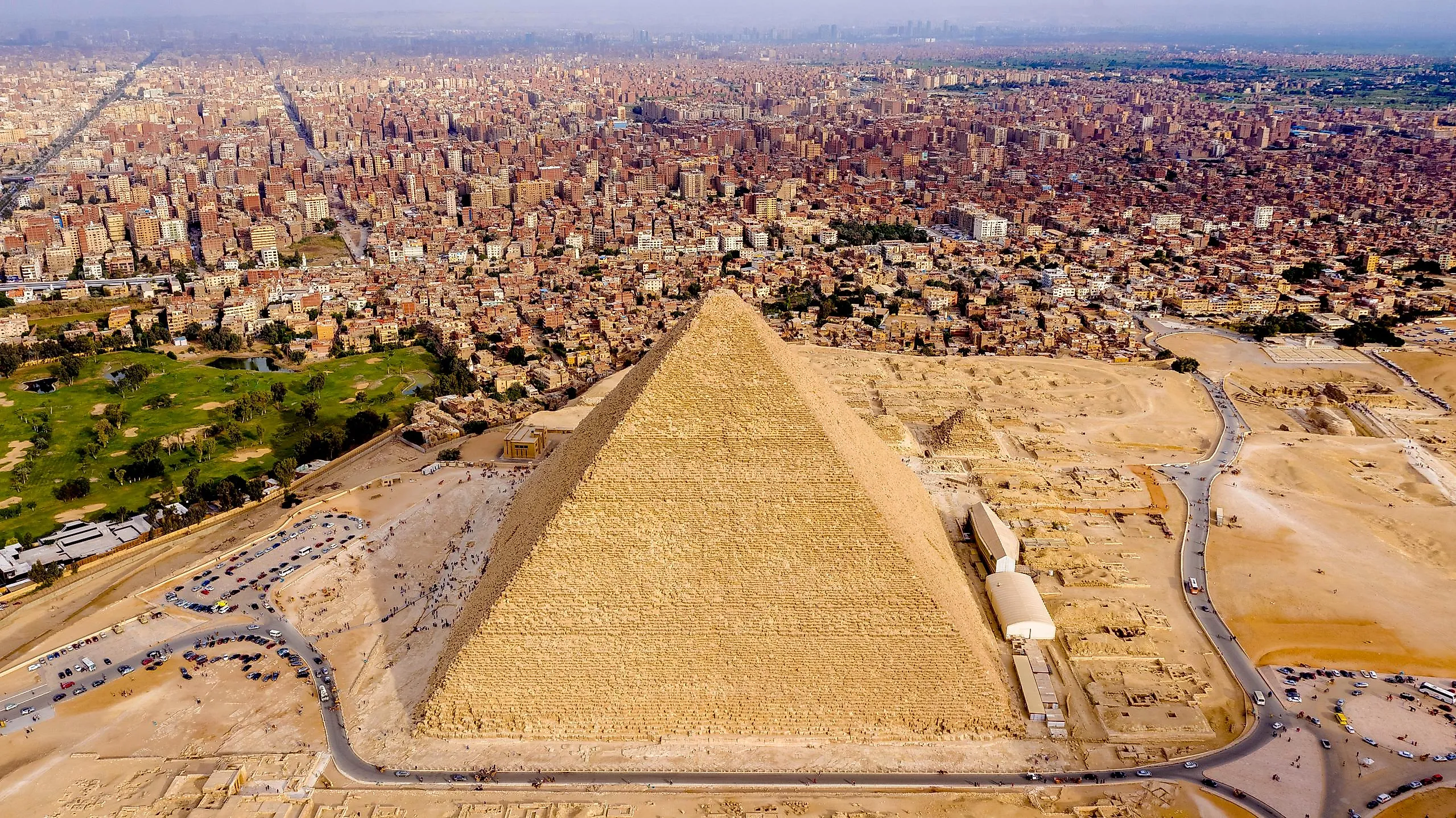
Great Pyramid Of Giza
When Cleopatra and Julius Caesar looked upon the Great Pyramid of Giza, they saw a monument as ancient to them as they are to us. The Great Pyramid is as impressive as it is ancient, but most only know it for its shape and size. There is so much more to the Great Pyramid; its construction, interior, and history weave the pyramid not only into the history of Ancient Egypt but also the history of the entire region of Egypt.
History Of The Great Pyramid Of Giza
Most of the Pyramids of Ancient Egypt served as tombs for Pharaohs, the ruling kings, and the Great Pyramid of Giza was no exception. For a time, there was debate about whom the Great Pyramid was built for, but it is now widely believed to have been constructed for Khufu, the second Pharaoh of Egypt's Fourth Dynasty. Pharaohs often commissioned their pyramid tombs well before their deaths and usually had some involvement in overseeing their construction. However, Khufu probably did not design the pyramid himself. Many Egyptologists think it was built by his vizier, Heminu, who was Egypt's top official and executed the Pharaoh’s orders.

Due to the Great Pyramid's age and the limited sources, it is difficult to determine exact construction dates, but most Egyptologists place it around 2570 B.C.E., over four thousand years ago. Based on archaeological experiments and reconstructions, the Great Pyramid would have taken roughly 27 years to build, with a workforce of between 13,000 and 40,000. Whether Khufu was laid to rest in the Great Pyramid is unknown. At some point in the early Middle Ages, the Great Pyramid was robbed, and the sarcophagus was gutted and looted, including the mummy of Khufu, if it had ever lain there. During the Middle Ages, the Great Pyramid was left mostly alone, except for the occasional researcher who came to study the monument's engineering or history. It was left relatively undisturbed until the 18th and 19th centuries, when European expeditions from many nations began excavating the site. From there, the history of the Great Pyramid's construction was rediscovered.
One significant expedition was linked to Napoleon's campaign in Egypt. During the Battle of Embabeh, which he won, the Great Pyramid of Giza could be seen 9 miles away, and he named the engagement the 'Battle of the Pyramids.' Following the battle, Napoleon's scientists and Egyptologists studied the pyramid and its complex, creating numerous maps and sketches, and examining and looting many artifacts. Later, Italian explorers Giovanni Battista Cavigila in 1816 and Giovanni Belzoni in 1818 conducted further expeditions. The British also carried out expeditions in 1835, 1872, 1880, and 1902, resulting in significant discoveries, looting, and questionable tactics such as blasting. Today, many nations, including France, Japan, and Egypt, continue archaeological investigations, often with major discoveries and controversial methods.
Construction Of The Great Pyramid of Giza

How exactly the Great Pyramid of Giza was built is still debated, but the method presented here has the most consensus among Egyptologists. The Great Pyramid was constructed by a force of between 13,000 and 40,000 conscripted and paid laborers, not slaves, as the ancient Greeks and modern pop culture have suggested. The limestone that makes up the bulk of the pyramid was quarried and cut to the south of Giza. The limestone that once covered the pyramid's exterior was hauled across the Nile on boats from quarries in Tura. The last major material, granite, was quarried in Aswan in southern Egypt and floated to Giza on Nile River boats.
Workers likely used chisels, mallets, saws, and various stone tools to shape the stone. The exact movement of the stone remains a topic of debate. Although riverboats could transport materials over long distances, there are two main theories on how the workers moved the massive stone blocks weighing hundreds of tons. One suggests they used wooden log rollers to roll the stones, while the other proposes they wetted the sand in front of the bricks and pulled them with a team of about 40 workers. In either case, the bricks could be hauled up large ramps constructed around the Great Pyramid as it was built upward.
Exterior Of The Great Pyramid

The exterior of the Great Pyramid would have appeared quite different during its construction. Instead of the large, earthen-colored limestone blocks, it would have been covered with smooth white limestone. Over time, this outer layer was gradually removed to be reused in other construction projects, sometimes thousands of years later, as seen with the Alabaster Mosque built from 1830 to 1848. The pyramid's summit would also have looked different, featuring a pyramidion—a pointed capstone probably made of white limestone, basalt, or granite. Some suggest it could have been gold or electrum. The original pyramidion's fate remains unknown, as it was either stolen or destroyed long ago, with Roman scholars like Pliny the Elder noting the missing top.
The Great Pyramid of Giza held the record of the world's tallest building from its construction circa 2570 B.C.E., taking it from the Red Pyramid in Egypt, until 1311 C.E., when Lincoln Cathedral was finished after almost 300 years of construction in Lincoln, England. Today, it stands at 481 feet, but with the missing pyramidion, it now stands at 454 feet tall. It weighs around 6.5 million tons.
Interior Of The Great Pyramid

There are two entrances to the Great Pyramid; the original path and the robbers' path. The original path rests on the pyramid's north side, alongside the robbers' entrance, carved out by looters at some point, which is also on the pyramid's north face. The robbers' entrance is where modern tourists enter the Great Pyramid.
Inside the Great Pyramid is the subterranean chamber, carved into the bedrock beneath the structure, featuring a Greek calendar on the ceiling. It currently contains debris from various expeditions. The next major chamber is the Queen's Chamber, visibly marked by looters, and has been examined by both a robot and a snake camera, revealing hieroglyphs painted in red on the walls. Connecting to it is the Grand Gallery, which leads to the Antechamber and then the King's Chamber. The Antechamber was intended to shield the King's Chamber from looters with a stone portcullis but was unsuccessful, as looters dug through the ceiling. Contrary to popular culture, there are no traps. Finally, the King's Chamber contains only a hollowed-out granite sarcophagus, emptied by looters, with airways in both the King's and Queen's chambers.
Visiting The Great Pyramid

Like many travel destinations, the best times to visit are during the off-season and quieter hours. For the Great Pyramid, these are in winter and early mornings. There's a small entrance fee for the Giza Pyramid complex, and a smaller fee applies to access the interior of the Great Pyramid, though only a limited area is open inside. Climbing the pyramids is forbidden, although some have attempted to bribe guards for permission. Tipping is an essential part of Egyptian culture; it’s wise to carry coins to tip guides, servers, taxi drivers, and service providers. Tours around the Great Pyramid and the site are available on foot, horseback, or camelback. Like with all travel, arrive early with plenty of time, and remain courteous to staff and animals.
The Great Pyramid of Giza and the complex of other pyramids and monuments surrounding it is one of the ancient world's last surviving wonders. It has endured for over 4,000 years and dozens of kingdoms, empires, and nations. Not only is the Great Pyramid impressive as a towering structure, but it is also a testament to the ingenuity and determination of humanity who, even without advanced technology or machinery, built these titanic structures that tower over the desert to this day.