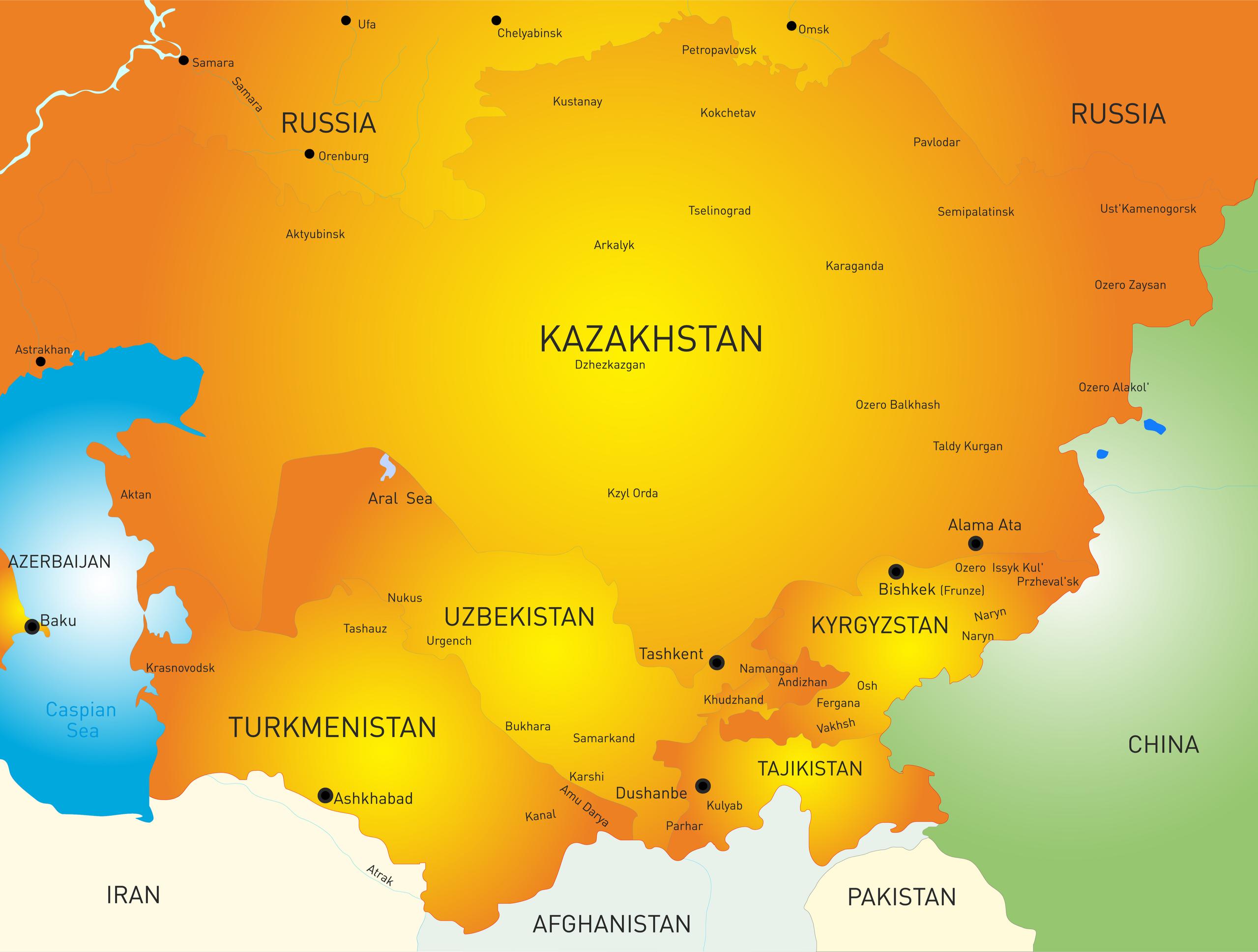
Landlocked Countries In Asia
- Twelve countries in Asia are landlocked.
- Uzbekistan is considered doubly-landlocked because its neighboring countries are landlocked as well.
- Some landlocked countries still have a navy, while most others do not.
Kazakhstan has no coastline, and Kazakhstan has a navy. Both of those things are true, and the explanation says a lot about how strange the geography of landlocked Asia gets. Twelve countries on the continent have no access to the open ocean: Afghanistan, Armenia, Azerbaijan, Bhutan, Kazakhstan, Kyrgyzstan, Laos, Mongolia, Nepal, Tajikistan, Turkmenistan, and Uzbekistan. Three of them still operate ports and warships on the Caspian Sea, which is legally a lake despite the name. One of them is landlocked twice over. And all twelve have spent their histories solving the same problem: how to trade with a world you can only reach through somebody else's territory.
Afghanistan

Afghanistan sits in South-Central Asia, wedged between six neighbors: Pakistan, Iran, Turkmenistan, Uzbekistan, Tajikistan, and China, the last through a narrow mountain corridor. Covering 652,860 square kilometers (252,071 square miles), the country has long depended on Pakistan's port of Karachi for maritime trade, and has looked to Iran's port of Chabahar on the Gulf of Oman as a shorter alternative route to the sea. The only commercially navigable water inside Afghanistan is the Amu Darya River along its northern border, where the river ports of Shir Khan Bandar and Kheyrabad handle cross-border cargo with its Central Asian neighbors.
Armenia

Armenia, at 28,470 square kilometers (10,992 square miles), is one of the smallest countries in Asia and among the most boxed in. It shares roughly 1,560 kilometers (975 miles) of border with Turkey, Georgia, Azerbaijan, and Iran, but its borders with Turkey and Azerbaijan have been closed for decades, a legacy of the conflict over Nagorno-Karabakh, and a trade embargo keeps Turkish ports off the table. Armenia instead routes nearly all of its seaborne trade through Georgia, relying on the Black Sea ports of Batumi and Poti. Like most landlocked states, it maintains no navy.
Azerbaijan

Azerbaijan straddles the meeting point of Western Asia and Eastern Europe and borders five countries: Russia, Georgia, Armenia, Iran, and, through its Nakhchivan exclave, a short frontier with Turkey. Its entire eastern edge runs along the Caspian, and Azerbaijan behaves like a maritime nation on it. The Baku International Sea Trade Port anchors a busy shipping trade across the Caspian, and the country operates one of the larger navies on the water. It is landlocked only in the technical sense that matters most: no ship can leave Baku and reach an ocean.
Bhutan

The Kingdom of Bhutan, 38,117 square kilometers (14,717 square miles) of Himalayan ridgeline, has exactly two neighbors and no room for a third: China to the north and India everywhere else, along a combined border of about 1,136 kilometers (706 miles). For access to the sea, Bhutan reaches through friendly territory, with an agreement to route its maritime trade through the Port of Mongla in Bangladesh. The kingdom has never needed a navy, which is just as well for a country whose average elevation, at roughly 3,280 meters (10,760 feet), is the highest of any nation on Earth.
Kazakhstan

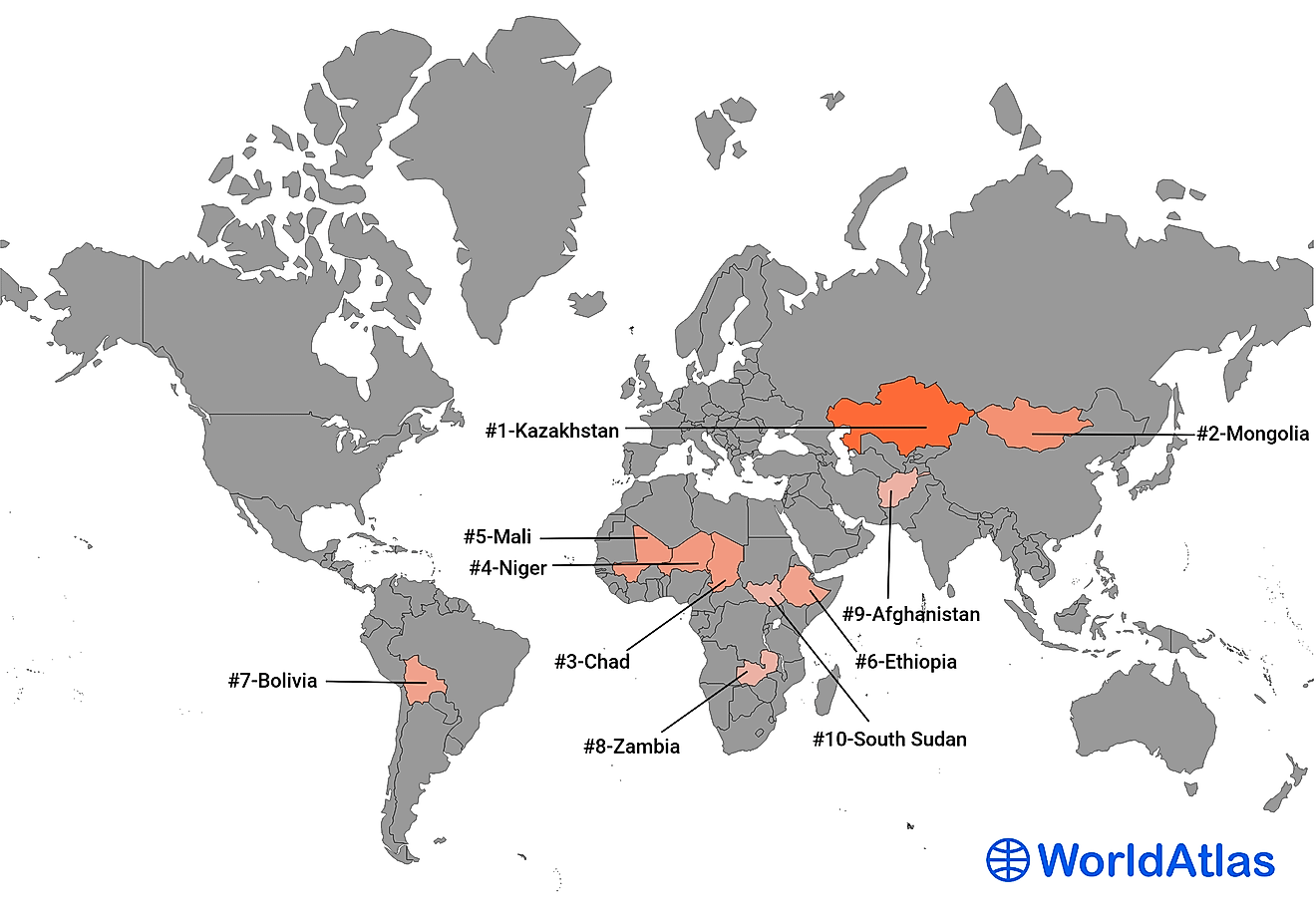
Kazakhstan is the largest landlocked country on Earth and the ninth-largest country overall, bordering five states: Russia, China, Kyrgyzstan, Uzbekistan, and Turkmenistan. It fronts the Caspian Sea, which sounds like a loophole until you remember the Caspian is a lake, the largest inland body of water in the world, with no natural outlet to any ocean. Kazakhstan works the lake hard anyway. The Port of Aktau, one of the Caspian's largest, ships cargo west toward the Caucasus and onward to Turkey, the Port of Atyrau handles more, and the Syr Darya and Ertis rivers add thousands of kilometers of inland waterways. The country even keeps a working navy on Caspian patrol, making Kazakhstan the rare nation with admirals and no ocean.
Kyrgyzstan

Kyrgyzstan is what happens when a country is made almost entirely of mountains. Bordered by Kazakhstan, Uzbekistan, Tajikistan, and China, the country sits high in the Tian Shan range, with roughly 90 percent of its territory classed as mountainous. It has no seaports, no navigable rivers with commercial capacity, and very little flat ground on which to put either. Everything Kyrgyzstan trades with the wider world travels by road, rail, or air through its neighbors first.
Laos

Laos is the only landlocked country in Southeast Asia, surrounded by five neighbors: China, Myanmar, Thailand, Cambodia, and Vietnam. Its lifeline is the Mekong, which defines much of the western border and carries most of the country's water transport along with the Nam Ou. Laos even fields a small river navy that patrols the Mekong against smuggling and illegal crossings. In theory, the river connects Laos to the South China Sea; in practice, the Khone Phapheng Falls in the far south, the largest waterfall in Southeast Asia by volume, brings all through-navigation to a definitive stop. Laos has ocean access on the map and a waterfall in the way.
Mongolia

Mongolia keeps things simple: 1,553,560 square kilometers (599,833 square miles), two neighbors, zero coastline. As the world's second-largest landlocked country, it is wedged entirely between Russia and China, and every ton of its external trade crosses one of those two borders, giving its foreign policy all the flexibility of a two-lane road. The nearest seaport is China's Tianjin, hundreds of kilometers beyond the border, which Mongolia reaches by rail across the Gobi.
Nepal

Nepal contains the highest place on the planet and no way to sail anywhere. Squeezed between India and China along 2,925 kilometers (1,818 miles) of border, the country holds the Himalayas and Mount Everest, and the same terrain that gives Nepal its skyline takes away its waterways: the rivers plunge through gorges too steep and fast for commercial navigation. Nearly everything Nepal trades with the world funnels through India, its transit country to the ports of the Bay of Bengal.
Tajikistan

Tajikistan sits in the heart of Central Asia, bordered by Kyrgyzstan, Uzbekistan, Afghanistan, and China, with more than 90 percent of its land covered by the Pamir and Alay mountains. There are no seaports and no meaningful inland shipping; trade moves by road, rail, and air, and the country has worked out transit agreements with its neighbors to reach their ports. Its most valuable liquid asset flows the other way: the glaciers and rivers of the Tajik highlands supply much of Central Asia's fresh water.
Turkmenistan

Turkmenistan borders Kazakhstan, Uzbekistan, Afghanistan, and Iran, and like its northern neighbor it runs a full maritime operation on a lake. The Port of Turkmenbashi on the Caspian is the country's gateway, developed with berths deep enough for large vessels, including oil tankers, and a small naval force patrols the Turkmen stretch of the water. The arrangement works because everyone on the Caspian has agreed to treat the world's largest lake as a sea in daily practice, if not in law.
Uzbekistan

Uzbekistan is landlocked with a twist: every one of its four neighbors, Kazakhstan, Turkmenistan, Kyrgyzstan, and Afghanistan, is landlocked too. That makes Uzbekistan one of only two doubly landlocked countries on Earth, alongside Liechtenstein, meaning a traveler must cross at least two international borders in any direction before smelling salt air. It once had a busier relationship with water: the Aral Sea carried real shipping before decades of river diversion drained the vast majority of it away, leaving fishing fleets rusting in a desert. Today the Amu Darya River and its port at Termez handle what water transport remains, while ocean cargo routes through partners like Georgia's Poti and Iran's Bandar Abbas.
Twelve Countries, Zero Coastlines
Landlocked Asia is a study in workarounds. The Caspian trio built ports and navies on a lake and carries on as if it were an ocean, Bhutan and Nepal lease their sea legs from neighbors, and Laos got a river to the sea and a waterfall in the middle of it. Geography dealt all twelve the same card, and each has played it differently, through transit treaties, river fleets, and rail lines to other people's harbors. The sea is negotiable. The map, so far, is not.
Which Countries In Asia Are Landlocked?
| Country | Land Area (Sq Km) | Population (2025 UN Estimate) | Neighboring Countries |
|---|---|---|---|
| Afghanistan | 652,860 | 43,844,000 | 6 - China, Iran, Pakistan, Tajikistan, Turkmenistan, Uzbekistan |
| Armenia | 28,470 | 2,952,000 | 4 - Azerbaijan, Georgia, Iran, Turkey |
| Azerbaijan | 82,658 | 10,398,000 | 5 - Armenia, Georgia, Iran, Russia, Turkey |
| Bhutan | 38,117 | 797,000 | 2 - China, India |
| Kazakhstan | 2,699,700 | 20,844,000 | 5 - China, Kyrgyzstan, Russia, Turkmenistan, Uzbekistan |
| Kyrgyzstan | 191,800 | 7,295,000 | 4 - China, Kazakhstan, Tajikistan, Uzbekistan |
| Laos | 230,800 | 7,873,000 | 5 - Cambodia, China, Myanmar, Thailand, Vietnam |
| Mongolia | 1,553,560 | 3,517,000 | 2 - China, Russia |
| Nepal | 143,350 | 29,618,000 | 2 - China, India |
| Tajikistan | 139,960 | 10,787,000 | 4 - Afghanistan, China, Kyrgyzstan, Uzbekistan |
| Turkmenistan | 469,930 | 7,619,000 | 4 - Afghanistan, Iran, Kazakhstan, Uzbekistan |
| Uzbekistan | 425,400 | 37,053,000 | 4 - Afghanistan, Kazakhstan, Kyrgyzstan, Turkmenistan |
Population figures are United Nations 2025 estimates (World Population Prospects).