How Much Of The World's Fresh Water Sits In North America?
North America holds roughly one-quarter of the world's fresh surface water, and most of it is concentrated in a handful of enormous lakes. EPA estimates that the Great Lakes alone contain about 21% of the global supply and roughly 84% of North America's. Add Canada's giant northern lakes, including Great Bear and Great Slave, and the continental share rises to around 25%. That figure covers liquid freshwater at the surface, such as lakes and rivers. Groundwater and frozen water are counted separately and make up an even larger share of Earth's total freshwater.
About One-Quarter Of The World's Fresh Surface Water

EPA puts the world's fresh surface-water volume at roughly 25,600 mi3 (106,707 km3) using an average of several major inventories. The agency also reports that the Great Lakes hold about 21% of that supply and 84% of North America's. Dividing those rounded percentages gives a continental share of about 25%. In volume terms, that points to something on the order of 6,500 mi3 (27,000 km3) for North America.
The continental total is best treated as an approximation. Global lake datasets differ in how they handle reservoirs and smaller water bodies, while published estimates for some large northern lakes also vary. “About one-quarter” is therefore more defensible than an exact figure such as 25.0% or 25.3%.
The Great Lakes Hold About 21% By Themselves

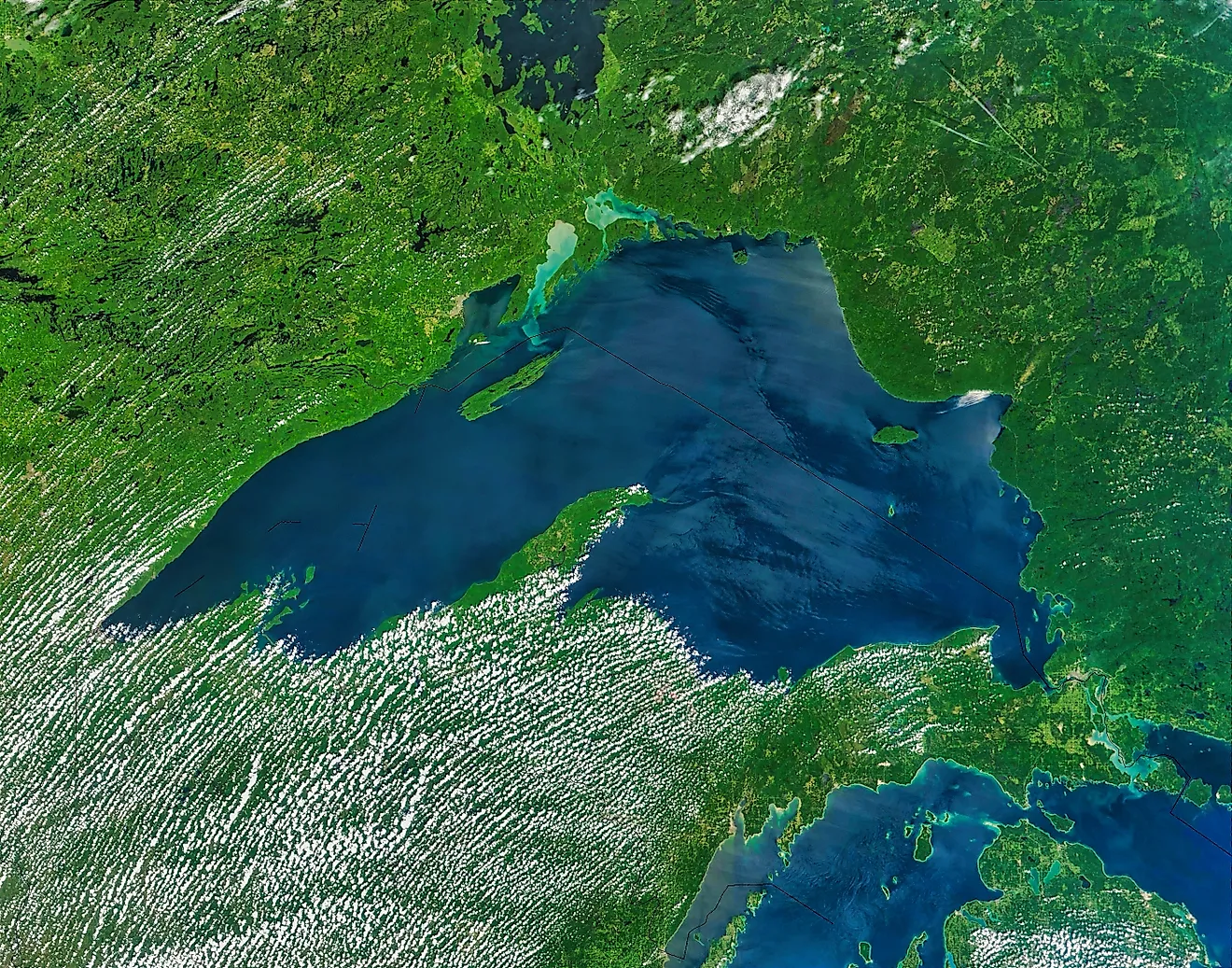
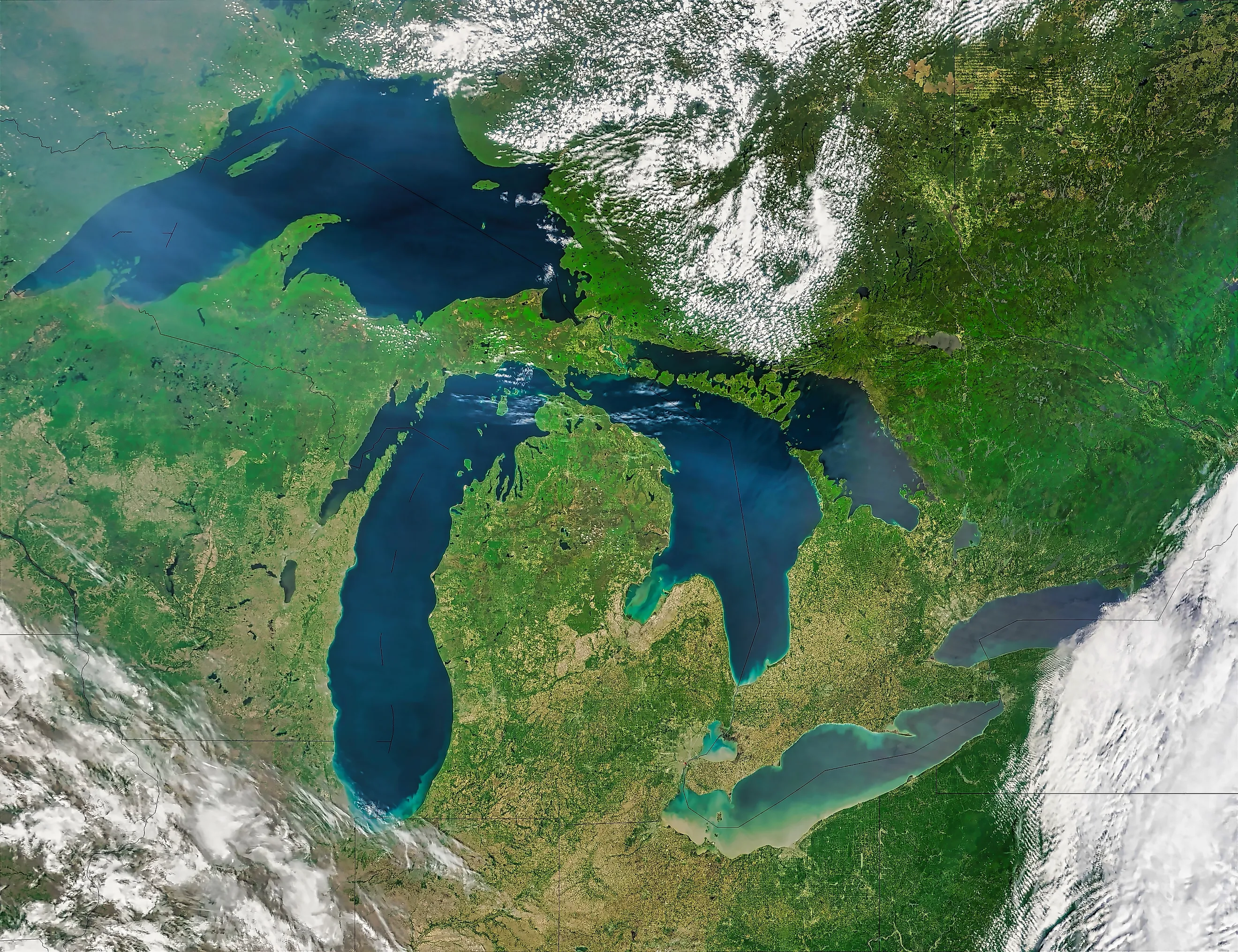
EPA lists 5,439 mi3 (22,684 km3) of water in the five Great Lakes. Compared with the global fresh surface-water estimate, that is about 21.3%. Superior, Huron, Erie, and Ontario cross the United States-Canada boundary, but all five lakes remain entirely within North America.
Lake Superior provides 2,900 mi3 (12,100 km3) by itself. That is more than half of all Great Lakes water and roughly 11% of the world's estimated fresh surface-water volume.
The full system accounts for about 84% of North America's surface fresh water according to EPA. Before Great Bear Lake or any smaller Canadian lake enters the total, the continent already holds more than one-fifth of the global supply.
Lake Michigan Alone Holds About 4.6% Of The Global Supply

Lake Michigan contains about 1,180 mi3 (4,920 km3) of water, according to EPA. That gives the lake about 4.6% of the world's estimated fresh surface-water volume. Compared with the approximate North American total, Lake Michigan also holds close to 18% of the continent's supply.
Lake Huron holds about 850 mi3 (3,540 km3), while Lake Ontario contains about 393 mi3 (1,640 km3). Lake Erie is much shallower, with about 116 mi3 (484 km3). The large differences in depth are why surface area alone cannot show how much freshwater a lake stores.
Canada Has Major Freshwater Stores Beyond The Great Lakes

North America's enormous total extends far beyond the Great Lakes shoreline. Great Bear Lake in Canada's Northwest Territories holds about 536 mi3 (2,236 km3) according to recent peer-reviewed measurements. That equals roughly 2.1% of the world's estimated fresh surface-water volume. Great Slave Lake is another giant, with recent research using a volume near 379 mi3 (1,580 km3), although published bathymetric estimates vary. Farther south, Manitoba reports about 68 mi3 (284 km3) in Lake Winnipeg. Great Bear and Great Slave alone add hundreds of cubic miles beyond the Great Lakes system. Canada's 2026 national climate assessment reports more than 875,000 lakes larger than 0.1 km2, with lakes covering nearly 9% of the country. Those northern lake basins supply much of the difference between the Great Lakes' 21% and North America's roughly 25% share.
Even Huge Reservoirs Barely Move The Percentage
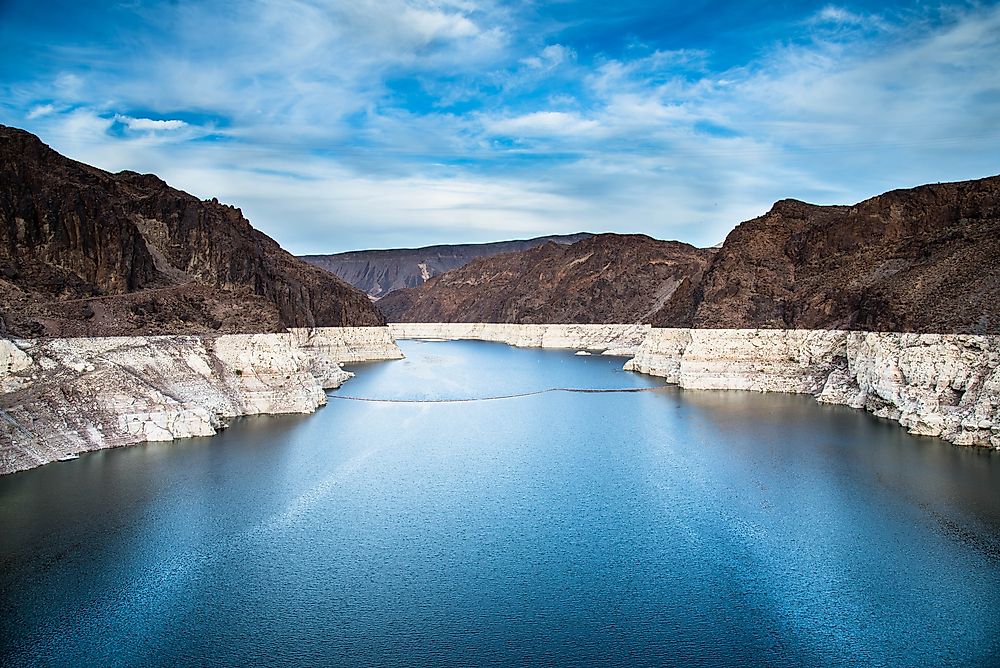
Lake Mead looks immense against the desert, but its numbers show how difficult it is for a reservoir to compete with North America's natural lakes. The U.S. Bureau of Reclamation gives Lake Mead a capacity near 28.9 million acre-feet at its traditional full-pool elevation. That converts to roughly 8.6 mi3 (36 km3). Compared with the global fresh surface-water estimate, a completely full Lake Mead would account for only around 0.03%.
Actual storage rises and falls with water level, so capacity is not the same as current volume. The Great Lakes contain more than 600 times Lake Mead's full capacity. Large reservoirs remain important for water management, but natural lake basins dominate North America's share of global fresh surface water.
Rivers Store Only A Small Slice Of Surface Freshwater

The Mississippi River drains an enormous section of North America, but river size can be misleading when measuring stored water. USGS estimates that every river on Earth contains only about 510 mi3 (2,120 km3) at a given time. Freshwater lakes hold about 21,830 mi3 (91,000 km3). Rivers constantly receive new water and send it downstream, so annual discharge can be enormous without creating a similarly large standing volume. North America's global surface-water share is driven mainly by lakes. The Mississippi, Mackenzie, and other major rivers are essential parts of the continental water cycle, but their stored volumes remain small beside the Great Lakes and Canada's northern lake basins.
What The One-Quarter Figure Does Not Include

The one-quarter estimate applies only to fresh surface water. USGS estimates about 2.526 million mi3 (10.53 million km3) of fresh groundwater worldwide. That underground store is roughly 100 times larger than the world's freshwater lakes. North America contains major aquifers of its own, but groundwater belongs to a separate part of the global freshwater inventory.
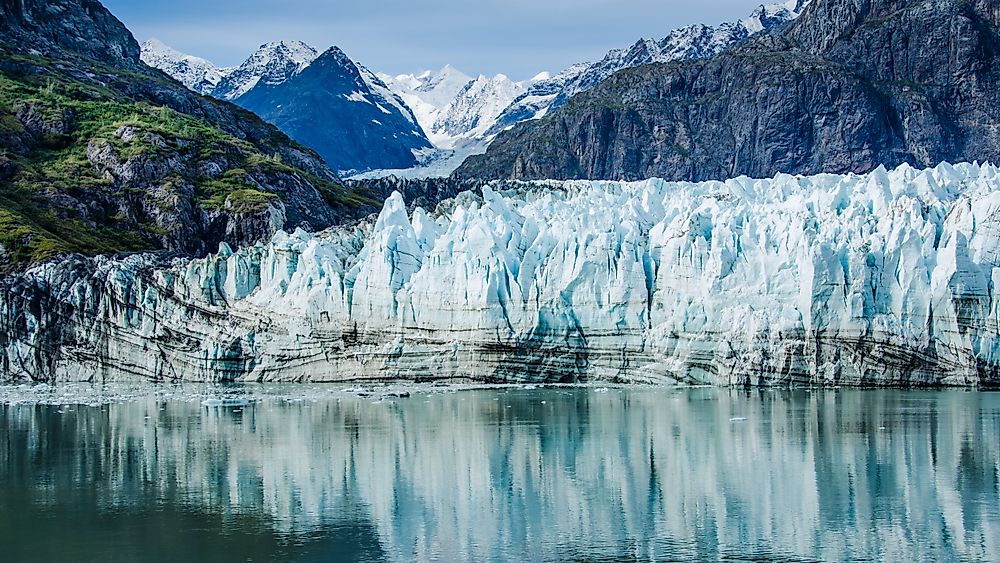
Frozen water pushes the difference even further. USGS estimates about 5.773 million mi3 (24.064 million km3) in glaciers, ice caps, and permanent snow worldwide. That is nearly 69% of Earth's freshwater.
North America holds roughly one-quarter of the world's liquid fresh surface water. About 21% is concentrated in the Great Lakes alone, while Canada's northern lake basins account for much of the remaining continental share.