What Happens When An Invasive Insect Reaches A Forest
An insect smaller than a penny was first detected near Detroit in 2002, although evidence suggests it had arrived from Asia years earlier in wood packing material. Since then, it has killed hundreds of millions of ash trees across North America. That insect is the emerald ash borer, one of several invasive insects affecting American forests.
Emerald ash borer, hemlock woolly adelgid, Asian longhorned beetle, and spotted lanternfly illustrate the different paths an introduced insect can take. Some kill healthy trees and transform forests. Others primarily threaten crops or cause more limited damage. A few, including the Asian longhorned beetle, have been eradicated from certain areas through intensive monitoring, quarantines, and tree removal.
Reaching a forest does not guarantee that an invasive insect will become established or cause widespread damage. The outcome depends on the insect, available host plants, climate, natural enemies, and how early the infestation is detected. When a destructive species does become established, however, its effects can spread from individual trees to wildlife habitat and the forest's future composition. This is what that process can look like in American forests.
Why Invasive Insects Spread So Easily

Native forest insects have spent thousands of years evolving alongside their host trees. Trees have defenses like resin, bark chemistry, and growth patterns. On the other hand, insects have predators, parasites, and diseases that keep their numbers in check. An invasive insect breaks both halves of that deal at once.
It usually arrives in wood packing material or nursery stock. Without the natural enemies that limit it in its natural habitat, it can spread quickly through trees that never evolved resistance because they have never encountered it before. That combination can drive severe declines across a tree species' entire range, and losses complete enough in places that the tree no longer functions as part of the forest. Outright biological extinction of a tree species is rare, but regional collapse is not.
What Happens Once They Take Hold

Most invasive insects don't transform a forest overnight. They spread quietly for years before the damage becomes obvious. By the time large numbers of trees begin dying, the insect may already be established across thousands of acres.
The first signs usually appear in the trees themselves. Depending on the species, some insects tunnel beneath the bark as larvae, and others feed on sap, leaves, or needles. As the damage builds, trees struggle to move water and nutrients, store energy, and defend themselves against drought, disease, and other stresses. Affected trees may die within a few years, although the timeline varies by insect and tree species.
As more trees die, the forest begins to change. Gaps open in the canopy, letting more sunlight reach the forest floor. Different tree species, shrubs, and invasive plants move into those openings, gradually changing the makeup of the forest. Wildlife changes too, as birds, mammals, and insects that depended on the original trees lose food or habitat.
Those changes can spread beyond the forest itself. Streams may warm as shade disappears. The forest floor also receives more sunlight, changing soil moisture and the kinds of plants that grow there. The exact details vary from one invasive insect to another, but the overall pattern is similar.
Emerald Ash Borer

The emerald ash borer is native to eastern Asia and was first detected in North America in 2002, in southeastern Michigan. Since then, USDA's Animal and Plant Health Inspection Service (APHIS) has confirmed it in 38 states and the District of Columbia. The real damage comes from the larvae, not the adult beetles.
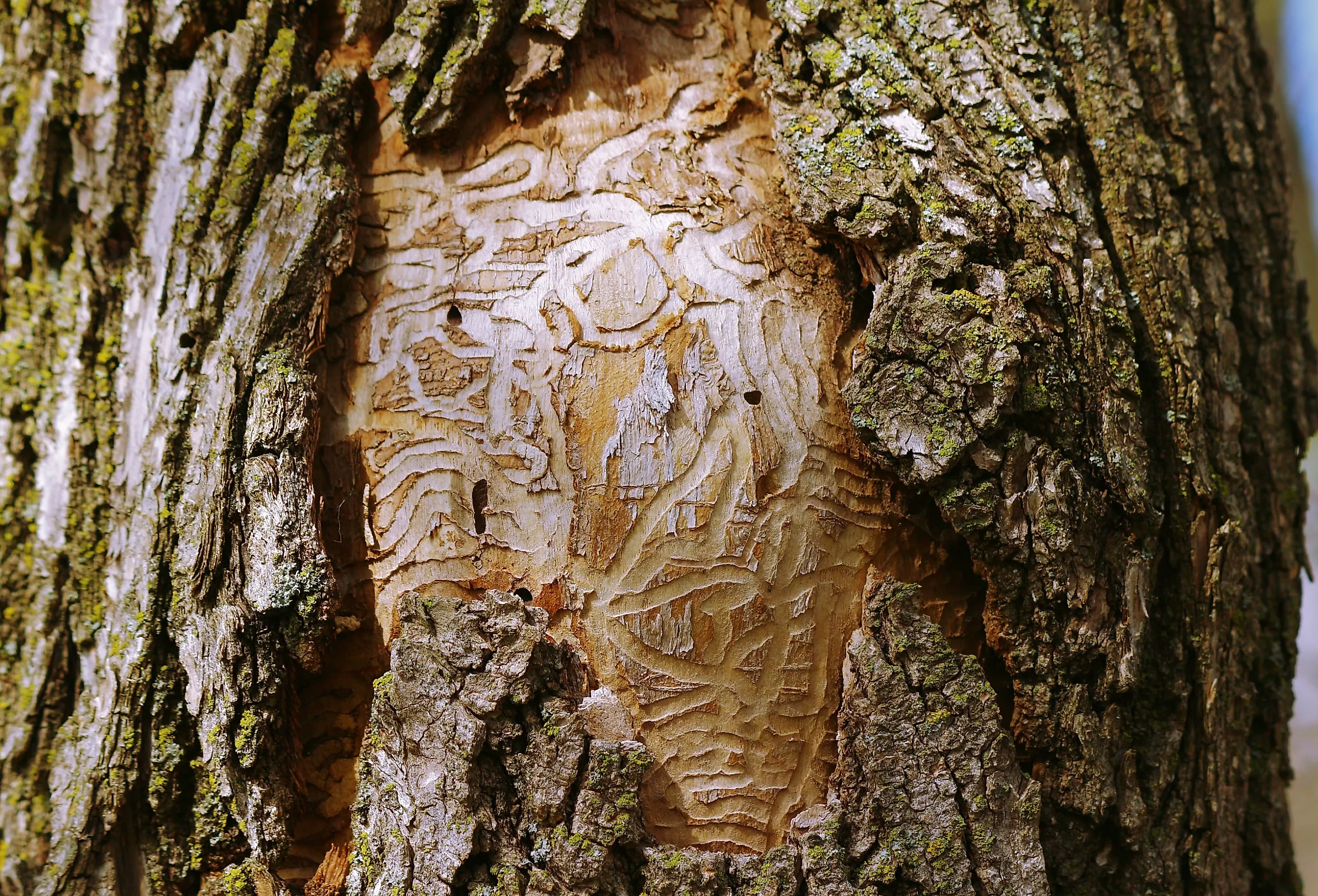
They tunnel beneath the bark and cut off the tree's ability to move water and nutrients. An infested ash typically dies within a few years. Every native North American ash species is vulnerable to the beetle. It doesn't just reduce local populations. Over time, it can remove ash from much of a forest's future canopy.
A 2010 modeling study projected $10.7 billion in discounted treatment, removal, and replacement costs over the following decade, covering more than 17 million ash trees on developed land in communities across a 25-state area centered on Detroit. White, green, and black ash are common across the northeastern United States and eastern Canada, and ash accounts for roughly 7 percent of the trees in eastern US forests. Black ash is especially important to Indigenous basket-weaving traditions.
Hemlock Woolly Adelgid

In the southern Appalachians, a similar story is unfolding with eastern hemlock. Hemlock woolly adelgid, first found in the eastern US in the 1950s, is a nonnative insect that feeds on hemlock sap. Mortality varies with tree health, site, and climate: stressed hemlocks may die within three to five years, while healthy trees can persist for seven to ten years or longer.
What makes this case different is eastern hemlock's role in the forest. It shades mountain streams and keeps them cold enough for trout. Forest Service researchers have found that as hemlocks die, deciduous trees gradually replace them. That shift changes stream temperatures and water movement across entire watersheds, not just the patch of forest where the trees once stood. The losses aren't only ecological.
One study estimated that hemlock decline reduced property values by about $24.6 million across parts of Connecticut and Massachusetts, and noted that the true economic impact was likely much higher because recreational losses were difficult to measure.
Asian Longhorned Beetle

Asian longhorned beetle poses a different kind of forest threat. Native to China and the Korean Peninsula, it was first detected in the United States in Brooklyn, New York, in 1996 after likely arriving in wood packing material. Unlike the emerald ash borer, which primarily attacks ash, the Asian longhorned beetle can reproduce in a dozen genera of hardwood trees. Maples are its preferred hosts, but it also attacks elms, birches, willows, poplars, and several other common trees.
The damage begins when females chew pits in the bark and lay their eggs. After hatching, the larvae tunnel through the tissues that carry water and nutrients before boring deeper into the wood. Repeated attacks weaken branches, disrupt the tree's internal transport system, and eventually kill it. Infested trees cannot recover and may become dangerous as weakened branches break or the entire tree falls.
Because maples and other host trees are abundant in eastern forests, an uncontrolled infestation could cause extensive canopy loss and alter wildlife habitat, forest composition, and urban landscapes. The beetle has been eradicated from several US infestations, but eradication efforts remain active in parts of Massachusetts, New York, Ohio, and South Carolina. Officials rely on quarantines, repeated inspections, and the removal and destruction of infested trees because no treatment can save a tree once it is infested.
Spotted Lanternfly

Spotted lanternfly is a more recent case and a slightly different kind of threat. First detected in Pennsylvania in 2014, this planthopper, native to China, Vietnam, and India, feeds on more than 70 plant species rather than specializing on a single tree genus. Its preferred host is tree-of-heaven, another invasive species.
But it also feeds on grapevines, maples, walnuts, and other hardwoods. That is why USDA considers it both an agricultural and a forest-health threat. It rarely kills a mature tree the way a borer does. In a Penn State experiment that let lanternflies feed on the same saplings for four straight growing seasons, a worst-case scenario that almost never happens in the wild, growth slowed sharply after two years. Once the feeding pressure eased, the native maples, willows, and birches recovered, and none of the trees died. Grapevines remain the better-established economic concern.
A 2020 Penn State analysis modeled annual losses of $324.9 million if spotted lanternfly spread to all 67 Pennsylvania counties; it estimated the then-current loss in the 14-county quarantine zone at $50.1 million. Today, the insect is established in 19 states and the District of Columbia, spreading primarily by hitching rides on vehicles and shipped goods.
Why Early Detection Matters

Not every invasive insect wins. The Asian longhorned beetle has been eradicated from several US infestations, including Illinois, Boston, and parts of New York and New Jersey, the first of them declared free of the beetle in 2008. That success came through years of quarantine, tree removal, and monitoring led by APHIS.
Emerald ash borer shows another outcome. It reached dozens of states before anyone could draw a containment line around it, and APHIS dropped its domestic ash quarantine in 2021 to concentrate on biological control instead. A pest caught early, when its population is still small, can sometimes be eliminated. One that's already spread across dozens of states usually can't.
Not Every Forest Insect Is Invasive

It's easy to assume that any insect killing large numbers of trees must be invasive, but that is not always the case. The mountain pine beetle, for example, is native to western North America and has lived alongside pine forests for thousands of years. Its outbreaks can be dramatic, killing millions of trees across large areas, but they are part of a natural cycle driven by drought, aging forests, and winter temperatures.

The key difference is history. Native bark beetles evolved alongside their host trees and are part of the forest ecosystem, even when their populations surge. Invasive insects arrive in forests that have never encountered them before, giving trees few natural defenses against attack. Both kinds can reshape an ecosystem. Invasive pests are more likely to do so severely and permanently because the trees and food webs they encounter have no shared history with them.
How National Forests Respond

National forests and national parks operate under different legal mandates, but both use integrated pest management, choosing tools according to the pest, the site, and agency rules. Depending on the insect, the forest, and the extent of the infestation, managers may use a combination of approaches.
Limits on moving firewood
Moving infested firewood, logs, and nursery stock is one of the main ways invasive borers and beetles spread long distances. That is the reasoning behind "Don't Move Firewood" campaigns and restrictions on moving wood out of infested areas. For most people, the simplest way to help is to avoid moving firewood long distances and report unusual insects or tree damage to their state forestry or agriculture agency.
Biological control
For the emerald ash borer, APHIS rears and releases tiny parasitic wasps that attack the beetle's eggs and larvae. The goal isn't to eliminate the pest completely, but to slow its spread and reduce long-term damage.
Selective tree removal
Depending on the infestation, managers may remove dead, dying, infested, or nearby host trees to reduce hazards, slow the spread of invasive insects, or support forest restoration.
Restoration and replanting
Where infestations have killed large numbers of trees, restoration may include planting non-host species. Researchers are also breeding ash with greater resistance to the emerald ash borer.
Most forests recover from invasive insects, but they don't always become the same forest again. The trees that return, the wildlife they support, and the way the ecosystem functions can all be different from what came before. That is why preventing new introductions and detecting insect infestations early are the most effective ways to protect America's forests.