What's Killing America's Ash Trees
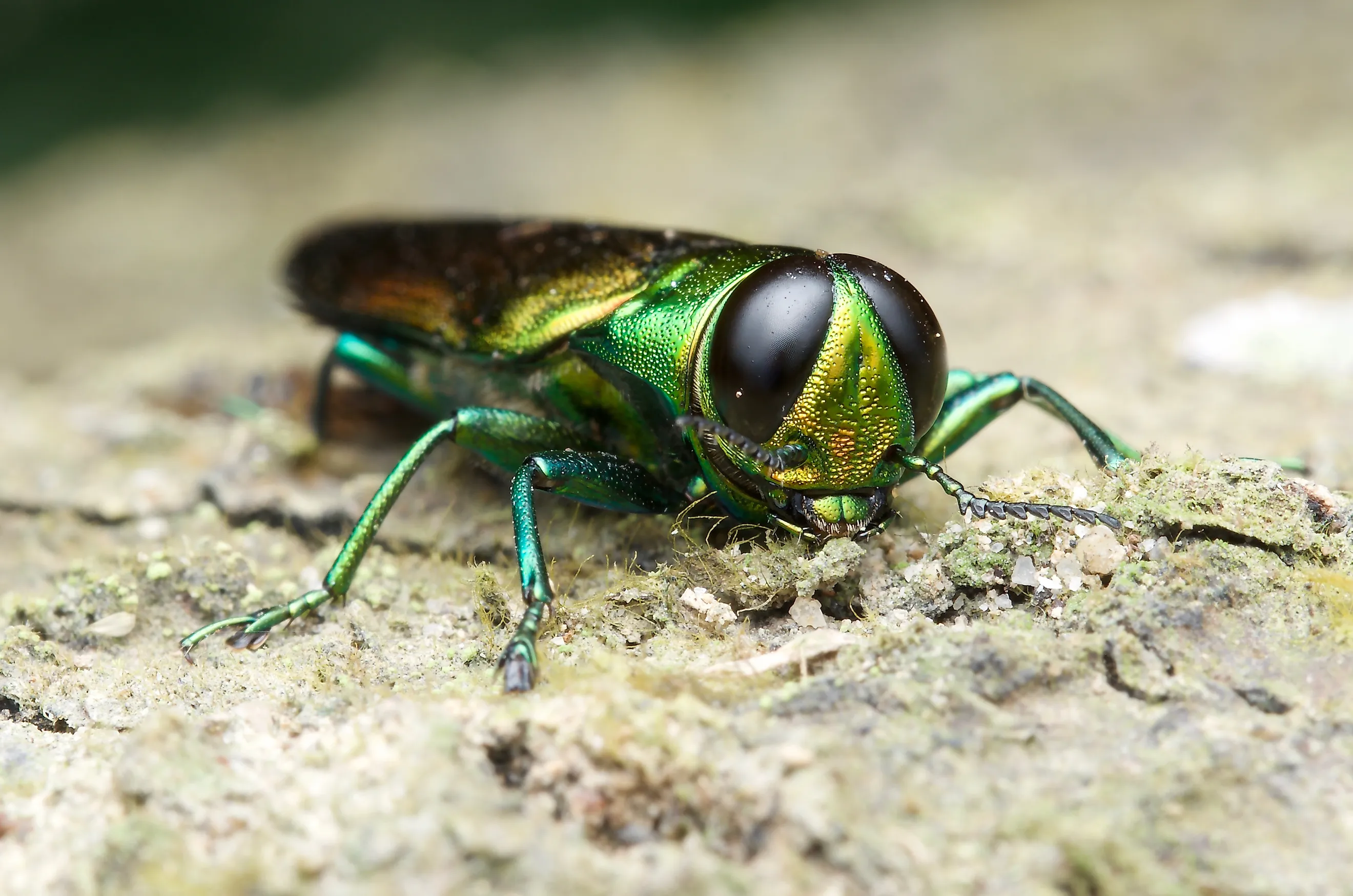
A single invasive species, barely half an inch long, has killed millions of ash trees (Fraxinus spp.) across the United States since 2002. The emerald ash borer (Agrilus planipennis), a metallic-green insect native to eastern Asia, now infests at least 38 states and the District of Columbia.
The Cary Institute of Ecosystem Studies calls it the most destructive and costly forest insect ever to invade North America. A second, less understood disease called ash yellows adds a separate threat to the same trees across parts of the Northeast and Midwest.
The Beetle Behind the Damage

The emerald ash borer, known as EAB, does almost none of its damage as an adult. Adult beetles feed lightly on ash foliage from late spring through early fall and leave few visible marks on the tree. They are about a third to half of an inch long, and the beetle is easy to miss even at close range. The real destruction happens underneath the bark: females lay eggs in bark crevices, and the larvae that hatch tunnel through the inner bark, carving S-shaped wounds that cut off the tree's flow of water and nutrients.
The Signs of an Infected Ash Tree

Homeowners and foresters look for canopy thinning and crown dieback, D-shaped exit holes about one-eighth of an inch wide, new growth of suckers (epicormic sprouting) at the base of the tree from stress, and increased woodpecker activity, since woodpeckers strip bark away trying to reach the larvae underneath. A tree usually shows no symptoms for a year or two after infestation, then declines and dies within two to six years, according to the University of Illinois Extension research.
All 16 species of ash native to North America are vulnerable. And unlike ash trees in the beetle's native range of northeastern China, the Korean Peninsula, and eastern Russia, none carry natural resistance to it.
A Beetle that Arrived by Accident

Scientists first detected the emerald ash borer in southeastern Michigan in 2002. Though, the Animal and Plant Health Inspection Service (APHIS) believes the beetle arrived a year earlier, likely hidden inside wood packing material shipped from Asia. It spread through southeastern Michigan before officials recognized what they were dealing with, and its range has expanded every year since.
The beetles have moved outward from Michigan through both natural flight and the movement of infested firewood, logs, and nursery stock. By the time APHIS ended its federal domestic quarantine on EAB, effective January 14, 2021, the agency had concluded that regional quarantines were not slowing the beetle's spread. As a result, it redirected resources toward other management tools instead, including biological controls, insecticide treatments for high-value trees, and research into breeding EAB-resistant ash.
The Toll on Forests, Cities, and Culture

Ash trees make up about seven percent of the trees in eastern US forests, according to the US Department of Agriculture. They also account for a far higher share of the street trees planted in many American cities, which is why municipal budgets have absorbed much of the direct cost of removal and treatment. One estimate put the cost of ash tree treatment and removal in US cities at $12.5 billion through 2020, according to the Cary Institute of Ecosystem Studies. A newer study cited by the same institute projects that EAB may eventually threaten as many as eight billion ash trees across North America if the beetle continues spreading unchecked.
In wetland forests, where black ash often grows in nearly pure stands, losing the trees can shift the whole habitat toward grass, cattails, and shrubs, according to the Minnesota Department of Natural Resources. Since black ash is uniquely able to withstand root flooding, it can grow in wetlands and helps maintain the water table where it grows by sucking up excess water. Without the trees, the groundwater rises and bottomland forests will turn into marshes and brushlands.
The loss of ash trees also has cascading consequences for native wildlife; more than 150 species of native moths and butterflies depend on ash trees for food, and their decline can reduce food availability for birds and other predators. Furthermore, many small mammals and birds rely on ash seeds for food, while cavity-nesting birds, including several species of woodpeckers, rely heavily on the trunk cavities formed by mature ash trees for nesting habitat.
Black ash also carries a cultural weight beyond its ecological role: Indigenous communities across the eastern United States and Canada use the tree for traditional basket weaving, since its wood splits cleanly along its growth rings, a property few other native trees share. Tribal foresters in states such as Maine have spent two decades working alongside state and federal researchers to collect and preserve black ash seed before local stands disappear. Ash also supplies the wood for most wooden baseball bats, giving the beetles' spread a direct line to American ballparks as well as backyards.
Fighting Back with Biological Controls

Since regional quarantines failed to contain the beetle, APHIS and its partners have leaned on biological control instead. Researchers in the beetle's native range identified several parasitoid wasps that attack EAB eggs and larvae without harming other insects. APHIS began releasing them in Michigan in 2007. Four wasp species are now approved for release nationwide: Oobius agrili, which parasitizes EAB eggs, and Spathius agrili, Spathius galinae, and Tetrastichus planipennisi, which attack the larvae.
APHIS reports that the agency and its partners have released more than eight million of these wasps across 30 states and the District of Columbia. A three-year field study by the Forest Service in Michigan found that wasps killed between 36 percent and 85 percent of EAB larvae in monitoring ash saplings, allowing some saplings to survive and recover. Separately, researchers are breeding ash trees for resistance to the beetle, though none are yet available for widespread release.
A Second, Quieter Threat
While EAB draws most of the public attention, a phytoplasma disease, caused by bacteria-like microorganisms, called ash yellows has weakened white ash trees across the Northeast for decades. Documented outbreaks trace back to the 1960s. Unlike the ash borer, ash yellows stays nearly invisible until a tree develops witches' brooms, dense tufts of stunted shoots on the trunk or lower limbs, according to Vermont Invasives.
Leafhoppers are suspected to spread the phytoplasma from tree to tree, though researchers have not confirmed a specific vector. White ash suffers the most, while green and black ash tend to tolerate infection with less dieback. No cure currently exists, so management amounts to promoting species diversity in affected stands and easing other stresses, such as drought, that make infected trees more likely to decline.
What Comes Next for America's Ash Trees
The emerald ash borer's spread has slowed in some regions as biocontrol wasps establish themselves, but the insect remains present wherever it has already taken hold, and new detections continue to appear at the edges of its range, including states that had gone years without a confirmed find.
Forest Service researchers now describe recovery, not eradication, as the realistic goal: parasitoid wasps that suppress beetle populations enough for young ash to survive to reproductive age, insecticide treatments that protect individual high-value trees, and breeding programs aimed at resistant ash for the future.
Seed banks maintained by state agencies and tribal partners are also preserving ash genetics from stands that may not survive the current wave of infestation, insurance against a future in which resistant trees can finally be replanted. For the hundreds of millions of dead ash trees already standing in American forests and cities, the fight has shifted from prevention to a longer, slower project of helping the species hold on.