7 National & State Parks In The United States You Have To Visit
There are 63 national parks and 9,817 state parks throughout the United States; state parks alone stretch across more than 20 million acres, according to the National Association of State Park Directors. The National Park Service manages 433 units, including national monuments, national historic sites, national battlefields, and, of course, the big national parks. These areas cover more than 85 million acres.
The oldest national park is Yellowstone, which was established in 1872. The newest is New River Gorge, redesignated as a national park in West Virginia in 2020. Hundreds of millions of people visit national and state parks every year. If you wanted to visit all of them, you would need a couple of years at your disposal.
While you work on making enough time to get through all of them, here are the ones you should visit first.
Redwood National Park

Redwood National Park is an experience you can have nowhere else. It is the location of Hyperion, the world's tallest tree, though do not plan a trip around seeing it: the park closed the area around Hyperion to all public entry in 2022 after the off-trail traffic began damaging the root system, and the penalties run to a fine and possible jail time. The groves you can walk are more than enough.

The park lies south of the Oregon border and hugs the northern California coast. It is often mentioned alongside three California state parks: Prairie Creek Redwoods State Park, Del Norte Coast Redwoods State Park, and Jedediah Smith Redwoods State Park. When you visit, you are actually visiting Redwood National and State Parks in one.
The trees are why most people choose Redwood above other parks. The Stout Memorial Grove, in the Jedediah Smith section, features a short, easy trail that leads to the Smith River. The Lady Bird Johnson Grove is located within Redwood itself, and at 1.5 miles the trail here is also short enough for an easy walk.
Tall Trees Grove is also in Redwood, but it is not as easily accessible. You have to apply online for a free permit. If you get one, you have a long drive ahead that includes a gate, an unpaved road, and a significant elevation change. The experience of walking among those redwoods is more than worth the effort.

Other experiences include hiking the Fern Canyon Trail, the filming location for The Lost World: Jurassic Park, where more than seven species of fern grow on the canyon walls. Access now requires a permit in the summer months, so check before you drive out. You can also take the Trillium Falls hike to a small waterfall in the forest, and the Coastal Trail includes a 3.5-mile trek between the Crescent Beach picnic area and a long stretch of beach good for beachcombing. You may encounter Roosevelt elk as you go. Add whale watching from the Klamath River Overlook and the tidepools at Enderts Beach, and you will need several days.
Iao Valley State Park

If you prefer tropical scenery, Hawaii may be an automatic choice, and there is a remarkable state park here in the West Maui Mountains. Iao Valley State Monument is small, only a few acres of developed park inside a much larger valley, and it is renowned for its cliffs, rainforest, and the 1,200-foot Iao Needle.

Iao Valley is where Kamehameha I fought the Battle of Kepaniwai in 1790 during his campaign to unify the Hawaiian Islands. The fighting was severe enough that the name refers to the stream being dammed with bodies, and the valley is considered sacred ground. Treat it accordingly.
Aside from the Needle, which is a natural rock formation rather than a carved one, the park holds the Iao Stream and adjoins Kepaniwai Park. Check whether the trails are open before you go; if they are closed, the Waihee Ridge Trail elsewhere on Maui is the usual alternative. This is a short visit unless you bring a picnic and binoculars for the birds. Note that non-residents must book a reservation with a date and arrival time.
Mount Rainier National Park

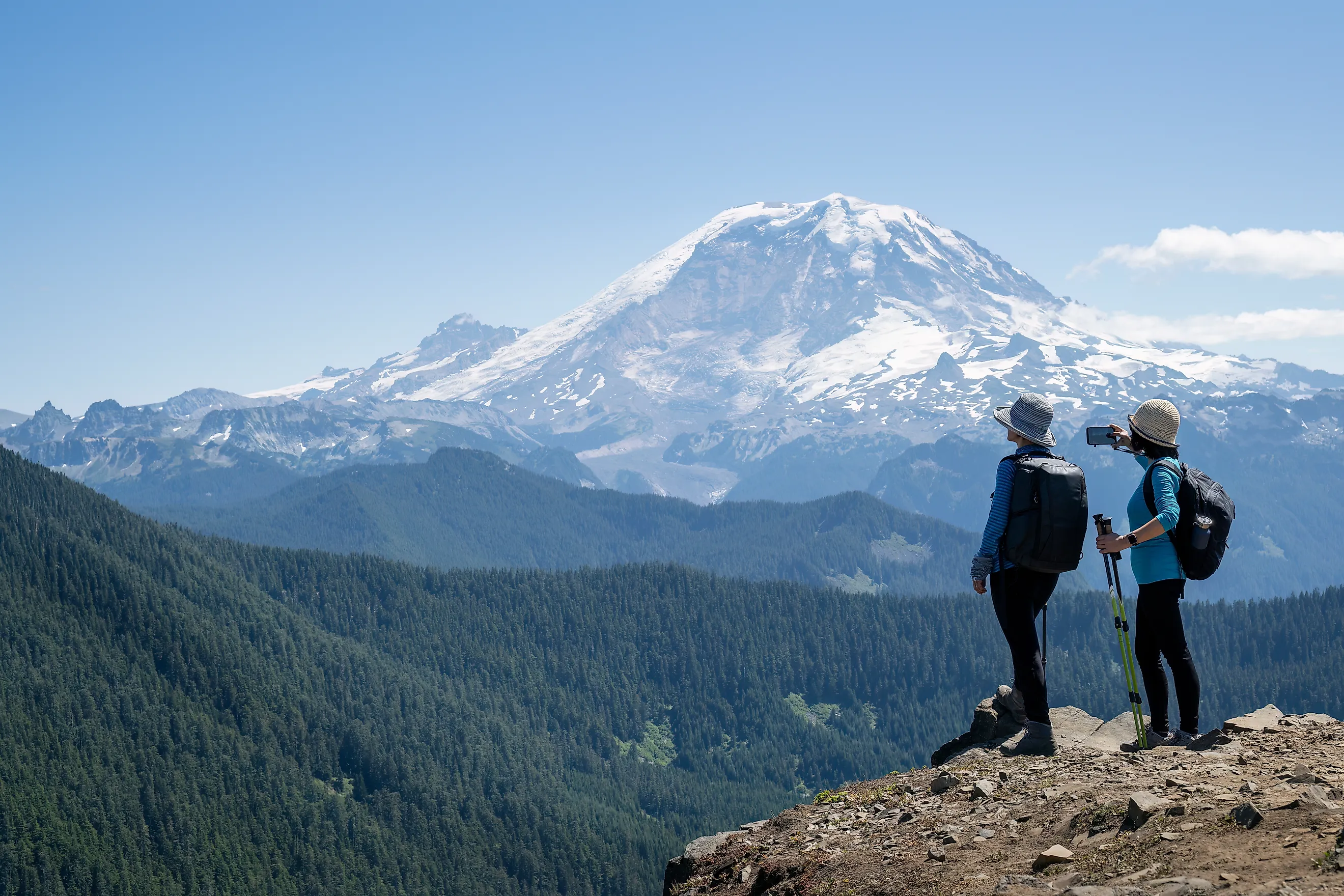
Mount Rainier National Park is on many travelers' bucket lists, and rightly so. It draws around 2 million visitors a year, most of them in summer, so a weekday visit is worth planning for.
The park is in western Washington, and its dominant feature, Mount Rainier, is the highest peak in the Cascade Range at 14,411 feet. The park was established in 1899. While there have been signs of minor activity in the last 150 years, the Smithsonian Institution puts the last confirmed eruption in the 15th century.

Many visitors head straight for the Mount Fremont Lookout Trail, which runs along Sourdough Ridge to Frozen Lake, about halfway, before climbing to the lookout. The views from the end are some of the best in the park, giving a real sense of the mountain's scale.
Rainier carries the largest glacial system of any single peak in the contiguous United States, with around 26 named glaciers. One thing to know before you plan: the Grove of the Patriarchs, the old-growth stand that long drew visitors to the Ohanapecosh corner, has been closed since November 2021, when flooding destroyed the suspension bridge that provided the only access. The Park Service plans to start building a replacement in 2028, with reopening projected for 2029. Silver Falls, from the same trailhead area, remains the walk to do there.
The park is 97 percent designated wilderness, so there is no shortage of places to disappear into.
Letchworth State Park

New York State has more than 200 state parks, and Letchworth is among the most popular. Known as the Grand Canyon of the East, it spans about 14,400 acres, running 17 miles long and 1.5 miles wide along the Genesee River. The gorge, the waterfalls, and the surrounding forest make a scene worth seeing in person.

Three waterfalls sit along the gorge: Upper, Middle, and Lower Falls. The visitor center will supply a map, and the Gorge Trail reaches all three. At Upper Falls, the Genesee Arch Bridge carries the rail line 240 feet above the river; it opened in 2017, replacing the 1875 iron trestle that stood there for over a century, and freight trains still cross it. At Lower Falls, a footbridge leads to the other side of the gorge.
Other options include hot air ballooning, whitewater rafting, and walking to the Mount Morris Dam, which is a spectacle when full. Keep an eye out for wildlife; deer are common along the Gorge Trail and black bears turn up occasionally, so give them room.
Yosemite National Park

No documentary or laptop wallpaper does justice to Yosemite. More than 4 million people visit each year, and 95 percent of the park is designated wilderness.
Yosemite was designated a national park in 1890, though federal protection began earlier with the 1864 Yosemite Grant, one of the first tracts of land in the country set aside for public recreation. Its 750,000 acres hold El Capitan, among the largest exposed granite monoliths on the planet, along with the famous Yosemite Falls and giant sequoias estimated at over 3,000 years old in the Mariposa Grove.

You can visit year-round, though most arrive in summer, and hiking season starts in spring depending on the snowpack. California's most famous park has used a timed-entry reservation system in peak periods in recent years, and the rules shift year to year, so check the park website before you set out rather than assuming.
For the Yosemite Firefall, when the setting sun lights Horsetail Fall, aim for the back half of February. Otherwise give yourself two or three days. Start in Yosemite Valley with a stop at Tunnel View, drive up to Glacier Point for the Half Dome view, and if you land a permit, take the overnight route up the Half Dome Trail. Tuolumne Meadows, the largest subalpine meadow in the High Sierra, usually opens in May.
Kodachrome Basin State Park

Utah's Kodachrome Basin State Park is small but holds its own among the state's attractions. Sitting at 5,800 feet near Cannonville, it has enough to bring people back. The Panorama Trail can be walked as a loop or out and back, with an extension to Panorama Point.
Angels Palace Trail is the one for looking down into the basin from above, while the Grand Parade Trail stays on the valley floor. You can also rent a mountain bike to cover the Grand Parade and Panorama routes.
The park's signature features are its sedimentary pipes, 67 of them, stone spires that formed when sediment filled ancient geyser or spring vents and the softer rock around them eroded away. Mammoth Spire and Ballerina Spire are the most dramatic, and Chimney Rock is worth the short drive.
Kodachrome works well for families, with a 3D archery course, disc golf, and two campgrounds open year-round. It is also a designated International Dark Sky Park, so on a clear night the Milky Way is the main attraction.
Yellowstone National Park

Yellowstone is arguably the best-known park in America. It sits in northwest Wyoming with sections extending into Idaho and Montana, and when it was established in 1872 it became the nation's first national park, and by most accounts the first in the world.
There are roughly 500 active geysers in the park, about half the world's total, among more than 10,000 hydrothermal features. It is the only place in the country where bison have lived continuously since prehistoric times, it holds what is often called the world's largest log structure in the Old Faithful Inn, and it has a canyon of its own that locals call the Grand Canyon of the Yellowstone.
Yellowstone Lake handles the boating and fishing, and there are more than 1,000 miles of trails. Wolves range throughout the park following their reintroduction in 1995. Must-see geysers include Old Faithful and Imperial Geyser, and the park also has the Upper and Lower Falls of the Yellowstone and Mammoth Hot Springs near the north entrance. A wildlife tour through the Lamar Valley is the reliable way to see bison, elk, and eagles.
Yellowstone gets over 4 million visitors a year and feels it. Plan for shoulder season if you can, and book accommodation months ahead, even for a campsite.
Find The Spirit Of Adventure In America's Parks
America's national and state parks tell the story of nature's power and wonder, and you will find the spirit of adventure in each one as you slow down to explore. Redwood and Yosemite hold the biggest trees and the biggest rock. Rainier and Yellowstone sit on top of volcanoes. Letchworth and Kodachrome prove that a state park can hold its own against the famous names, and Iao Valley packs a sacred battlefield and a 1,200-foot spire into a few acres. The only question left is where you want to start.