Countries By Literacy Rate
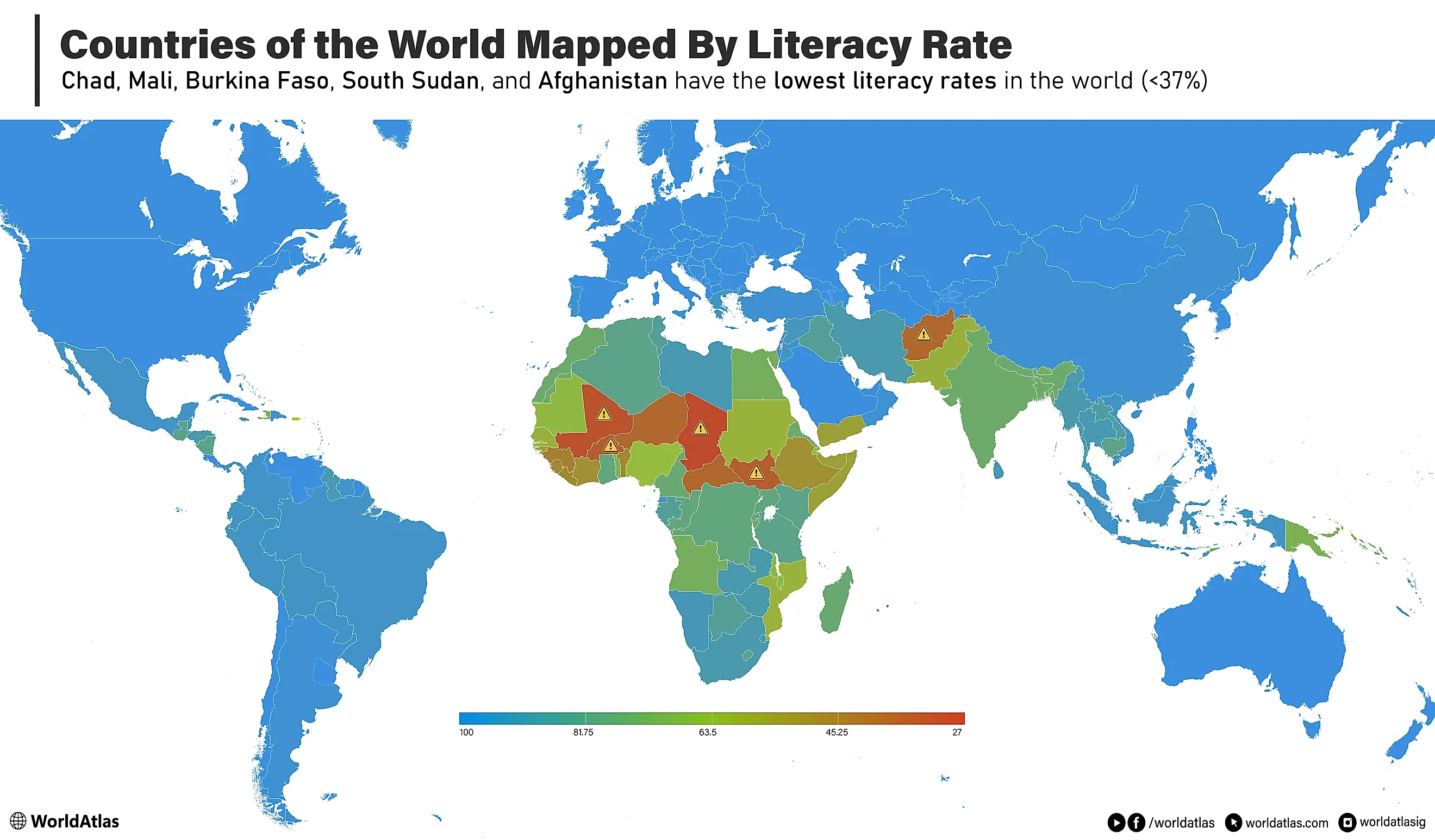
Why can almost every adult read in Finland or Andorra, while in Chad and Mali, fewer than one in three can? This countries by literacy rate list lines up every UN member from highest to lowest adult literacy, showing a world split between near-universal readers and places where reading is still a rare skill. At the top, small wealthy states and former socialist countries such as Andorra, Finland, Russia, and Uzbekistan report literacy rates around 99, 100%. At the bottom, countries like Chad (27.3%), Mali (31%), Burkina Faso (34.5%), and Afghanistan (37%) struggle to get even half their adults over the most basic reading threshold.
The rankings hint at deeper stories: long-term investment in compulsory schooling and welfare on one side; war, chronic underfunding, gender inequality, and school closures on the other. But they also come with caveats. Most figures here come from World Bank / UNESCO data on adult literacy, usually defined as the ability to read and write a short, simple statement, and not all countries are surveyed in the same year. Some "100%" values are rounded estimates, and none of these captures functional, digital, or critical literacy. As you read through the tables and country profiles, ask: what does it really mean when a society is almost fully literate, and what's lost when it isn't?
Countries With The Lowest Literacy Rates
| Rank | Country | Literacy Rate |
|---|---|---|
| 1 | Chad | 27.28 |
| 2 | Mali | 31 |
| 3 | Burkina Faso | 34.49 |
| 4 | South Sudan | 34.52276 |
| 5 | Afghanistan | 37 |
| 6 | Central African Republic | 37.49 |
| 7 | Niger | 38.1 |
| 8 | Guinea | 45.33 |
| 9 | Benin | 47.1 |
| 10 | Liberia | 48.30136 |
In the countries mentioned above, adult literacy is often below half the population, the result of very concrete, long-running shocks. Liberia's 14-year civil war (1989-2003) destroyed schools and teaching materials, and adult literacy was still only about 48% in 2017. In the central Sahel, Burkina Faso, Mali, Niger, and parts of Chad, armed groups have burned schools and threatened teachers. UNICEF and partners report that school closures in West and Central Africa tripled between 2017 and 2019, with closures in Burkina Faso, Mali, and Niger rising six-fold to over 3,000 schools. By 2023, Save the Children counted nearly 7,800 schools shut in the wider Sahel. In Afghanistan, the Taliban's 2021 decision to ban girls from secondary education has locked an estimated 2.2 million girls out of school, making it the only country where education beyond primary is formally forbidden to girls.

Across these ten states, extreme rural poverty, long distances to school, and the use of French, English or Arabic rather than local languages in early grades push children out of the system. Girls are especially affected by early marriage and domestic work, reinforcing gender gaps in literacy.

There are concrete efforts to reverse this, though coverage is still limited. In South Sudan, the UK-funded Girls' Education South Sudan (GESS) programme has provided cash transfers to roughly a million girls since 2014; its second phase (GESS2) formally ended in March 2024, and successor programmes such as Education for All South Sudan (EFASS) and new GESS cash-transfer rounds are continuing support into 2024-2025. In Mali, USAID's Selective Integrated Reading Activity (SIRA) ran from 2016 to about 2021-2022, improving early-grade reading in thousands of Bamanankan-medium classrooms before the project ended. Education Cannot Wait's Multi-Year Resilience Programmes for Burkina Faso, Mali, and Niger operated from 2021-2023 to keep crisis-affected children in school; that first phase has finished, and a new round of MYRPs for 2025-2027 is being prepared. In Liberia, the Luminos Fund's Second Chance accelerated-learning programme has been running since 2016 and is still active; by 2024, it had helped nearly 44,000 out-of-school children learn to read and re-enter government schools.
Countries With Near Universal Literacy Rates
| Country | Literacy Rate |
|---|---|
| Andorra | 100 |
| Armenia | 100 |
| Azerbaijan | 100 |
| Belarus | 100 |
| Finland | 100 |
| Georgia | 100 |
| Liechtenstein | 100 |
| Luxembourg | 100 |
| Norway | 100 |
| Russia | 100 |
| San Marino | 100 |
| Slovakia | 100 |
| Ukraine | 100 |
| Uzbekistan | 100 |
These countries report "100%" adult literacy largely because universal schooling has been in place for decades. In the former Soviet and socialist states, Armenia, Azerbaijan, Belarus, Georgia, Russia, Ukraine, Uzbekistan, and Slovakia, mass literacy was a political project from the 1920s onward. The state invested heavily in free, compulsory primary and lower-secondary education, ran adult literacy campaigns, and kept female enrolment high. That legacy still shows in very high school completion rates and a strong cultural expectation that everyone finishes at least secondary school.

In Andorra, Finland, Liechtenstein, Luxembourg, Norway, and San Marino, near-universal literacy reflects small, wealthy populations, strong welfare states, and well-funded public education systems. Early childhood education, low child labour, and safety nets that keep children in school make it unusual for anyone to grow up unable to read. Migrants and linguistic minorities are typically reached through language and integration classes, further pushing basic literacy close to 100%.

These conditions support complex economies and relatively strong civic life. High literacy makes it easier to adopt new technologies, absorb technical training, navigate bureaucracies, and follow news and political debate. It underpins high participation in higher education and helps explain why several of these states score well on innovation and human-development indices.
But the data come with caveats. "Literacy" is usually defined minimally as the ability to read and write a short, simple statement, often self-reported in a census. Figures rounded to 100% almost certainly hide small pockets of low literacy among older people, rural communities, or recent migrants, and they say nothing about functional or digital literacy. For Finland, Norway, Luxembourg, Liechtenstein, and Slovakia, the 100% figures are composite estimates rather than clearly dated surveys, so they should be treated as "virtually universal" rather than literally perfect.
Countries Ranked By Literacy Rate
| Country | Literacy Rate | Year | Source |
|---|---|---|---|
| Andorra | 100 | 2016 | UNESCO/Wikipedia adult table (approx 2016) |
| Armenia | 100 | 2020 | World Bank/UNESCO |
| Azerbaijan | 100 | 2023 | World Bank/UNESCO |
| Belarus | 100 | 2019 | World Bank/UNESCO |
| Finland | 100 | 0 | UNESCO/Wikipedia adult list; near-universal literacy |
| Georgia | 100 | 2022 | World Bank/UNESCO |
| Liechtenstein | 100 | 0 | UNESCO/Wikipedia adult table (year not specified) |
| Luxembourg | 100 | 0 | UNESCO/Wikipedia adult table (year not specified) |
| Norway | 100 | 0 | Global aggregates (UNESCO/World Bank mix); near-universal literacy |
| Russia | 100 | 2021 | World Bank/UNESCO |
| San Marino | 100 | 2022 | World Bank/UNESCO |
| Slovakia | 100 | 0 | Global aggregates (UNESCO/World Bank mix); near-universal literacy |
| Ukraine | 100 | 2021 | World Bank/UNESCO |
| Uzbekistan | 100 | 2022 | World Bank/UNESCO |
| North Korea | 99.99819 | 2018 | World Bank/UNESCO |
| Latvia | 99.89 | 2021 | World Bank/UNESCO |
| Estonia | 99.87 | 2021 | World Bank/UNESCO |
| Lithuania | 99.83 | 2021 | World Bank/UNESCO |
| Kazakhstan | 99.8 | 2020 | World Bank/UNESCO |
| Poland | 99.8 | 2021 | World Bank/UNESCO |
| Tajikistan | 99.7 | 2010 | World Bank/UNESCO |
| Cuba | 99.67311 | 2021 | World Bank/UNESCO |
| Barbados | 99.6 | 2014 | UNESCO/Wikipedia & IMF compilations (adult literacy 2014) |
| Kyrgyzstan | 99.6 | 2019 | World Bank/UNESCO |
| Moldova | 99.6 | 2021 | World Bank/UNESCO |
| Slovenia | 99.6 | 2001 | World Bank/UNESCO |
| Croatia | 99.45 | 2021 | World Bank/UNESCO |
| Tonga | 99.4 | 2021 | World Bank/UNESCO |
| Turkmenistan | 99.4 | 2005 | World Bank/UNESCO |
| Cyprus | 99.36 | 2021 | World Bank/UNESCO |
| Fiji | 99.1 | 2018 | UNESCO/World Bank compilations (adult literacy ~2018) |
| Hungary | 99.1 | 2021 | World Bank/UNESCO |
| Samoa | 99.1 | 2021 | World Bank/UNESCO |
| Antigua and Barbuda | 99 | 2001 | World Bank/UNESCO |
| Australia | 99 | 0 | UNESCO/World Bank/CIA aggregates for high-income country (approx 99%) |
| Belgium | 99 | 0 | UNESCO/Wikipedia adult list; near-universal literacy |
| Canada | 99 | 0 | UNESCO/Wikipedia adult list; near-universal literacy |
| Czechia | 99 | 0 | UNESCO/Wikipedia adult list for Czech Republic |
| Denmark | 99 | 0 | UNESCO/Wikipedia adult table (99%, year not specified) |
| France | 99 | 0 | UNESCO/Wikipedia adult list; near-universal literacy |
| Germany | 99 | 0 | UNESCO/Wikipedia adult list; near-universal literacy |
| Iceland | 99 | 0 | UNESCO/Wikipedia adult list; near-universal literacy |
| Ireland | 99 | 0 | UNESCO/Wikipedia adult table (99%, year not specified) |
| Italy | 99 | 2019 | World Bank/UNESCO |
| Japan | 99 | 0 | UNESCO/Wikipedia adult table (99%, year not specified) |
| Micronesia (Federated States of) | 99 | 0 | UNESCO/Wikipedia adult list (~99%, year not specified) |
| Monaco | 99 | 0 | UNESCO/Wikipedia adult table (approx 99%, year not specified) |
| Mongolia | 99 | 2020 | World Bank/UNESCO |
| Netherlands | 99 | 0 | UNESCO/Wikipedia adult list; near-universal literacy |
| New Zealand | 99 | 0 | Global aggregates (UNESCO/World Bank mix); near-universal literacy |
| Romania | 99 | 2021 | World Bank/UNESCO |
| Serbia | 99 | 2019 | World Bank/UNESCO |
| Spain | 99 | 2020 | World Bank/UNESCO |
| Sweden | 99 | 0 | UNESCO/Wikipedia adult list; near-universal literacy |
| Switzerland | 99 | 0 | UNESCO/Wikipedia adult list; near-universal literacy |
| Tuvalu | 99 | 0 | UN LDC profile & UNESCO estimates (~99, 99.8%) |
| United Kingdom | 99 | 0 | UNESCO/Wikipedia adult list; near-universal literacy |
| United States | 99 | 0 | UNESCO/World Bank/CIA aggregates; official adult literacy ~99% |
| Uruguay | 99 | 2022 | World Bank/UNESCO |
| Montenegro | 98.98 | 2021 | World Bank/UNESCO |
| South Korea | 98.8 | 2018 | World Bank/UNESCO |
| Grenada | 98.6 | 2014 | UNESCO/Wikipedia adult rate 2014 |
| Albania | 98.5 | 2022 | World Bank/UNESCO |
| Bulgaria | 98.42 | 2021 | World Bank/UNESCO |
| Bosnia and Herzegovina | 98.3 | 2022 | World Bank/UNESCO |
| Costa Rica | 98.04 | 2021 | World Bank/UNESCO |
| Austria | 98 | 0 | UNESCO/Wikipedia adult list (around 98%, year ~2010s) |
| Bahrain | 98 | 2023 | World Bank/UNESCO |
| Marshall Islands | 98 | 2011 | World Bank/UNESCO |
| Philippines | 98 | 2020 | World Bank/UNESCO |
| Qatar | 98 | 2014 | World Bank/UNESCO |
| Saudi Arabia | 98 | 2020 | World Bank/UNESCO |
| Singapore | 98 | 2021 | World Bank/UNESCO |
| United Arab Emirates | 98 | 2022 | World Bank/UNESCO |
| Kiribati | 97.95971 | 2018 | World Bank/UNESCO |
| Trinidad and Tobago | 97.9 | 2000 | World Bank/UNESCO |
| Maldives | 97.86 | 2021 | World Bank/UNESCO |
| Israel | 97.8 | 2011 | UNESCO/Wikipedia adult rate 2011 |
| North Macedonia | 97.6 | 2012 | World Bank/UNESCO |
| Venezuela | 97.6 | 2022 | World Bank/UNESCO |
| Brunei | 97.59 | 2021 | World Bank/UNESCO |
| Chile | 97.16 | 2022 | World Bank/UNESCO |
| Argentina | 97 | 2001 | World Bank/UNESCO |
| China | 97 | 2020 | World Bank/UNESCO |
| Oman | 97 | 2022 | World Bank/UNESCO |
| Palau | 97 | 2015 | World Bank/UNESCO |
| Saint Kitts and Nevis | 97 | 0 |
UNESCO/Wikipedia adult table (~97%, year not specified); consistent with 97.8% estimates |
| Turkey | 97 | 2019 | World Bank/UNESCO |
| Portugal | 96.78 | 2021 | World Bank/UNESCO |
| Seychelles | 96.2 | 2020 | World Bank/UNESCO |
| Colombia | 96 | 2020 | World Bank/UNESCO |
| Indonesia | 96 | 2020 | World Bank/UNESCO |
| Kuwait | 96 | 2020 | World Bank/UNESCO |
| Malaysia | 96 | 2022 | World Bank/UNESCO |
| Nauru | 96 | 0 | US State Dept & UN sources (adult literacy mid-90s; approximated 96%) |
| Panama | 96 | 2019 | World Bank/UNESCO |
| Saint Vincent and the Grenadines | 96 | 0 | UNESCO/Wikipedia adult table (~96%, year not specified) |
| Vietnam | 96 | 2022 | World Bank/UNESCO |
| Bahamas | 95.6 | 0 | ChartsBin & other compilations (adult literacy ~95, 96%) |
| Dominican Republic | 95.5 | 2022 | World Bank/UNESCO |
| Jordan | 95 | 2023 | World Bank/UNESCO |
| Mexico | 95 | 2020 | World Bank/UNESCO |
| Paraguay | 95 | 2020 | World Bank/UNESCO |
| Suriname | 95 | 2021 | World Bank/UNESCO |
| Malta | 94.94 | 2021 | World Bank/UNESCO |
| Brazil | 94.69 | 2022 | World Bank/UNESCO |
| Equatorial Guinea | 94.37054 | 2010 | World Bank/UNESCO |
| Bolivia | 94 | 2020 | World Bank/UNESCO |
| Ecuador | 94 | 2022 | World Bank/UNESCO |
| Greece | 94 | 2009 | World Bank/UNESCO |
| Peru | 94 | 2020 | World Bank/UNESCO |
| Syria | 94 | 2021 | World Bank/UNESCO |
| Sao Tome and Principe | 93.75 | 2022 | World Bank/UNESCO |
| Lebanon | 93 | 2018 | World Bank/UNESCO |
| Namibia | 92.25 | 2021 | World Bank/UNESCO |
| Mauritius | 92.15 | 2021 | World Bank/UNESCO |
| Dominica | 92 | 0 | UNESCO/Wikipedia adult list; AACRAO country profile |
| Sri Lanka | 92 | 2022 | World Bank/UNESCO |
| Thailand | 91.09987 | 2022 | World Bank/UNESCO |
| Cape Verde | 91 | 2022 | World Bank/UNESCO |
| Libya | 91 | 2015 | UNESCO/Wikipedia adult rate 2015 |
| Belize | 90.91604 | 2015 | World Bank/UNESCO |
| Eswatini | 90.74702 | 2022 | World Bank/UNESCO |
| Guyana | 90.03 | 2022 | World Bank/UNESCO |
| El Salvador | 90 | 2023 | World Bank/UNESCO |
| Saint Lucia | 90 | 0 | UNESCO/Wikipedia adult table & national estimates (~90%) |
| South Africa | 90 | 2021 | World Bank/UNESCO |
| Zimbabwe | 89.85 | 2022 | World Bank/UNESCO |
| Vanuatu | 89.1 | 2021 | World Bank/UNESCO |
| Honduras | 89 | 2019 | World Bank/UNESCO |
| Myanmar | 89 | 2019 | World Bank/UNESCO |
| Iran | 88.96 | 2022 | World Bank/UNESCO |
| Jamaica | 88.7 | 2015 | UNESCO/Wikipedia adult rate 2015 |
| Laos | 87.52 | 2022 | World Bank/UNESCO |
| Zambia | 87.5 | 2020 | World Bank/UNESCO |
| Botswana | 86.82318 | 2013 | World Bank/UNESCO |
| Iraq | 86 | 2017 | World Bank/UNESCO |
| Gabon | 85.69 | 2022 | World Bank/UNESCO |
| Tunisia | 85.21493 | 2022 | World Bank/UNESCO |
| Cambodia | 83.78 | 2022 | World Bank/UNESCO |
| Guatemala | 83.03117 | 2022 | World Bank/UNESCO |
| Kenya | 82.88 | 2022 | World Bank/UNESCO |
| Nicaragua | 82.61455 | 2015 | World Bank/UNESCO |
| Tanzania | 82.02 | 2022 | World Bank/UNESCO |
| Lesotho | 82.01 | 2022 | World Bank/UNESCO |
| Algeria | 81.40784 | 2018 | World Bank/UNESCO |
| Congo | 80.61 | 2021 | World Bank/UNESCO |
| Uganda | 80.59 | 2022 | World Bank/UNESCO |
| Democratic Republic of Congo | 80.54 | 2022 | World Bank/UNESCO |
| Ghana | 80.38 | 2020 | World Bank/UNESCO |
| Rwanda | 79 | 2022 | World Bank/UNESCO |
| Cameroon | 78.23 | 2020 | World Bank/UNESCO |
| Madagascar | 77.48 | 2022 | World Bank/UNESCO |
| Morocco | 77.35 | 2022 | World Bank/UNESCO |
| India | 77 | 2023 | World Bank/UNESCO |
| Solomon Islands | 76.6 | 1999 | UNESCO adult literacy rate 76.6% (1999) |
| Eritrea | 76.57052 | 2018 | World Bank/UNESCO |
| Bangladesh | 76 | 2021 | World Bank/UNESCO |
| Burundi | 75.54 | 2022 | World Bank/UNESCO |
| Egypt | 74.5 | 2022 | World Bank/UNESCO |
| Angola | 72.4 | 2022 | World Bank/UNESCO |
| Bhutan | 72.1 | 2022 | World Bank/UNESCO |
| Nepal | 71.15 | 2021 | World Bank/UNESCO |
| Papua New Guinea | 70.06368 | 2017 | World Bank/UNESCO |
| East Timor | 69.9 | 2020 | World Bank/UNESCO |
| Malawi | 68.08 | 2022 | World Bank/UNESCO |
| Haiti | 68.00986 | 2017 | World Bank/UNESCO |
| Togo | 67 | 2019 | World Bank/UNESCO |
| Mauritania | 66.96 | 2021 | World Bank/UNESCO |
| Djibouti | 65 | 0 | UNESCO GEM 2019 LDC profile; adult literacy roughly 65% |
| Nigeria | 63.15554 | 2021 | World Bank/UNESCO |
| Comoros | 61.71 | 2022 | World Bank/UNESCO |
| Sudan | 60.69718 | 2018 | World Bank/UNESCO |
| Mozambique | 60 | 2020 | World Bank/UNESCO |
| Gambia | 58.67 | 2022 | World Bank/UNESCO |
| Pakistan | 58 | 2019 | World Bank/UNESCO |
| Senegal | 57.67 | 2022 | World Bank/UNESCO |
| Yemen | 54.1 | 2004 | World Bank/UNESCO |
| Somalia | 54 | 2022 | World Bank/UNESCO |
| Guinea-Bissau | 53.9 | 2022 | World Bank/UNESCO |
| Ethiopia | 51.77118 | 2017 | World Bank/UNESCO |
| Cote d'Ivoire | 50.00064 | 2021 | World Bank/UNESCO |
| Sierra Leone | 48.64 | 2022 | World Bank/UNESCO |
| Liberia | 48.30136 | 2017 | World Bank/UNESCO |
| Benin | 47.1 | 2022 | World Bank/UNESCO |
| Guinea | 45.33 | 2021 | World Bank/UNESCO |
| Niger | 38.1 | 2022 | World Bank/UNESCO |
| Central African Republic | 37.49 | 2020 | World Bank/UNESCO |
| Afghanistan | 37 | 2021 | World Bank/UNESCO |
| South Sudan | 34.52276 | 2018 | World Bank/UNESCO |
| Burkina Faso | 34.49 | 2022 | World Bank/UNESCO |
| Mali | 31 | 2020 | World Bank/UNESCO |
| Chad | 27.28 | 2022 | World Bank/UNESCO |