The 10 Safest States in the US
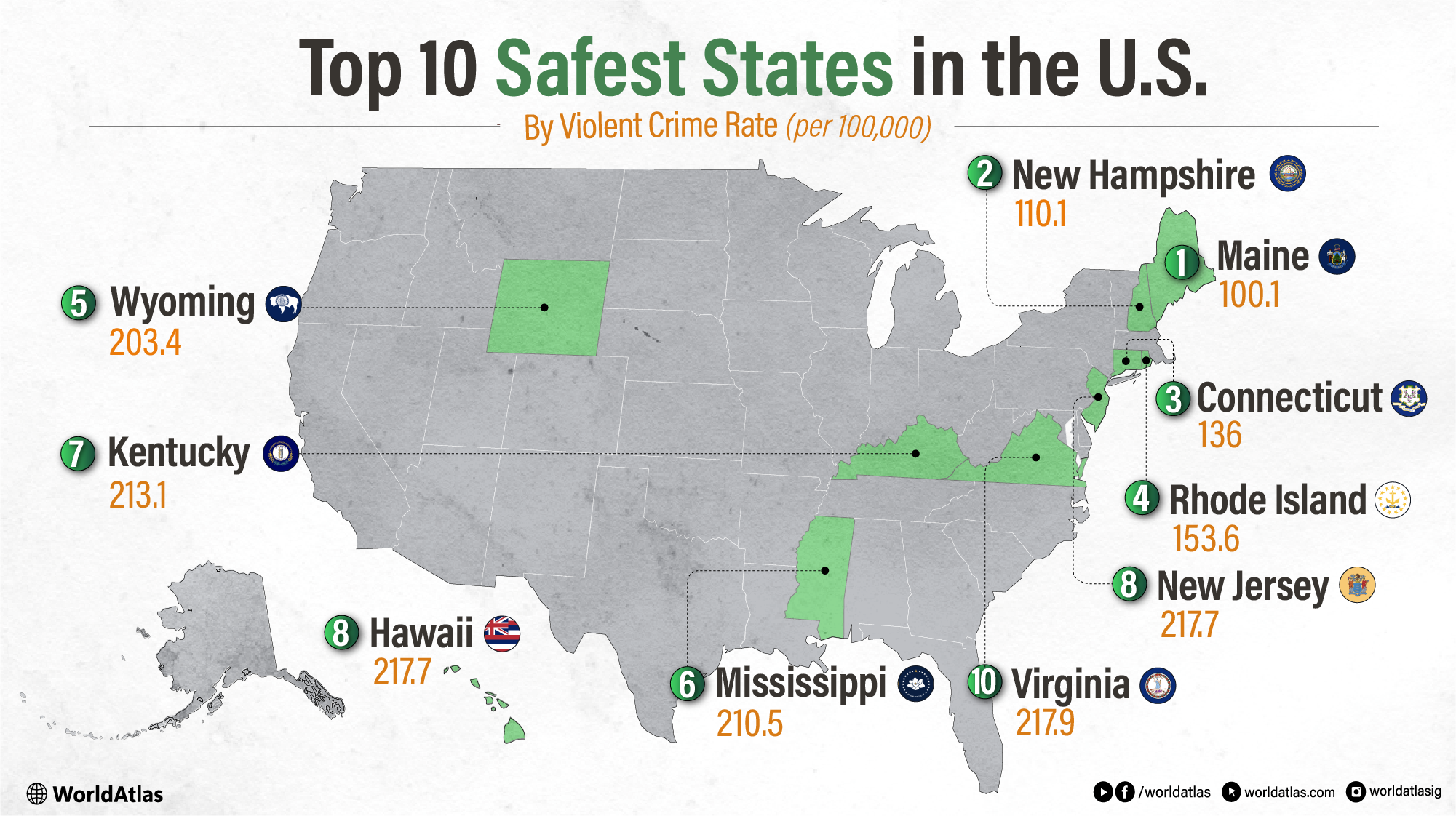
Looking for the safest places to live or travel in the U.S.? These are the 10 safest states in the US by violent crime rate per 100,000 residents: Maine (100.1), New Hampshire (110.1), Connecticut (136.0), Rhode Island (153.6), Wyoming (203.4), Mississippi (210.5), Kentucky (213.1), Hawaii (217.7), New Jersey (217.7), and Virginia (217.9).
Several leaders here are dominated by small towns and modest-size cities, where fewer high-intensity nightlife corridors and fewer entrenched hotspots reduce the steady churn of assaults and robberies. Compact geography can also be an advantage: shorter distances support tighter coordination among local departments and quicker emergency response across town lines. In metro-adjacent states, suburban growth pairs with strong services.
The FBI’s reporting framework matters too. “Violent crime” is tracked through categories such as murder, rape, robbery, and aggravated assault, and the balance between those offenses helps explain why two states with similar overall rates can feel different on the ground.
The 10 Safest States in the US
| Rank | State | Violent crime rate (per 100,000) |
|---|---|---|
| 1 | Maine | 100.1 |
| 2 | New Hampshire | 110.1 |
| 3 | Connecticut | 136 |
| 4 | Rhode Island | 153.6 |
| 5 | Wyoming | 203.4 |
| 6 | Mississippi | 210.5 |
| 7 | Kentucky | 213.1 |
| 8 (tie) | Hawaii | 217.7 |
| 8 (tie) | New Jersey | 217.7 |
| 10 | Virginia | 217.9 |
1. Maine - 100.1

Maine consistently ranks as the safest state in this list, and the low violent-crime rate is closely tied to where, and how, people live. For a deeper look, the FBI’s Crime Data Explorer tracks Maine’s violent-crime totals and rates year by year. With relatively few dense urban areas, there are fewer places where assaults, robberies, and late-night conflicts tend to cluster. Most Mainers live in small towns and smaller cities, which often supports faster informal "community awareness" when problems emerge. Even in the Portland area, where activity is more concentrated, the state's overall footprint of high-risk nightlife districts and large, densely populated corridors is limited compared with many states. As with any ranking, safety isn't uniform street-to-street, but Maine's settlement patterns and smaller number of major hotspots help keep violent crime comparatively low statewide.
2. New Hampshire - 110.1

New Hampshire's low violent-crime rate reflects a statewide pattern of limited large-city concentration and comparatively stable community conditions. The state has a few population centers, especially in the southern tier near Massachusetts, but much of New Hampshire is made up of smaller towns where serious violence is less likely to become routine. If you want the official breakdown, FBI reporting groups violent crime into categories like murder, rape, robbery, and aggravated assault for state-by-state comparisons. When violent crime does occur, it tends to be concentrated in specific neighborhoods or corridors rather than spread broadly across the state. That matters for residents and visitors: risk is often more "location-specific" than "statewide." Overall, the combination of fewer high-density hotspots, strong local civic institutions, and a broad suburban-and-small-town settlement pattern helps keep the violent-crime rate among the lowest in the country.
3. Connecticut - 136.0

According to FBI crime statistics, Connecticut’s violent-crime trends can be tracked over time at the statewide level and compared with other states. Connecticut's ranking is driven by a familiar safety pattern: most of the state is suburban or small-town, while a limited number of urban areas account for a disproportionate share of serious incidents. In practical terms, that means statewide violent-crime rates stay low because large portions of Connecticut experience relatively few assaults and robberies compared with major metro regions elsewhere. Regional coordination, between local departments, courts, and statewide services, also matters for safety outcomes, because it supports consistent enforcement and quicker follow-up across town borders. For readers, the key takeaway is that Connecticut's safety is strong at the state level, but the experience can vary by city and neighborhood; the statewide average is pulled down by broad areas with consistently low violence.
4. Rhode Island - 153.6

Rhode Island's relatively low violent-crime rate stands out because the state is compact and more densely settled than many others on this list. The advantage of that small footprint is that public-safety systems, police coverage, emergency response, and cross-jurisdiction coordination, can be more tightly integrated, with shorter travel distances and fewer "gaps" between communities. Providence is the main population center, and, like many states, the most serious violence tends to concentrate in specific areas rather than across the entire state. Outside those pockets, many Rhode Island communities see comparatively low rates of assaults and robberies. For readers checking the data source, the FBI’s Crime Data Explorer is where Rhode Island’s violent-crime counts and rates are published and updated. Overall, the state's small scale and concentrated geography help keep violent crime lower than many larger, more fragmented regions.
5. Wyoming - 203.4

Wyoming's safety profile is shaped by extremely low population density, which reduces the day-to-day conditions that often drive violent-crime totals in large metropolitan areas, frequent stranger interactions, concentrated nightlife districts, and dense corridors where robbery and assault are more common. FBI data can be useful context here because small-population states can see noticeable swings in statewide rates from year to year. With fewer large cities and fewer high-activity urban centers, statewide violent crime stays relatively low compared with much of the country. That said, "safe" doesn't mean "risk-free": in rural states, violence can be more likely to involve people who know one another (such as disputes and domestic situations) rather than random encounters. For travelers and new residents, Wyoming's overall risk is generally low statewide, but it still pays to be mindful in the handful of larger towns and late-night settings where incidents are more likely.
6. Mississippi - 210.5

In this ranking, Mississippi appears among the states with lower violent-crime rates, but it's especially important to stress that statewide averages can hide sharp local differences. The FBI’s statewide violent-crime figures are compiled from reporting agencies and are most useful when you look at trends and local concentrations rather than a single statewide number. Like many states, serious violence can concentrate in a small number of city neighborhoods or specific corridors, while many rural counties and smaller towns experience far fewer assaults and robberies. That unevenness is the main "safety story" readers should take from the state: outcomes vary dramatically by place and time of day. For practical safety, the same common-sense approach applies, know the local context, avoid isolated areas late at night, and pay attention to where incidents cluster, because statewide numbers don't guarantee uniform safety. Used carefully, the ranking suggests lower statewide violence on average, not that every community has the same risk level.
7. Kentucky - 213.1

Kentucky's relatively low violent-crime rate is consistent with a state where much of the population lives outside large, high-density urban cores. For anyone validating the figures, the FBI publishes Kentucky’s violent-crime totals and rates through its national crime reporting programs. Fewer massive city centers generally means fewer persistent "hotspot" zones for robbery and assault, and many communities are small enough that serious violence is less likely to become widespread. At the same time, Kentucky's safety is not evenly distributed: the largest metro areas can experience spikes, and the statewide average can mask neighborhood-level variation. For readers, the useful framing is that Kentucky tends to have lower violent crime overall because risk is more geographically concentrated than broadly spread across the state. Residents and visitors benefit most by paying attention to local patterns (specific corridors and late-night environments) rather than assuming uniform safety everywhere.
8. Hawaii - 217.7 (tied)

Hawaii's violent-crime rate is shaped by how the state's population and activity are concentrated. In FBI crime data, Hawaii’s violent-crime reporting can be reviewed by year to see how totals change as tourism and local activity shift. Most residents live on Oʻahu, and most visitor-heavy nightlife and entertainment districts are also clustered there, meaning risk, when it appears, tends to be location-specific rather than statewide. On many neighbor islands, communities are smaller and more interconnected, which can reduce the frequency of certain violent crimes that are more common in large, anonymous urban settings. Hawaii also has clear jurisdictional lines for public safety at the county level, which can support consistent enforcement and response within each island's main population centers. The key takeaway is that Hawaii's overall violent-crime rate is comparatively low, with risk most likely to appear in busier urban/tourist corridors rather than across the islands uniformly.
8. New Jersey - 217.7 (tied)

New Jersey's statewide violent-crime rate stays relatively low despite high population density because that density is largely suburban and spread across many municipalities, rather than concentrated in a few vast urban zones. In safety terms, that often means fewer persistent, high-intensity hotspots relative to population size, though some city neighborhoods can still experience elevated risk. New Jersey's strong local-service capacity in many communities (policing, EMS, and coordinated response) helps maintain lower rates of robbery and assault across much of the state. The state's firearms policy environment is also frequently cited as a factor that may affect the severity and lethality of conflicts. If you’re cross-checking sources, the FBI’s Crime Data Explorer is the standard place to verify New Jersey’s violent-crime trends and definitions. Overall, the pattern is consistent: low statewide violence, with the highest risk concentrated in specific urban corridors rather than across most suburbs and small towns.
10. Virginia - 217.9

Virginia ranks tenth on this list with a violent crime rate of 217.9 per 100,000, and much of the state's lower statewide violence is driven by where population growth has occurred. The FBI’s crime statistics for Virginia provide a consistent benchmark for tracking violent crime over time and comparing it with other states. Large shares of Virginians live in suburban regions, especially Northern Virginia, where stable employment, higher resources for public services, and broad residential development patterns tend to correlate with fewer robberies and assaults than highly concentrated urban cores. That said, Virginia's safety is not uniform: parts of larger metros can see periodic increases, and the statewide average can hide neighborhood-level variation. The practical takeaway for readers is that Virginia's lower violent-crime rate reflects broad statewide conditions, while personal safety still depends on local context, specific corridors, late-night environments, and whether an area has recurring hotspot patterns.
US States by Safety
| Rank | State | Violent crime rate (per 100,000) |
|---|---|---|
| 1 | Maine | 100.1 |
| 2 | New Hampshire | 110.1 |
| 3 | Connecticut | 136 |
| 4 | Rhode Island | 153.6 |
| 5 | Wyoming | 203.4 |
| 6 | Mississippi | 210.5 |
| 7 | Kentucky | 213.1 |
| 8 (tie) | Hawaii | 217.7 |
| 8 (tie) | New Jersey | 217.7 |
| 10 | Virginia | 217.9 |
| 11 | Vermont | 219.1 |
| 12 | Nebraska | 220.5 |
| 13 | Utah | 229.6 |
| 14 | Idaho | 230.6 |
| 15 | Iowa | 243.3 |
| 16 | Pennsylvania | 245.6 |
| 17 | West Virginia | 248.8 |
| 18 | North Dakota | 254.3 |
| 19 | Minnesota | 256.6 |
| 20 | Florida | 267.1 |
| 21 | Wisconsin | 278.5 |
| 22 | Illinois | 289.2 |
| 23 | Ohio | 293.7 |
| 24 | Indiana | 312.9 |
| 25 | Massachusetts | 314.7 |
| 26 | Georgia | 325.7 |
| 27 | Washington | 326.1 |
| 28 | Oregon | 331 |
| 29 | Alabama | 359.9 |
| 30 | Delaware | 360.8 |
| 31 | South Dakota | 362.3 |
| 32 | North Carolina | 375.8 |
| 33 | New York | 380.2 |
| 34 | Texas | 389.4 |
| 35 | Nevada | 402 |
| 36 | Maryland | 420.4 |
| 37 | Arizona | 421.9 |
| 38 | Oklahoma | 422.8 |
| 39 | Montana | 423.5 |
| 40 | Michigan | 434.3 |
| 41 | South Carolina | 436.7 |
| 42 | Kansas | 438.7 |
| 43 | Missouri | 462 |
| 44 | Colorado | 476.3 |
| 45 | California | 486 |
| 46 | Louisiana | 519.8 |
| 47 | Arkansas | 579.4 |
| 48 | Tennessee | 592.3 |
| 49 | New Mexico | 717.1 |
| 50 | Alaska | 724.1 |