10 U.S. States With the Highest Grocery Bills
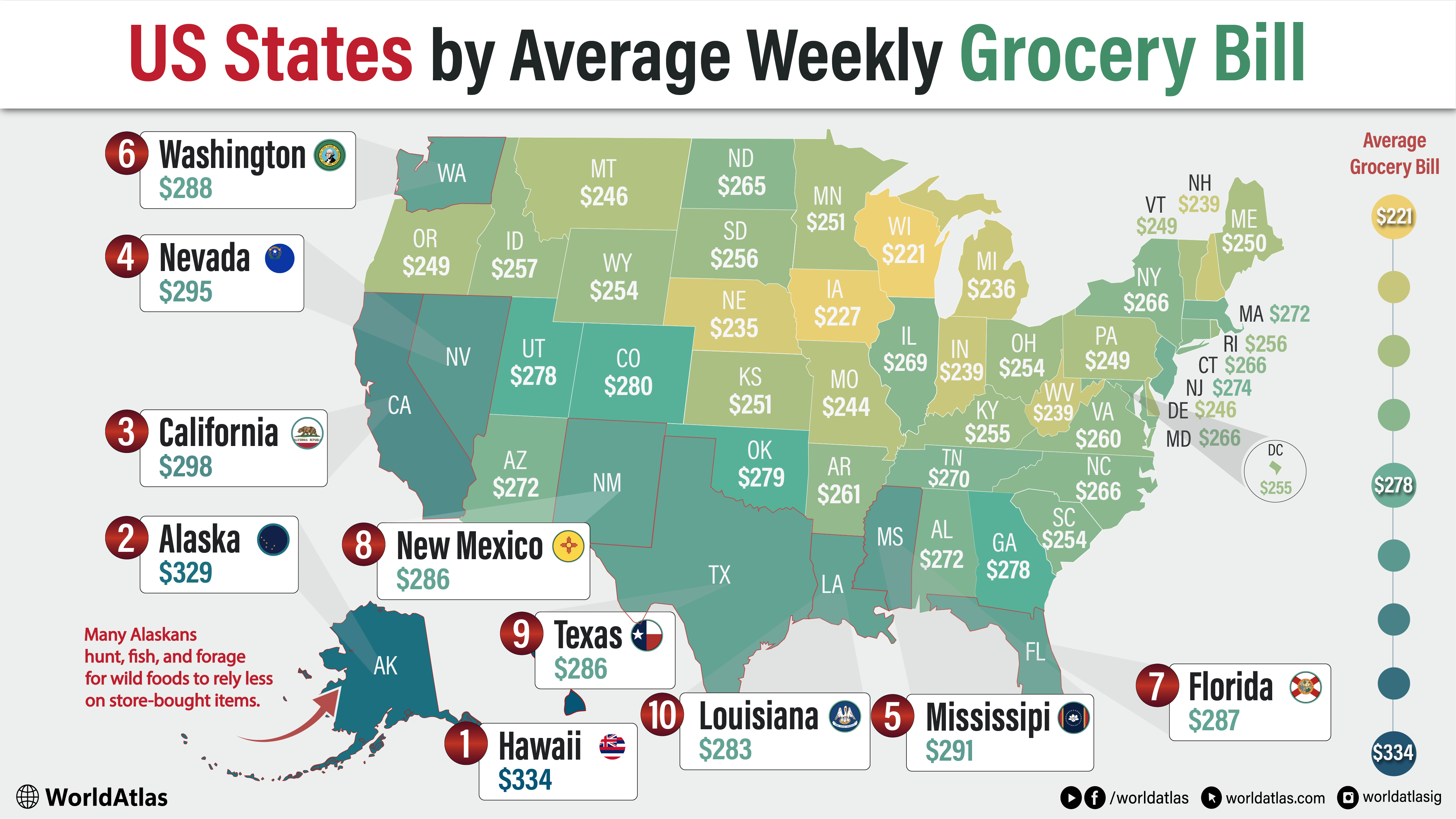
High grocery costs are important indicators of how people are living. The states at the top of this ranking share clear, measurable pressures that shape what families pay at the checkout. The U.S. states with the highest average weekly grocery bills are Hawaii ($333.88), Alaska ($328.71), California ($297.72), Nevada ($294.76), Mississippi ($290.64), Washington ($287.67), Florida ($287.27), New Mexico ($286.39), Texas ($286.19), and Louisiana ($282.95).
Two themes stand out immediately. Geography matters: Hawaii faces high import costs tied to ocean freight and limited local supply, while Alaska's prices reflect long internal distances, harsh weather, and reliance on barge and air freight for many communities. Cost structure matters too. On the mainland, California, Washington, Nevada, Texas, and Florida combine strong metro demand with high wages, commercial rents, utilities, and distribution costs that raise the price of everyday food.
High bills can surprisingly surface in lower-cost regions. Mississippi and Louisiana illustrate the price effects of rural coverage gaps, weaker competition in some markets, and storm-related supply risk along the Gulf. New Mexico shows how long-distance distribution for sparsely populated regions can push groceries higher. The narrow spread from ranks six through ten points to shared cost pressures across very different economies.
10 US States With The Highest Grocery Bills
| Rank | State | Average weekly grocery bill |
|---|---|---|
| 1 | Hawaii | $333.88 |
| 2 | Alaska | $328.71 |
| 3 | California | $297.72 |
| 4 | Nevada | $294.76 |
| 5 | Mississippi | $290.64 |
| 6 | Washington | $287.67 |
| 7 | Florida | $287.27 |
| 8 | New Mexico | $286.39 |
| 9 | Texas | $286.19 |
| 10 | Louisiana | $282.95 |
1. Hawaii - $333.88

Hawaii's position at the top of the list, with an average of $333.88 per week, reflects deep-rooted structural and economic realities. First, the state's geographic isolation means nearly all groceries must be imported from the mainland or abroad. Shipping costs, although only part of the story, still add up. Second, high costs for land, housing, and utilities raise overhead for stores , expenses that are ultimately passed on to shoppers. Because commercial real estate and operational costs are significantly higher than in mainland states, even staples such as dairy, meat, and produce carry a premium. Third, limited local food production means the islands cannot rely heavily on domestic agriculture to buffer prices.
As a result, what might be a modest weekly grocery bill elsewhere ends up being much larger in Hawaii , a consequence of geography, economics, and supply-chain realities combining under what many refer to as a "paradise tax."
2. Alaska - $328.71

Alaska's weekly grocery bill, averaging about $328.71, is among the highest in the U.S., and several concrete structural factors explain why. First, the sheer size of the state combined with a small and widely dispersed population makes distribution of food extremely costly. Grocery items often must be trucked, barged, or flown in across vast distances, especially to rural or remote communities, significantly boosting shipping and handling costs. Moreover, many parts of Alaska cannot reliably produce fresh fruits, vegetables, or other staples because of the climate and seasonality. As a result, almost all non-local food must be imported, which adds further overhead compared with more agriculturally productive regions.
Finally, even in larger hubs such as Anchorage and regional centers like Kodiak, retail costs remain elevated relative to the contiguous U.S., because transporting goods inland and covering labor and storage expenses remains costly.
Thus, Alaska's geographic isolation, limited local agriculture, and high logistics costs combine to push grocery bills far above the national norm, a predictable outcome of supplying food to a remote, sparsely populated region.
3. California - $297.72

California's average weekly grocery bill of $297.72 is driven by a combination of high input costs and market conditions unique to the state. California's food prices are heavily influenced by its elevated housing, labor, and energy costs, all of which raise operating expenses for grocery retailers. The state's minimum wage, one of the highest in the nation, directly increases labor costs across farming, transportation, and retail. In addition, California's electricity rates are consistently among the most expensive in the U.S., raising the cost of refrigeration and storage throughout the supply chain.
Although California is a major agricultural producer, much of what residents purchase, such as meat, dairy, and packaged goods, still relies on long-distance transportation. Congestion in major ports and highways adds further logistical expense. The state's frequent droughts also increase the cost of locally grown produce by raising water and compliance costs for farmers.
4. Nevada - $294.76

Nevada's high average weekly grocery bill of $294.76 reflects the state's dependence on imported food, rapid population growth, and elevated operating costs within its retail sector. Nevada produces relatively little of its own food due to its arid climate and limited farmland, meaning most groceries must be shipped in from California, Arizona, and other regional suppliers. This reliance on long-haul trucking makes prices especially sensitive to fuel costs and supply-chain congestion.
Population growth in metropolitan areas such as Las Vegas and Reno has increased demand faster than local distribution infrastructure can expand, putting upward pressure on prices. Retail operating costs are also significant: commercial rents in Nevada's major cities have risen steadily, and grocers face higher labor expenses as wages adjust to keep pace with fast-growing service industries. Nevada's tourism-and-events economy, concentrated around Las Vegas, can create demand spikes that complicate forecasting. Retailers may carry larger buffers of perishable inventory and rely on faster replenishment, which can raise operating costs.
5. Mississippi - $290.64

Mississippi's average weekly grocery bill of $290.64 is unusually high relative to its low median income, and several structural factors help explain the gap. Mississippi has limited food distribution infrastructure. Many rural areas rely on small, independent grocers that lack the purchasing power and scale of large national chains, resulting in higher per-unit costs for basic goods. Transportation expenses further elevate prices; distributing goods across low-density regions increases fuel, labor, and delivery costs, which retailers pass along to consumers.
Many parts of Mississippi have limited supermarket coverage and fewer large-format chains. Where shoppers rely on smaller stores with lower sales volumes, retailers often face higher wholesale costs and less ability to spread fixed expenses, which can raise shelf prices. High poverty rates are also associated with more food deserts in some communities, leaving households with fewer options and less price competition.
6. Washington - $287.67

Washington's average weekly grocery bill of $287.67 is shaped by a mix of high operating costs, strong regional demand, and supply-chain pressures linked to its growing economy. Washington has one of the highest minimum wages in the country, raising labor expenses throughout food production, transportation, and retail. These costs are particularly influential in metropolitan areas like Seattle and Bellevue, where wages, commercial rents, and utility expenses run well above national averages.
While Washington is an agricultural leader in products such as apples, potatoes, and hops, consumers still rely heavily on imported goods, including meat, dairy, and packaged foods, that travel long distances before reaching stores. Congestion at the Ports of Seattle and Tacoma can increase freight delays, raising inventory and handling costs for grocers. Rapid population growth along the I-5 corridor also places sustained pressure on local supply chains, pushing prices higher during periods of strong demand.
7. Florida - $287.27

Florida's average weekly grocery bill of $287.27 reflects a combination of rapid population growth, high distribution costs, and vulnerability to climate-related disruptions. The state's population has expanded quickly, especially in metropolitan areas like Miami, Tampa, and Orlando, increasing demand for food faster than supply chains can scale. This sustained demand pressure raises prices, particularly for perishable items that require cold storage and timely delivery.
Florida's geography also plays a central role. Because the state sits at the end of major interstate freight routes, transportation costs for goods arriving from the Midwest and West Coast are higher than in centrally located states. Retailers must also price in elevated insurance, warehousing, and storm-preparation costs due to frequent hurricanes, which regularly disrupt supply chains and increase the cost of maintaining inventory.
While Florida produces fruits, vegetables, and seafood, these sectors cannot meet year-round demand. As a result, reliance on imported goods and costly logistics keeps grocery prices among the highest in the nation.
8. New Mexico - $286.39

New Mexico's average weekly grocery bill of $286.39 is shaped by its geographic constraints, limited retail competition, and uneven distribution infrastructure. Much of the state is rural and sparsely populated, which raises transportation costs for grocers. Moving food across long distances, often from distribution hubs in Texas, Arizona, or Colorado, adds fuel, labor, and refrigeration expenses that retailers pass on to consumers. These costs are amplified in remote communities, where delivery routes are infrequent and expensive to maintain.
Retail consolidation also plays a significant role. Many areas rely on only one or two major grocery chains, reducing competitive pressure and limiting price variation. Smaller independent stores, which serve rural regions, lack the buying power of national retailers and therefore pay more for wholesale goods.
New Mexico's relatively low agricultural output for consumer staples further increases reliance on imported products. Combined with lower household incomes, these structural factors make groceries disproportionately expensive compared with national averages.
9. Texas - $286.19

Texas's average weekly grocery bill of $286.19 reflects the combined effects of rapid population growth, rising operating costs, and regional disparities in food access. Texas has added millions of residents over the past decade, placing sustained pressure on supply chains serving major metros such as Houston, Dallas-Fort Worth, and Austin. Strong demand increases pricing power for retailers, especially during periods of congestion or supply shortages.
Texas produces large volumes of agricultural commodities, but that does not automatically translate into cheaper grocery baskets. Many processed and packaged items are sourced through national supply chains, and long in-state distances plus fast metro growth can keep distribution and retail costs high.
Urbanization also contributes to higher prices. Commercial rents, labor costs, and utilities have risen sharply in the state's fastest-growing cities, raising overhead for grocers. Meanwhile, rural areas often face limited competition, allowing higher prices to persist.
10. Louisiana - $282.95
Louisiana's average weekly grocery bill of $282.95 is elevated largely due to structural weaknesses in its food distribution network, high vulnerability to weather disruptions, and limited retail competition in many regions. Much of the state's population is spread across small and mid-sized communities, which increases transportation costs for grocers. Delivering perishable goods across low-density areas requires more fuel and labor per unit sold, raising final prices for consumers.
Louisiana's location on the Gulf Coast also exposes it to hurricanes and frequent flooding, which periodically disrupts supply chains, damages infrastructure, and increases insurance and inventory-management costs for retailers. These risks are priced into everyday goods, even outside storm seasons. Additionally, many rural parishes have only a few grocery options, allowing remaining stores to maintain higher markups. Although Louisiana produces seafood and some agricultural goods, these sectors do not significantly offset reliance on imported staples.
US States Ranked By Average Grocery Bill
| Rank | State | Average weekly grocery bill |
|---|---|---|
| 1 | Hawaii | $333.88 |
| 2 | Alaska | $328.71 |
| 3 | California | $297.72 |
| 4 | Nevada | $294.76 |
| 5 | Mississippi | $290.64 |
| 6 | Washington | $287.67 |
| 7 | Florida | $287.27 |
| 8 | New Mexico | $286.39 |
| 9 | Texas | $286.19 |
| 10 | Louisiana | $282.95 |
| 11 | Colorado | $279.98 |
| 12 | Oklahoma | $279.16 |
| 13 | Utah | $278.41 |
| 14 | Georgia | $278.32 |
| 15 | New Jersey | $274.69 |
| 16 | Massachusetts | $271.98 |
| 17 | Arizona | $271.84 |
| 18 | Alabama | $271.64 |
| 19 | Tennessee | $270.45 |
| 20 | Illinois | $269.47 |
| 21 | New York | $266.40 |
| 22 | North Carolina | $266.23 |
| 23 | Maryland | $266.11 |
| 24 | Connecticut | $265.90 |
| 25 | North Dakota | $265.11 |
| 26 | Arkansas | $260.91 |
| 27 | Virginia | $259.76 |
| 28 | Idaho | $257.54 |
| 29 | South Dakota | $256.48 |
| 30 | Rhode Island | $255.86 |
| 31 | Washington, D.C. | $254.70 |
| 32 | Kentucky | $254.57 |
| 33 | South Carolina | $254.36 |
| 34 | Wyoming | $254.24 |
| 35 | Ohio | $253.74 |
| 36 | Kansas | $250.88 |
| 37 | Minnesota | $250.56 |
| 38 | Maine | $249.91 |
| 39 | Vermont | $249.38 |
| 40 | Oregon | $249.38 |
| 41 | Pennsylvania | $249.09 |
| 42 | Montana | $246.42 |
| 43 | Delaware | $246.21 |
| 44 | Missouri | $244.43 |
| 45 | New Hampshire | $239.33 |
| 46 | West Virginia | $239.24 |
| 47 | Indiana | $239.11 |
| 48 | Michigan | $236.38 |
| 49 | Nebraska | $235.12 |
| 50 | Iowa | $227.32 |
| 51 | Wisconsin | $221.46 |