10 U.S. States With The Highest Crime Rates
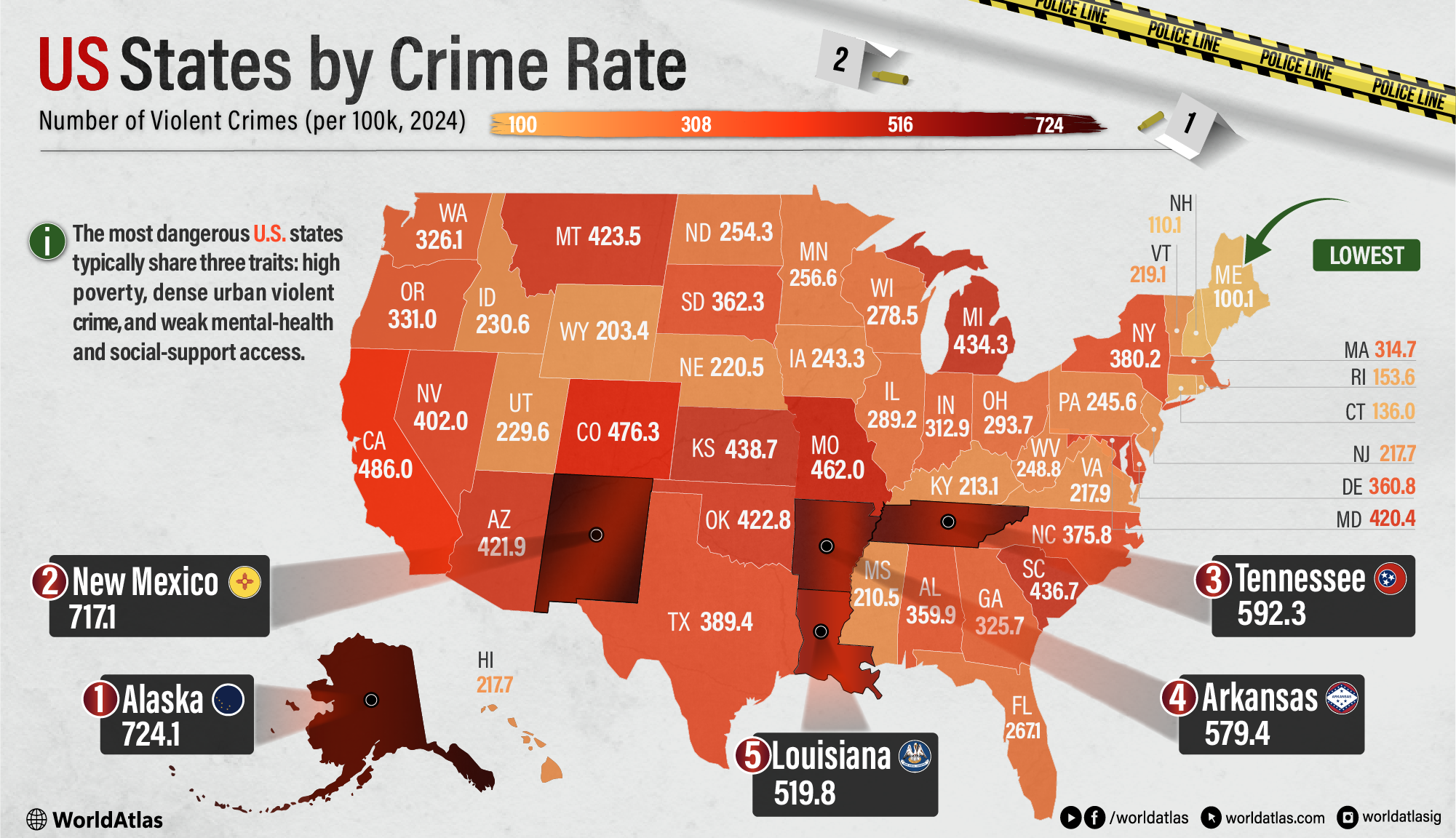
Violent crime shapes daily life differently across America, but statewide rates reveal where the risk is most acute. The 10 most dangerous states in the U.S. in 2024, measured by violent crime per 100,000 residents, are Alaska (724.1), New Mexico (717.1), Tennessee (592.3), Arkansas (579.4), Louisiana (519.8), California (486.0), Colorado (476.3), Missouri (462.0), Kansas (438.7), and South Carolina (436.7).
The sharp drop after the top two hints at how isolation, substance abuse, and strained services can collide in some places, while dense metro corridors amplify different pressures elsewhere. Danger is rarely uniform within a border. Metro areas often drive state averages, but rural counties may face longer response times and fewer mental health and victim support resources.
Across this group, recurring pressures include addiction, concentrated poverty, and firearm-fueled assaults, with some states also carrying heavy burdens of sexual assault and domestic violence. Population growth in several of these states adds pressure on courts, jails, and social services, making coordination across agencies essential. Beyond the human toll, high violent-crime rates drain local economies through medical costs, lost productivity, and long-term trauma.
The 10 Most Dangerous U.S. States
| Rank | State | Violent crime rate (per 100k) |
|---|---|---|
| 1 | Alaska | 724.1 |
| 2 | New Mexico | 717.1 |
| 3 | Tennessee | 592.3 |
| 4 | Arkansas | 579.4 |
| 5 | Louisiana | 519.8 |
| 6 | California | 486.0 |
| 7 | Colorado | 476.3 |
| 8 | Missouri | 462.0 |
| 9 | Kansas | 438.7 |
| 10 | South Carolina | 436.7 |
1. Alaska - 724.1

Alaska tops this list with a 2024 violent crime rate of 724.1 per 100,000 people. The state’s vast size, sparse population, and numerous remote communities present significant public-safety challenges, characterized by long response times and high costs associated with maintaining a robust police presence.
Due to this, violent offenses like murder, rape, robbery, and aggravated assault occur well above the national average, and the state is often cited for especially high rates of sexual assault and domestic violence. Additionally, substance abuse, particularly alcohol and drugs, is a major contributor, as it is harder to regulate in the rugged and distant communities of this state. On the positive side, Alaska has expanded community policing, sought federal support, and adopted new technologies to improve coverage across difficult terrain.
2. New Mexico - 717.1

New Mexico ranks second on this list with a 2024 violent crime rate of 717.1 per 100,000 residents. The state struggles with violent and property crime, and earlier reports show the burden concentrated in Albuquerque. Though about 27% of New Mexicans live there, the city historically accounted for a much larger share of statewide violent incidents. In 2016, law enforcement reported 14,619 violent crimes, a rate of 702.5 per 100,000 versus 386.3 nationally.
Drug abuse, especially opioids, has compounded the challenge, with overdose deaths rising sharply since 1990. Moreover, the region faces issues such as high poverty and unemployment rates, weak rehabilitation services, and understaffed law enforcement, making it an uphill task to reduce crime. However, numbers do seem to be stabilizing in recent years, with a focus on policing, plus addiction treatment and prevention.
3. Tennessee - 592.3

The third-highest crime rate in America is in Tennessee, which is known for its gun-related issues. In 2024, the state had a violent crime rate of 592.3 per 100,000 people, and in 2009-2010, it led the nation in violent gun crime and ranked highest for aggravated assaults with a firearm. Metro areas drive much of the burden: the Memphis metro has repeatedly ranked among the most violent U.S. cities, while Jackson has appeared in earlier high-crime metro lists. While cities like Nashville have improved over the past few decades, others like Memphis fall prey to issues including gang violence, opioid-related drug activity, and economic disparities. This leads to major problems, and in 2018, agencies reported 498 murders and 42,226 other violent crimes, a rate of 623.7 per 100,000. The state is working to improve conditions, and Tennessee had 259 police officers per 100,000 residents in 2018.
4. Arkansas - 579.4

Home to over three million people, Arkansas mixes major metros and small, widely spaced communities. Little Rock, the capital and largest city, anchors Central Arkansas, while the Fayetteville-Springdale-Rogers corridor drives rapid growth in the northwest. However, crime is prevalent throughout, and the state ranks fourth on this list with a violent crime rate of 579.4 per 100,000 people in 2024.
The primary issue is that historical economic divides between the Delta lowlands and the Ozark hill country continue to shape access to jobs, services, and public safety resources. This leads to economic disparity, a prominent reason for crime worldwide. Addressing Arkansas’s violence likely requires targeted city strategies alongside rural support, improved prevention and reentry programs, and investments that strengthen community stability in high-risk areas statewide today.
5. Louisiana - 519.8

Nestled in the Deep South with over 4.5 million residents, Louisiana comes in fifth in terms of violent crime in the United States. In 2024, the state had a violent crime rate of 519.8 per 100,000 residents. Despite some recent declines, the state has led the nation in murder rates for 36 consecutive years. In 2024, Louisiana’s homicide rate was 10.8 per 100,000, which is more than double the national average. Firearms were used in over 80% of murders, a persistent trend over decades. Major cities like New Orleans and Baton Rouge have long been hotspots, though recent data shows some reduction in homicides. While overall violent crime has seen modest declines, Louisiana’s legacy of high murder rates continues to drive concern.
6. California - 486

California ranks sixth nationally with a 2024 violent crime rate of 486 incidents per 100,000 residents. Although the state’s homicide rate is below the national average, its large population results in substantial totals, with roughly 150,000 violent offenses and more than one million property crimes reported in a typical year.
Much of the most serious violence is concentrated in major urban centers such as Los Angeles, where gang activity and organized criminal networks contribute heavily to homicide numbers. Broader disparities in economic opportunity, policing resources, and access to social services also influence safety outcomes from one region to the next. Addressing these challenges requires a coordinated approach that blends focused law enforcement with community-based prevention, expanded treatment for substance use, and stronger reentry programs designed to reduce long-term risk.
7. Colorado - 476.3

Colorado's crime rate has been among the highest in America for many years, and the state sits at eighth as of figures from 2024. During the year, Colorado saw a violent crime rate of 476.3 per 100,000 residents. The state's crime rate peaked in 2022 but has gradually declined in most cities since then. Denver currently leads the state in violent crime, followed by Aurora, while Centennial and Thornton report the lowest rates. Notably, Aurora saw a 36% drop in violent crime from 2022 to 2025. Only Colorado Springs experienced an increase during that time. Despite recent improvements, violent crime continues to impose major economic costs, totaling $27 billion in 2022, underscoring the need for data-driven policies and targeted local interventions.
8. Missouri - 462

Missouri ranks eighth nationally for violent crime, with a rate of 462 per 100,000 residents in 2024. Urban hubs like St. Louis and Kansas City account for a disproportionate share of the violence, including homicides, aggravated assaults, and gun-related offenses. St. Louis has often ranked among the most dangerous cities in the U.S., despite broader statewide crime fluctuations. The state’s historical and geographic role as a borderland between North and South has influenced its demographic and economic dynamics, which intersect with crime patterns. While Missouri has seen some efforts to revitalize its urban cores, violent crime remains a persistent concern.
9. Kansas - 438.7

Kansas ranks ninth among U.S. states for violent crime, with a rate of 438.7 incidents per 100,000 residents in 2024. While much of the state remains rural and sparsely populated, urban centers like Wichita, Kansas City, and Topeka drive much of the crime statistics. Factors influencing crime rates include economic inequality, rural depopulation, and concentrated urban poverty. Kansas’s growing diversity, shifting migration patterns, and historical social divides contribute to complex demographic dynamics. Although the state’s economy benefits from agriculture and aerospace industries, its budget shortfalls and political turmoil over the past decade have impacted public services, including crime prevention efforts.
10. South Carolina - 436.7

South Carolina closes out the top ten most dangerous states, recording 436.7 violent incidents per 100,000 residents in 2024. The state’s crime patterns stem from a mix of rapid population growth, ongoing urban expansion, and deep-rooted economic and racial disparities. Larger cities, including Columbia and Charleston, see the highest concentrations of violence, influenced by poverty, gun activity, and strained public-safety resources. Rural communities face distinct pressures, often stemming from limited enforcement capacity and reduced access to support services.
South Carolina’s history of segregation and its sizable African American population (~25%) have shaped its social dynamics. Despite strong economic gains in tourism and manufacturing, the state continues to struggle with poverty and systemic inequality, which influence crime trends.
US States Ranked By Violent Crime Rate (per 100k, 2024)
| Rank | State | Violent crime rate (per 100k) |
|---|---|---|
| 1 | Alaska | 724.1 |
| 2 | New Mexico | 717.1 |
| 3 | Tennessee | 592.3 |
| 4 | Arkansas | 579.4 |
| 5 | Louisiana | 519.8 |
| 6 | California | 486.0 |
| 7 | Colorado | 476.3 |
| 8 | Missouri | 462.0 |
| 9 | Kansas | 438.7 |
| 10 | South Carolina | 436.7 |
| 11 | Michigan | 434.3 |
| 12 | Montana | 423.5 |
| 13 | Oklahoma | 422.8 |
| 14 | Arizona | 421.9 |
| 15 | Maryland | 420.4 |
| 16 | Nevada | 402.0 |
| 17 | Texas | 389.4 |
| 18 | New York | 380.2 |
| 19 | North Carolina | 375.8 |
| 20 | South Dakota | 362.3 |
| 21 | Delaware | 360.8 |
| 22 | Alabama | 359.9 |
| 23 | Oregon | 331.0 |
| 24 | Washington | 326.1 |
| 25 | Georgia | 325.7 |
| 26 | Massachusetts | 314.7 |
| 27 | Indiana | 312.9 |
| 28 | Ohio | 293.7 |
| 29 | Illinois | 289.2 |
| 30 | Wisconsin | 278.5 |
| 31 | Florida | 267.1 |
| 32 | Minnesota | 256.6 |
| 33 | North Dakota | 254.3 |
| 34 | West Virginia | 248.8 |
| 35 | Pennsylvania | 245.6 |
| 36 | Iowa | 243.3 |
| 37 | Idaho | 230.6 |
| 38 | Utah | 229.6 |
| 39 | Nebraska | 220.5 |
| 40 | Vermont | 219.1 |
| 41 | Virginia | 217.9 |
| 42 | New Jersey | 217.7 |
| 43 | Hawaii | 217.7 |
| 44 | Kentucky | 213.1 |
| 45 | Mississippi | 210.5 |
| 46 | Wyoming | 203.4 |
| 47 | Rhode Island | 153.6 |
| 48 | Connecticut | 136.0 |
| 49 | New Hampshire | 110.1 |
| 50 | Maine | 100.1 |