10 Longest Serving Popes In History
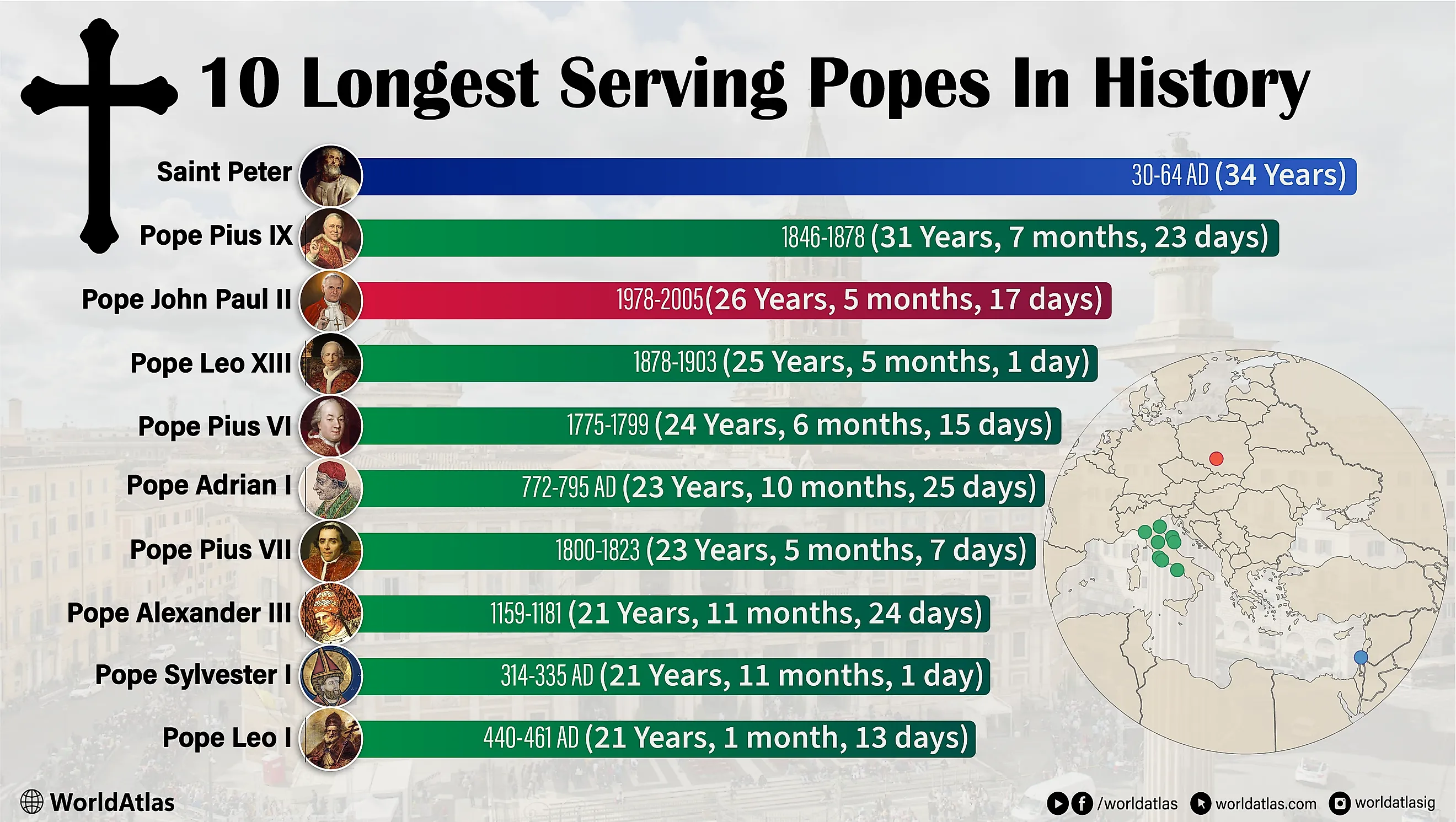
Longevity on the Chair of St. Peter has often reshaped the Church's theology, diplomacy, and public presence. The 10 longest serving popes in history span two millennia, from the apostolic age to the modern era: Saint Peter (traditionally 30-64 AD, about 34 years), Pius IX (1846-1878), John Paul II (1978-2005), Leo XIII (1878-1903), Pius VI (1775-1799), Adrian I (772-795), Pius VII (1800-1823), Alexander III (1159-1181), Sylvester I (314-335), and Leo I (440-461).
These long pontificates provided stability in moments of upheaval and gave individual popes time to leave lasting institutional and cultural marks. Pius IX governed through revolution and the loss of the Papal States, then oversaw Vatican I and the definition of papal infallibility. Leo XIII's Rerum Novarum set a durable framework for Catholic engagement with labor and modern economics. John Paul II's pastoral travels and role in late-Cold War history made the papacy a moral office.
Earlier long reigns shaped medieval Europe and the foundations of Western Christianity: Adrian I's partnership with Charlemagne, Alexander III's reforms of papal elections, Sylvester I's era of Constantine, and Leo I's decisive voice at Chalcedon. Together, these reigns show how continuity at the top can steer faith, power, and culture across centuries.
10 Longest Serving Popes In History
| Rank | Pope | Era of Papal Reign | Length of Reign |
|---|---|---|---|
| 1 | Saint Peter | 30-64 AD | 34 years |
| 2 | Pius IX | 1846-1878 |
31 years, 7 months, 23 days |
| 3 | John Paul II | 1978-2005 |
(26 years, 5 months, 17 days)
|
| 4 | Leo XIII | 1878-1903 |
25 years, 5 months, 1 day
|
| 5 | Pius VI | 1775-1799 |
24 years, 6 months, 15 days
|
| 6 | Adrian I | 772-795 AD |
23 years, 10 months, 25 days
|
| 7 | Pius VII | 1800-1823 |
23 years, 5 months, 7 days
|
| 8 | Alexander III | 1159-1181 |
21 years, 11 months, 24 days
|
| 9 | Sylvester I | 314-335 AD |
21 years, 1 month, 1 day
|
| 10 | Leo I | 440-461 AD |
21 years, 1 month, 13 days
|
1. Saint Peter, 30-64 AD (34 years)

Simon Peter, a Galilean fisherman from Bethsaida and brother of Andrew, was called by Jesus and became a leading apostle. Passionate and sometimes rash, he walked on water, confessed Jesus as Messiah, then denied him before the crucifixion. After the resurrection, Peter was restored and became a cornerstone of the Jerusalem church, preaching at Pentecost and urging repentance and baptism. He helped open the movement to Gentiles and guided early doctrine. Tradition says he later ministered in Rome, often regarded as the first pope, and died a martyr during Nero's persecution, possibly crucified upside down. His dates remain approximate overall.
2. Pope Pius IX, 1846-1878 (31 years, 7 months, 23 days)

Pope Pius IX, born Giovanni Maria Mastai-Ferretti in 1792, served as pope from 1846 to 1878, the longest verified reign in papal history. Initially seen as a liberal reformer, his views shifted amid political turmoil, especially after losing the Papal States to Italian unification. He defined the dogma of the Immaculate Conception (1854) and convened the First Vatican Council (1869-70), which proclaimed papal infallibility. His papacy marked a transition from temporal power to a more spiritual role. Before becoming pope, he was Archbishop of Spoleto and Bishop of Imola. After his death, he was beatified in 2000 by Pope John Paul II.
3. Pope John Paul II, 1978-2005 (26 years, 5 months, 17 days)

Pope John Paul II, born Karol Józef Wojtyła in Poland in 1920, was the first non-Italian pope in over 450 years. Elected in 1978, he served for over 26 years, traveling widely and becoming one of the most visible and influential popes in history. He played a key role in opposing communism, particularly in Eastern Europe, and supported human rights globally. He survived an assassination attempt in 1981, later forgiving the attacker. Before his papacy, he was a philosopher, poet, and Archbishop of Kraków. He upheld traditional Catholic teachings and was canonized in 2014, nine years after his death in 2005.
4. Pope Leo XIII, 1878-1903 (25 years, 5 months, 1 day)

Pope Leo XIII, born Vincenzo Gioacchino Pecci in 1810, served as pope from 1878 to 1903. Known for his intellectualism and diplomacy, he sought to engage the modern world without compromising Catholic doctrine. He is most famous for his 1891 encyclical Rerum Novarum, which addressed the rights of workers and laid the foundation for modern Catholic social teaching. Before his papacy, he was Archbishop of Perugia and a respected Vatican diplomat. Leo XIII promoted Thomistic philosophy, encouraged scholarly study, and improved relations with secular governments. He died at age 93, making him one of the oldest popes in Church history.
5. Pope Pius VI, 1775-1799 (24 years, 6 months, 15 days)

Pope Pius VI, born Giovanni Angelo Braschi in 1717, led the Catholic Church from 1775 to 1799 during a time of immense political upheaval. His papacy was marked by the aftermath of the 1773 suppression of the Jesuits. He opposed civil reforms that diminished church authority and condemned the Civil Constitution of the Clergy in France. Pius VI was eventually taken prisoner by French forces and died in captivity in Valence. Before his election, he served as a papal administrator and treasurer. His long reign ended with the Church in crisis and the Papal States weakened.
6. Pope Adrian I, 772-795 AD (23 years, 10 months, 25 days)

Pope Adrian I, born in Rome around 700 AD, served as pope from 772 to 795, one of the longest pontificates of the early Church. He forged a crucial alliance with Charlemagne, who defended the Papal States from the Lombards, solidifying ties between the papacy and the Frankish Empire. Adrian supported the development of Roman liturgy and church infrastructure, restoring churches and aqueducts. He supported the Second Council of Nicaea (787), which affirmed the veneration of icons. His nearly 24-year reign strengthened the pope's temporal power. After his death, Charlemagne reportedly mourned him as a dear friend.
7. Pope Pius VII, 1800-1823 (23 years, 5 months, 7 days)

Pope Pius VII, born Barnaba Chiaramonti in 1742, became pope in 1800 during the Napoleonic era. His papacy was defined by conflict with Napoleon Bonaparte, including signing the Concordat of 1801 to restore the Church in France. In 1809, Napoleon arrested Pius VII, holding him captive for five years. After Napoleon's fall, he returned to Rome and helped restore the Jesuit order in 1814. Before his election, he was a Benedictine monk, theologian, and Bishop of Imola. Known for his patience and dignity during imprisonment, Pius VII died in 1823 and is remembered for defending the Church during turbulent times.
8. Pope Alexander III, 1159-1181 (21 years, 11 months, 24 days)

Pope Alexander III, born Roland of Siena around 1100, served as pope from 1159 to 1181. His papacy was marked by a prolonged conflict with Holy Roman Emperor Frederick Barbarossa, who supported rival antipopes. Forced into exile multiple times, Alexander III maintained legitimacy and gained support from much of Western Europe. He presided over the Third Lateran Council in 1179, which enacted significant church reforms, including new rules for papal elections. A skilled diplomat and canon lawyer, he also supported the independence of the Church from secular control. Before his papacy, he was a respected theologian and advisor to Pope Eugene III.
9. Pope Saint Sylvester I, 314-335 AD (21 years, 11 months, 1 day)

Pope Saint Sylvester I served as pope from 314 to 335 AD, during a pivotal time following Emperor Constantine's legalization of Christianity. Little is known about his life before the papacy, but he became pope shortly after the Edict of Milan, which ended persecution of Christians. His reign coincided with the construction of major churches in Rome, including the original St. Peter's Basilica and the Lateran Basilica. Though he did not attend the First Council of Nicaea in 325, he approved its outcomes, including the Nicene Creed. Sylvester's long pontificate helped transition the Church into a new era of public prominence.
10. Pope Saint Leo I, 440-461 AD (21 years, 1 month, 13 days)

Pope Saint Leo I, also known as Leo the Great, served from 440 to 461 AD and was one of the most influential early popes. Before his papacy, he was a deacon known for diplomacy and theological insight. As pope, he defended orthodox doctrine, particularly against heresies like Pelagianism and Monophysitism. His Tome of Leo became a key text at the Council of Chalcedon (451), affirming Christ's dual nature. He also strengthened papal authority and famously persuaded Attila the Hun to spare Rome in 452. Leo was declared a Doctor of the Church and remains a central figure in Church history.