The Ocean Predators Bigger Than A Great White
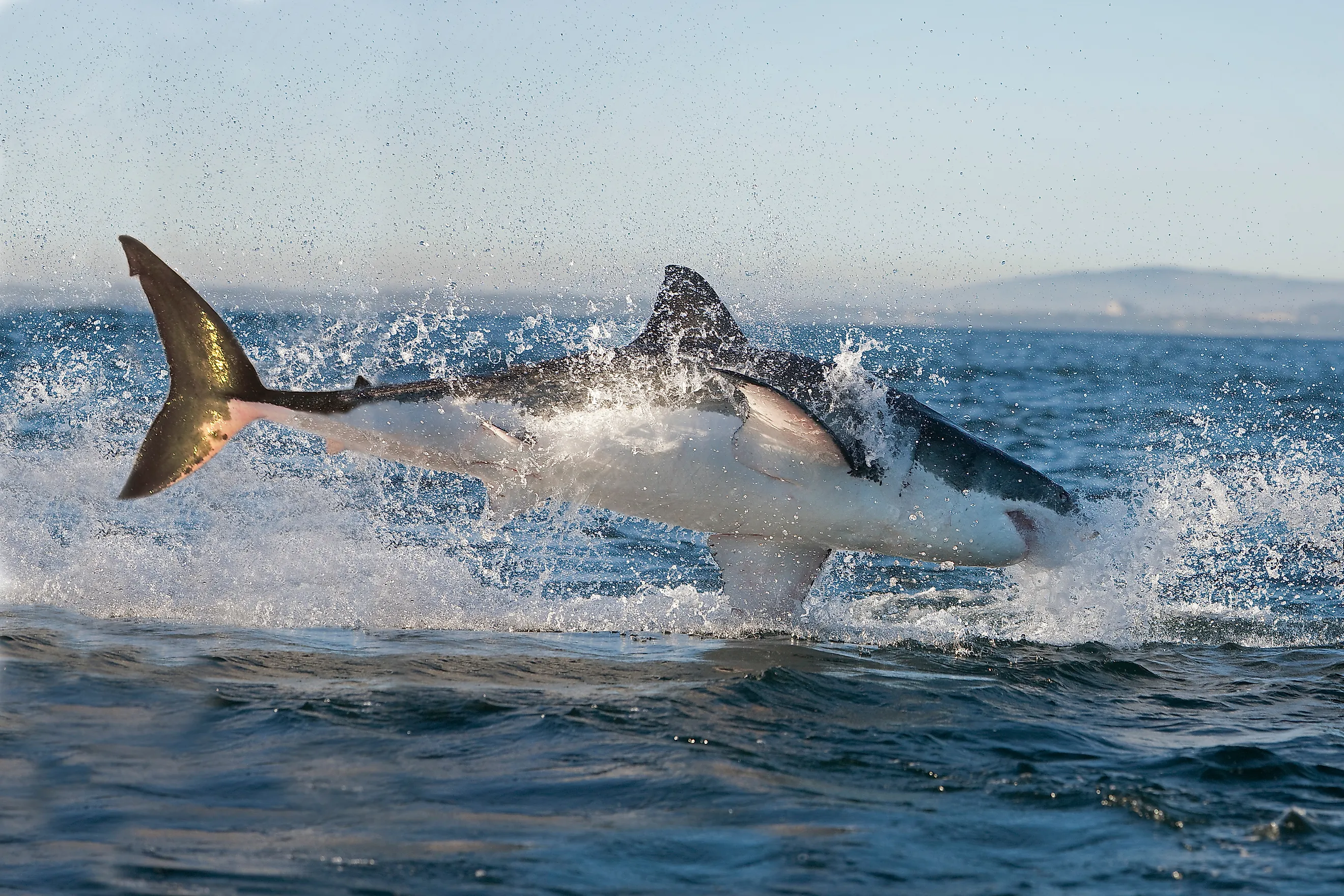
A great white shark estimated at about 4.9 meters (16 feet) long has prowled the waters of Massachusetts. Nicknamed Large Marge, the enormous female was tagged by the Massachusetts Division of Marine Fisheries and photographed just 40 kilometers (25 miles) off Boston. Yet even she falls several feet short of the upper limits of her species. NOAA says white sharks can reach about 6.1 meters (20 feet) and weigh more than 1,800 kilograms (4,000 pounds). Deep Blue, listed by Guinness World Records as the largest living white shark, is estimated at that length, though she has never been formally measured. A specimen reported at 6.4 meters (21 feet) off Cuba in 1945 was never measured either, and later analysis of the photographs put it closer to 4.9 meters (16 feet).
A 6.1-meter (20-foot) white shark is roughly as long as a standard shipping container and capable of hunting seals, sea lions, and dolphins. Though very rare, the great white has also been involved in more attacks on humans than any other shark species. But it is nowhere near the size limit for a predator in the modern ocean. Plenty of filter-feeding giants are larger than a great white, including whale sharks, blue whales, and humpback whales. But the following focuses only on large predators that capture individual prey rather than filtering concentrations of small animals from the water. Living in waters off the United States and across the world's oceans are active hunters that can grow considerably longer or heavier than even an exceptionally large great white.
Orca/Killer Whale
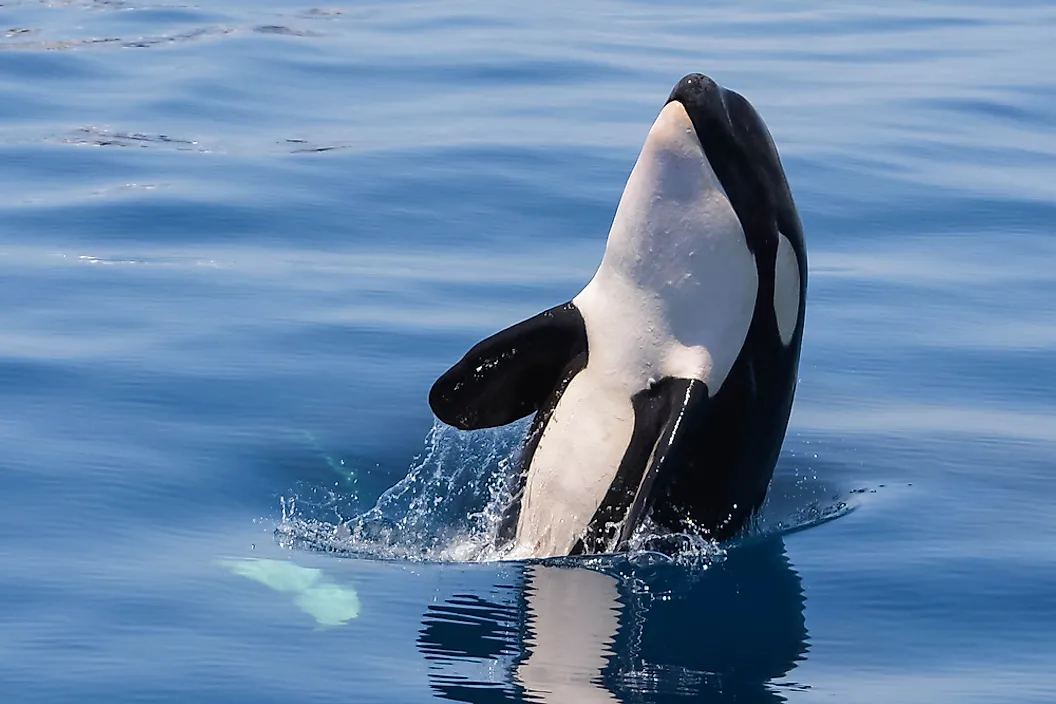
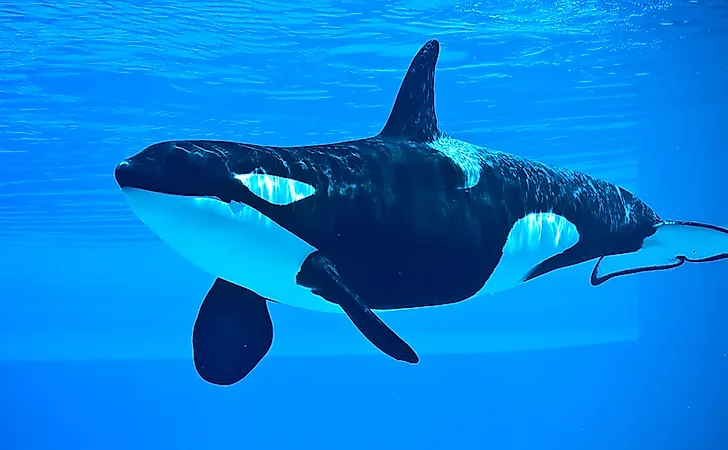
At up to 9.8 meters (32 feet) long and 10 metric tons (11 tons), an orca/killer whale (Orcinus orca) can outweigh even an enormous great white several times over. NOAA identifies the orca as the largest member of the dolphin family and an apex predator, but what it eats depends heavily on population. In the Pacific Northwest, for example, resident orca whales specialize in fish, particularly salmon, while Bigg's orca primarily hunt marine mammals and squid. Other populations have even developed a taste for sharks.
Given that multiple species of sharks are found in US waters, local orca populations have their pick. It also puts orcas into direct competition and, occasionally, a predator-prey relationship with great whites. Researchers studying the Southeast Farallon Island off California found that brief appearances by orcas could send the area's white sharks packing. On November 2, 2009, orcas arrived while 17 tagged white sharks were present. Within 8 hours, all 17 had disappeared from the receivers around the island. Sixteen stayed away until at least the following season, and several displaced sharks turned up roughly 89 kilometers (55 miles) south around Año Nuevo Island.
There is good reason for the white sharks to retreat. Orcas have been documented actually killing great whites, though that does not mean every orca hunts great whites. Shark hunting is associated with particular populations and learned behaviors, and interactions between the two species remain relatively uncommon. But where shark-hunting orcas and great whites do meet, the size advantage is only part of the equation. Like wolves, orcas can coordinate with one another, learn specialized techniques, and pass hunting behaviors through their social groups.
Sperm Whale
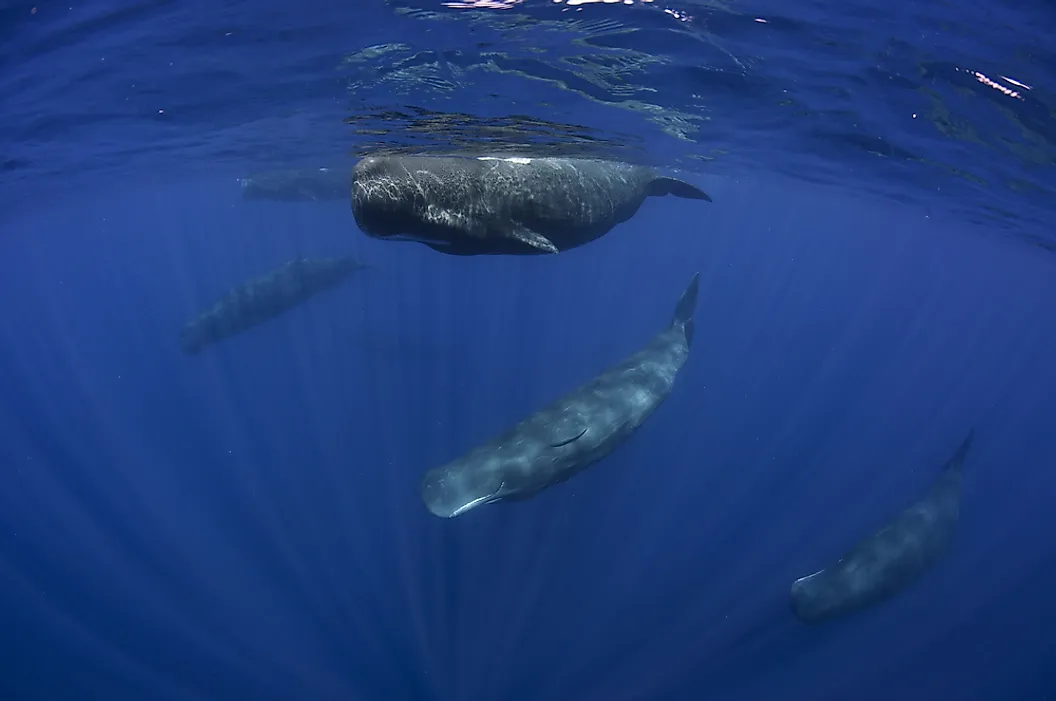
The great white is one of the world's largest sharks, but it would be badly outsized beside an adult male sperm whale (Physeter macrocephalus). NOAA puts males at up to 16 meters (52 feet) long and 41 metric tons (45 tons), more than two and a half times the shark's length and roughly 20 times its weight. Females are considerably smaller, reaching about 12 meters (40 feet) and 14 metric tons (15 tons). These are not simply enormous whales, however. Sperm whales are active hunters, using echolocation to find squid, sharks, and smaller fish in deep water.
Americans do not have to leave US waters to enter their territory. NOAA recognizes sperm whale stocks off Alaska, California, Oregon, Washington, and Hawaiʻi, and the species can also be found in deep waters off the Atlantic and Southeast. However, much of the hunting happens far below anything visible from a beach. Typical foraging dives reach around 600 meters (2,000 feet) and last about 45 minutes, while NOAA has recorded sperm whales descending as deep as 3,000 meters (10,000 feet) and remaining submerged for more than an hour. A large whale can consume roughly 3% to 3.5% of its body weight each day.

Their strangest feature may be the one visible above water. A sperm whale's enormous, blunt head contains the spermaceti organ, part of the sound-producing system that allows the animal to navigate and hunt where sunlight cannot reach. It means one of the ocean's largest predators does much of its hunting not by sight, but by sending sound into the darkness and listening for what comes back. While great whites have been documented feeding on sperm whale carcasses, there's no doubt that the sperm whale is both the larger and superior ocean predator.
Giant Squid
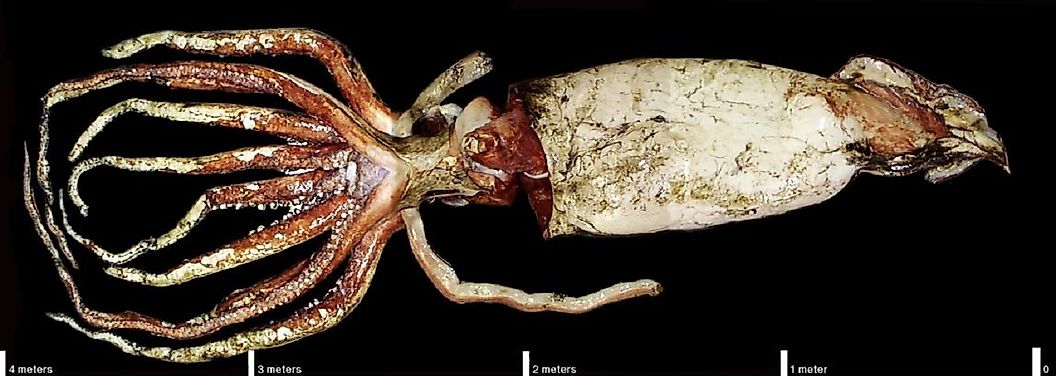
Most giant squid (Architeuthis dux) scientists encounter do not stretch 12 or 15 meters (40 or 50 feet) through the water. In fact, determining just how large these deep-sea predators can become is unusually difficult because living adults are so rarely seen. The Smithsonian says the length from the top of the fins to the ends of the squid's eight arms rarely exceeds about 5 meters (16 feet). Add its two extraordinarily long feeding tentacles, however, and the largest specimen scientifically recorded measured almost 13 meters (43 feet) in total length and may have weighed nearly 900 kilograms (nearly a ton). Measurements of giant squid beaks have led scientists to estimate that the species could reach 20 meters (66 feet), although no individual that long has ever been documented.
That uncertainty is part of what makes the giant squid so different from a great white. Scientists can tag and follow white sharks along American coastlines. Still, much of what is known about giant squid instead comes from carcasses found at the surface or on beaches, animals caught by fishermen, and remains recovered from the stomachs of sperm whales.

A giant squid has eight arms but uses two much longer feeding tentacles to shoot outward and seize deep-water fish and other squid. Hundreds of powerful suckers help hold the prey, with serrated rings of chitin providing additional grip. The squid then draws its catch toward its eight shorter arms and a hard beak that slices the meal into smaller pieces. Its eyes can approach 30 centimeters (a foot) in diameter, helping it detect prey and predators, such as sperm whales, in the darkness.
Baird's Beaked Whale

A Baird's beaked whale (Berardius bairdii) can surpass a great white in both length and weight. NOAA puts females at up to 11 meters (36 feet) long and males at 10.7 meters (35 feet), while adults can weigh more than 11,800 kilograms (26,000 pounds). That makes the largest member of the beaked whale family roughly 4.6 meters (15 feet) longer and several times heavier than the upper limits NOAA gives for a great white.
Baird's beaked whales inhabit the North Pacific and occur in US waters off the West Coast, as far south as California and as far north as Alaska. They favor cold, deep oceanic water and are often associated with the continental slope, although they can occasionally approach shore where continental shelves are narrow. Like other beaked whales, they can be difficult to study.

Their prey is found far below the surface. Baird's beaked whales hunt deep-water and open-ocean fish as well as squid, octopuses, crustaceans, and even sea cucumbers. Their deep-diving lifestyle keeps them underwater for extraordinary periods, largely beyond human observation, while sound plays an important role in finding food, communicating, and navigating the ocean. Despite their elusive lives, Baird's beaked whales are highly social. NOAA says they are some of the most commonly sighted beaked whales, partly because of their social behavior and enormous size.
Short-Finned Pilot Whale

A short-finned pilot whale (Globicephala macrorhynchus) does not dwarf a great white as a sperm whale does, but the largest individuals can still beat one in both length and weight. NOAA puts the species at 3.7 to 7.3 meters (12 to 24 feet) long and 1,000 to 3,000 kilograms (2,200 to 6,600 pounds), with adult males significantly larger than females. Despite their name, pilot whales are members of the dolphin family, making them relatives of orcas.
Their hunting style is considerably different than both orcas and great whites. NOAA calls short-finned pilot whales the "cheetahs of the deep sea" for the deep, high-speed dives they make while pursuing large squid. Squid constitute most of their diet, although they also eat octopuses and fish, with prey generally taken from depths of 300 meters (1,000 feet) or more. Research in Hawaiian waters has recorded pilot whales sprinting into the darkness as deep as 800 meters (2,625 feet) in search of squid and other deep-water prey.

Short-finned pilot whales are commonly sighted during NOAA surveys within the US Exclusive Economic Zone around the Hawaiian Islands, including frequent encounters nearshore in the Northwestern Hawaiian Islands. NOAA research has also found genetic differences between pilot whales around the main Hawaiian Islands, those around the Northwestern Hawaiian Islands, and animals inhabiting the surrounding open ocean.
Where The Great White Actually Ranks
Great whites may dominate our imagination, but they do not dominate the ocean by size. Short-finned pilot whales can reach 7.3 meters (24 feet), orcas 9.8 meters (32 feet), and Baird's beaked whales 11 meters (36 feet), while the longest scientifically recorded giant squid approached 13 meters (43 feet). Sperm whales push the comparison further still, reaching 16 meters (52 feet) and 41 metric tons (45 tons). Even among active ocean hunters, a great white sits surprisingly far from the upper limit.