The 10 Largest Fish Species Living Today
Here is the twist nobody asks for: the biggest animal in the ocean is not a fish at all. The blue whale outweighs everything on this list put together, but it breathes air, nurses its calves, and is a mammal through and through. No gills, no entry. So we are sticking to actual fish, ranked by the heaviest and longest individuals ever reliably recorded. The lineup is full of surprises: the top two are gentle giants that survive on some of the smallest food in the sea, the famous man-eaters land in the middle, and the heaviest bony fish looks like a swimming dinner plate. And one naming quirk worth flagging up front: the whale shark that tops the list is, despite the "whale" in its name, every bit a fish.
1. Whale Shark

We may as well start at the very top, with the one that has "whale" in its name and none of the mammal credentials. The whale shark (Rhincodon typus) grows up to about 41.5 feet and 21.5 tons, making it not only the largest fish alive but the largest non-mammalian vertebrate on the planet. It is a true shark, a fish with gills, despite a name borrowed from the very whales it rivals in size. It drifts through warm open oceans, can live around 70 years, and feeds almost entirely on plankton, which makes that bulk all the more absurd. For all its size, it is harmless to people. The IUCN lists it as Endangered, with bycatch, vessel strikes, and a slow birth rate all stacked against it.
2. Basking Shark

Silver medal, and a complete gentle giant. The basking shark (Cetorhinus maximus) commonly reaches around 26 feet, with the largest reliably measured near 12 meters (about 40 feet), and the heaviest can approach 19 tons. It roams temperate seas worldwide and, like the whale shark, lives entirely on plankton, cruising the surface with its cavernous mouth gaping open as if it were sunbathing, which is how it got the name. It is one of only three filter-feeding sharks on Earth. A century of hunting for its meat, fins, and liver oil, on top of ongoing bycatch and ship strikes, has cut populations hard, and in 2019 the IUCN reassessed it from Vulnerable up to Endangered.
3. Great White Shark

Here is the one the movies made famous. The great white shark (Carcharodon carcharias) prowls coastal waters across every ocean where the temperature sits between 12 and 24 degrees Celsius. The biggest verified individuals reach about 20 feet and 3.3 tons, though most are closer to 13 feet, and they can live more than 70 years. It logs the most recorded attacks on humans, mainly because it shares the coastlines we swim in, but people are not on its menu and the worst encounters are usually cases of mistaken identity. It is the apex predator of its world, with one exception: orcas occasionally kill and eat them. Like so much else on this list, it is rated IUCN Vulnerable.
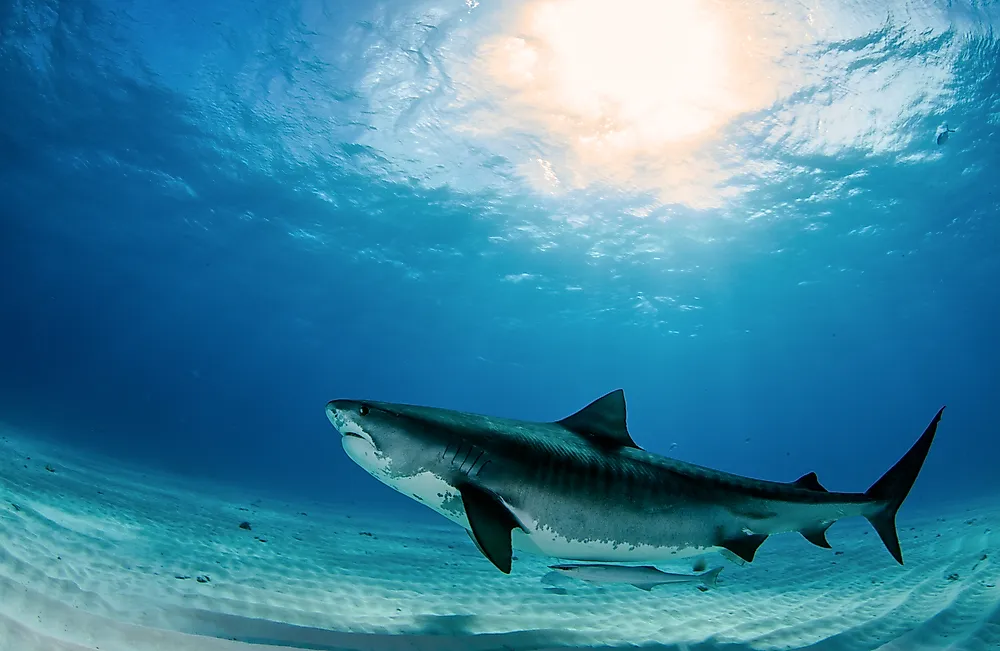
4. Tiger Shark

The tiger shark (Galeocerdo cuvier) is where this list turns its teeth on you. Nicknamed the "sea tiger" for the dark stripes young sharks wear and slowly lose with age, it grows past 16 feet and around 3 tons and patrols tropical and temperate seas, with strongholds near the central Pacific islands. It has the least selective palate of any shark, eating fish, seabirds, smaller sharks, and a famous grab-bag of human garbage hauled out of its stomach over the years. It is also responsible for more attacks on people than any shark except the great white. Even so, the pressure runs mostly the other way, and the IUCN rates it Near Threatened.
5. Giant Oceanic Manta Ray

The giant oceanic manta ray (Mobula birostris) is the largest ray on the planet, spanning up to 23 feet across and weighing roughly 3 tons, and it glides through tropical and subtropical seas like a slow-motion stealth bomber. Like its reef cousin, it was reshuffled out of the old genus Manta into Mobula in 2017. It filters plankton, travels alone or in loose groups, and is curious enough that divers routinely describe being circled and checked out by one. The bad news arrived in 2020, when the IUCN uplisted it to Endangered, the first manta ray ever given that label, largely because its gill plates are hunted for the traditional-medicine trade.
6. Ocean Sunfish
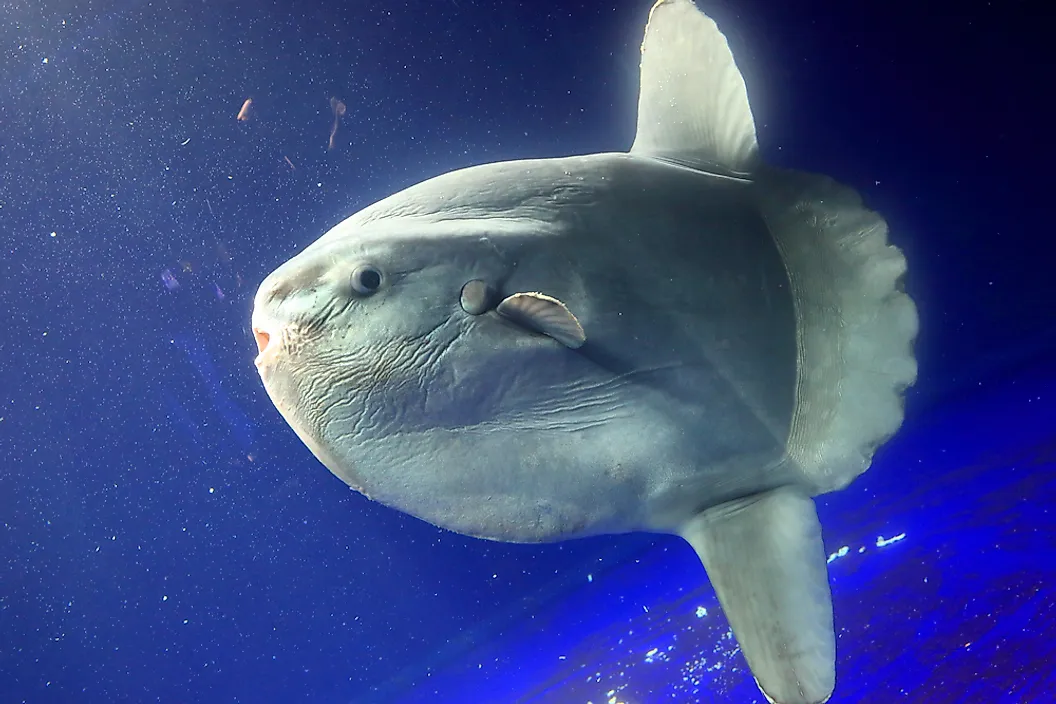
Meet the heavyweight champion of the bony fish. The ocean sunfish (Mola mola) is the largest bony fish on Earth, hitting around 2.3 tons and up to 10.8 feet long, with a body so tall it is nearly as high as it is long. Picture a giant swimming head that someone forgot to finish. It drifts through warm and temperate oceans inhaling huge volumes of sea jellies, has almost no natural predators, and still winds up rated IUCN Vulnerable thanks to fishing and bycatch. Note the shift, too: every shark above it is built from cartilage, but the Mola is pure bone, the bony-fish king wearing its crown like a dropped dinner plate.
7. Sharptail Mola

Another mola, another mystery. The sharptail mola (Masturus lanceolatus) gets its name from the pointed flap of tail that sets it apart from its blunt-bodied cousins. It reaches about 11 feet and 2 tons, lurks in tropical and temperate seas around the world, and is spotted so rarely that biologists still know little about it. Its menu is refreshingly un-picky: worms, sponges, small fish, whatever drifts past. The IUCN has not formally assessed it yet, which tells you just how far off the radar this heavyweight swims.
8. Hoodwinker Sunfish

The hoodwinker sunfish (Mola tecta) lived up to its name by hiding in plain sight: it was only described in 2017, after researchers realized a "known" sunfish was actually a separate species nobody had pinned down. Tecta even means "hidden" in Latin. It haunts the open waters of the Southern Hemisphere, grows big enough to crack the top ten, and feeds on salps, the gelatinous drifters of the open sea. Beyond that, we are mostly guessing. Almost everything about how it behaves is still a blank, which is a wild thing to say about a fish that can outweigh a small car.
9. Beluga Sturgeon
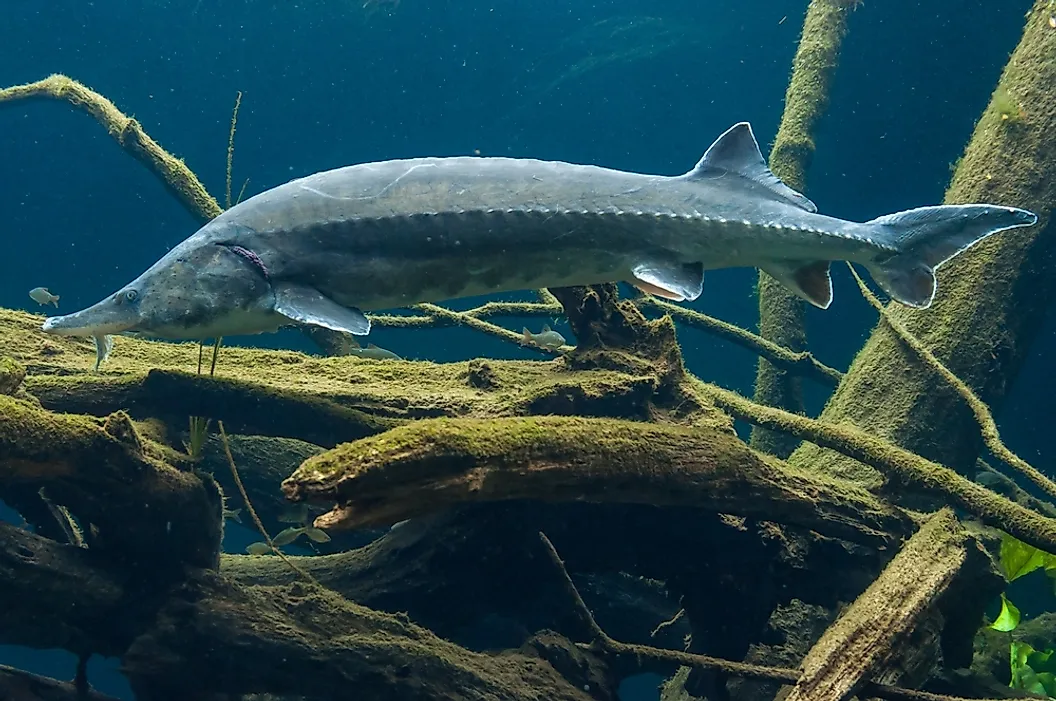
The beluga sturgeon (Huso huso) is the river-spawning giant of the group, a slow-growing, long-lived fish that lives in the Black, Caspian, and Adriatic Seas and runs upriver to lay its eggs. The largest one on record stretched 23.6 feet (7.2 meters) and weighed 1,571 kilograms, around 1.4 tons. It is also the source of beluga caviar, which is exactly the problem: decades of fishing and poaching for those high-priced eggs have gutted the population. The IUCN now lists it as Critically Endangered, the grimmest status on this list. Its job description, more or less: eat other fish and the occasional careless waterbird, and try to live nearly a century while humans chase your roe.
10. Reef Manta Ray

Rounding out the list is a ray that flies. The reef manta (Mobula alfredi) spans up to 5.5 meters (18 feet) wingtip to wingtip and tips the scales near 1.4 tons, making it the second-largest ray alive and the tenth-largest fish, period. It cruises tropical and subtropical waters worldwide, skipping only the eastern Pacific and western Atlantic, and it does it all on a diet of zooplankton strained from the water. Heads up on the name: until 2017 it sat in the genus Manta, but DNA bumped it into Mobula alongside the devil rays. Little dares to attack something this big and fast, so the real threat is us. Overfishing has landed it on the IUCN Red List as Vulnerable.
Why the Biggest Fish Eat the Smallest Food
The best pattern in this ranking hides in plain sight. The four largest fish in the sea, and most of the top ten, survive on plankton, salps, and sea jellies, some of the tiniest food in the ocean. The whale shark and basking shark filter it by the ton; the mantas and molas graze it quietly. The famous predators, the great white and the tiger shark, sit in the middle of the pack rather than the top. There is a sadder pattern too: nearly every species here carries an IUCN warning label, whether Vulnerable or Critically Endangered, and almost always because of us. The biggest reminder of all is the animal that did not make the cut at all. The blue whale dwarfs every fish on this list, but it is a mammal, which is exactly why the whale shark, a true fish, gets to wear the crown. Here is the extended ranking, the 25 largest fish by known maximum size:
| Rank | Animal | Known maximum mass [tonnes] | Maximum length [m] |
|---|---|---|---|
| 1 | Whale shark | 21.5 | 12.65 |
| 2 | Basking shark | 19 | 12.27 |
| 3 | Great white shark | 3.324 | 7 |
| 4 | Tiger shark | 3.11 | 7.4 |
| 5 | Giant oceanic manta ray | 3.0 | 5 |
| 6 | Ocean sunfish | 2.3 | 3.1 |
| 7 | Sharptail mola | 2 | 3.0 |
| 8 | Hoodwinker sunfish | 1.87 | 2.4 |
| 9 | Beluga sturgeon | 1.571 | 7.2 |
| 10 | Reef manta ray | 1.4 | 5.5 |
| 11 | Greenland shark | 1.397 | 7.3 |
| 12 | Megamouth shark | 1.215 | 5.2 |
| 13 | Kaluga sturgeon | 1.14 | 5.6 |
| 14 | Atlantic blue marlin | 0.818 | 5 |
| 15 | White sturgeon | 0.816 | 6.1 |
| 16 | Bluntnose sixgill shark | 0.763 | 4.8 |
| 17 | Black marlin | 0.75 | 4.6 |
| 18 | Atlantic bluefin tuna | 0.68 | 3 |
| 19 | Swordfish | 0.65 | 4.5 |
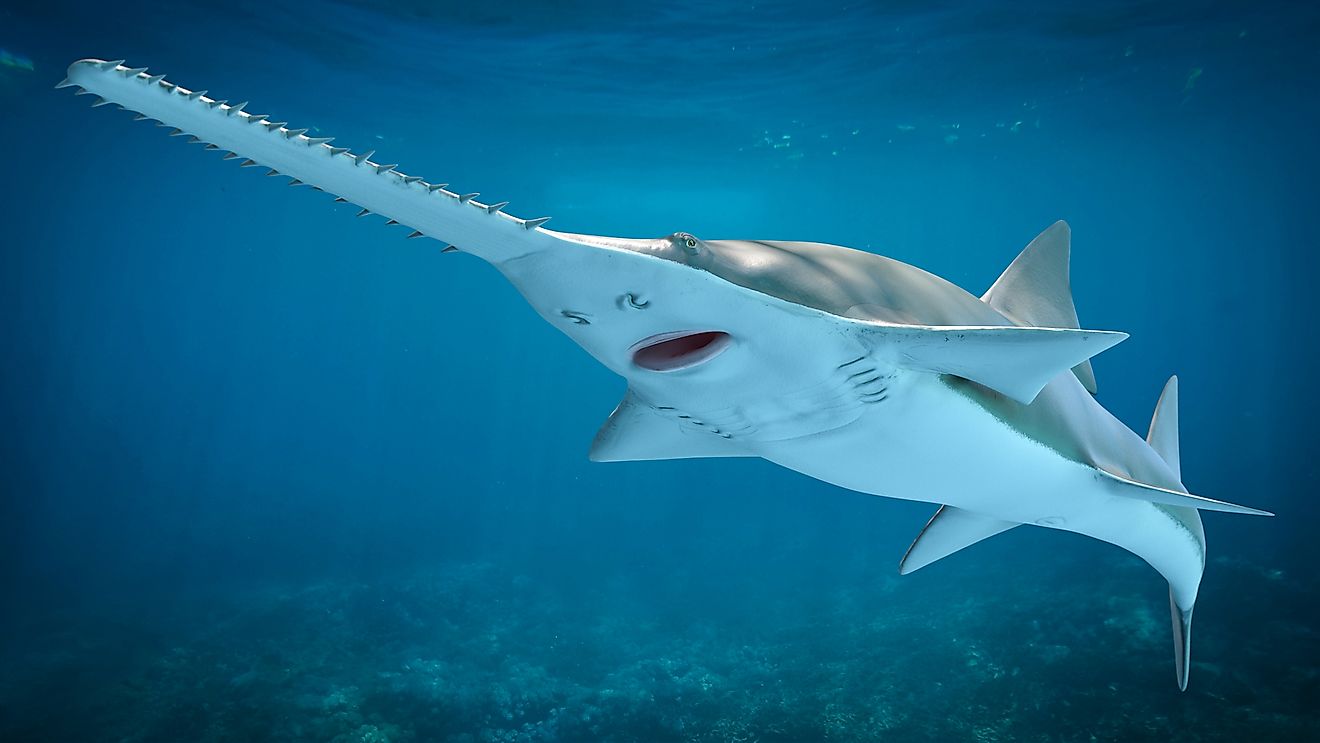
| 20 | Largetooth sawfish | 0.6 | 7.5 |
| 21 | Bull shark | 0.575 | 4 |
| 22 | Common thresher shark | 0.51 | 7.6 |
| 23 | Great hammerhead shark | 0.5 | 6.1 |
| 24 | Giant grouper | 0.4 | 2.7 |
| 25 | Atlantic halibut | 0.32 | 4.7 |