Humpback Whale
If you are lucky enough to see a whale breaching high into the air and slapping its mighty fluke on the water, chances are good you are seeing a humpback whale. While many whales slink silently through the deep waters, humpback whales delight whale watchers with their acrobatic feats. Weighing up to 40 tons and growing to be up to 60 feet long, the flukes on an adult can be up to 18 feet wide. Humpback whales can be found in all oceans of the world and have a potential lifespan of 80 to 90 years. Many humpback whale populations were driven to very low numbers by commercial whaling and some populations remain endangered or threatened today.
Taxonomy of Humpback Whales
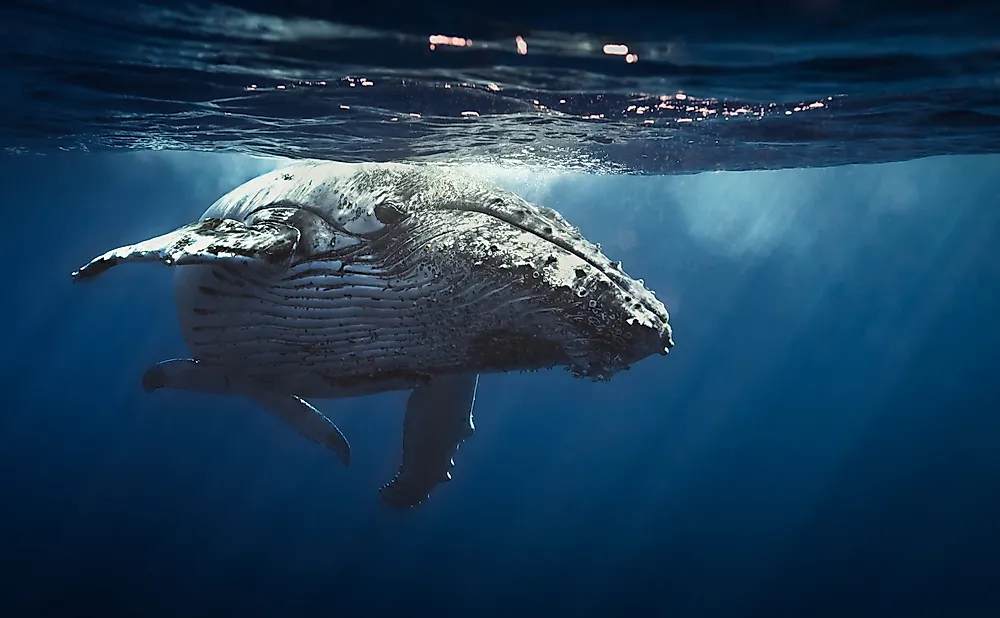
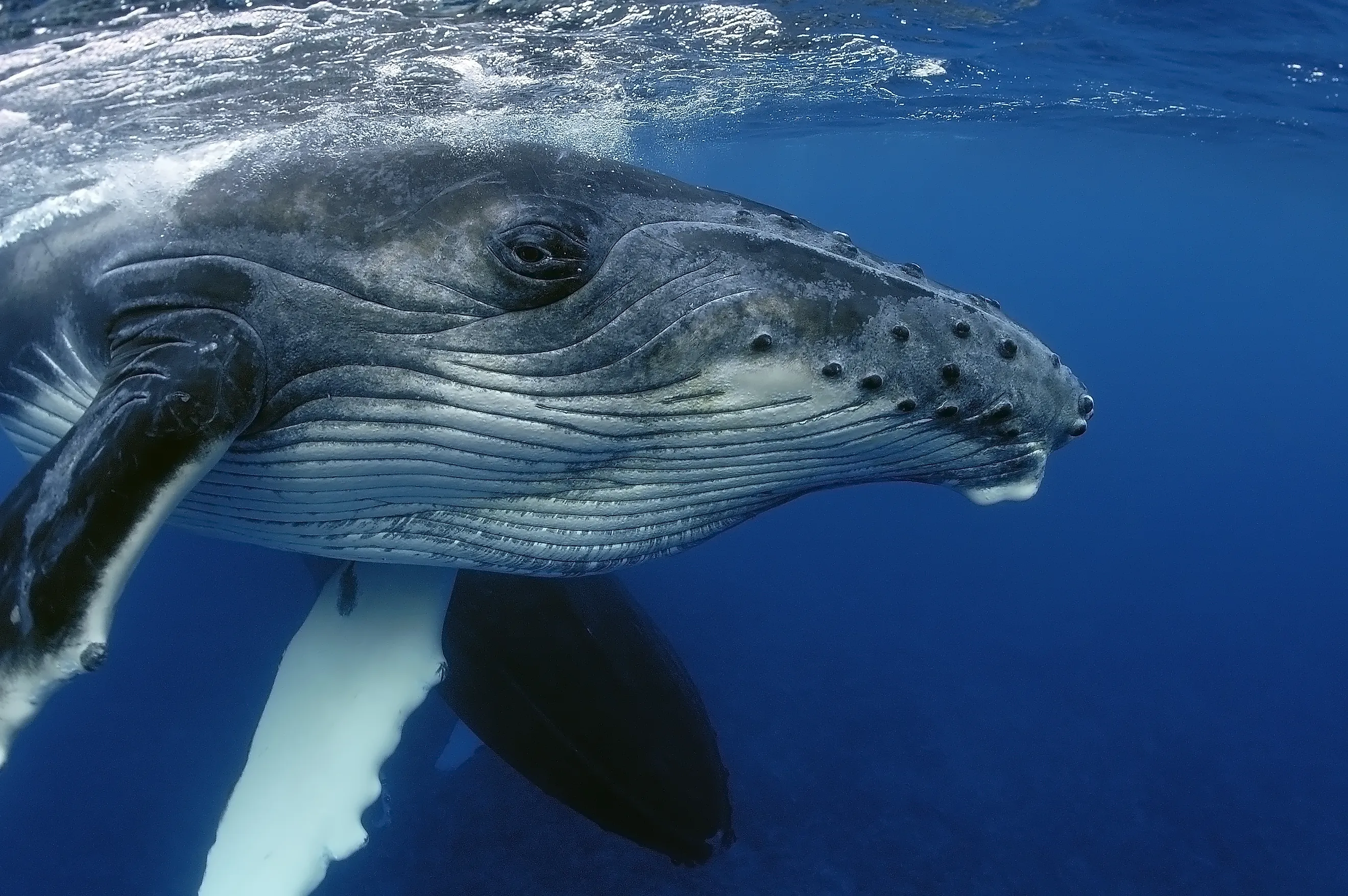
Taxonomy is the scientific classification of living organisms according to their similarities and differences. Humpback whales belong to the kingdom Animalia, the phylum Chordata, and the class Mammalia. They are members of the order Cetacea, which includes all whales, dolphins, and porpoises. Humpback whales belong to the family Balaenopteridae, a group of baleen whales known as rorquals. Instead of teeth, baleen whales have plates of baleen that act like a sieve, helping them filter small prey from the water. The humpback whale's genus name, Megaptera, means "big-winged," referring to its unusually long flippers. Its scientific name is Megaptera novaeangliae, meaning "of New England," because the species was formally described from specimens associated with New England waters.
Physical Characteristics

Humpback whales are mostly black or dark gray, with varying amounts of white on their bellies, the undersurface of the fluke, and their flippers. Some individuals' flippers may even be all white. Sometimes a pattern may be visible under the flipper. Humpback whales in the Southern Hemisphere seem to have more white markings on their bodies than those in the Northern Hemisphere. Not surprisingly, this whale has a visible hump on its back when it is arching. Adults grow up to 60 feet in length, with flukes measuring up to 18 feet wide. Females are typically longer than males. Both females and males can weigh up to 40 tons.
The unique patterns and markings on the underside of each whale's fluke are as distinctive as fingerprints. Scientists have named individuals and recognize them years later, which has allowed researchers to map their locations, how far they have migrated, and other data about them. By tracking individual whales, they know, for example, that humpback whales have a potential lifespan of 80 to 90 years.
Habitats, Feeding, and Migration

Humpback whales are found in every ocean of the world, including the Atlantic Ocean, Pacific Ocean, and the Mediterranean Sea. Scientists identified 14 groups of humpback whales that live and travel together. They frequent the warmer southern waters near the equator for mating and breeding, then migrate to colder feeding grounds, where food is more plentiful. Northern Hemisphere populations travel north, while Southern Hemisphere populations travel south toward Antarctic waters. It is not uncommon for these whales to migrate 3,000 to 5,000 miles, one of the longest migrations of any mammal.
Feeding on krill and small schooling fish that can be strained through their baleen plates, individuals can eat up to 3,000 pounds per day during feeding season. They build up their blubber to keep themselves nourished during the breeding and migration periods. To eat this much food, humpback whales are known for working together using a process called bubble-net feeding, in which they disorient their prey by making walls of bubbles and pushing the food towards the center. Then they surge upward through the concentrated prey with their mouths open, trapping large amounts of food and water before filtering the food through their baleen plates.
Mating and Reproduction

The age when humpback whales reach sexual maturity ranges between 4 and 10 years. At this point, males perform various athletic feats, like breaching and slapping the water with their fins and bodies to impress the females. Males also "sing" elaborate, lengthy tunes for females. Male humpback whales sing complex songs, and whales within the same population typically sing very similar songs. These songs gradually change over time and can last for more than 30 minutes. Humpbacks do not mate for life; both males and females can have multiple partners throughout their lives.
The gestation period for a pregnant female humpback is 11 months. Newborn calves measure between 10 and 15 feet long and weigh as much as 1.5 tons. Calves stay with their mothers in the warm southern waters for up to one year, nursing and learning how to survive. Calves learn important survival skills by staying close to their mothers, including feeding behaviors, migration routes, communication, and how to respond to potential threats. They begin weaning at around 10 months and start the long migration to the cold, polar waters for the summer feeding season. The calf will be completely weaned that summer and ready to live on its own. Female humpbacks typically have one calf every two to three years, although a few have been documented as having one calf every year.
Predators and Threats

The orca, or "killer whale," is the major natural predator of the humpback whale, and many humpbacks bear scars from these predators' attacks. Humpback whales are fierce defenders, however, defending both themselves and other whales from attack. Orcas often prey on calves because they are not as large or as strong as adult whales. Large sharks also may attack humpback whales, especially the calves, so mothers guard their calves intensely.
Unfortunately, humpback whales are also threatened by humans, both intentionally and through the consequences of their actions. For many years, commercial whaling reduced humpback whale populations to dangerously low levels. The Endangered Species Act of 1973 included humpback whales on its list of endangered species. In 1982, the International Whaling Commission voted to establish a moratorium on commercial whaling, which took effect during the 1985-1986 whaling season. The ban is still in effect and is followed by most countries.

Other threats still harm humpbacks, however. They become caught in nets as a byproduct of fishing for other species, and they are injured by becoming entangled in fishing lines, nets, and other marine items. They are sometimes accidentally struck by ships, and they are overwhelmed and stressed by ocean noises and even by whale-watching boats with tourists eager to see them. For these reasons, laws were passed that require keeping a distance of 100 yards away from humpback whales.
Lastly, climate change has caused sea temperatures to rise and ice caps to melt, with the water draining into the oceans and causing a rise in sea levels. Scientists continue to monitor these conditions and the effects on populations of humpback whales. Today, many humpback whale populations have recovered thanks to conservation efforts, although some populations remain endangered or threatened.
Importance to Our Planet

During their long-distance migrations, humpback whales help to keep our oceans flourishing with flora and fauna. Although they feed and travel at lower underwater depths, they rise to the surface to take a breath, releasing deposits rich in iron and other nutrients. This supports the health and growth of phytoplankton, the basis of all sea life. At least 50% of the world's oxygen comes from these phytoplankton. Thus, humpbacks keep the oceans rich in nutrients that support more sea life.
Their above-the-surface antics of breaching and slapping the water help promote the tourism that coastal communities rely on worldwide. For many visitors, whale watching is an opportunity to see remarkable mammals they won't find back home. And it is the humpback whale that provides most of the excitement.
The Bottom Line

Humpback whales are the ocean's performers. Active at the water's surface, they leap into the air and slap the water vigorously, giving whale watchers the show they came for. They are extremely strong swimmers capable of making one of the longest migration treks of all mammals. The health of the humpback whale species is vital to the health of our planet as a whole. Healthy humpbacks fertilize the oceans as they feed voraciously. This iron-rich fertilizer helps phytoplankton to flourish and produce at least half of the oxygen we breathe. Scientists have tagged and photographed humpback whales to learn more about them and how to protect them. Their numbers have improved so that many populations that were once nearly extinct have rebounded, but more needs to be done to ensure that humpback whales stay protected and their populations continue to thrive for years and generations to come.