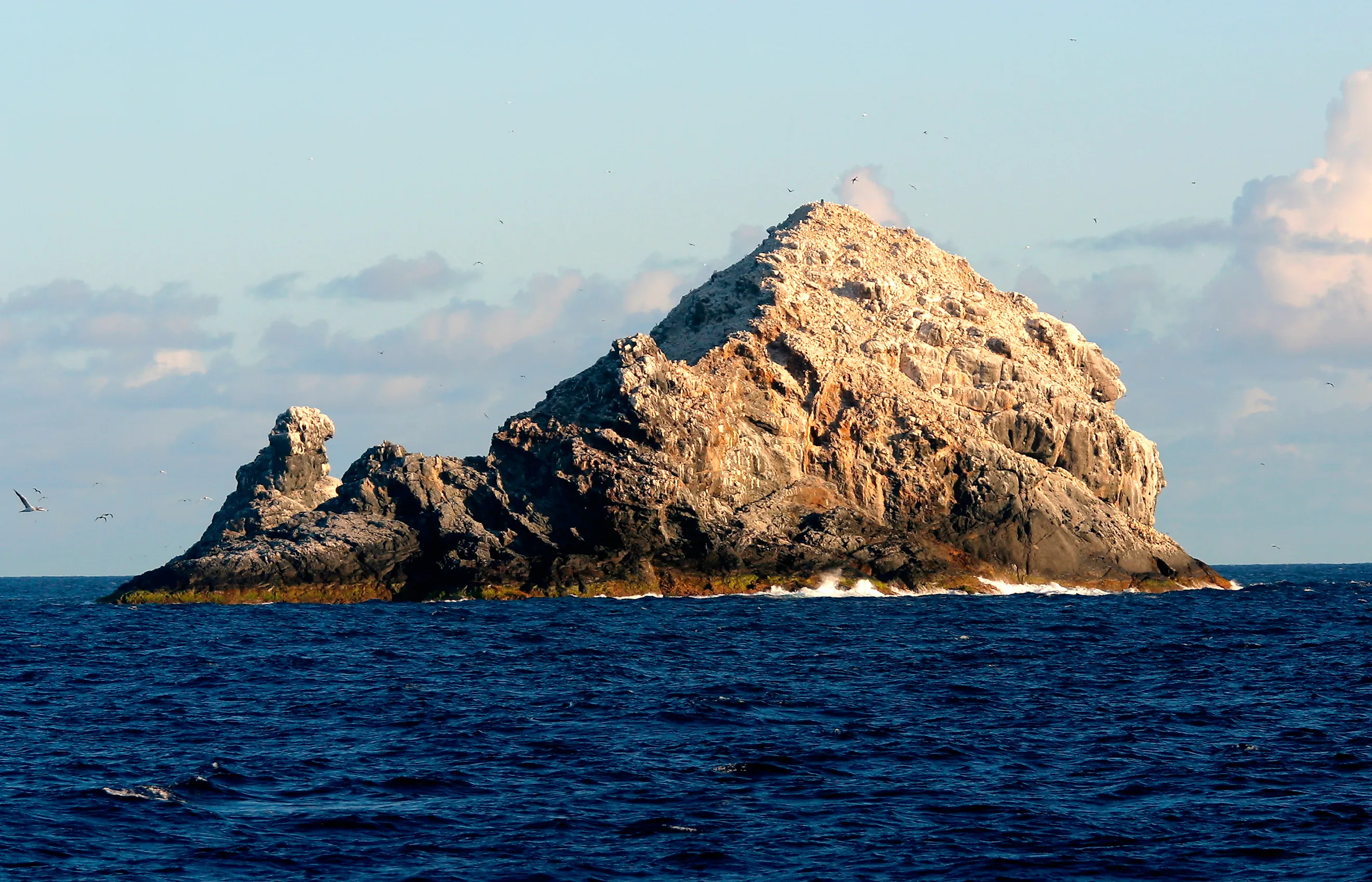
The Largest Underwater Volcano In American Waters
Pūhāhonu, in the Northwestern Hawaiian Islands, is the largest known shield volcano on Earth and a mostly submerged giant in American waters. Its estimated volume is roughly twice Mauna Loa's, although only two small rocky peaks, called Gardner Pinnacles, rise above the Pacific. The exposed land totals about five acres. Seabirds breed on those cliffs, with coral reefs spreading through the surrounding waters. Far below them, volcanic rock continues beneath the ocean floor, where the mountain's weight bent the crust downward. That buried portion helps explain how a place with so little dry land can exceed the bulk of Hawaii's largest active volcano.
Most Of Pūhāhonu Is Hidden Beneath The Seafloor

Pūhāhonu lies roughly 620 miles northwest of Honolulu. Its underwater structure stretches about 171 miles long and 56 miles wide, with long ridges extending away from the summit area. The volcano rises approximately 14,800 feet above the surrounding seafloor.
A 2020 calculation put its total volume at approximately 148,000 cubic kilometers, or 35,500 cubic miles. About one-third lies above the surrounding ocean floor. The larger share occupies the depression created as the volcano's weight pushed the crust downward. Researchers combined seabed mapping with a model of that bending to estimate the buried rock. Their calculation carries uncertainty of roughly 20 percent. Even the lower end remains well above the approximately 74,000 cubic kilometers used for Mauna Loa in the same comparison.
Extra Heat Helped Build An Exceptionally Large Volcano

The Hawaiian hotspot supplies the molten rock that builds the island chain. Pūhāhonu's enormous volume points to an unusually productive period in that system. Hotter mantle rock can melt more extensively, increasing the supply of magma available to build a volcano. Chemical evidence preserved in Pūhāhonu's lava supports exceptionally high temperatures during its formation.
Research reported by the University of Hawaiʻi in July 2026 placed Pūhāhonu within a heat surge roughly 14 million to 20 million years ago. The researchers compared volcanic rock chemistry with the sizes of volcanoes along the Hawaiian Ridge. Temperature showed a strong relationship with volume; differences in plate movement and source composition did not explain the pattern as well.
A second, more recent heat surge helped produce the main Hawaiian Islands. The researchers suggested that movement of hot material deep in the mantle could help explain the hotspot's rising temperature over time.
The Pacific Plate Carried Pūhāhonu Away From Its Magma Supply

Hawaiian volcanoes move with the Pacific Plate. As the plate travels northwest over the hotspot, older volcanoes drift away from the main supply of magma. Their eruptions diminish, and eventually stop. Pūhāhonu is long extinct, leaving erosion and sinking to reduce the land above water.
Sinking begins while Hawaiian volcanoes are still growing. Lava adds so much weight that the underlying crust bends downward. During the most productive stage, eruptions can build the mountain upward fast enough to keep a large island above sea level. Once that supply fades, continued sinking reduces the island's height, while waves and rainfall wear away exposed rock. Over millions of years, a large volcanic island can shrink to scattered remnants. The USGS describes erosion and sinking as capable of removing a Hawaiian volcano's exposed land in about 15 million years.
Coral Reefs Surround The Remaining Peaks

Across the submerged shelves around Gardner Pinnacles, the old volcano provides space for reef communities far beyond its tiny land area. Twenty-seven species of stony coral have been documented in the reef system. Table corals occur on the sheltered side of the pinnacles, and the surrounding waters support redlip parrotfish and doublebar goatfish. Federal wildlife accounts describe some of the Northwestern Hawaiian Islands' highest recorded fish diversity here.
Above the reefs, giant ʻopihi, Hawaiian limpets, occupy the rocky intertidal zone. The cliffs provide breeding sites for 12 seabird species, including the blue-gray noddy. Vegetation is much less varied: sea purslane is the only plant species reported by the monument's site account. Migrating ruddy turnstones and golden plovers also stop at the pinnacles to rest or feed.

Mauna Loa remains in the main growth stage of a Hawaiian volcano. Eruptions still add rock to a mountain covering over half the Big Island. About 90 percent of its exposed surface consists of lava flows erupted within the past 4,000 years. Pūhāhonu's remaining land has had a very different history, with its main volcanic construction long finished. The small surviving peaks stand between French Frigate Shoals and Maro Reef, inside Papahānaumokuākea Marine National Monument. Their Hawaiian name means "turtle surfacing for air," a description of the shape above the waves. Continued erosion removes rock at the surface, while the bulk accumulated during its volcanic growth remains underwater.