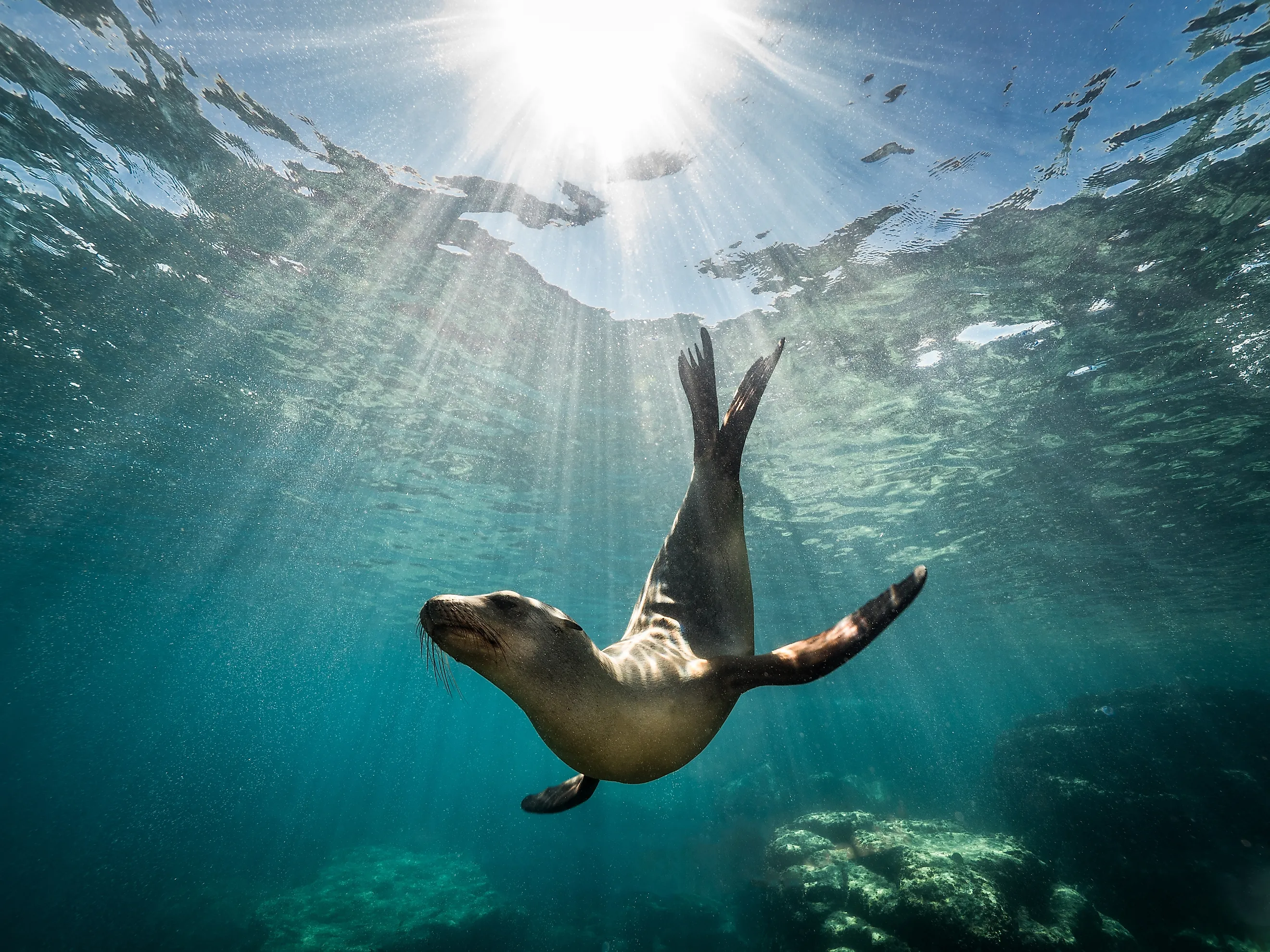
Sea Lion
Sea lions are large, loud, and highly social marine mammals that play a vital role in coastal ecosystems. They live mostly along the coasts of the Pacific Ocean, recognizable by their bulky chests, pronounced muzzles, front and rear flippers, thick blubber, and short fur that helps them handle both land and water. They split their time between the two, switching habitats depending on what the season and the breeding cycle demand. Read on for more on what makes these animals tick.
Taxonomy and Habitat

Sea lions are pinnipeds, a group within the Order Carnivora that also includes seals and walruses. The name Pinnipedia means "winged foot" or "finned foot," a nod to the front and rear flippers shared across the group. Within pinnipeds, sea lions belong to the family Otariidae, meaning "little ear," a reference to the visible ear flaps that distinguish them from true seals. That feature also explains the common name "eared seals."
Six species of sea lion are recognized today, each named for its range. The California sea lion (Zalophus californianus) stretches from as far north as British Columbia, Canada, down to Costa Rica. The closely related Galápagos sea lion (Zalophus wollebaeki) is endemic to the Galápagos Islands. The South American sea lion (Otaria flavescens, also known as the Southern sea lion) occurs along both the Atlantic and Pacific coasts of South America. The Australian sea lion (Neophoca cinerea) is found along the southern and western coasts of Australia, while the New Zealand sea lion (Phocarctos hookeri, also called Hooker's sea lion) is restricted to New Zealand. The Steller sea lion (Eumetopias jubatus, also known as the Northern sea lion) ranges along the Bering Sea and both northern edges of the Pacific.
Behavior

Sea lions are social animals, and the groups they form even take different names depending on location. At sea, they travel in groups called rafts. On land, they rest in colonies and breed in rookeries. They are carnivores, feeding mostly on fish and cephalopods such as squid and octopus. Steller sea lions will occasionally prey on their smaller relatives, including harbor seals and northern fur seals. Sea lions hunt by diving on prey, and although they cannot breathe underwater, typical dives last a few minutes, with some reaching 15 to 20 minutes depending on the species. Adults typically eat around 5 to 8 percent of their body weight per day, varying with species, season, and prey availability. On land, a colony gets loud, with a mix of roars, barks, yips, and other vocalizations.
Reproduction

Sea lions are polygynous: males are territorial and mate with multiple females within a rookery. Breeding season varies by species but generally falls in summer. A male, or bull, stakes out a territory by competing with other males, and once he holds ground, females arrive to breed. A single bull may mate with 15 or more females. Pregnancy in most species lasts about 11 to 12 months, typically including a period of delayed implantation. The Australian sea lion is unusual for its roughly 18-month breeding cycle. Females reach sexual maturity between three and eight years of age, while males can take up to a decade to become fully competitive for territories.
Ecological Importance and Threats

As predators, sea lions help manage prey populations and transfer nutrients between the ocean and the land. Some species also serve as useful indicator species, because changes in their health, diet, and reproduction can reflect broader changes in ocean conditions. Their status varies. According to the International Union for Conservation of Nature (IUCN) Red List, California and South American sea lions are classified as Least Concern, while Australian, Galápagos, and New Zealand sea lions are listed as Endangered.

Like other coastal marine species, sea lions face a range of human-driven pressures. Commercial fishing threatens populations through bycatch, where animals get entangled in fishing nets or other gear, and overfishing can deplete the prey species they depend on. Sea lions have also been hunted historically for their whiskers, organs, and meat. Climate change and pollution contribute further by driving red tides and harmful algal blooms, which raise toxin levels in local ecosystems. Non-native species introduced near coastal habitats can also bring in potentially deadly pathogens.
Fun Facts

A few more notes on sea lion biology:
- Front flippers help sea lions propel themselves through the water and support them on land, and they also play a role in regulating body temperature.
- A seventh species, the Japanese sea lion (Zalophus japonicus), is thought to have been driven to extinction by hunting in the mid-20th century.
- Pups are born with their eyes open and a long, dense coat called lanugo that keeps them warm until they develop blubber. They can walk within about 30 minutes of birth.
- Sea lions have teeth but mostly swallow their food whole, so the teeth are used chiefly for defense. They rely primarily on water obtained from their prey rather than drinking seawater.
- Males and females can look so different that they almost seem like separate animals. Male Steller sea lions can reach around 11 feet and 2,500 pounds, far outweighing females, and male California sea lions develop a distinctive crest on the skull as they mature.
Sea lions are versatile marine mammals with a mix of social, physical, and ecological traits worth paying attention to, especially given the pressures facing several species today.