10 US States With the Most Tornadoes
For most U.S. states, tornadoes are rare enough to feel like a far-flung problem. But in parts of the country, especially across the Deep South and the Midwest, they're a reliable, annual threat that can influence insurance costs, building practices, and day-to-day safety. Tornadoes peak in the warmer months, particularly May and June, and their intensity is measured on the Enhanced Fujita (EF) scale: EF0 storms are the weakest (65-85 mph winds over three seconds), EF5 storms are the most violent (200+ mph), with EF1 (86-110), EF2 (111-135), EF3 (136-165), and EF4 (166-200) in between.
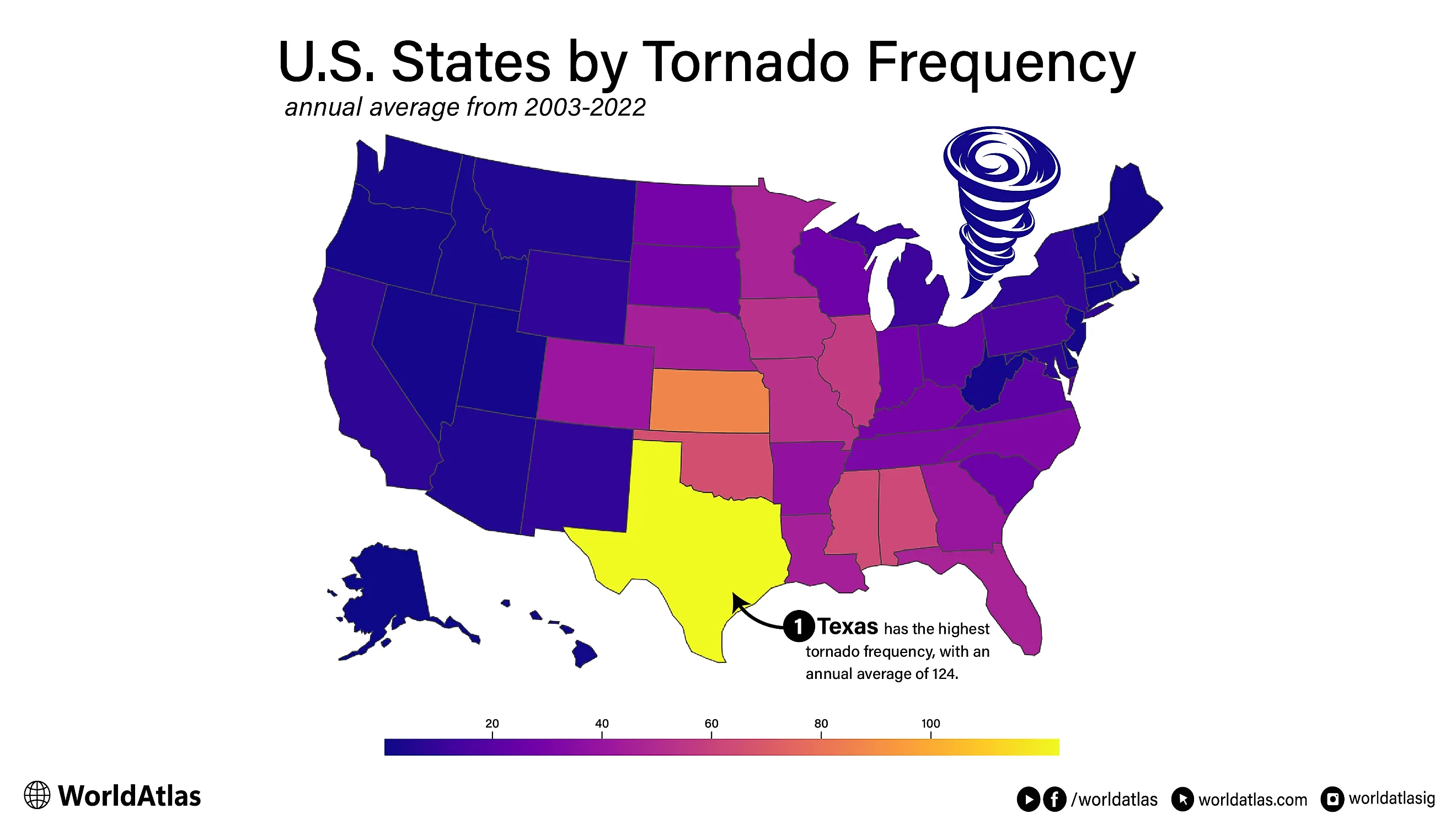
Based on Storm Prediction Center data from 2003 to 2022, these are the top 10 states with the highest average number of tornadoes per year, plus a quick look at what makes each one so storm-prone.
Top 10 US States By Tornado Frequency
| Rank | State | Yearly Avg Tornadoes |
|---|---|---|
| 1 | Texas | 124 |
| 2 | Kansas | 87 |
| 3 | Oklahoma | 66 |
| 4 | Mississippi | 64 |
| 5 | Alabama | 63 |
| 6 | Illinois | 57 |
| 7 (tie) | Missouri | 53 |
| 7 (tie) | Iowa | 53 |
| 9 (tie) | Florida | 46 |
| 9 (tie) | Minnesota | 46 |
1. Texas - 124 Per Year

Texas definitely likes to lead the pack in a number of ways, and tops the nation in annual tornado frequency by a good margin. Storms in the Lone Star State primarily occur across both the Panhandle and northeastern regions. Overall, its vast size creates a variety of tornado-friendly environments, from the flat plains of the west to the more humid, forested areas in the east.
Perhaps most significant of all is the reality that many of the largest population centers in the United States lie in the path of Texas's "tornado alleys," with cities like Dallas, Fort Worth, and Houston having experienced damaging events over the decades since proper records began. The deadliest of all was the 1953 Waco Tornado, which killed 114 people, injured about 600 more, damaged and estimated 2,000 vehicles, along with around 1,600 buildings.
2. Kansas - 87 Per Year

Kansas is at the heart of Tornado Alley, and although most people would understandably assume this state tops this list, it actually comes in at second, and the competition is not all that close either. Still, it experiences some of the highest tornado frequencies in the nation year over year, mainly in the central and western regions that feature expansive plains and limited natural barriers.
Kansas has a storied history of powerful EF5 tornadoes that have affected both its rural communities and urban centers like Wichita and Topeka. With frequent disasters that bad, a robust chain of warning systems and storm shelters is common throughout the state, and panic rooms are commonplace even in small residential homes.
One of the more notable storms in recent years was a 2007 tornado that destroyed 95% of the city of Greensburg and recorded wind speeds of 315 mph. Its economy and population still have not recovered to this day (and likely will not for a long, long time either), and its main claim to fame for now is that it was the site of one of the worst disasters ever in Kansas.
3. Oklahoma - 66 Per Year

It is fairly common knowledge that Oklahoma is among the nation's most active tornado states, with frequent high-intensity events, including numerous EF4 and EF5 storms along its incredibly flat landscapes. The central and northern regions of Oklahoma, particularly along the I-35 corridor, see the greatest concentrations, usually in clusters during major spring outbreaks.
As mentioned, the state's mix of open plains and agricultural land, as well as its growing urban centers like Oklahoma City and Tulsa, makes it tornadoes especially destructive, forcing skyscrapers in said cities to be made specifically to withstand wind storms. With advancements in technology, new builds often feature especially deep foundations and internal counterweights to fight against sway, just to name a couple measure.
Oklahoma has a long history of record-breaking events, including multi-vortex storms that have caused significant casualties and property loss. The best examples may be the Woodward event of 1947 that had 782 injuries and 116 fatalities, or the Bridge Creek-Moore Tornado, which saw the highest wind speeds ever recorded on Earth at 321 mph!
4. Mississippi - 64 Per Year

Mississippi experiences some of the Southeast's most destructive tornadoes, particularly in its northern and central parts. Furthermore, the flat terrain and open farmland around the Mississippi River make the state prone to lengthy storms capable of widespread damage. Given the region's sheer lack of major metros, this often means impacts on small towns and rural communities.
Mississippi's history includes the aforementioned 2011 storm, as well as an EF4 in 1971 that took the lives of 58 and injured almost 800 in and around the Issaquena-Grenada area. However, cities such as Jackson, Tupelo, and Corinth have been affected by significant events from time to time, just not as severely.
5. Alabama - 63 Per Year

Alabama sits directly on the Gulf of Mexico (Gulf of America), a temperate state known for high-intensity storms, including multiple EF4 and EF5 tornadoes in recent decades. Local tornadoes have hit both cities and rural areas over the years, with the Tennessee Valley and Appalachian foothills tending to channel storms along predictable wilderness-covered paths, while urban centers like Birmingham and Huntsville have seen significant impacts, too.
In 2011, Alabama saw one of its most intense outbreaks ever, with an EF4 tornado tearing through Tucaloosa and northern Birmingham, and an EF5 attacking the towns of Phil Campbell and Hackleburg, causing around 4.3 billion dollars total and killing about 240, as well as 110 others in other nearby states.
6. Illinois - 57 Per Year

Illinois lies in the heart of the Midwest, and serves as the northernmost destination on this list. Like the previous two, a convergence of warm and cool air creates a high likelihood of severe thunderstorms and tornadoes within it, especially during the early summer season.
While most tornadoes in Illinois are actually quite moderate, the state has experienced several significant outbreaks, including long-track events capable of substantial damage. In fact, the Tri-State Tornado of 1925, the deadliest tornado in United States history, passed through the area, killing nearly 700 and injuring thousands more, most of whom were in southern Illinois.
7. Missouri - 53 Per Year (tie)

Missouri's location just below Iowa keeps it at the intersection of the Great Plains and the Mississippi Valley, creating a consistent setup for dangerous weather, from violent gusts to full-blown tornadoes. Likewise with its northern neighbor, warm, humid air from the Gulf of Mexico often collides with cooler air masses moving in from the Rockies and/or upper Midwest, producing volatile conditions. Tornadoes in this slightly more mountainous state typically peak from April through June, though activity has been known to occur year-round.
Missouri has been the site of several destructive outbreaks, including major events affecting both rural communities and urban centers such as St. Louis and Kansas City. Most notable of which is the Joplin Tornado of 2011, an EF5 which killed 158 and injured well over 1,100 others.
7. Iowa - 53 Per Year (tie)

Iowa ranks eighth nationally, with an average of 53 tornadoes per year. Its position in the central Plains places it in a zone where warm, moisture-rich Gulf air frequently collides against cooler, drier air from the west and north. With that, tornado activity peaks from May through July, when strong wind shear and unstable air masses fuel the severe thunderstorms that can evolve into something more.
While Iowa records fewer tornadoes than, say, Texas or Kansas, it has experienced notable outbreaks in recent years, including long-track (tornadoes that carry on for over 25 miles) and high-intensity events. On the other hand, the state's predominantly rural and agricultural landscape thankfully means damage more often affects farmers' fields rather than populated cityscapes.
9. Florida - 46 Per Year (tie)

Florida is a bit of a wildcard on tornado lists because it doesn’t rely on classic Great Plains “Tornado Alley” setups to rack up big numbers. Instead, the state’s peninsula geography puts warm, humid air on tap from both the Gulf of Mexico and the Atlantic, and daily thunderstorms (especially when sea breezes collide) regularly spin up brief, fast-forming twisters. Add in landfalling tropical systems and waterspouts that move onshore, and you get frequent tornado reports across the year—even if many of them are on the weaker, shorter-lived side compared to the Plains.
That said, Florida can absolutely produce devastating events when the ingredients line up. In late February 1998, a major outbreak tore through Central Florida along the I-4 corridor and remains the deadliest tornado event in state history. Another infamous reminder came on February 2, 2007 (the “Groundhog Day” outbreak), when multiple strong tornadoes struck Central Florida in the pre-dawn hours, causing widespread destruction and dozens of casualties.
9. Minnesota - 46 Per Year (tie)

Minnesota might be better known for blizzards and lake-effect weather, but it sits right on the northern edge of the Plains tornado belt, where summer setups can get nasty in a hurry. When warm, moisture-rich air surges north from the Gulf and collides with cooler, drier air dropping in from Canada, strong wind shear and a powerful jet stream can turn ordinary thunderstorms into rotating supercells. Tornado season here tends to peak from June through August, with the greatest activity often focused across the flatter, more agricultural southern and western parts of the state.
Minnesota’s tornado history has a few sobering highlights, including the May 6, 1965 Twin Cities outbreak (often nicknamed “The Longest Night”), when multiple strong tornadoes struck the metro area and surrounding counties. More recently, June 17, 2010 brought the largest tornado outbreak day in modern Minnesota records, including an extremely destructive EF4 that tore into the city of Wadena. It’s a good reminder that while Minnesota doesn’t see tornadoes every week, the ones that do form can still be powerful and costly.
US States Ranked By Tornado Frequency
| Rank | State | Avg Yearly Tornadoes |
|---|---|---|
| 1 | Texas | 124 |
| 2 | Kansas | 87 |
| 3 | Oklahoma | 66 |
| 4 | Mississippi | 64 |
| 5 | Alabama | 63 |
| 6 | Illinois | 57 |
| 7 (tie) | Iowa | 53 |
| 7 (tie) | Missouri | 53 |
| 9 (tie) | Florida | 46 |
| 9 (tie) | Minnesota | 46 |
| 11 (tie) | Louisiana | 45 |
| 11 (tie) | Nebraska | 45 |
| 13 | Colorado | 41 |
| 14 | Georgia | 40 |
| 15 | Arkansas | 38 |
| 16 | North Carolina | 32 |
| 17 | Tennessee | 31 |
| 18 (tie) | Kentucky | 29 |
| 18 (tie) | North Dakota | 29 |
| 20 | South Dakota | 28 |
| 21 | Indiana | 27 |
| 22 (tie) | South Carolina | 26 |
| 22 (tie) | Wisconsin | 26 |
| 24 | Ohio | 23 |
| 25 | Virginia | 21 |
| 26 | Pennsylvania | 16 |
| 27 | Michigan | 12 |
| 28 (tie) | New Mexico | 9 |
| 28 (tie) | New York | 9 |
| 28 (tie) | Wyoming | 9 |
| 31 (tie) | California | 8 |
| 31 (tie) | Maryland | 8 |
| 33 (tie) | Arizona | 5 |
| 33 (tie) | Montana | 5 |
| 35 (tie) | Idaho | 3 |
| 35 (tie) | Washington | 3 |
| 37 (tie) | Connecticut | 2 |
| 37 (tie) | Maine | 2 |
| 37 (tie) | Massachusetts | 2 |
| 37 (tie) | Nevada | 2 |
| 37 (tie) | New Jersey | 2 |
| 37 (tie) | Oregon | 2 |
| 37 (tie) | Utah | 2 |
| 37 (tie) | West Virginia | 2 |
| 45 (tie) | Delaware | 1 |
| 45 (tie) | Hawaii | 1 |
| 45 (tie) | New Hampshire | 1 |
| 45 (tie) | Vermont | 1 |
| 49 (tie) | Alaska | 0 |
| 49 (tie) | Rhode Island | 0 |