The 10 Busiest Train Stations in the World
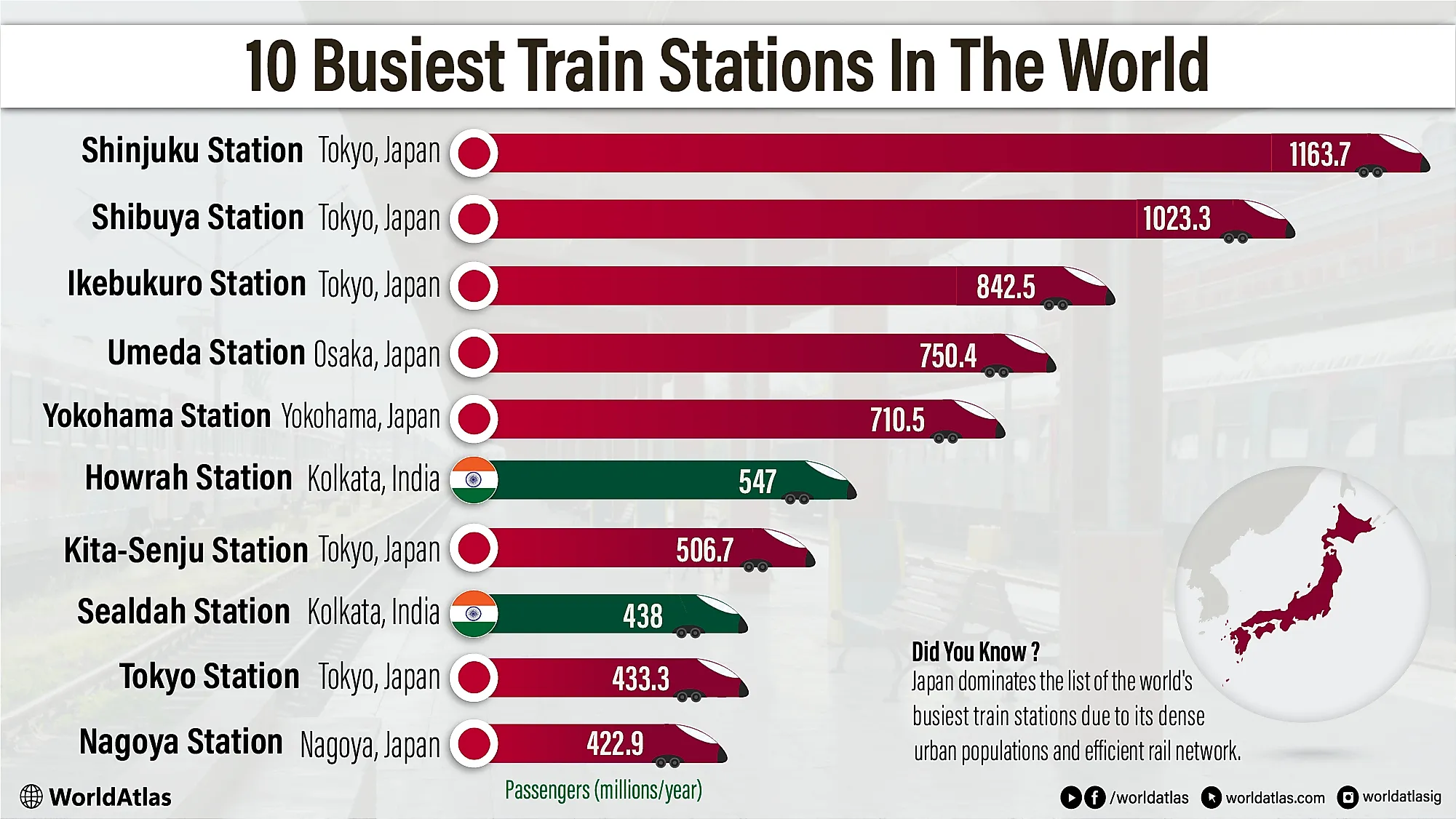
The world's busiest train stations are high-capacity city engines that concentrate work, shopping, and daily life into a few intensely connected blocks. The 10 busiest train stations in the world are led by Shinjuku Station in Tokyo with about 1,164 million passengers per year, followed by Shibuya at 1,023 million and Ikebukuro at 843 million. Osaka-Umeda and Yokohama extend Japan's lead in the top five, while Kolkata's Howrah and Sealdah demonstrate the scale of India's commuter and regional rail demand. Tokyo Station and Nagoya Station add national reach through major intercity services.
Japan accounts for eight of the ten entries, including five in Tokyo, reflecting a dense, multi-operator network built around frequent transfers and high service intensity. These stations also function as commercial centers, with department stores, offices, and dining woven into the station footprint and surrounding streets.
10 Busiest Train Stations In The World
| Rank | Station | City | Country | Passengers (millions/year) |
|---|---|---|---|---|
| 1 | Shinjuku Station | Tokyo | Japan | 1,164 |
| 2 | Shibuya Station | Tokyo | Japan | 1,023 |
| 3 | Ikebukuro Station | Tokyo | Japan | 843 |
| 4 | Osaka-Umeda Station | Osaka | Japan | 750 |
| 5 | Yokohama Station | Yokohama | Japan | 711 |
| 6 | Howrah Station | Kolkata | India | 547 |
| 7 | Kita-Senju Station | Tokyo | Japan | 507 |
| 8 | Sealdah Station | Kolkata | India | 438 |
| 9 | Tokyo Station | Tokyo | Japan | 433 |
| 10 | Nagoya Station | Nagoya | Japan | 423 |
1. Shinjuku Station - 1,164 million/year
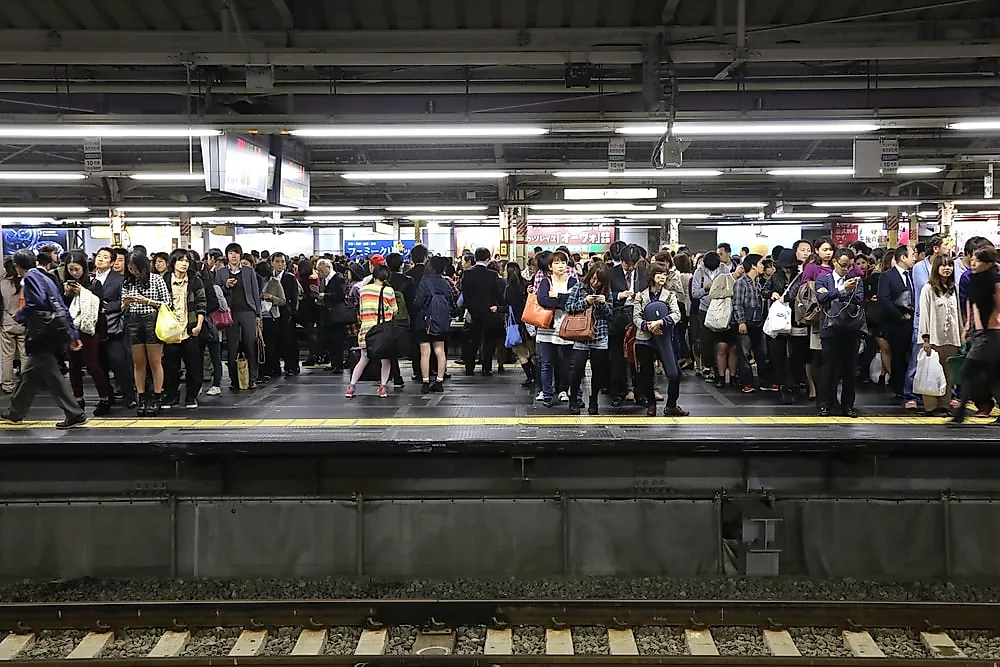
With an annual ridership of 1.16 billion, Shinjuku Station is the busiest railway station in the world. Opened in 1885, it serves as a key transport hub connecting central Tokyo with suburban and regional lines. The station is jointly operated by JR East, Odakyu Electric Railway, Keio Corporation, and Tokyo Metro, with over 200 exits and multiple underground levels. Surrounding it is one of Tokyo's major commercial districts, featuring department stores, offices, and entertainment venues.
2. Shibuya Station - 1,023 million/year

Shibuya Station in Tokyo records more than one billion passengers each year, making it one of the world's busiest transit points. JR East, Tokyu, Keio, and Tokyo Metro operate the station, which opened in 1885. The station is central to the Shibuya district, a major commercial area known for retail, entertainment, and the Shibuya Scramble Crossing, which is located directly outside its Hachiko Exit. Recent redevelopment projects, including the Shibuya Stream and Shibuya Scramble Square complexes, have expanded the station's connectivity and capacity.
3. Ikebukuro Station - 843 million/year

Ikebukuro Station in Tokyo handles an estimated 843 million passengers each year, placing it among the busiest stations globally. Opened in 1903, it is jointly operated by JR East, Tobu Railway, Seibu Railway, and Tokyo Metro. The station anchors the Ikebukuro district, a major retail and entertainment center that includes large department stores such as Seibu and Tobu, both directly connected to the station. Its layout integrates multiple rail lines linking northern Tokyo and Saitama Prefecture with central Tokyo.
4. Osaka-Umeda Station - 750 million/year

Roughly 750 million travelers use Osaka-Umeda Station annually, the highest figure in western Japan. The area consists of several linked stations operated by JR West, Hankyu Railway, Hanshin Electric Railway, and Osaka Metro. Its core facilities date to the early 20th century, but the district has been extensively rebuilt, most recently through the Grand Front Osaka and Osaka Station City developments. The station complex sits at the center of the Umeda commercial district, which houses major department stores, offices, and hotels.
5. Yokohama Station - 711 million/year

Annual traffic of 711 million passengers positions Yokohama Station as one of Japan's busiest transit hubs. Yokohama Station, first built in 1872 and later reconstructed several times, is operated by JR East and four private railways. The station links central Yokohama with Tokyo and Kanagawa Prefecture through major lines such as the Tokaido, Keihin-Tohoku, and Yokosuka lines. Its surrounding district includes large retail complexes like Sogo and Joinus, which are directly connected to the station.
6. Howrah Station - 547 million/year

Howrah Station in Kolkata records an estimated 547 million passengers each year, making it one of India's busiest railway terminals. Howrah Station has served passengers since 1854 and is operated by Eastern and South Eastern Railway. The station has two large complexes with multiple platforms handling long-distance, suburban, and regional services. Its location at the eastern end of the Howrah Bridge provides direct access to central Kolkata. Significant upgrades in recent decades have expanded capacity and improved passenger facilities, reinforcing Howrah's role as a central hub in India's rail network.
7. Kita-Senju Station - 507 million/year

Kita-Senju Station in Tokyo handles roughly 507 million passengers per year, placing it among the busiest stations in Japan. Opened in 1896, it is operated by JR East, Tobu Railway, Tokyo Metro, and the Tsukuba Express, making it a key interchange for northern Tokyo and neighboring prefectures. The station connects major lines such as the Joban Line and Tobu Skytree Line, supporting heavy commuter traffic. Its surrounding district includes shopping centers and local businesses that are directly linked to the station's entrances. Kita-Senju functions as an important transfer point, distributing passenger flow across eastern and northern parts of the metropolitan area.
8. Sealdah Station - 438 million/year

Handling approximately 438 million passengers yearly, Sealdah Station is a core node in Kolkata's rail network. Sealdah, opened in 1869, is run by Eastern Railway and supports multiple service types. The station is divided into three sections, North, Main, and South, each managing distinct passenger flows and service patterns. Its suburban network is one of the busiest in the country, supporting daily commuter movement into central Kolkata. Ongoing infrastructure improvements, including platform upgrades and signaling enhancements, aim to increase efficiency and accommodate rising demand within the metropolitan region.
9. Tokyo Station - 433 million/year

Tokyo Station records approximately 433 million passengers per year and serves as Japan's central intercity rail hub. Tokyo Station, dating to 1914, is operated by JR East and houses terminals for major Shinkansen lines. The station also supports major commuter routes on the Yamanote, Chuo, and Keihin-Tohoku lines. Its restored red-brick Marunouchi building is a preserved historic landmark, while the Yaesu side features large commercial complexes and long-distance bus terminals. Tokyo Station's role as the capital's main rail gateway makes it essential to both national travel and daily metropolitan commuting.
10. Nagoya Station - 423 million/year

Nagoya Station records about 423 million passengers per year, one of Japan's busiest rail hubs. JR Central oversees Nagoya Station, which began operations in 1886 alongside later subway connections. The station is the headquarters of JR Central and the primary terminal for the Tokaido Shinkansen, linking Nagoya with Tokyo, Kyoto, and Osaka. Its station complex includes the JR Central Towers, which house offices, hotels, and retail facilities directly above the platforms. Nagoya Station's central location and high-speed rail connections make it a key gateway for travel throughout the Chubu region and beyond.