The National Parks With The Most Venomous Snakes
Dozens of venomous snakes inhabit the United States, mostly in the South and Southwest regions. Different national parks provide habitat for different venomous snakes. The dry desert environment of Joshua Tree National Park is exclusively home to rattlesnakes. Whereas the wetlands of Congaree National Park are home to species that can handle more humid environments, like copperheads and cottonmouths. The six national parks that follow contain some of the greatest diversity of venomous snakes in the United States.
Saguaro National Park, Arizona

Saguaro National Park is home to eight species of venomous snake, although only seven are capable of posing a threat to humans. The park's snake diversity can be credited to its location in the Sonoran Desert, the most biodiverse desert in the United States. Saguaro is divided into two districts on either side of Tucson. The Rincon Mountain District to the east reaches elevations of 8,666 feet, while the Tucson Mountain District to the west reaches elevations of 4,687 feet.

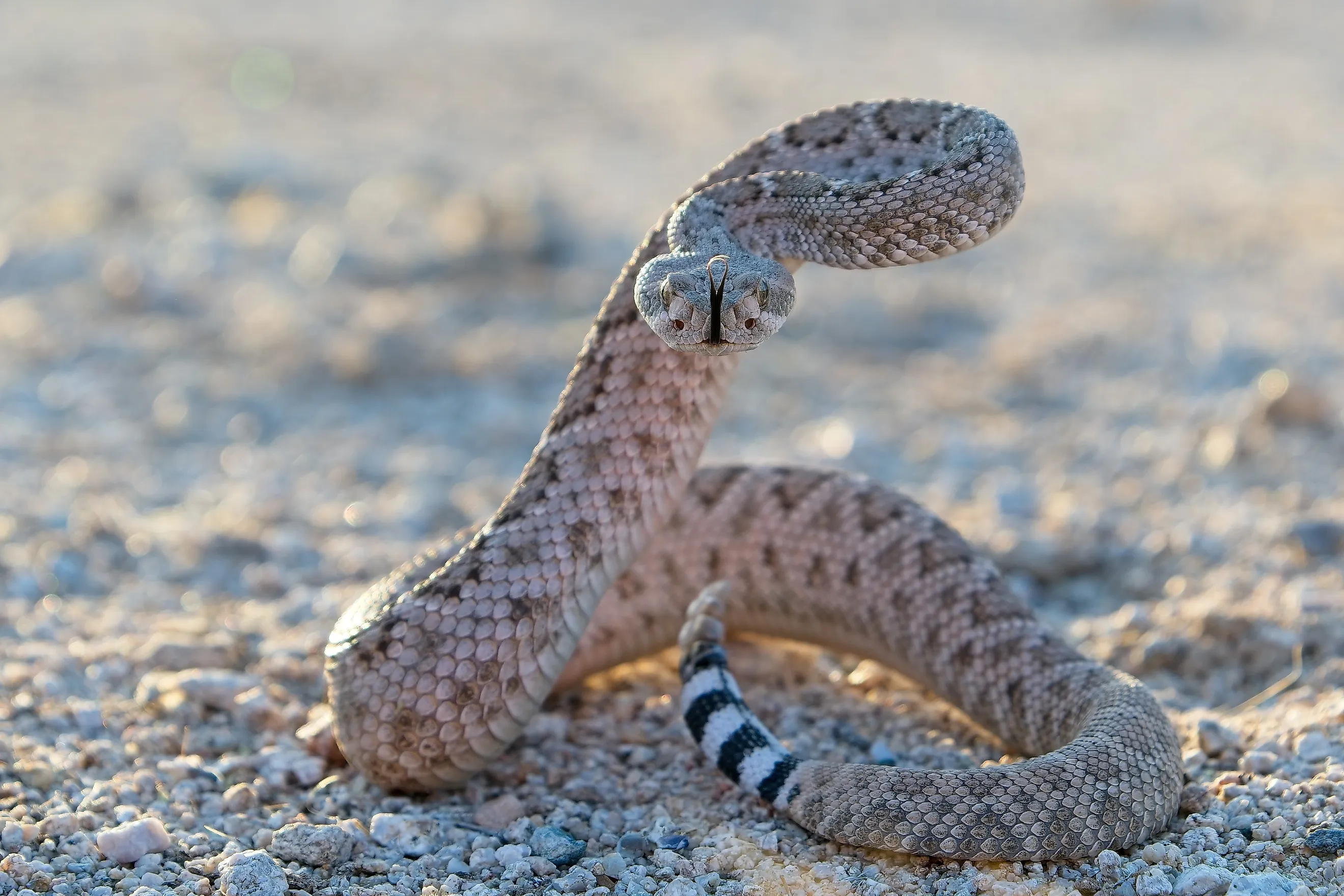
The western diamondback rattlesnake (Crotalus atrox) is the most common and widespread snake in the park, occupying different arid and semi-arid habitats. Five other rattlesnakes live in Saguaro. The Arizona black rattlesnake (Crotalus cerberus) is rarely seen as they live at elevations above 4,500 feet, while the sidewinder (Crotalus cerastes) is better suited to flatter, sandy terrain.
The park's other venomous snakes are less intimidating. While the Sonoran coral snake (Micruroides euryxanthus) possesses potent venom similar to cobras, it is small, secretive, and less likely to encounter people. The nightsnake (Hypsiglena torquata) is a rear-fanged venomous snake, but its venom is adapted to subduing small prey items, rather than large animals like humans.
Joshua Tree National Park

Rattlesnakes are the only venomous snake found in California. They are plentiful in Joshua Tree National Park, where six different species live. Joshua Tree covers close to 800,000 acres where three ecosystems converge, the Colorado Desert, the Mojave Desert, and the Little San Bernardino Mountains. Much of the park sits at elevations above 4,000 feet, with the highest point being 5,814 feet.

Rattlesnakes inhabit every corner of Joshua Tree, although different species have adapted to different parts of the park. Western diamondback rattlesnakes are limited to the Colorado Desert ecoregion. Sidewinders (Crotalus cerastes), which are represented by two subspecies, are limited to areas with sandy substrates. Southern Pacific rattlesnakes (Crotalus helleri) are found in rocky areas within the Pinyon-Juniper Pine of the Little San Bernardino Mountains. Southwestern speckled rattlesnakes (Crotalus pyrrhus) live in the rocky canyons, hills, and ridges in the eastern half of the park. Red diamond rattlesnakes (Crotalus ruber) are in the southwestern corner of the park. The Mojave rattlesnake (Crotalus scutulatus) is in the northwestern corner of the park, which represents the southern extent of their range.
Joshua Tree's convergence of three different ecosystems allows six different species of rattlesnake to adapt to different habitats. Merriam's kangaroo rat is preyed on by adults, while the side-blotched lizard is consumed by young rattlesnakes.
Grand Canyon National Park

Grand Canyon National Park is another exclusive rattlesnake hotspot. They are the only venomous snake found in the park. Although nine species of rattlesnakes are found in the wider Grand Canyon, only six are found within the boundaries of the park. Some are found above the rim. Some are found below the rim.

Some, like the Grand Canyon rattlesnake (Crotalus oreganus abyssus), are found nowhere else in the world other than the Grand Canyon. The Grand Canyon rattlesnake is characteristically pink in coloration which helps it blend into the Grand Canyon's varied layers of rock. Other species, like the black-tailed rattlesnake (Crotalus molossus), are found both above and below the rim.
Rattlesnakes can potentially be encountered all over the park. Most are observed within the canyon around sources of water like springs, streams, and the Colorado River. Here they will utilize rock crevices, burrows, and leaf litter that helps them hide from predators and prey alike.
Big Bend National Park, Texas

Big Bend National Park is home to five species of venomous snakes in one of the most geographically diverse landscapes in Texas. Vegetation belts along the Rio Grande give way to the largest preserved tract of the Chihuahuan Desert before rising in elevation to the Chisos Mountains. Despite the contrasting geographical features, venomous snakes have adapted to almost all of the park.

The Trans-Pecos copperhead (Agkistrodon contortrix pictigaster) is found throughout the park, although it is most dense around springs and the Rio Grande. The other four are rattlesnakes. The western diamondback rattlesnake and Mojave rattlesnake are also found near the Rio Grande floodplain, and up to elevations of 4,000 feet in the foothills of the Chisos Mountains.
Although the black-tailed rattlesnake and the mottled rock rattlesnake (Crotalus lepidus lepidus) can both be found throughout the park, they are most commonly associated with the Chisos Mountains and foothills. They spend much of their time hidden in crevices, rocky outcrops, and talus slopes.
Everglades National Park, Florida

Everglades National Park protects over 1.5 million acres of tropical and subtropical wetlands and forests. Alligators may be most closely associated with the Everglades, but four species of venomous snake also thrive in the park's marshes, forests, and waterways.

At one end of the scale is the dusky pygmy rattlesnake (Sistrurus miliarius barbouri), the smallest species of venomous snake in Florida. It is common in both wet and dry areas where it will prey on amphibians and lizards. At the other end of the scale is the eastern diamondback rattlesnake (Crotalus adamanteus), the largest rattlesnake in North America, as well as the longest and heaviest venomous snake in North America. Due to its large size, it can consume marsh rabbits, cottontails, and other small animals.
The park's other venomous snakes occupy different habitats. The eastern coral snake (Micrurus fulvius fulvius) is most common in wooded upland habitats, while the Florida cottonmouth (Agkistrodon piscivorus conanti) is found across all aquatic habitats.
Congaree National Park, South Carolina

Rattlesnakes. Copperheads. Cottonmouths. Coral Snakes. These are the four main groups of venomous snakes in the United States. All of them can be found in Congaree National Park. The park contains the largest intact expanse of old-growth bottomland hardwood forest remaining in the southeastern United States. The forest is supported by the Congaree and Wateree Rivers, which both sweep through the floodplain, creating a landscape of forests, swamps, and wetlands.

The most common venomous snakes in the park are the eastern copperhead (Agkistrodon contortrix), northern cottonmouth (Agkistrodon piscivorus), and timber rattlesnake (Crotalus horridus). Coral snakes are rarely encountered, although they still exist in the park. Copperheads and timber rattlesnakes are most commonly found in a variety of forests and woodlands. Cottonmouths are found in almost any wetland habitat.
Coral snakes are much more elusive. They occur in Congaree, but are rarely encountered by visitors. They spend much of their time concealed beneath leaf litter and vegetation.
National Parks Where Venomous Snakes Thrive
Venomous snakes are not restricted to deserts or wetlands or rocky canyons. They can be found in a variety of habitats. Some places like Grand Canyon National Park are home to a rattlesnake found nowhere else on earth, while Congaree National Park is home to all four main groups of venomous snakes found in the United States. What is more impressive than the extreme landscapes these parks preserve is how these venomous snakes have adapted to survive in them.