The 9 Most Venomous Snakes In The United States
Here is the good news, right up front: of the roughly 7,000 to 8,000 Americans bitten by a venomous snake each year, only about five die. Antivenom, hospitals, and the simple fact that snakes would much rather flee than fight keep that number remarkably low. The United States is home to around 30 venomous species, and nearly all of them fall into four groups: rattlesnakes, cottonmouths, copperheads, and coral snakes. But "venomous" is not the same as "deadly," and the ranking below shows exactly why. It runs by venom potency, and the snake at the top is one most people have never heard of.
How Venom Gets Measured, and Why the Ranking Lies a Little
Toxicologists rate venom strength using the LD50, the dose that kills half of a test group of mice, expressed in milligrams of venom per kilogram of body weight. The smaller the number, the more potent the venom. It is a useful yardstick and a genuinely imperfect one: the same species can post wildly different LD50 values depending on whether the venom was injected into a vein, under the skin, or into the abdomen, and some snakes vary chemically from one county to the next. So treat the figures below as a rough ordering, not gospel. Potency is also only half the danger. A snake's venom yield, its temperament, and how often it actually encounters people matter just as much, which is why the most toxic snake on this list is nowhere near the deadliest.
1. Tiger Rattlesnake

Pound for pound, the tiger rattlesnake (Crotalus tigris) carries the most potent venom of any rattlesnake in the Americas, with an LD50 measured as low as 0.06 mg/kg. Then comes the twist: it barely has any to give. This small, unusually tiny-headed desert dweller of southern Arizona and northwestern Mexico produces a venom yield of just 6 to 11 milligrams, a fraction of what the bigger rattlers pack. Its venom leans neurotoxic, chemically related to the dreaded Mojave toxin, but human bites are so rare that there is almost no clinical literature on them. The snake is well camouflaged, generally shy, and quick to rattle a warning. It is the deadliest venom on the list attached to one of the least dangerous delivery systems.
2. Mojave Rattlesnake

Nicknamed the "Mojave green" for its faint olive tint, this desert rattler (Crotalus scutulatus) has earned a fearsome reputation, and it is complicated. The Mojave comes in two chemical flavors depending on where it lives. "Type A" populations produce a potent neurotoxin that can hit an LD50 near 0.2 mg/kg, while "Type B" populations farther from the toxin's range are far less potent but more tissue-destroying. Either way, it delivers a serious payload of 50 to 150 milligrams and is most active from April through September, hunting by night in summer and holing up in rodent burrows through winter. The neurotoxic bites are the ones that frighten physicians, because symptoms can be delayed and then escalate fast.
3. Harlequin Coral Snake

The one entry here that is not a pit viper, the harlequin coral snake (Micrurus fulvius) belongs to the Elapidae family alongside cobras and kraits, and it packs a genuinely potent neurotoxin (LD50 around 0.2 mg/kg). What saves people is its almost comically bad equipment for using it. This small, secretive snake has tiny fixed fangs and a feeble delivery system yielding under 5 milligrams, and it would rather vanish into the leaf litter than confront anything human-sized. Only about 100 bites happen in a typical year, and roughly 40 percent of those are dry, meaning no venom is injected at all. The species has been recorded across every county in Florida. Gorgeous to look at, best left completely alone, but far less menacing on the trail than on paper.
4. Western Diamondback Rattlesnake

Here is where potency stops telling the story. The western diamondback (Crotalus atrox) has a comparatively mild LD50 of about 1.01 mg/kg, yet it is thought to cause more venomous bites, and more snakebite deaths, than any other snake in the country. The reason is simple math: it is common, widespread across the American Southwest and into northern Mexico, equally at home in grassland and rocky desert, and it delivers a huge dose of 35 to 250 milligrams when it strikes. It also stands its ground more readily than most. Weak venom in large quantities, from a snake you are actually likely to meet, is a more dangerous combination than superb venom from one you will never see.
5. Eastern Diamondback Rattlesnake

The eastern diamondback (Crotalus adamanteus) is the largest venomous snake in the country and the largest rattlesnake in the world. Most adults run three to six feet, but the record specimen, caught in 1946, stretched nearly eight feet and weighed 34 pounds, and it is the heaviest venomous snake in the Americas. That bulk comes with an ambush hunter's patience rather than speed: it lies in wait for the rats, mice, and birds that make up its diet, and it strikes people only when startled or cornered. Its venom is moderate in potency (LD50 around 1.2 mg/kg) but overwhelming in volume, averaging 400 to 450 milligrams per bite against an estimated human lethal dose of just 100 to 150. Untreated, its bites carry one of the highest fatality rates of any North American snake. It ranges through the pinelands of Florida, southern Mississippi, and the coastal plains of North Carolina, though habitat loss has pushed it to the brink of vanishing from Louisiana.
6. Timber Rattlesnake

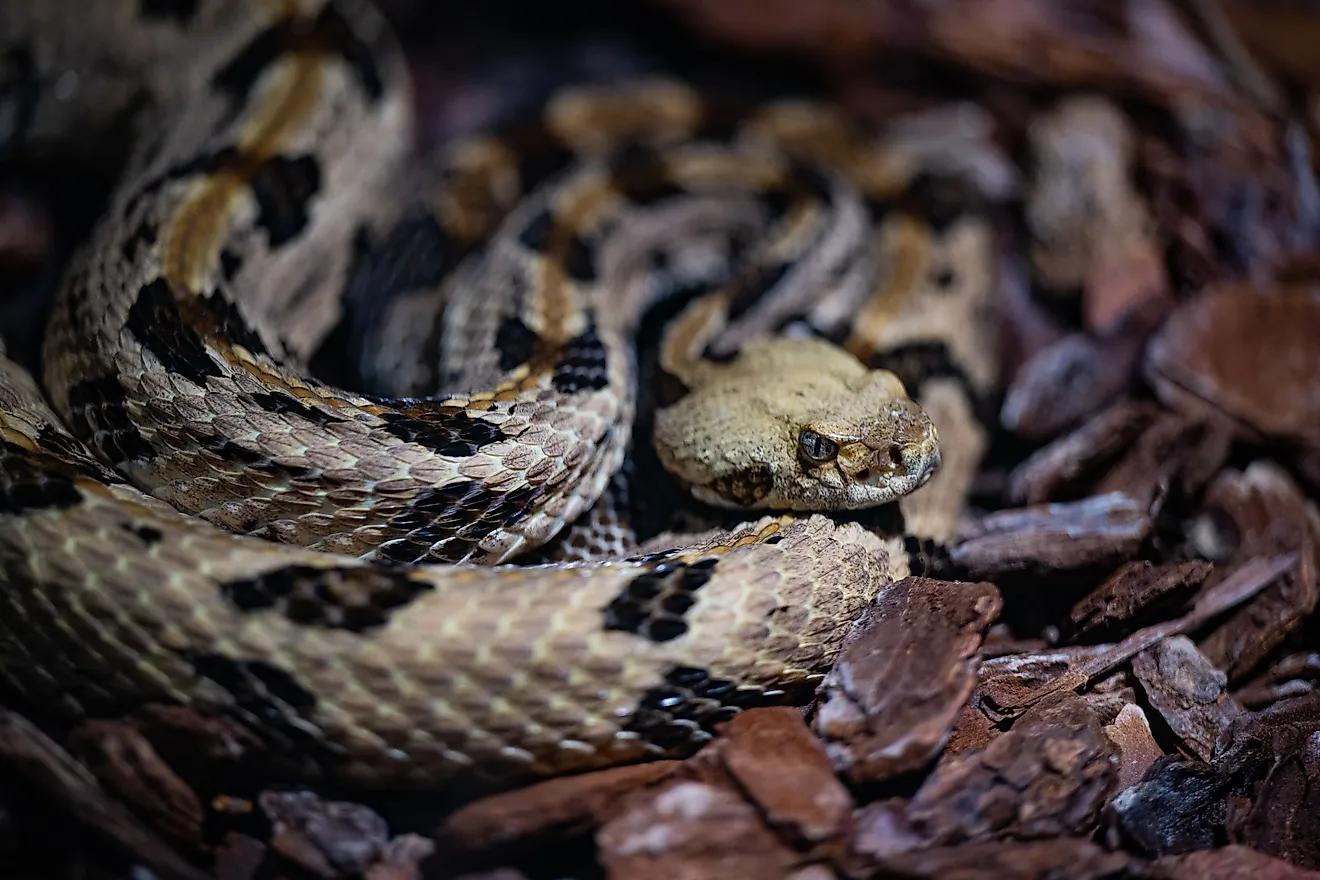
The timber rattlesnake (Crotalus horridus) answers to a small pile of aliases, including canebrake, black rattlesnake, and American viper, and it is the rattlesnake you are most likely to meet in the northern woods, ranging from New York south to Florida. It is a large, patient ambush predator with an LD50 around 1.64 mg/kg and a venom yield of 75 to 210 milligrams, and it will occasionally climb into low trees and brush after prey. Its saving grace is temperament: the timber is famously reluctant to strike, often enduring a great deal of provocation before it does. That mild disposition, combined with effective antivenom, keeps its bites from being the disaster its size would suggest.
7. Cottonmouth

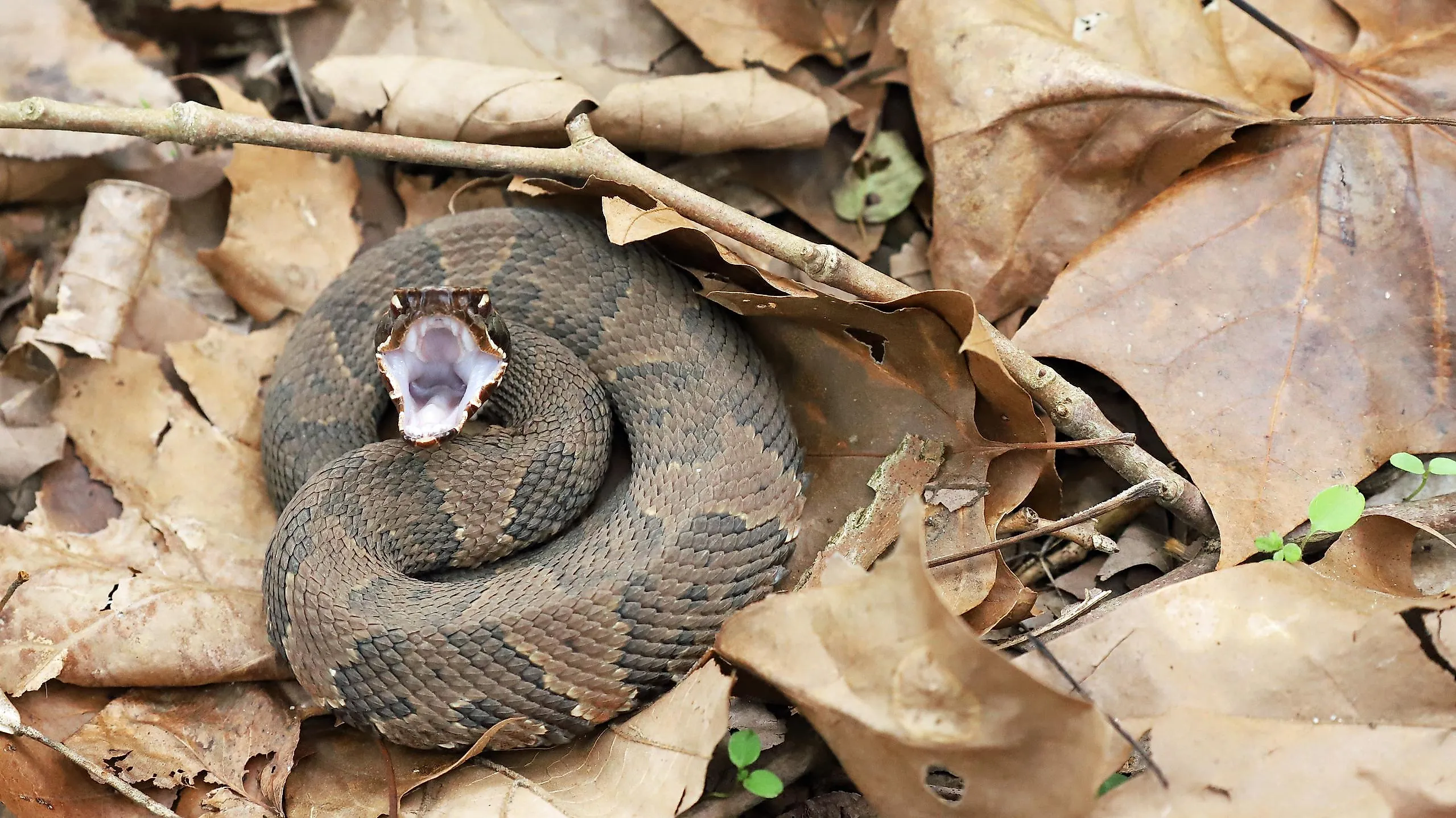
The cottonmouth (Agkistrodon piscivorus) gets its name from the startling white lining of its mouth, which it flashes as a warning, and its nickname, "water moccasin," from its love of the ponds, swamps, and slow rivers of the American Southeast. It grows up to about six feet, swims readily, and feeds on fish, frogs, and small mammals. Swimmers and anglers should give it room: its venom (LD50 around 2.04 mg/kg, yield of 80 to 170 milligrams) has anticoagulant effects that can cause heavy bleeding, breathing trouble, and, in bad cases, tissue necrosis severe enough to require amputation. It is often described as aggressive, though it is more accurately territorial, standing its mouth-gaping ground rather than fleeing the way most snakes do.
8. Sidewinder

The sidewinder (Crotalus cerastes) is named for its signature move, a sideways shimmy that lets it rocket across loose desert sand while barely touching the scorching surface. It patrols the deserts around the head of the Gulf of California, reaching into both the Mojave and Sonoran Deserts, and though it is small, it is the quickest of the rattlesnakes. Its venom is on the milder end (LD50 around 2.6 mg/kg, yield of just 18 to 50 milligrams), and as a nocturnal recluse that spends the day hiding from the heat, it rarely tangles with humans. The rodents and lizards that wander within range are far less fortunate, paralyzed and swallowed whole.
9. Copperhead

The copperhead (Agkistrodon contortrix) has an ominous name and a mostly harmless bite, which is the reason it closes out the list. Its venom is by far the weakest here (LD50 around 10.9 mg/kg, yield of 40 to 75 milligrams), and here is the paradox that makes it worth knowing: the copperhead bites more Americans than any other venomous snake, yet its bites almost never kill. It lays low around people, often delivers a dry bite when it does strike, and reserves its real venom for mice, frogs, and lizards. A bite still means a painful trip to the hospital and deserves a wide berth, but of all the snakes here, this is the one whose reputation most outpaces its threat.
The Takeaway
Run your eye down the list and a pattern jumps out: the order flips almost completely if you rank by actual danger instead of raw potency. The tiger rattlesnake tops the venom chart but almost never bites; the copperhead sits dead last on potency but bites more people than anything else. The truly dangerous snakes, the diamondbacks, land in the middle, dangerous precisely because they combine decent venom with big doses, bad tempers, and a habit of living where people do. None of this should keep anyone indoors. Watch where you put your hands and feet, give any snake a generous berth, and if a bite does happen, stay calm and get to a hospital. The odds, overwhelmingly, are on your side.