Which US State has the Most Venomous Snakes?
Snakes turn up in almost every corner of the US, which makes the interesting question not whether you will run into one but where the odds go up. Only two states sit the game out entirely. Alaska is simply too cold for a cold-blooded animal to make a living, and Hawaii has no native land snakes at all. Everywhere else, some states are clearly holding a fuller hand than others. So which one earns the title for the most venomous snakes? The honest answer is that it depends on what you count, and it involves an awful lot of rattles.
Texas Versus Arizona: It Depends How You Count

"Most venomous snakes" can mean two different things, and the winner changes depending on which one you have in mind. Count every kind of snake a state has, and one answer wins. Count only the venomous species, and a different state takes it. Both live in the warm, dry southern and southwestern belt, where hot days, cool nights, and rocky, broken ground give reptiles exactly the mix of sun and shelter they are after.

On raw variety, nobody touches Texas. The state is home to 105 snake species and subspecies, more than any other, which is what happens when your borders wrap around swamp, prairie, brush, and desert all at once. Fifteen of those are venomous, the second-highest venomous tally in the country. Florida and the humid Gulf states are thick with snakes too, but none of them out-counts Texas on total species.
Here is the catch: total count is not the title. If you specifically want the state with the most venomous species, you leave the Gulf and drive into the desert. That crown belongs to Arizona, which does not have the most snakes overall but has quietly assembled the deepest bench of dangerous ones in the nation.
What Venomous Snakes Live In Arizona?

Arizona is the country's venom capital, with somewhere around 20 to 21 venomous species and subspecies, the highest count of any state. The real flex is the rattlesnakes. Arizona has 13 species of them, more than any other state and about a third of every rattlesnake species on Earth. One of them, the tiger rattlesnake (Crotalus tigris), carries what is often ranked the most toxic venom of any rattlesnake in the Western Hemisphere, all behind one of the smallest heads in the group. Most of these snakes keep to the desert, though they have been known to turn up on golf course greens, which is one way to add a hazard to your short game.
For the record, the full Arizona venom roster reads like a festival lineup: the Arizona black, ridge-nosed, banded rock, Grand Canyon, Great Basin, Hopi, Mojave, northern black-tailed, prairie, tiger, southwestern speckled, western twin-spotted, and western diamondback rattlesnakes, plus three subspecies of sidewinder, the desert massasauga, and the lone oddball, the Sonoran coral snake. Here are five worth knowing on sight.
Western Diamondback Rattlesnake

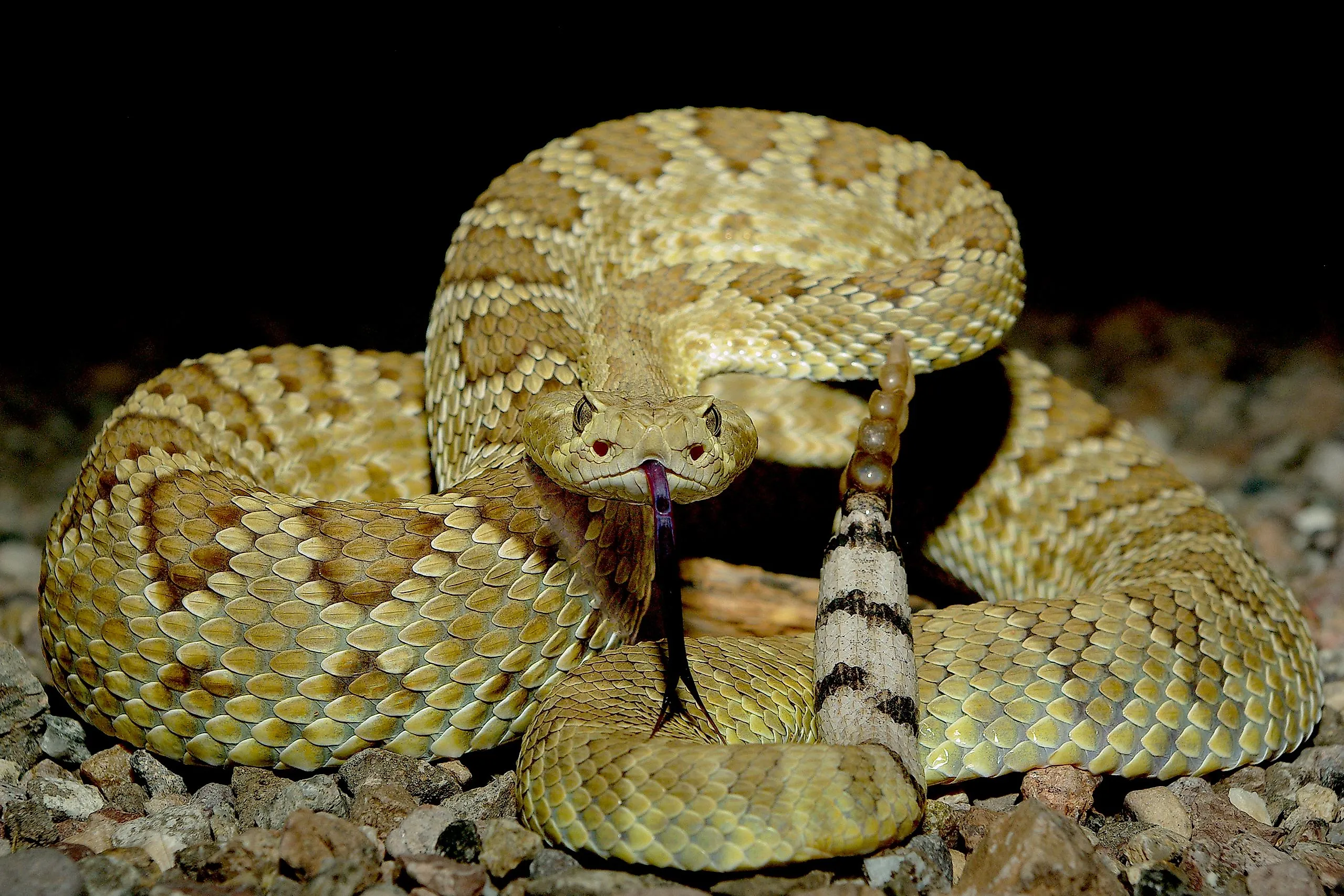
The western diamondback (Crotalus atrox) is the snake most people picture, and it has earned the billing. It is big, sometimes past five feet, wears the textbook chain of diamonds down its back, and, crucially, it does not spook and flee. Corner one and it will plant itself, rise up, and buzz that rattle like it means it. It is not the most toxic rattlesnake in Arizona, but it does not have to be. Because it is large, common, and unbothered by people, the western diamondback bites and kills more people than any other snake in the country. Its venom is hemotoxic, so a real bite brings swelling, pain, and tissue damage. Deaths are rare thanks to antivenom, but it built its reputation the old-fashioned way, on sheer volume.
Mojave Rattlesnake

If the diamondback is the brawler, the Mojave rattlesnake (Crotalus scutulatus) is the one that keeps toxicologists up at night. Its venom includes a neurotoxic component, the famous Mojave toxin, that can go after the nervous system on top of the usual damage, and it is widely rated among the most potent venoms of any snake in the United States. The twist is that Mojaves are shy homebodies. They live out on southern Arizona's open desert flats and grassland and generally want nothing to do with you. So the country's most fearsome venom belongs to a snake that would much rather you both pretend the encounter never happened. It sometimes takes on a greenish cast, which is where the nickname "Mojave green" comes from.
Sonoran Coral Snake

Also known as the Arizona coral snake, the Sonoran coral snake (Micruroides euryxanthus) is the outlier of the group, a relative of the cobra rather than a pit viper, banded in red, black, and yellow. It is tiny, roughly 13 to 21 inches, and spends nearly all of its life underground or beneath rocks, surfacing mostly at night. Its venom is neurotoxic in theory, but here is the reassuring part: the snake is reclusive to the point of near invisibility, its fangs are minuscule, and the medical literature notes that its bites generally do not require medical intervention. There is no confirmed record of one ever killing a person. It is proof that a frightening paint job and a genuinely dangerous bite are two very different things.
Arizona Black Rattlesnake

The Arizona black rattlesnake (Crotalus cerberus) trades the desert for the high country, living in the pine-clad mountains and rocky canyons of central and northern Arizona. True to the name, adults darken to a deep brown or near-black, and they can actually change color, lightening or darkening over minutes to hours depending on temperature and mood, which is unusual for a rattlesnake. Do not let the shy, retiring manner fool you: drop for drop, its venom has been measured at two to two and a half times the toxicity of the western diamondback's. It would still rather slip away than bite, but it is not one to underestimate.
Western Rattlesnake

The western rattlesnake, also called the Pacific rattlesnake (Crotalus oreganus), rounds out the list, and in Arizona it turns up mainly in the north rather than the south. Its best-known local form is the Grand Canyon rattlesnake, a subspecies tinted pink and salmon to blend into the canyon's red rock, found right along the rims and even down on the canyon floor. These snakes run three to four feet and vary their color and pattern to match wherever they live. Like most rattlers, they would rather retreat than fight, but they will defend themselves if pushed, and a bite is serious enough to warrant a fast trip to the hospital. Antivenom handles it well.
So, which state has the most venomous snakes? If you mean the most snakes of any kind, it is Texas. If you mean the most venomous species, the title is Arizona's, and it is not especially close. The good news for everyone actually living among them: of the roughly 7,000 to 8,000 venomous bites recorded in the US each year, only about five turn out to be fatal. These snakes are not hunting you. Watch where you put your hands and feet, give anything that rattles a wide berth, and the desert stays a good deal friendlier than its reputation suggests.