The National Forests With The Most Wild Hogs
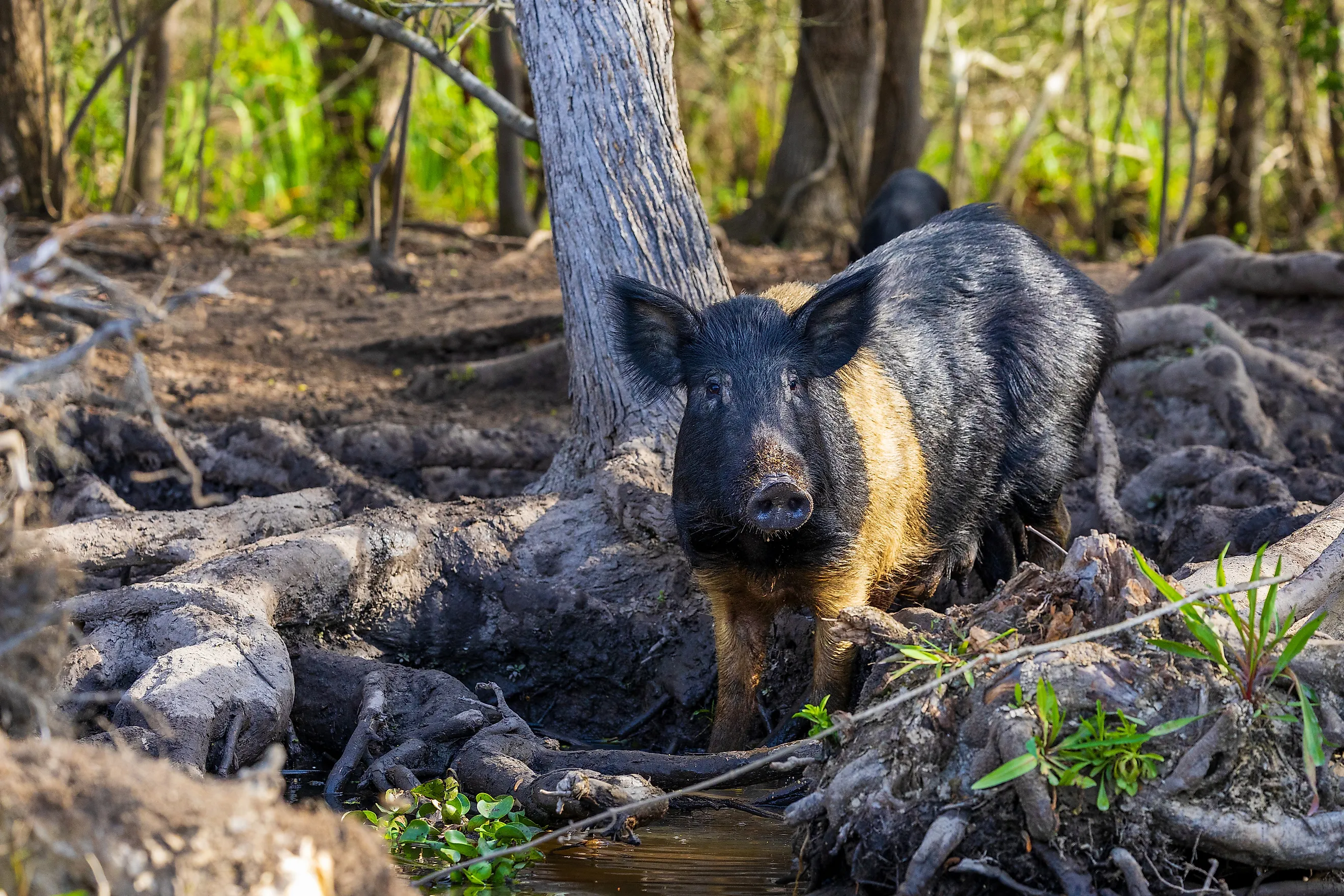
Wild hogs are tearing up America’s national forests. More than 6 million of them now roam at least 35 states, and in the forests of the South and the Ozarks, they dig through creek bottoms and swamp edges until the ground looks plowed.
They have wiped out entire pine plantings. They have torn up the breeding grounds of rare salamanders. The fight to stop them has gotten so desperate that one forest banned hunting them, and another paid hunters by the pig.
Sabine National Forest, Texas

In Sabine County, which holds most of the Sabine National Forest's acreage in the East Texas Pineywoods along the Louisiana line, a local incentive program called Operation Pork Chop has paid out prizes for dead hogs. Trappers and hunters in the program took more than 1,200 hogs out of the county between 2019 and the spring of 2021, and that year's $2,400 in prizes were to be awarded at a wild hog supper at a marina pavilion on Toledo Bend Reservoir.
Texas has the largest feral hog population in the country, an estimated 2.6 million to more than 3 million by Texas A&M figures published in 2026, and on the Sabine, hogs are usually found in the bottomlands. Moore Plantation Wildlife Management Area, more than 26,000 acres of upland pine with bottomlands mixed in, is open year-round, and Texas has no closed season on hogs. Inside the WMA, hunters with a Texas license and the Annual Public Hunting Permit can take hogs any month of the year in daylight, without dogs, and baiting is banned across the national forest.
Ozark-St. Francis National Forests, Arkansas

North of the Pineywoods, Arkansas has stopped treating hogs as a sporting target on its wildlife management areas, including the Sylamore WMA inside the Ozark National Forest and the St. Francis National Forest WMA. Hunters there can still shoot a hog they come across during an open deer, bear, or elk season, but hunting hogs for their own sake is banned. The Arkansas Game and Fish Commission considers large-scale trapping the most efficient way to cut hog numbers, since hunting reduces populations by only 8 to 50 percent. The commission has aimed a special hog project at the Buffalo River watershed in the Arkansas Ozarks, where the National Park Service says hogs destroy glades, marshes, and springs along the Buffalo National River. In November 2025, a representative of the Ozark-St. Francis told the state's feral hog task force that the forests had removed just under 1,000 hogs and planned to expand aerial work in the spring. Whether to close hog hunting across the rest of the national forest was still undecided.
Mark Twain National Forest, Missouri

The Current, Jacks Fork, and Eleven Point rivers run through the Ozark hollows of southern Missouri, and the Forest Service names all three among the rivers that feral hogs can irreversibly alter. Rooting and wallowing also tear up the glades, fens, and springs scattered across the Mark Twain National Forest, and hogs feed heavily on the acorns that native wildlife depends on.
In December 2019, the Mark Twain issued a forest order banning hog hunting on its 1.5 million acres, with an exception for people holding a valid state deer or turkey permit who take a hog while hunting under it. After decades of open hog hunting and trapping, hog numbers had risen across southern Missouri, and forest spokesperson Cody Norris said hunters were "actually interfering with trapping."
By the summer of 2021, a group of agencies that includes the forest's managers had eliminated more than 6,000 feral hogs over two years, with trapping the most common tool. State crews reported the highest hog density in southeast Missouri in 2017, and in 2022 the partnership's work in Iron, Shannon, Wayne, and Reynolds counties produced the most results.
Bankhead National Forest, Alabama

Southeast of the Ozarks, in northwestern Alabama, the hogs of the Bankhead National Forest keep their stronghold inside the Sipsey Wilderness, roughly 25,000 acres of sandstone canyons nicknamed the "Land of a Thousand Waterfalls," where Thompson and Hubbard creeks join to form the Sipsey Fork of the Black Warrior River. Wild pigs reached the Bankhead in the late 1980s and 1990s. A 2024 paper on the district's control program describes the wilderness as a refuge where the pigs are "severely degrading its unique qualities," and as the likely source of the hogs on the western half of the surrounding Black Warrior Wildlife Management Area.
Crews on the 180,000-acre district go after whole sounders, as hog family groups are called, and one of their best tools is the Judas pig, a hog fitted with a radio collar and released to rejoin its group. In 2022, a collared Judas pig led trappers to the most successful trapping location in the wilderness, and the district removed a record 421 pigs, 91 of them from the Sipsey. A single day of aerial gunning in early March 2023 found no pigs, yet traps caught 78 in the wilderness that year, 61 percent of the district's total.
Apalachicola National Forest, Florida

Down in the Florida Panhandle, the southern dusky salamander shares the Apalachicola National Forest with hogs. When biologist Bruce Means resurveyed the species in Florida, he found it nearly extinct except for a small group of populations in the forest. As hog numbers in the Panhandle grew, so did the rooting damage he saw, including what he called "outrageous evidence of their destroying the breeding habitat for several salamanders," and hog rooting has been named as one possible factor in the dusky salamander's decline.
Most of the forest falls inside the Apalachicola Wildlife Management Area, more than 582,000 acres across Franklin, Leon, Liberty, and Wakulla counties, where dogs may be used on hogs only during the general gun and small game seasons in the dog-hunt area. A much smaller tract holds hunts for hogs alone, in two forms, one with dogs and one without, and during the dog hunts no hog may be shot until the dogs have it bayed. That tract is the Bradwell Unit, 1,420 acres of bottomland hardwoods, swamp, and pine bordered by the Ochlockonee River on the east and south.
Francis Marion National Forest, South Carolina

Up the Atlantic coast, north of Charleston, the hog problem on the Francis Marion National Forest had grown bad enough by 2015 that the South Carolina Department of Natural Resources and the Forest Service hired three hunters in a trial program. The contract hunters were paid by the pig, up to $80 for the largest, and focused on environmentally sensitive parts of the forest where endangered and other valuable native species live. The tally stood at 34 hogs when the program made the news. Some local hunters objected, among them a man who hunted the Hell Hole Swamp area and said the public got only a couple of dog-hunting weekends a year.
The forest's WMAs now give the public set dates. Hogs can be taken during any open game season there, and special hog-only still hunts run in early March, followed by dog hunts in March and May, all in daylight, and no hog may be transported alive. During the trial program, state regional wildlife coordinator Sam Chappelear put the goal plainly: "We don't treat hogs as game animals. We want them eradicated."
Nantahala National Forest, North Carolina

Inland from the coast, in the mountains of western North Carolina, the Cherohala Skyway climbs through the Nantahala National Forest toward the Tennessee line. Between mile markers 7 and 8 on the North Carolina side, a half-mile trail leads to the top of 5,429-foot Hooper Bald, where much of the region's wild hog story began. In 1912, a game preserve of about 1,600 acres near the bald brought in more than a dozen European wild boar, and hogs that escaped settled in the mountains of Graham County and across the state line in Monroe County, Tennessee.
Their descendants still range through these mountains. In the 2009-10 season, a state harvest report counted 132 wild boar taken on the Nantahala game lands, 56 of them in Graham County, and North Carolina's 2025 wildlife plan describes feral hogs as widespread in the western part of the state and in neighboring Great Smoky Mountains National Park. On the national forest, which is managed as state game land, licensed hunters can take hogs during any open season for game animals, with dogs only where dogs are allowed for deer or bear, and a permit is required to hunt them after dark.
Missouri shows what can happen when a forest stops treating hogs as game. The state's public land agencies, the Mark Twain among them, stopped hog hunting and handed the job to trapping and aerial crews, and Missouri's elimination partnership reported an 83 percent drop in the number of watersheds occupied by hogs between 2016 and 2025. Crews still removed 6,125 hogs across the state in 2025. On the Mark Twain, anyone who spots a hog or fresh rooting along a river or spring is asked to report it to the Missouri Department of Conservation rather than shoot it.
The federal feral swine program had cleared hogs entirely from 11 states by 2022, among them Michigan, New York, and Wisconsin, none of them in the South. Closer to these forests, hogs are still turning up on new Forest Service ground. At Land Between the Lakes, the Forest Service-managed recreation area on the Kentucky-Tennessee line, where hunting hogs is illegal, federal crews removed 70 hogs in 2018 and 1,445 in 2025.