The Oil Field Hidden Under Downtown Los Angeles
Drive through the neighborhoods just north of downtown Los Angeles today and you would never guess what lies beneath your tires. Hidden under the streets, homes, and freeways is one of the most important oil fields in American history, the place where LA's entire petroleum empire was born. More than a century ago, this ground bristled with hundreds of wooden derricks pumping out half of California's oil. Today almost nothing remains above the surface, and yet the oil, along with the wells, is still very much down there. Here is the story of the oil field hidden under downtown Los Angeles.
The Field That Started It All

The field in question is the Los Angeles City Oil Field, which underlies the area just north of downtown, stretching roughly from Vermont Avenue east to Dodger Stadium and through Echo Park. Its story begins in 1892, when a down-on-his-luck prospector named Edward Doheny, so broke at the time that he could barely afford his boarding room, heard that locals were finding tar in the area. He dug the first successful well near the corner of Glendale Boulevard and 2nd Street, on the very spot where the Echo Park swimming pool now sits. Famously short on equipment, Doheny and his partner Charles Canfield are said to have deepened the hole using a sharpened eucalyptus log as a makeshift drill, scraping out tar and oil by hand. That modest well, producing around 45 barrels a day, set off the first great oil boom in the history of modern Los Angeles and transformed the penniless Doheny into the city's first, and biggest, oil tycoon. His dramatic rise would later loosely inspire the oilman at the center of the film "There Will Be Blood."
A Forest of Derricks

What followed Doheny's strike was an outright explosion. Within a single year, 121 wells had been sunk into the field, crammed in among houses and businesses, and eventually around 1,250 wells would be drilled across it. The low hills north of downtown sprouted a dense forest of wooden derricks, standing shoulder to shoulder in people's backyards and along the streets, so tightly packed that the neighborhoods looked more like industrial zones than places to live. By the end of 1895 the field was pumping 2,000 barrels a day and supplying more than half of all the oil produced in California, and at its 1901 peak some 200 separate oil companies were working the ground at once. The scramble got messy, with reports of oil thieves, sabotaged wells, and even a burst storage tank that spilled crude toward Echo Lake. For a brief, frenzied stretch, Los Angeles was the most productive oil region on the entire planet, a kind of early Saudi Arabia, much as the sprawling fields around Bakersfield remain central to California's output today. The boom spilled well beyond the city too, with derricks crowding the beach at Venice and bristling so thickly on Long Beach's Signal Hill that it earned the nickname Porcupine Hill.
Why the Oil Is There

All that oil was no accident of history; it is the product of deep geology. Los Angeles sits atop the Los Angeles Basin, one of the richest petroleum basins anywhere in the world, where millions of years of marine sediments were buried, heated, and folded by the region's restless faults into enormous underground reservoirs. In the Los Angeles City field, the oil lies unusually close to the surface, which is exactly why early drillers could reach it so easily with such primitive tools, and why natural tar seeps still bubble up on their own elsewhere in the city. The most famous of those seeps, the La Brea Tar Pits, had been oozing crude for so long that Native peoples once gathered the tar to waterproof their boats and baskets. Even now, geologists estimate the basin holds billions of barrels of recoverable oil in its largest fields alone. Between the shallow oil and those surface seeps, the signs of petroleum here were so obvious that it was less a matter of discovering oil than of finally deciding to pump it. The city was, quite literally, built on top of a giant tank of crude.
Still Pumping, in Disguise

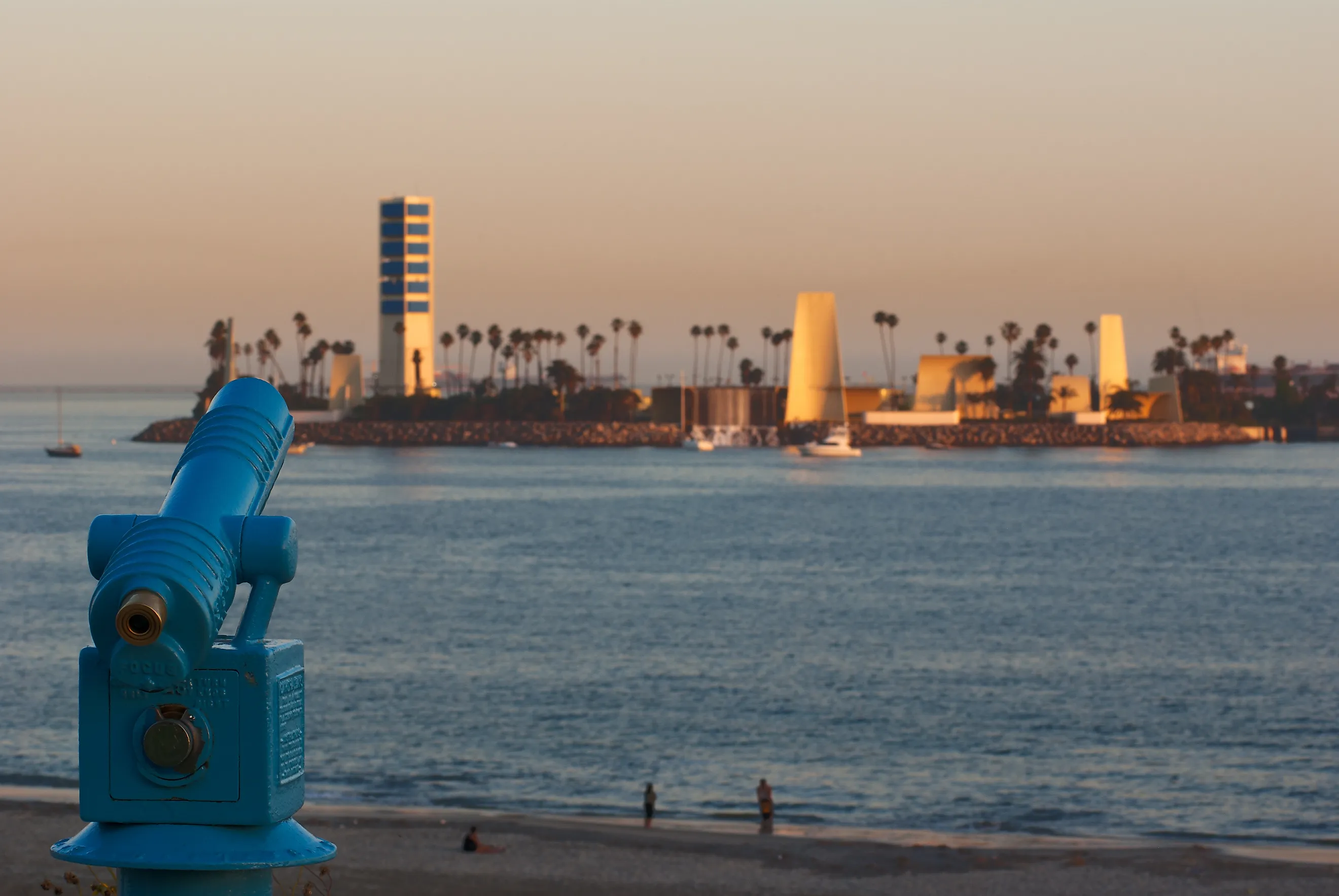
Here is the strangest part of the whole story: Los Angeles never actually stopped drilling, it simply learned to hide it. As the city grew up and around its oil fields, operators disguised their active well sites so thoroughly that most residents walk right past them without a clue. On Pico Boulevard, a windowless beige "office tower" known as the Cardiff Tower is really a drilling rig, concealing dozens of wells that angle out beneath the surrounding neighborhood, while the nearby Packard well site hides behind a similar facade. For decades, a derrick wrapped in colorful floral panels even operated right beside Beverly Hills High School, and elsewhere a tower on tracks quietly slides between wells drilled at sharp angles under the homes next door. Most dramatic of all, off the coast of Long Beach, four artificial islands dressed up with palm trees, sculptural walls, and waterfalls conceal more than a thousand wells, their tropical landscaping handled by a firm that had worked on Disneyland. From the shore, they look like resorts rather than oil platforms.
A City Riddled With Wells

Beneath the city itself, the legacy of all this drilling is far less glamorous. Over more than a century, Los Angeles County has been left honeycombed with thousands of old, idle, and orphaned wells, many of them capped and long forgotten under streets and buildings across the metro area, from downtown out toward cities like Glendale. These abandoned wells can leak methane and other gases, which has caused real trouble in the past, most notoriously a 1985 gas explosion in the Fairfax district that injured nearly two dozen people. Because nobody kept careful records in the chaotic early years, the exact location of many old wells is simply unknown, which complicates any new construction above them. In response to the mounting risks, California has recently tightened its rules on plugging and cleaning up idle wells. It is a quiet reminder that a city built on oil never fully escapes what lies beneath it.
What's Left of the Field Today

As for the Los Angeles City Oil Field itself, it has mostly played out. By 2011, just a single active well remained, hidden behind a fence in the Westlake neighborhood and producing a trickle of roughly three and a half barrels a day. Of the 1,250 wells and the vast forest of derricks that once defined the hills north of downtown, almost no trace survives above ground, long since replaced by homes, parks, and the busy streets of a modern metropolis. The crude is still down there, along with a century's worth of capped and buried wells, but you would never know it from the surface. The money the field generated, meanwhile, financed the search for other fields across the basin, from Salt Lake to Beverly Hills, that kept the region pumping for generations. So the next time you find yourself downtown, it is worth remembering that the gleaming city around you is standing squarely on top of the field that first made it rich.