10 Most Harmful Invasive Species In The World
- Some invasive species spread on the hulls of boats as they travel.
- Rabbits are an invasive species that has been very successful.
- Kudzu is an invasive vine.
An invasive species is a non-native plant, animal, or other organism that spreads beyond the place it was introduced and harms the local environment, economy, or human health. The damage tends to follow a few repeating patterns. The newcomer arrives without the predators, parasites, and competitors that held it in check back home, so its numbers climb unchecked. The native species around it, meanwhile, have no evolved defense against it, whether that means a toxin they cannot tolerate or a predator they do not recognize. Many of the worst offenders were moved deliberately, often to control some other pest, and then became a bigger problem than the one they were meant to fix. The ten species below show how that plays out on land and in the water, and why each one is so hard to undo.
European Rabbit

The European rabbit (Oryctolagus cuniculus) is native to the Iberian Peninsula and parts of northwest Africa, but its most destructive chapter belongs to Australia. Domestic rabbits arrived with the First Fleet in 1788, yet the feral population that overran the continent traces to a single release. In October 1859 the settler Thomas Austin set loose about two dozen wild rabbits on his estate near Geelong, Victoria, so he would have something to hunt. A 2022 genetic study confirmed that Australia's feral rabbits descend almost entirely from that one event. Within roughly 50 years they had spread across the continent, and the population today is estimated at around 200 million.
The harm comes down to appetite and sheer numbers. Rabbits graze native vegetation down to the roots, stripping ground cover, accelerating soil erosion, and removing the plants that native herbivores depend on. They breed faster than most control efforts can keep up with, and they compete directly with native mammals for food and burrows. Australia has thrown fences, poison, and two separate viruses at the problem: myxomatosis, released in 1950, killed an estimated 90 to 99 percent of rabbits at first, until survivors evolved resistance, followed by rabbit hemorrhagic disease from the mid-1990s. The rabbits are still there.
Small Indian Mongoose

The small Indian mongoose (Urva auropunctata, long catalogued as Herpestes auropunctatus) is native to southern Asia, across Iran, Pakistan, northern India, Nepal, and Myanmar. Beginning around 1870, sugar planters shipped it to islands across the Caribbean, then to Hawaii in 1883, Fiji, the Mascarenes, stretches of the South American coast, and several Japanese and Croatian islands. The aim was to clear rats and venomous snakes out of the cane fields. The mongoose did eat rats, but as a generalist daytime hunter it ate nearly everything else too.
That is the problem. On islands that had never held a small mammalian predator, ground-nesting birds, reptiles, amphibians, and small mammals had no defenses against it. The mongoose has been tied to the decline or disappearance of native species throughout its introduced range, including hawksbill turtle hatchlings, eight endangered Hawaiian birds such as the nene goose, and the Amami rabbit on Japan's Amami Oshima, where the animal was introduced in 1979. It also carries diseases including rabies and leptospirosis. It now sits on the conservation community's list of the world's worst invasive species, and eradication campaigns, such as the long effort on Amami, are slow and expensive.
Cane Toad

The cane toad (Rhinella marina, formerly Bufo marinus) is the largest toad in the world and is native to Central and South America. In 1935, around 100 of them were released in the sugarcane districts of Queensland, Australia, to eat the cane beetles damaging the crop. The toads ignored the beetles, which lived high on the stalks out of reach, and instead spread across northern Australia, where they have become a textbook case of biological control gone wrong.
What makes the cane toad so destructive is its defense rather than its diet. It carries a potent poison called bufotoxin in the parotoid glands behind its eyes, and the toxin is present at every stage of its life, including the eggs and tadpoles. Australia's native predators had never met a poisonous amphibian and had no resistance to it. Quolls, goannas, freshwater crocodiles, and several snake species die after mouthing or swallowing a toad, and their populations crash wherever the toads arrive. Australian authorities count dozens of native reptile species as threatened by the spread. A single female can lay clutches of 8,000 to 30,000 eggs, so once an area is colonized the toads are nearly impossible to clear.
European Starling

The European starling (Sturnus vulgaris) is native to Europe, North Africa, and western Asia. Its North American population began in 1890 and 1891, when Eugene Schieffelin and the American Acclimatization Society released roughly 100 birds in New York City's Central Park. (The popular tale that he wanted to introduce every bird mentioned in Shakespeare is now doubted by historians, though the release itself is well documented.) From that small founding flock, starlings spread across the continent within about 50 years and now number more than 200 million, over a third of the species worldwide.
Starlings are aggressive cavity nesters. They drive native birds such as bluebirds, woodpeckers, and purple martins out of nest holes, cutting into the breeding success of species that were already short on nesting sites. Large flocks descend on grain fields, feedlots, and orchards, and the U.S. government puts the resulting agricultural damage at roughly 800 million dollars a year. Their enormous winter roosts also foul buildings and have created safety hazards near airports.
Asian Carp

"Asian carp" covers four related fish from eastern Asia: bighead (Hypophthalmichthys nobilis), silver (H. molitrix), grass (Ctenopharyngodon idella), and black carp (Mylopharyngodon piceus). Fish farms and water-treatment operations in the southern United States imported them in the 1970s to keep algae, weeds, and snails out of their ponds. Flooding let the fish escape into the Mississippi River, and from there they pushed up the Missouri, Illinois, and Ohio river systems.
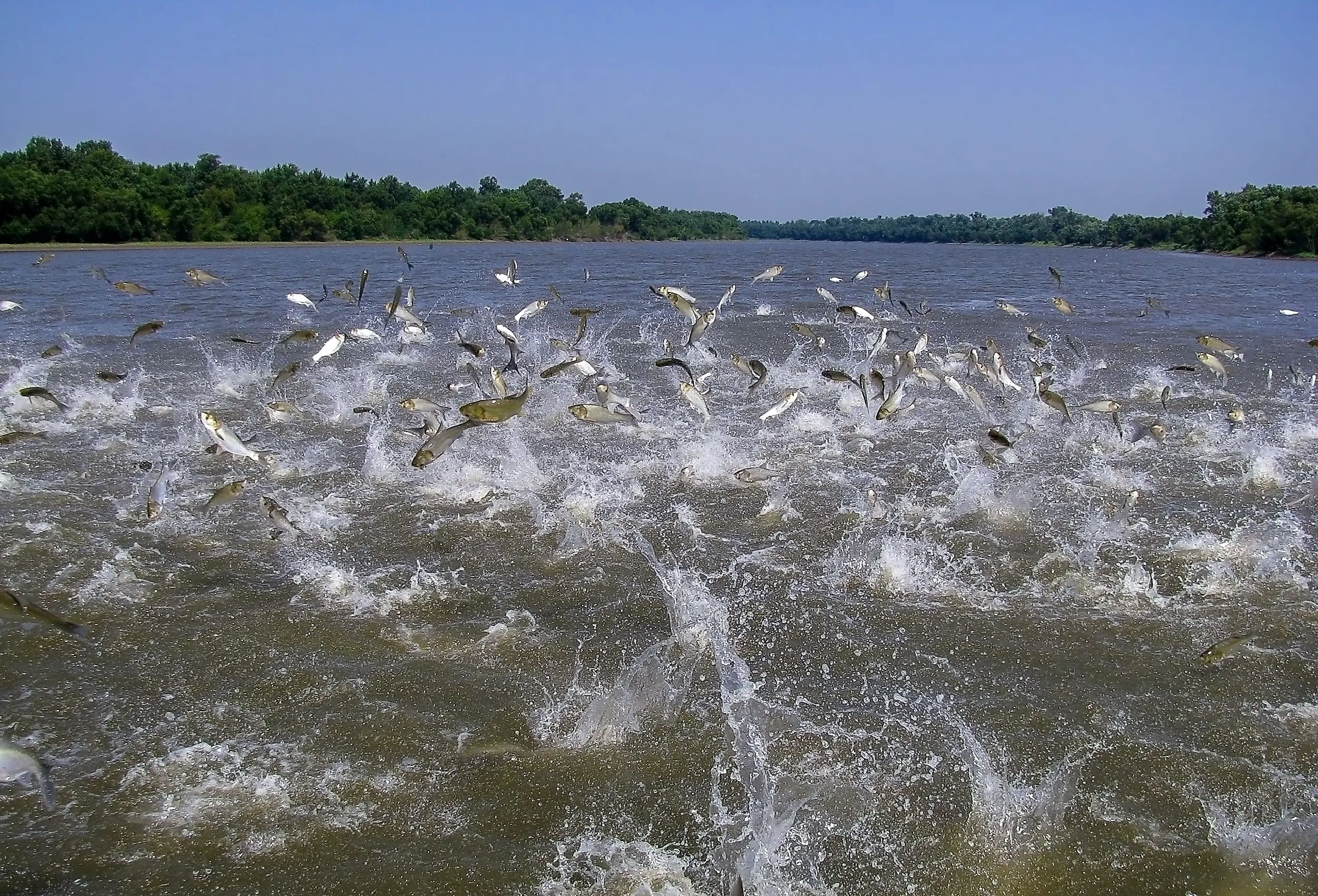
Bighead and silver carp are filter feeders that strain huge volumes of plankton from the water, eating as much as 5 to 20 percent of their body weight a day. That is the same food base the larvae of native fish depend on, and across parts of the Mississippi basin the carp now make up the majority of the fish by weight, crowding native species out. They grow large, breed fast, and have no real predators in North American waters. Silver carp add an odd hazard: startled by boat motors, they launch themselves out of the water and have injured boaters. The pressing worry now is the canal network linking the Illinois River to Lake Michigan, which could carry the carp into the Great Lakes and their multibillion-dollar fishery.
Northern Pacific Sea Star

The Northern Pacific sea star (Asterias amurensis) is a large five-armed starfish native to the coasts of Japan, Korea, China, and far eastern Russia. It reached southern Australia in the 1980s, almost certainly as microscopic larvae carried in the ballast water that cargo ships take on and discharge for stability. It first appeared in Port Phillip Bay near Melbourne and in Tasmania's Derwent Estuary, and in Port Phillip its numbers hit an estimated 12 million within two years.
It is a voracious predator of shellfish, favoring mussels, scallops, clams, and oysters, which puts it in direct conflict with native marine life and with commercial shellfish farms. Its best-known victim is the critically endangered spotted handfish (Brachionichthys hirsutus), found only around Tasmania. The sea star preys on the egg masses of the handfish and on the sea squirts the fish uses to anchor those eggs. With almost no native animal willing to eat it, the sea star ranks among the most damaging marine pests in Australia.
Zebra Mussel

Despite the name, the zebra mussel (Dreissena polymorpha) is a freshwater animal, not a marine one, and it will not survive in saltwater. It is native to the Black and Caspian Sea drainages of southeastern Europe and western Asia, and it reached North America in the late 1980s in the ballast water of ocean-going ships, first turning up in the Great Lakes near Detroit.
A single zebra mussel is no bigger than a fingernail, but they arrive in the millions. They are filter feeders, and a dense bed can strip the water of nearly all its suspended plankton, starving the native fish and mussels that rely on it. They also cement themselves by the thousands to any hard surface, including living native mussels, which they smother and kill, and they pack the intake pipes of power plants and municipal water systems, which is costly to clean and prevent. Once a lake or river is colonized the mussels are effectively permanent, and they have spread across much of the eastern and central United States on the hulls and in the bilge water of recreational boats.
Asian Long-Horned Beetle

The Asian long-horned beetle (Anoplophora glabripennis) is a large wood-boring insect native to eastern China and the Korean Peninsula. It has been carried into North America and Europe inside solid-wood packing material, the pallets and crates used in international shipping, and was first detected in the United States in 1996, on Long Island, New York.
The damage is done out of sight. Adult females lay eggs beneath the bark of hardwood trees, and the larvae tunnel deep into the wood, carving galleries through the tissue that moves water and nutrients up the trunk. Over a few years this girdles the tree from the inside, weakening its limbs and eventually killing it; infested trees almost always have to be cut down. The beetle attacks a wide range of hardwoods and is especially drawn to maples, which makes it a threat to city street trees, northern hardwood forests, and the industries that depend on hardwoods, including timber and maple syrup. Because there is no way to cure an infested tree, control means quarantine and the removal of every host tree in an outbreak zone, which has already meant felling tens of thousands of trees in affected areas.
Water Hyacinth

Water hyacinth (Pontederia crassipes, formerly Eichhornia crassipes) is a free-floating freshwater plant native to the Amazon basin of South America. Prized for its lavender flowers, it was carried around the world as an ornamental pond plant and now grows in more than 50 countries. It is one of the fastest-growing plants known, and a mat can double in size in one to two weeks.
That growth is the whole problem. The plant forms dense floating mats that seal off the surface of a lake or river. The mats block sunlight from reaching submerged plants and choke off the exchange of oxygen between the water and the air, so dissolved oxygen levels drop and fish and other aquatic animals suffocate. The mats also jam waterways, stall boats, foul fishing gear, and increase water loss through the plant's heavy transpiration. Because it regrows from broken fragments and from seeds that stay viable for years, clearing it is a constant and costly fight.
Kudzu

Kudzu (Pueraria montana) is a climbing vine in the bean family, native to East Asia. It arrived in the United States as an ornamental at the 1876 Centennial Exposition in Philadelphia, and through the 1930s, 1940s, and 1950s the federal Soil Conservation Service actively promoted it across the South to control erosion, even paying farmers to plant it. It earned the nickname "the vine that ate the South."
The trouble is its speed. In peak season kudzu can grow about a foot a day, throwing vines as long as 100 feet over the ground, up trees, and across anything that holds still. As it climbs, it blankets the plants beneath it and shuts them off from sunlight, so they can no longer photosynthesize and they die. Whole stands of native trees and shrubs can be smothered under a single sheet of kudzu, replacing a diverse plant community with a vine monoculture. Deep roots and energy-storing tubers let it shrug off drought and resprout after cutting, which is why it was listed as a federal noxious weed in 1998 and remains entrenched across the southeastern states.
What the Ten Have in Common
For all the difference between a vine, a beetle, and a 200-million-strong rabbit population, the same story runs through every case. A species is moved somewhere new, on purpose or by accident, and lands without the predators and competitors that limited it at home. It then breeds or spreads faster than anything local can match, and the native species around it have no evolved answer to a new toxin, an unfamiliar predator, or a mat of leaves sealing off the water. Several of these, including the cane toad, the small Indian mongoose, the Northern Pacific sea star, and water hyacinth, appear on the conservation community's lists of the world's worst invaders. The clearest lesson is that prevention costs far less than the cure. Nearly every species here is now considered impossible to fully remove, and simply holding them back runs to billions of dollars a year.