The Deepest Lakes In The United States
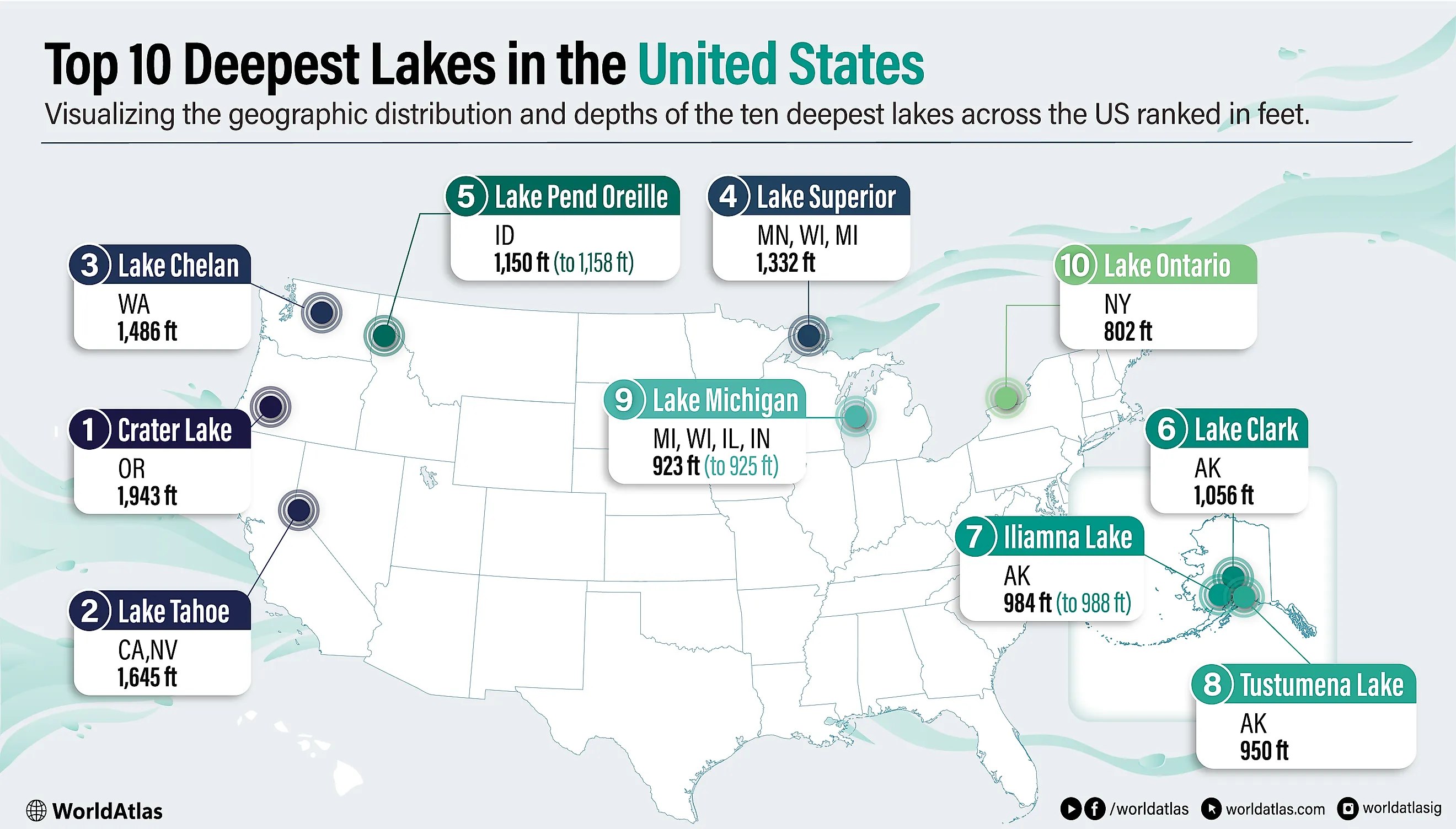
With about half a million lakes in the contiguous United States and more than 3 million in Alaska, only a small number reach truly extraordinary depths. The 10 deepest lakes in the country were shaped by powerful geological forces over thousands, or in some cases millions, of years. Some, like Crater Lake, were formed by volcanic collapse, while others, including Lake Tahoe, Lake Chelan, and Lake Superior, were carved and deepened by glaciers. Alaska also claims several of the nation’s deepest lakes, including Lake Clark, Iliamna Lake, and Tustumena Lake. Together, these lakes stand out for their immense depth, striking scenery, and the dramatic natural history that created them.
The 10 Deepest Lakes In The United States
| Rank | Lake | States | Depth in Feet |
|---|---|---|---|
| 1 | Crater Lake | Oregon | 1,943 |
| 2 | Lake Tahoe | California, Nevada | 1,645 |
| 3 | Lake Chelan | Washington | 1,486 |
| 4 | Lake Superior | Minnesota, Wisconsin, Michigan | 1,332 |
| 5 | Lake Pend Oreille | Idaho | 1,150 to 1,158 |
| 6 | Lake Clark | Alaska | 1,056 |
| 7 | Iliamna Lake | Alaska | 984 to 988 |
| 8 | Tustumena Lake | Alaska | 950 |
| 9 | Lake Michigan | Michigan, Wisconsin, Illinois, Indiana | 923 to 925 |
| 10 | Lake Ontario | New York | 802 |
1. Crater Lake - 1,943 Feet

A relatively young lake in southwest Oregon, Crater Lake formed 7,700 years ago after the powerful explosion of Mount Mazama created a volcanic crater that was later filled with rain and snowmelt, resulting in a lake that is not only the deepest in the United States at 1,943 feet (592 meters) but also one of the clearest in the country. In fact, Crater Lake is so deep that at its greatest depth, the combined height of the Eiffel Tower, the Washington Monument, and the Statue of Liberty would not even reach the bottom. Today, it is protected by Crater Lake National Park, which bans private boats. Even still, parkgoers can enjoy swimming in designated areas and take in the dramatic volcanic landscape from scenic overlooks and hiking trails.
But wait, if it is that deep, how did people measure it in the first place? In 1886, US geologists got creative and developed a rudimentary measuring tool using nothing but a lead pipe attached to piano wire. By their original estimates, the lake was measured at 1,996 feet (608 meters). As stronger and more accurate measuring tools were developed, geologists later used multibeam sonar to refine the measurement and found that the early team was only 53 feet (16 meters) off the mark.
2. Lake Tahoe - 1,645 Feet

Tucked away in the Sierra Nevada mountains along the California and Nevada border, Lake Tahoe is a major destination for hikers, cyclists, boaters, skiers, and swimmers. It has a measured depth of 1,645 feet (501 meters), making it the second-deepest lake in the country. Lake Tahoe has a surface area of about 191 square miles (495 square kilometers) and holds roughly 39 trillion gallons of water. About 63 streams flow into the lake, while only one river—the Truckee River—flows out, eventually draining into Pyramid Lake in Nevada. Because of its high elevation and size, Lake Tahoe is often referred to as the largest alpine lake in North America.
3. Lake Chelan - 1,486 Feet

Washington's Lake Chelan was carved by glaciers during multiple advances of the Cordilleran Ice Sheet during the last Ice Age. Today, the lake reaches a maximum depth of 1,486 feet (453 meters), placing it third on this list. It is long and narrow, stretching about 50.5 miles (81 kilometers) and reaching roughly 2 miles (3.2 kilometers) at its widest point. Chelan’s northwestern end lies within the Lake Chelan National Recreation Area, which borders North Cascades National Park. This upper portion of the lake is remote and largely surrounded by protected forest lands. In contrast, the southeastern end near the city of Chelan is more developed and is known for tourism, apple orchards, vineyards, wineries, and vacation homes.
4. Lake Superior - 1,332 Feet

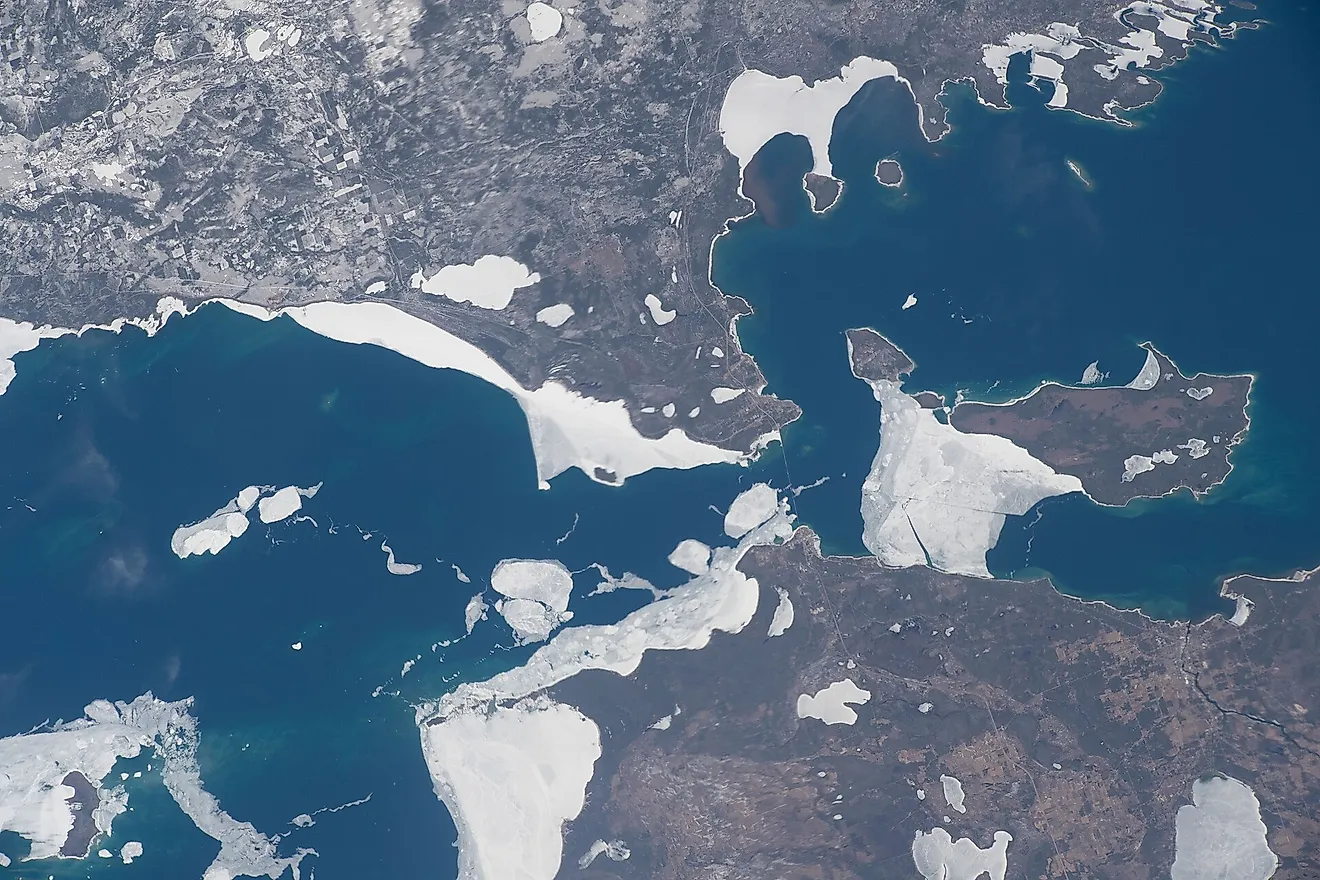
When glaciers crashed through the upper Midwest in the last Ice Age, the region’s soft rock was transformed into a series of huge basins that filled with meltwater as the ice retreated, thus forming the five Great Lakes. Superior, Michigan, Huron, Erie, and Ontario make up this chain of lakes. Of the five, Lake Superior is both the largest and the deepest, reaching a measured depth of 1,332 feet (406 meters). Despite Lake Superior being ranked fourth on this list, it still lives up to its name in other ways. It holds about 10 percent of the world’s fresh surface water and has the largest surface area of any freshwater lake on Earth, covering about 31,700 square miles (82,100 square kilometers) and stretching across the border between the United States and Canada.
5. Lake Pend Oreille - 1,150 to 1,158 Feet

Lake Pend Oreille in the Idaho Panhandle boasts a depth of about 1,150 to 1,158 feet (roughly 351 to 353 meters), making it the fifth-deepest lake in the United States. The basin was initially carved by glaciers during the last Ice Age, and the region was later shaped by a series of massive floods linked to the repeated outbursts of Lake Missoula thousands of years ago. In more recent history, the US Navy established Farragut Naval Training Station at the southern end of the lake during World War II. Built in 1942, the base became the second-largest naval training center in the world and trained hundreds of thousands of sailors before closing after the war. Today, Lake Pend Oreille is known as a fishing destination and is home to several species of trout, including a record-breaking 37-pound rainbow trout caught in 1947.
6. Lake Clark - 1,056 Feet

Located in remote southern Alaska, Lake Clark reaches a maximum depth of about 1,056 feet (322 meters), making it the sixth-deepest lake in the country. Set within Lake Clark National Park and Preserve, the lake is surrounded by rugged mountains, glaciers, and undeveloped wilderness, giving it one of the most dramatic settings of any lake on this list. The lake stretches for roughly 42 miles (68 kilometers) and has long served as an important travel corridor for Indigenous communities in the region. Today, it is best known for its remote scenery, sport fishing, and access to backcountry adventures. Because it lies far from major roads and cities, Lake Clark feels very different from more heavily visited lakes farther south, offering a deeper look at Alaska’s wild interior landscapes.
7. Iliamna Lake - 984 to 988 Feet

Also in Alaska, Iliamna Lake ranks seventh, with a maximum depth commonly cited at about 984 to 988 feet (300 to 301 meters). It is the largest lake in Alaska and one of the largest freshwater lakes entirely within the United States. The lake was shaped by glacial forces and is known for its vast open water, remote shoreline, and outstanding salmon habitat. Several rivers feed into and out of the lake, helping support one of the region’s richest fisheries. Iliamna is also famous for an unusual natural feature: it is home to a rare population of freshwater seals. Surrounded by mountains and volcanic landscapes, the lake remains lightly developed and is prized for fishing, wildlife viewing, and the sense of isolation that defines much of southwest Alaska.
8. Tustumena Lake - 950 Feet

Tustumena Lake, on Alaska’s Kenai Peninsula, reaches a depth of about 950 feet (290 meters), placing it eighth on this list. Fed in part by glacial melt, the lake is known for its cold, silty waters and unpredictable winds, which can make boating conditions challenging. Tustumena is part of the Kenai National Wildlife Refuge and lies at the foot of the Tustumena Glacier, which helps give the lake its striking wilderness setting. The surrounding area supports bears, moose, eagles, and salmon, making it important both ecologically and recreationally. Although it is not as famous nationally as some of the lower-48 lakes on this ranking, Tustumena stands out for its depth and remoteness. Its wild shoreline and glacier-backed scenery make it one of Alaska’s most memorable inland waters.
9. Lake Michigan - 923 to 925 Feet

At about 923 to 925 feet (281 to 282 meters) deep, Lake Michigan ranks ninth among the deepest lakes in the United States. It is the only one of the five Great Lakes located entirely within the United States, bordered by Wisconsin, Illinois, Indiana, and Michigan. Like the other Great Lakes, it was carved by glaciers during the last Ice Age. Beyond its depth, Lake Michigan is notable for its enormous size, long sandy shoreline, and economic importance to the Midwest. Major cities including Chicago and Milwaukee sit along its shores, and its waters support shipping, tourism, and recreation on a massive scale. Even though it is often discussed more for its size than its depth, Lake Michigan easily earns a place among the deepest lakes in the country.
10. Lake Ontario - 802 Feet

Rounding out the top 10, Lake Ontario reaches a maximum depth of about 802 feet (244 meters). Shared by New York and the Canadian province of Ontario, it is the smallest Great Lake by surface area, but it is still impressively deep. Like the rest of the Great Lakes, Ontario was formed by glacial activity during the last Ice Age and later filled with meltwater as the ice sheets retreated. The lake plays a major role in regional transportation, ecology, and freshwater supply, and it connects to the Atlantic Ocean through the St. Lawrence River. Its shorelines include major urban centers such as Toronto and Rochester, as well as beaches, parks, and wetlands. Though often overshadowed by the larger Great Lakes, Lake Ontario’s depth secures its place on this ranking.
From the volcanic depths of Crater Lake to the glacier-carved basins of Lake Tahoe, Lake Chelan, and the Great Lakes, the deepest lakes in the United States reveal a landscape shaped by ice, fire, and time. Alaska’s Lake Clark, Iliamna Lake, and Tustumena Lake also rank among the country’s deepest, adding remote northern wilderness to the story. Together, these 10 lakes highlight some of the most dramatic freshwater environments in North America.