6 Most Snake-Filled Bodies Of Water In Ontario
Seventeen snake species call Ontario home. One of them rattles. Several have a habit of playing dead when cornered. One can hold its breath underwater for an hour. A handful are endangered or threatened and seeing them in the wild is a small thrill. Six waterways concentrate enough of the action to deserve a closer look.
Georgian Bay

Georgian Bay is a massive extension of Lake Huron. Known colloquially, although not officially, as "the sixth Great Lake," the bay is delineated from the broader Great Lake by the long arm of the Bruce Peninsula and the eastern shore of Manitoulin Island. Georgian Bay has stark limestone cliffs and thousands of gneiss islands, where pines and shrubbery hold fast against brisk north winds.
The naturescape, and the many snakes it harbors, is protected by Bruce Peninsula National Park, Fathom Five National Marine Park, Georgian Bay Islands National Park, the Niagara Escarpment Biosphere Reserve, the Georgian Bay Mnidoo Gamii Biosphere Reserve, and many provincial parks.
Despite its truncated summer season, the Georgian Bay region congregates plenty of cold-blooded creatures. The Georgian Bay Mnidoo Gamii Biosphere has catalogued 11 species of snakes, and a total of 33 species of reptiles and amphibians have been documented in Georgian Bay Islands National Park, more than any other national park in Canada. Beausoleil Island (the park's largest island) has been designated as an Important Amphibian and Reptile Area (IMPARA) by the Canadian Herpetological Society.
One reason for this is the presence of the eastern hog-nosed snake (special concern), the eastern fox snake (endangered), and the venomous Massasauga rattlesnake (threatened). The Massasauga is most associated with the Georgian Bay region, though smaller, isolated populations also occur in southern Ontario.
Wainfleet Bog

While we're on the subject of Ontario's only venomous snake, let's take a closer look at one of its remaining sub-populations outside of the Georgian Bay region. The Wainfleet Bog Conservation Area sits just north of Lake Erie near the waterfront community of Port Colborne. The wetland is the largest remaining bog in Southern Ontario, and the only bog wetland of the Niagara Peninsula. Along with being an Area of Natural and Scientific Interest (ANSI) and the site of a rare peatland community, the Wainfleet Bog is home to as many as 70 mature Massasauga rattlesnakes.
Though this venomous species is biologically consistent with its brethren to the north, this isolated community is considered part of the Carolinian population (endangered), as opposed to the Great Lakes-St. Lawrence population (threatened). Should you find yourself wading the waters of either Wainfleet or Georgian Bay, note that the Massasauga rattlesnake looks similar, and behaves similarly, to its serpentine peers.
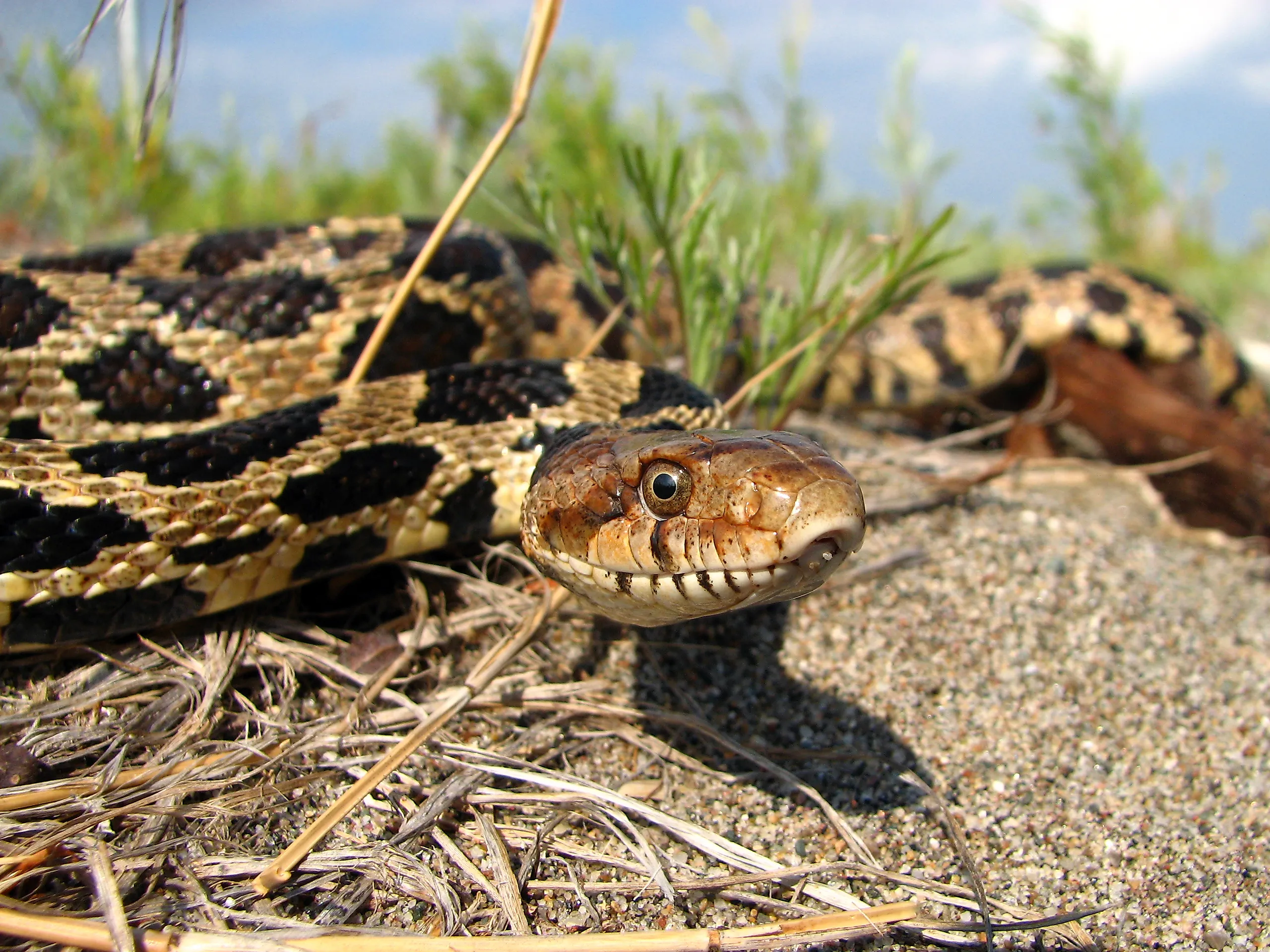
For example, the fox snake, northern water snake, milk snake, and hognose snake all have blotched patterns on their bodies, and the first three will also rattle their tails in a defensive act of mimicry. (Even though they lack an actual rattle, the shaking of their tails against vegetation can still produce a similar sound.) The Massasauga rattler can be differentiated by its short (47-76 centimeters/19-30 inches) and stout body, its diamond-shaped head, and its vertical, cat-like pupils.
Lake Erie

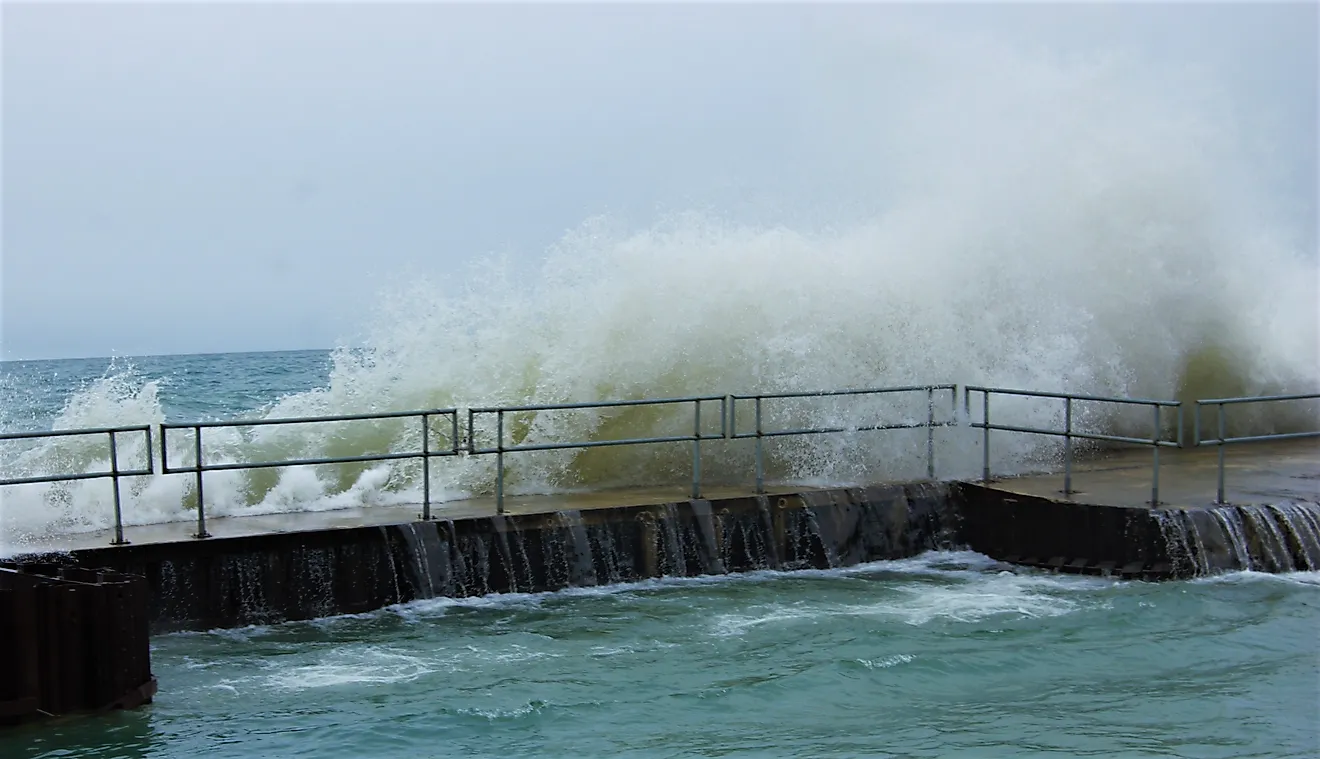
Lake Erie is the shallowest and southernmost (and therefore warmest) of the five Great Lakes. The setup theoretically makes it conducive to snakes; however the relatively higher rates of shoreline development and historical industrial contaminants have impacted wildlife of all kinds. Several provincially and even nationally rare species of snakes still find sanctuary in and around Lake Erie.
On top of the satellite community of Massasauga rattlesnakes found just off Lake Erie's northeast shore, western Lake Erie's Pelee Archipelago introduces three more snakes of interest. The Lake Erie water snake slithers and swims around the shorelines of Pelee Island, Canada's southernmost inhabited point. Here, just north of the Ohio border, the endangered eastern fox snake, the second-largest snake in Ontario, also takes up residence. And finally, having been extirpated from the mainland in the early 1980s, Pelee Island is the only remaining habitat for the swift, beautiful (and crucially endangered) blue racer.
Sydenham River Watershed

The Sydenham River Watershed covers 2,751 square kilometers (1,062 square miles) of Southwestern Ontario, an area known as Canada's Carolinian Life Zone. The North and East Sydenham branches cover primarily agricultural lands before converging near Wallaceburg and emptying into Lake St. Clair shortly thereafter. The silty streams, rich soils, and temperate climate create a bastion of biodiversity, including dozens of species at risk.
Along with 20 species of at-risk fish and mussels and five species of turtles, three snake species of conservation significance live in the Sydenham Watershed: the eastern fox snake, eastern hog-nosed snake, and eastern milk snake. The lengthy fox snake (upwards of 1.8 meters/6 feet) is an excellent climber and swimmer and is just as likely to be spotted in the canopy as the slow-moving waterways below.

The stout hog-nosed snake likes to hang out in open habitat near water, and stands out not only because of its namesake facial feature, but also its two-part defensive strategy. First, the hog-nose snake goes on the offensive: raising its head, hissing, and repeatedly bluff-striking with a closed mouth. If that doesn't do the trick, a dramatic playing-dead routine follows in which the snake flips on its back, writhes, and excretes a repulsive odor. The performance can lead to hog-nose snakes being killed by humans who mistake the act for a medical emergency. Lastly, the milk snake is flexible to a range of habitats but does generally prefer to be near a source of water with good cover for egg-laying and hibernation.
Charleston Lake

The rocky yet forested shorelines of this large, splotchy waterbody support nine species of snakes, including a couple of curious species we've not yet met. The eastern ribbon snake is common within Charleston Lake Provincial Park but is listed as special concern by Ontario authorities. The slender snake has three bright-yellow stripes running lengthwise down its black back and can usually be found close to the water (enter Charleston Lake), where it feasts on frogs and sometimes dives into shallow areas to evade predators.
The gray rat snake (also called black rat snake or eastern rat snake) is a rarer find. Reaching as long as 2 meters (6.5 feet), the gray rat snake is Ontario's largest snake. Juveniles exhibit gray coloration with darker blotching, while adults sport a shiny black body that adds to its startling, seemingly out-of-place appearance. There are two known populations of rat snakes in Ontario. The Carolinian population is endangered and trends toward the fringes of forests, whereas Charleston Lake's Frontenac Axis population is listed as threatened and relies on a variety of habitats including the lake and surrounding wetlands.
Lake Huron

Since we started our snake investigation on the eastern shores of Lake Huron (Georgian Bay), let's finish back on its lengthy and scenic southern shoreline. Stretching from the Michigan border city of Sarnia, through the summertime attractions of Lambton Shores and havens such as Bayfield, all the way to Tobermory at the tip of the Bruce Peninsula, Lake Huron's Southern Ontario lakeshore is as much a magnet for hikers and campers as it is for snakes.
Using the popular and ecologically significant Pinery Provincial Park as a snapshot, we can get a quick idea of what snakes are drawn to the main body and offshoots of Lake Huron. The Pinery is home to seven different snake species. The northern water snake is well adapted to the lake-paralleling Old Ausable Channel and other slow-moving extensions of the Great Lake. A proficient swimmer, the northern water snake can also hold its breath for up to an hour (helpful when evading predators) and has evolved teeth fit for snatching slippery prey.

The hog-nosed snake can also be found here, although its provincial population continues to face pressures. The smooth green snake might be hard to spot because it only grows to about 40 centimeters (16 inches) on average and its coloration helps it blend in with vegetation. Conversely, two of Ontario's most common snakes (eastern garter snake and De Kay's brown snake) live not only in the Pinery, but up and down this entire coast.
Ontario's Sneaky Snake Populations

Whether it's the streets of Toronto, the beaches of the Great Lakes, or the heavy snows that descend for months on end, Ontario doesn't initially seem conducive to snakes. But as we have seen, 17 native species manage, and many of them turn up around the province's waterways. In some cases, like the ubiquitous garter snake or highly adaptive water snake, these serpents thrive in fair-weather conditions and hibernate the winters away. In other cases, such as the Massasauga rattlesnake or blue racer, unique species are pushed to their limits. So as summer returns, pay extra heed to the snakes of Ontario's waterways. They're overwhelmingly harmless and are just there to enjoy the same waterfront bounty as the rest of us.