The Most Humid States in the United States
Humidity is one of the defining characteristics of many regional climates in the United States. Humidity refers to the amount of water vapor present in the air, and scientists measure it using several indicators, including relative humidity and dew point.
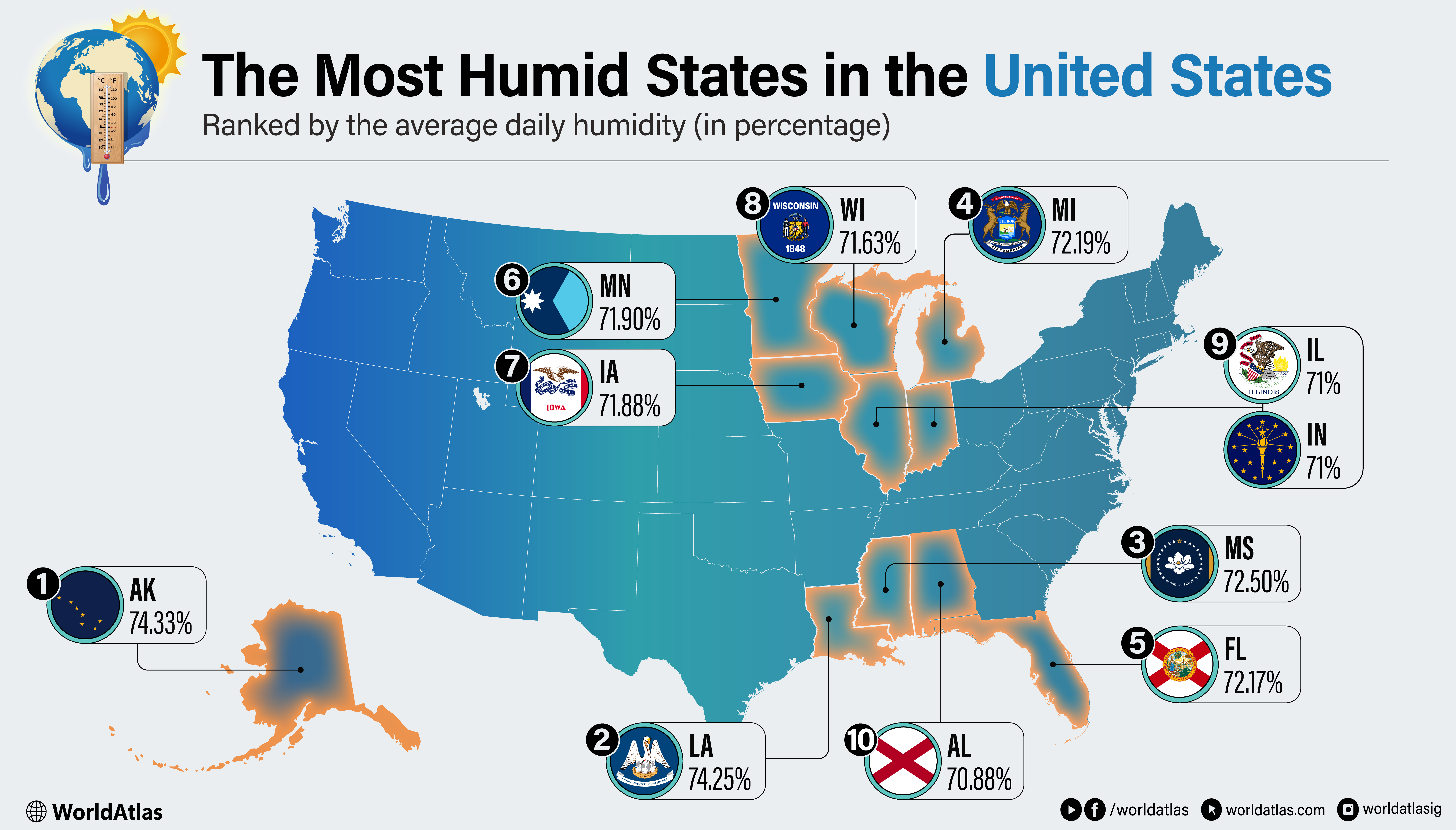
Relative humidity describes how close the air is to saturation. It is expressed as a percentage, comparing the amount of water vapor currently in the air to the maximum amount the air can hold at a given temperature. Because warm air can hold more moisture than cold air, regions with higher temperatures and abundant water sources tend to experience the most persistent humidity. Coastal geography, prevailing wind patterns, and local climate zones also play major roles. These factors combine to make the following states the most humid in the country, based on average daily humidity. According to the National Oceanic and Atmospheric Administration (NOAA), Alaska, Louisiana, and Mississippi rank among the most humid states in the country.
Alaska (74.33%)

Despite its cold climate, Alaska frequently ranks among the states with the highest relative humidity. The reason lies in the relationship between temperature and moisture capacity. Cold air can hold far less water vapor than warm air. As a result, even a small amount of moisture in frigid air can produce very high relative humidity readings. In coastal areas such as Juneau, the average relative humidity often ranges from 75% to 85% throughout the year. The city’s proximity to the Pacific Ocean provides a steady source of moisture, while cool temperatures prevent the air from holding large quantities of water vapor.
Geography also contributes to Alaska’s persistent humidity. Much of the southern coastline lies within the Marine West Coast climate zone, where frequent cloud cover, ocean moisture, and regular precipitation keep the atmosphere close to saturation. Here, seasonal variation is noticeable but moderate. Winter temperatures remain cold but moist due to ocean influence, while summer brings slightly lower humidity levels as warmer air can hold more moisture before becoming saturated.
Louisiana (74.25%)

Louisiana consistently ranks among the most humid states due to its subtropical climate, low elevation, and direct exposure to moisture from the Gulf of Mexico. Much of the state lies near the 30th parallel north, a latitude associated with strong solar radiation and warm temperatures for much of the year. In New Orleans, for example, average morning relative humidity frequently exceeds 90% during summer, while dew points commonly remain above 70°F. These conditions create the heavy, muggy air for which the region is known.
The state’s geography intensifies these effects. Extensive wetlands, bayous, and marshes provide additional sources of evaporation beyond the Gulf itself. As sunlight warms these shallow water bodies, moisture readily enters the atmosphere. Seasonal patterns further reinforce Louisiana’s humidity. Long summer days allow the land and water to absorb and retain large amounts of solar energy, increasing evaporation. Combined with frequent thunderstorms and persistent Gulf air masses, these factors help maintain very high humidity levels from late spring through early fall.
Mississippi (72.5%)

Mississippi shares many of the same climatic influences as its neighboring Gulf Coast states. The state’s humid subtropical climate is characterized by warm temperatures, abundant precipitation, and frequent inflows of moist air from the Gulf of Mexico. Cities such as Jackson and Biloxi often experience average morning relative humidity levels between 85% and 90% during the summer months, while dew points regularly climb into the upper 60s and low 70s, producing the muggy conditions typical of southern summers.
Prevailing southerly winds are one of the primary drivers of Mississippi’s humidity, transporting warm, moisture-laden air from the Gulf northward across the state, particularly from late spring through early fall. When combined with daytime heating, this moisture contributes to frequent thunderstorms and sustained atmospheric humidity. Seasonal variation mirrors the broader Gulf Coast region. Summer brings the highest humidity levels due to stronger solar heating and warmer Gulf waters, while winter typically features slightly lower humidity as cooler temperatures reduce evaporation rates.
Michigan (72.19%)

In a completely different part of the country, Michigan is also known for its variable but often humid climate, caused by its proximity to the Great Lakes. Surrounded by four of the five Great Lakes, the state has a steady influence of moisture-laden air, particularly during the warmer months. Cities like Detroit and Grand Rapids frequently see average morning relative humidity levels around 82% before dipping into the low 60s in the afternoon.
Michigan’s climate is classified as humid continental, which is a climate characterized by large seasonal temperature differences and moderate to high humidity in the warmer months. During late spring and summer, increased heating from the sun drives evaporation from the Great Lakes, injecting significant moisture into the atmosphere. Winds from the west and south then carry this moisture across the state, contributing to elevated humidity levels.
Seasonal patterns play a key role in Michigan’s humidity profile as well. The highest humidity levels typically occur from June through August, when lake temperatures rise and evaporation peaks. In contrast, autumn brings a gradual drying trend, and winters are considerably less humid, as cold air holds less moisture. Proximity to the lakes can still produce localized moisture effects, however, including lake-effect cloud cover and abundant snowfall.
Florida (72.17%)

Florida is widely recognized for its muggy climate, driven by a combination of warm temperatures, surrounding ocean waters, and tropical air masses. This comes as no surprise, given that the peninsular state is bordered by the Atlantic Ocean and the Gulf of Mexico, both of which act as consistent sources of atmospheric moisture. Cities such as Miami and Tampa regularly record average morning relative humidity values between 85% and 90% during the summer months. Afternoon humidity typically drops slightly as temperatures rise, but dew points often remain above 70°F, a level considered uncomfortably humid.
Like Mississippi, Florida’s climate is classified primarily as humid subtropical, with parts of South Florida approaching a tropical climate. During the summer, intense solar heating increases evaporation from surrounding waters, and prevailing winds transport this moisture inland, where it fuels frequent thunderstorms and maintains high atmospheric moisture levels. Seasonal variation is also pronounced. Humidity tends to peak from June through September, when warm ocean waters and strong solar heating combine to maximize evaporation. The winter months are somewhat drier but remain humid compared with most parts of the United States.
Minnesota (71.9%)

The “Land of 10,000 Lakes” is great for water sports, but those lakes also earn Minnesota a spot on this list of the most humid states in the US. Minnesota also sits in the path of air masses moving north from the Gulf, and during late spring and summer, those southern winds transport warm, moisture-rich air that adds to locally generated moisture from lakes and wetlands. Minneapolis and St. Paul often record morning relative humidity levels between 80% and 85% in warmer months. Afternoon humidity typically declines as temperatures rise, though dew points can reach the mid to upper 60s to create humid and muggy conditions.
Like Michigan, Minnesota’s climate is humid continental. During late spring and summer, solar heating drives evaporation from lakes and wetlands, increasing atmospheric moisture. Seasonally, humidity peaks from June through August, when temperatures and evaporation rates are highest. Fall brings drier air, while winter humidity drops significantly due to cold temperatures limiting moisture retention, despite occasional localized effects from frozen or partially open water surfaces.
Iowa (71.88%)

Iowa is the nation’s number one state for corn production, and they come in second for soybeans; however, all that agriculture also contributes to Iowa’s placement on our list. Despite being a landlocked state, Iowa becomes relatively humid from June through August, aligning with peak growing season and maximum evapotranspiration. Plants like corn and soybeans pull water from the soil and release it through their leaves in a process called transpiration, which is essentially how plants breathe. In heavily farmed regions, millions of acres of crops are doing this at the same time, which can significantly increase atmospheric moisture.
Conditions become drier in the fall, and winters are comparatively less humid due to colder air and reduced moisture availability. While it lacks large bodies of water, moisture is also frequently transported into the region from the south, and cities like Des Moines and Cedar Rapids commonly experience morning relative humidity levels of 80% to 85% during the summer months.
Wisconsin (71.63%)

Wisconsin’s humidity is shaped by its proximity to the Great Lakes and its northern continental climate. Moisture from Lakes Michigan and Superior plays a significant role in the state’s atmospheric conditions, and many urban areas report summer morning humidity levels between 80% and 85%. Afternoon levels may ease slightly, but dew points frequently reach the mid to upper 60s, occasionally producing muggy conditions that last throughout the day.
Wisconsin’s humid continental climate features warm summers and cold winters. During the summer, heat from the sun increases evaporation from nearby lakes and inland water sources, while wind distributes moisture across the region. This contributes to its high humidity levels. Like many of these states, humidity peaks from June through August, when lake temperatures and evaporation rates are highest. In contrast, fall introduces drier air masses, and winter humidity is significantly lower due to colder temperatures, though lake-effect influences can still contribute to localized moisture and cloud cover.
Illinois & Indiana (71%)

Illinois and Indiana share very similar humidity patterns, shaped by their location in the Midwest and exposure to moisture transported from the south. While neither state is dominated by large inland water systems, both are influenced by regional air masses and nearby features such as Lake Michigan. Similar to Wisconsin, cities like Chicago, Springfield, and Indianapolis experience morning relative humidity levels between 80% and 85% during the summer months. Afternoon humidity generally decreases as temperatures rise, though dew points often remain in the upper 60s to low 70s, creating stretches of muggy and uncomfortable conditions.
Both states are classified as having a humid continental climate, with hot summers and cold winters. During late spring and summer, south winds transport moisture northward from the Gulf, significantly increasing atmospheric humidity. This influx of warm, moist air frequently contributes to thunderstorm activity and sustained high moisture levels across the region. Seasonal variation is pronounced, with humidity peaking from June through August when temperatures and evapotranspiration rates are at their highest. In the fall, drier air begins to move in, greatly reducing the humidity.
Alabama (70.88%)

Alabama’s humidity levels are also strongly influenced by the Gulf of Mexico and the state’s humid subtropical climate. Although only the southern edge of Alabama directly borders the Gulf, moist air masses frequently move inland across the entire state. In coastal Mobile, average morning relative humidity during summer often reaches 90% or higher, while cities farther north, such as Birmingham, still regularly record values above 80%. Geography plays a key role in this pattern. Warm Gulf waters supply moisture that evaporates into the atmosphere, and prevailing winds transport that moisture northward. Alabama’s forests, rivers, and lakes also contribute additional local evaporation, further increasing atmospheric moisture.
Seasonally, humidity peaks during the late spring and summer months, when higher temperatures increase evaporation rates. Thunderstorms are common during this period, and rainfall helps maintain high moisture levels in the air. Winter conditions are typically less humid, though the region still experiences higher moisture levels than many inland states.
The Science Behind The Humidity
Understanding why these states are so humid requires looking at the underlying physics of the atmosphere. Warm air molecules move more rapidly than cold air molecules, allowing warm air to contain more water vapor before reaching saturation. This is why tropical and subtropical regions tend to experience the highest humidity levels. Relative humidity alone does not always reflect how humid conditions feel, however. For example, Alaska tops this list and reports very high relative humidity because cold air reaches saturation quickly. However, the actual amount of water vapor present is relatively small. Dew point provides a clearer picture of how humid the air actually feels. When dew points rise above 65°F, many people begin to perceive the air as muggy, and dew points above 70°F often feel oppressive because the body’s natural cooling system, the evaporation of sweat, becomes less effective. In the United States, the most persistently high dew points occur along the Gulf Coast and southeastern states, where warm ocean waters continuously supply moisture to the atmosphere.