Lynx
The lynx is one of the most recognizable wild cats of the Northern Hemisphere, known for its tufted ears, dense coat, and oversized paws adapted for snow travel. Across boreal forests, mountain ranges, and remote scrublands, this predator occupies a wide but fragmented range. This is shaped by climate, prey availability, and habitat density. Although rarely observed in the wild due to its secretive behavior, the lynx plays an important ecological role as a specialized hunter, helping regulate populations of small- and medium-sized mammals across northern ecosystems.
Four species belong to the lynx genus, each adapted to distinct geographic regions but sharing core evolutionary traits. These include the Canada lynx (Lynx canadensis), Eurasian lynx (Lynx lynx), Iberian lynx (Lynx pardinus), and bobcat (Lynx rufus). They form a group of highly specialized carnivores whose survival strategies reflect the environmental pressures of cold forests, mountainous terrain, and in some cases, semi-arid scrublands.
Taxonomic Classification

The lynx belongs to the family Felidae, which includes all modern cat species. Within this family, lynxes are classified under the genus Lynx, a taxonomic group defined by short tails, ear tufts, and a facial ruff of fur, especially pronounced in certain species such as the Eurasian lynx. Like all cats, lynxes are obligate carnivores; taxonomically, they belong to the order Carnivora. All lynx species share a common ancestral lineage but diverged due to geographic isolation and differing environmental conditions across the Northern Hemisphere.
Range and Habitat

Lynx can be found across North America, Europe, and Asia, though their range is uneven and closely tied to habitat suitability. The Canada lynx inhabits the boreal forests of Canada and Alaska, extending into parts of the northern United States such as Maine, Minnesota, and Washington. These regions are characterized by dense coniferous forests dominated by spruce and fir, which provide cover for both predator and prey, particularly the snowshoe hare, which forms the foundation of the Canada lynx diet.
The Eurasian lynx occupies the widest geographic range of any lynx species, extending from Scandinavia through Eastern Europe and into Russia and Central Asia. These wild cats are most commonly found in mixed forests and mountainous regions, including parts of the Carpathian Mountains and the alpine zones of Central Europe. In contrast, the Iberian lynx remains limited to the Iberian Peninsula, with fragmented populations in Spain and Portugal, where it depends mainly on Mediterranean scrubland and rabbit-rich habitat.
The bobcat, native to North America, demonstrates the greatest ecological flexibility. It occupies forests, deserts, swamps, and even suburban fringes across the United States, Canada, and Mexico. Despite this adaptability, all lynx species share a preference for environments that provide dense cover, stable prey populations, and minimal human disturbance.
Physical Description

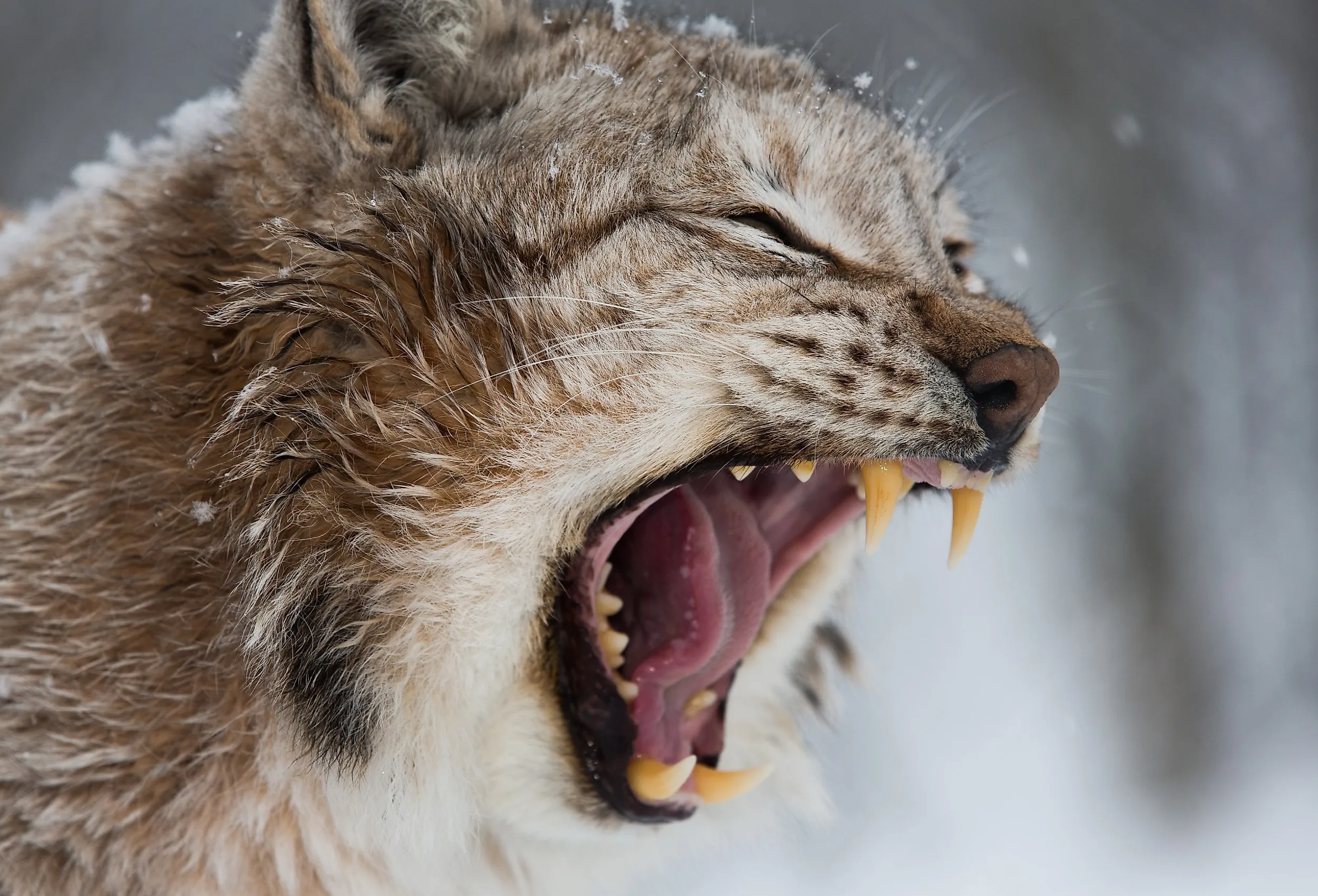
The lynx is a medium-sized wild cat with a robust build, well-suited to life in cold, challenging environments. Its most distinctive features include prominent black ear tufts, a short black-tipped tail, and large fur-covered paws that function like natural snowshoes, allowing the animal to move efficiently across deep snow without sinking. The facial ruff, especially noticeable in the Eurasian lynx, gives the animal a broad and rounded appearance.
Body size varies by species. The Eurasian lynx is the largest, with some individuals reaching up to 66 pounds. The Canada lynx is slightly smaller, typically ranging between 18 and 31 pounds, while the Iberian lynx is significantly lighter and more slender, often under 30 pounds. The bobcat varies widely in size depending on the region, but generally falls within a similar range to the Canada lynx.
Fur coloration also varies depending on habitat and season. Most lynx exhibit grayish-brown to reddish coats that provide camouflage within forest environments. In winter, particularly in northern populations, the coat becomes thicker and lighter in color, enhancing insulation and concealment against snow-covered landscapes.
Ecological Importance

Lynx influence prey communities in different ways depending on the species. Canada lynx closely track snowshoe hare cycles, Iberian lynx depend heavily on European rabbits, and Eurasian lynx can affect local ungulate prey such as roe deer or chamois. This predator-prey relationship influences broader ecological processes, including plant community structure and biodiversity distribution.
Because lynx populations are sensitive to prey availability, habitat connectivity, snow conditions, and human-caused mortality, their status can provide useful, but not standalone, evidence of ecosystem health.
Food and Hunting Behavior

Lynx are obligate carnivores, meaning their diet consists entirely of animal prey. Their hunting behavior is highly specialized and depends on stealth, patience, and short bursts of speed rather than prolonged chases. The Canada lynx relies heavily on the snowshoe hare, with its population cycles closely tracking fluctuations in hare abundance. In contrast, the Eurasian lynx often preys on roe deer, red deer fawns, and smaller ungulates, while the Iberian lynx focuses primarily on European rabbits. The bobcat has a more generalized diet, including rabbits, rodents, and birds, and occasionally small reptiles.
Lynx typically hunt alone and rely on silent movement through dense vegetation to approach prey undetected. Once within striking distance, they launch a rapid ambush, using powerful forelimbs to seize prey and deliver a fatal bite to the neck or head. Their large paws provide stability on snow, allowing them to move quietly across terrain where prey animals are often slowed or less aware of approaching predators.
Behavior

Lynx are solitary animals that maintain large territories marked through scent marking, scratch marks on trees, and occasional vocalizations. Adults generally avoid one another outside of the breeding season, and interactions are typically limited to mating or territorial disputes. Activity patterns are primarily crepuscular, with the highest levels of movement occurring during dawn and dusk when prey species are also most active.
Communication among lynx is relatively limited but includes growls, hisses, and occasional calls during mating season. Scent marking plays a significant role in maintaining territorial boundaries and reducing direct conflict between individuals. Movement through their habitat is deliberate and quiet, with lynx often remaining still for long periods while observing prey behavior before initiating a short pursuit.
Reproduction

Lynx reproduction occurs seasonally, with mating typically taking place in late winter. After a gestation period of approximately 60 to 70 days, females give birth to litters (often one to four kittens) in secluded dens located in dense vegetation, rocky crevices, or hollow logs. These dens provide protection from predators and harsh weather conditions.
Kittens are born blind and completely dependent on their mother for warmth and nourishment. Over the first several months, they develop coordination and begin to explore their surroundings under maternal supervision. Hunting skills are gradually learned through observation and practice. Independence is usually achieved between nine and twelve months of age, although this can vary depending on prey availability and environmental conditions. Sexual maturity is reached between one and three years, depending on species and habitat pressures.
Threats and Conservation

Lynx populations face varying levels of pressure depending on species and region. Habitat fragmentation caused by logging, road construction, and agricultural expansion has reduced connectivity between populations, limiting genetic exchange and increasing isolation. Declines in prey species, particularly snowshoe hares and European rabbits, have also had direct impacts on certain lynx populations.
Climate change presents an additional challenge, particularly for northern species such as the Canada lynx, as changes in snow conditions can affect hunting efficiency and mobility. The Iberian lynx experienced the most severe historical decline of any lynx species, driven largely by habitat loss and prey reduction. However, conservation programs in Spain and Portugal have supported its gradual recovery, leading to its classification as Vulnerable (a change from Endangered) on the IUCN Red List as of June 2024.
Despite these challenges, several lynx populations remain stable or are slowly recovering due to legal protections, habitat restoration efforts, and targeted conservation programs aimed at improving prey availability and habitat connectivity.
The Lynx's Future
The lynx remains one of the most specialized and influential predators of the Northern Hemisphere. Its survival depends on dense habitats, stable prey populations, and environmental conditions that support its stealth-based hunting strategy. Across Europe, Asia, and North America, each lynx species is adapted to different climates and landscapes, yet all share a central ecological role in maintaining balance within forest ecosystems. As environmental pressures continue to reshape natural habitats, the future of the lynx will depend on sustained conservation efforts and the preservation of connected wild habitats.