The Sunniest Cities in the United States
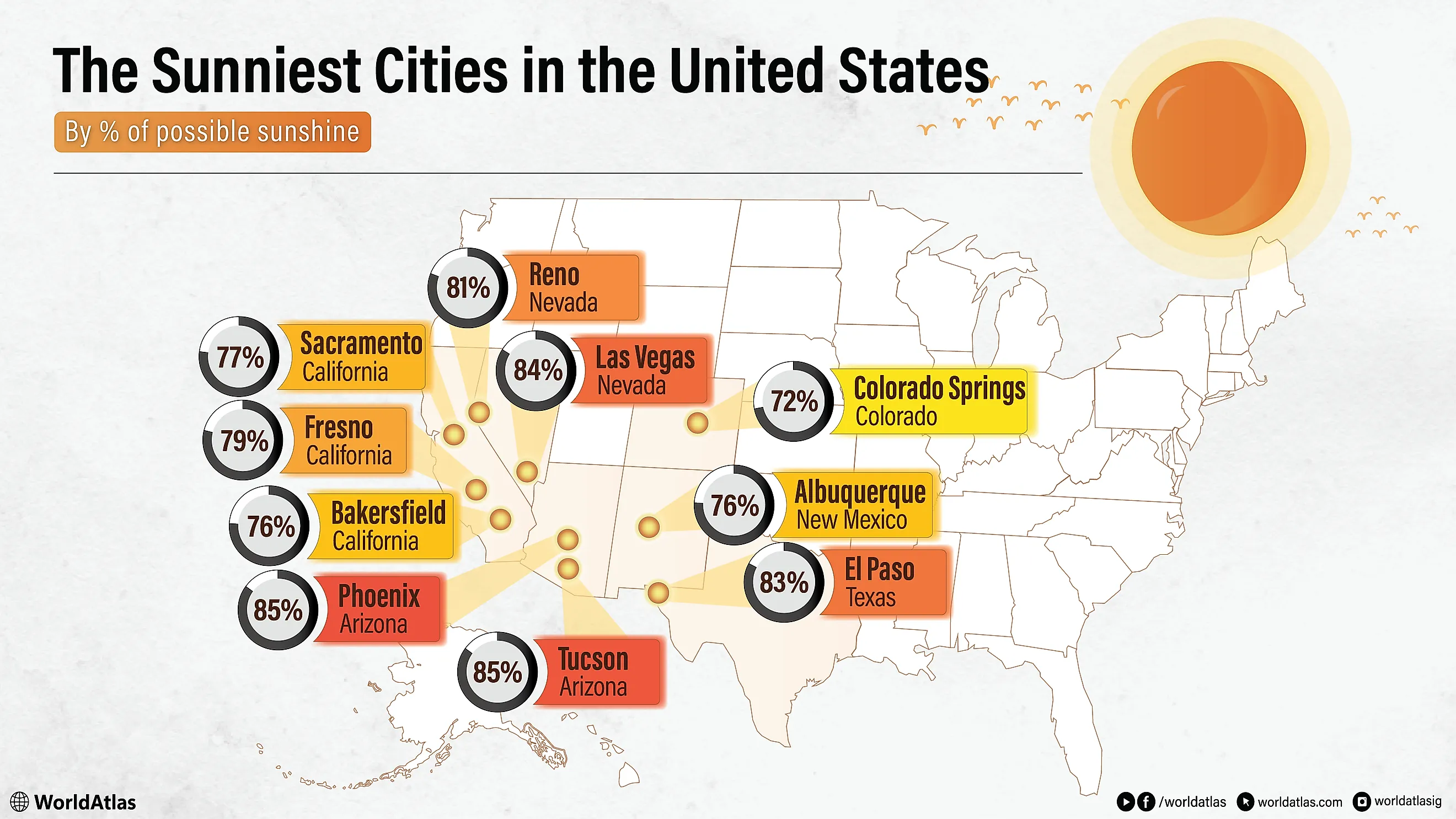
The sunniest US cities are ranked by percent of possible sunshine, a climatological measure of how often the sun shines when it could, based on long-term weather observations. At the very top of this list are Phoenix, Tucson, and Las Vegas, which consistently post the highest sunshine percentages among U.S. cities with 100,000+ residents. Because conditions vary from year to year, these figures are typically averaged over multi-decade periods (often 30 years) to reflect what’s truly typical for each location. Factor in big-picture climate controls, subtropical high-pressure patterns, storm-track positioning, mountain rain shadows, and (in some regions) coastal marine layers, and the sunshine data becomes easier to interpret: some metros spend most of the year under clear, sinking air, while others see more frequent cloud-building systems. Below are the 10 sunniest U.S. cities with a population over 100,000.
The 10 Sunniest Cities in the US
| Rank | City, State | % of Possible Sunshine |
|---|---|---|
| 1 (tie) | Phoenix, Arizona | 85% |
| 1 (tie) | Tucson, Arizona | 85% |
| 3 | Las Vegas, Nevada | 84% |
| 4 | El Paso, Texas | 83% |
| 5 | Reno, Nevada | 81% |
| 6 | Fresno, California | 79% |
| 7 | Sacramento, California | 77% |
| 8 (tie) | Albuquerque, New Mexico | 76% |
| 8 (tie) | Bakersfield, California | 76% |
| 10 | Colorado Springs, Colorado | 72% |
Phoenix, Arizona (85%)

Phoenix sits in the heart of the Sonoran Desert, a basin surrounded by the mountains of southern Arizona. It receives an average of 3,872 hours of sun per year, more than any other major city on Earth, and its summers are the hottest of any major city in the United States. Scientists attribute its extraordinary sunshine to three interlinked factors. First, the region lies within a subtropical high-pressure zone. Descending air warms up and dries out, which inhibits cloud formation, and the persistent high pressure deflects passing storms. Second, a ring of mountains around Phoenix creates a rain-shadow effect, as moisture from the Gulf of Mexico and Pacific Ocean must rise over the surrounding ranges before reaching the valley. As the moisture ascends, water vapor condenses and precipitates on the windward slopes, leaving only dry air to descend into the valley. This air heats quickly and lowers relative humidity, promoting clear skies. Third, Phoenix’s landscape is arid and sparsely vegetated. Dry surfaces and low soil moisture mean little evaporation and relatively few clouds. All of these things combine to produce a climate where sunshine is the norm and cloudy days are rare.
Tucson, Arizona (85%)

Tucson sits at about 2,450 feet in the Sonoran Desert, nestled among five mountain ranges. Meteorologists classify its climate as a hot desert (BWh), but its location and elevation temper the heat and add just enough moisture to distinguish it from Phoenix. The combination of intense surface heating, ample low-level moisture, and air rising up along the Mogollon Rim and Tucson’s surrounding mountains can also trigger thunderstorms. These storms are intense but short-lived. Once they pass, the sky clears quickly, and the sun reasserts itself. The city's higher elevation means that the temperature threshold to spark storms is a bit cooler than in Phoenix, but the underlying pattern of clear winters and brief summer deluges keeps Tucson among the sunniest cities in the country.
Las Vegas, Nevada (84%)

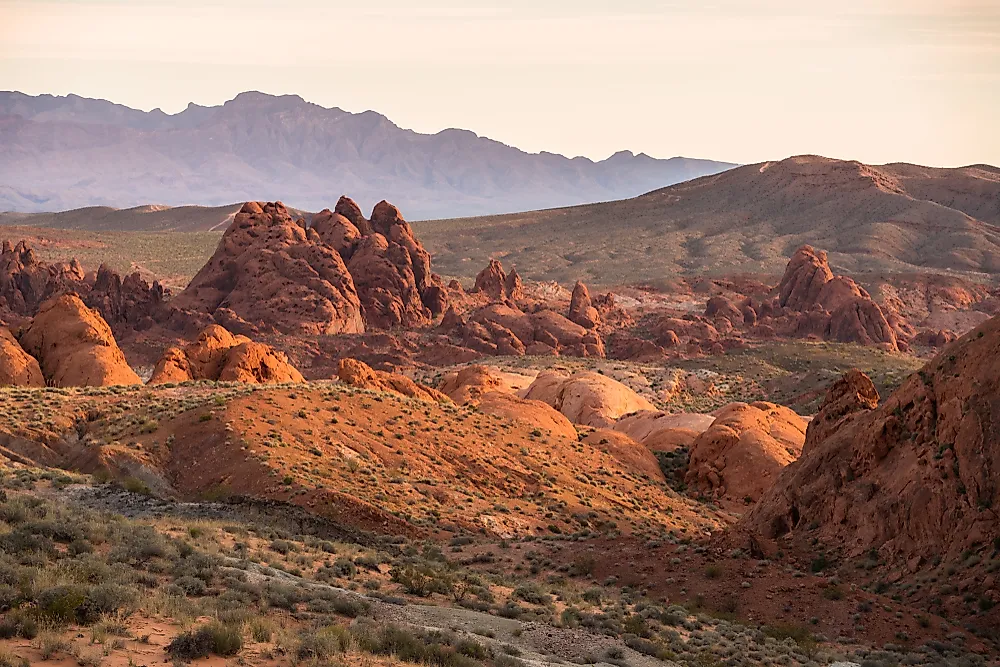
Las Vegas occupies a basin in the Mojave Desert, almost completely encircled by mountain ranges that rise several thousand feet above the valley floor. Its abundance of sunshine can be attributed to the classic rain-shadow phenomenon that Phoenix enjoys. Moist air traveling east from the Pacific hits the Sierra Nevada mountains and other coastal ranges, at which point water vapor condenses and falls as rain or snow on the windward slopes. By the time the air descends the leeward side into Nevada, it is warm and dry. The Spring Mountains and nearby Sierra Nevada act as barriers, limiting the number of storms that reach the Las Vegas Valley and making it one of the driest major metropolitan areas in the continental United States. High-pressure systems also tend to dominate subtropical latitudes, keeping things bright and sunny.
El Paso, Texas (83%)

El Paso sits at the western tip of Texas, where the Chihuahuan Desert meets the Franklin Mountains. With sunshine gracing the city roughly 83% of the time and more than 300 sunny days annually, El Paso rivals its desert neighbors in Arizona and Nevada. Its bright skies are largely the result of persistent high-pressure systems that dominate the subtropics, suppressing cloud formation for much of the year. Like Phoenix and Las Vegas, El Paso benefits from a rain-shadow effect. Moisture moving inland from the Pacific must cross multiple mountain ranges, shedding precipitation before reaching far West Texas. By the time the air descends into the Rio Grande Valley, it is warm and dry. The city’s inland location also limits the influence of humid Gulf air, keeping skies clearer than in eastern Texas. Even during the summer monsoon season, thunderstorms are typically brief, and the sun quickly returns to center stage.
Reno, Nevada (81%)

Reno sits on the western edge of Nevada in the Truckee Meadows, with the Sierra Nevada rising immediately to the west. That location is a sunshine sweet spot: storms rolling in from the Pacific tend to drop much of their moisture on the Sierra’s windward slopes, then arrive in Reno as drier air that favors clearer skies. The region’s high desert climate also keeps humidity low, which limits the kind of lingering cloud cover you see in coastal California. Winter brings some snow and passing systems, but between storms, skies often snap back to bright blue. Add in Reno’s elevation and inland setting, and you get a city where sunshine is a frequent companion—whether you’re looking toward Lake Tahoe or cruising along the Truckee River.
Fresno, California (79%)

Fresno lies in California’s Central Valley, a vast trough bounded by the Coast Ranges to the west and the Sierra Nevada to the east. Its high percentage of sunny days reflects a Mediterranean climate with long, dry summers and mild, wet winters. Two broad atmospheric features govern this pattern. During the warm season, the North Pacific High (a semi-permanent high-pressure cell offshore) expands northward. The high creates air that warms and dries, which prevents clouds from forming and steers storm tracks toward the Pacific Northwest. As a result, central California goes months without significant precipitation. At the same time, the cold California Current flows southward along the Pacific coast, stabilizing the marine layer, further suppressing cloud development over land. Locally, Fresno’s position between two mountain ranges enhances the dryness, as moist airmasses from the Pacific release much of their water on the windward slopes, then descend the leeward side as warm, dry winds, producing a rain-shadow effect that extends across the valley. What's more, high-pressure ridges occasionally park over the eastern Pacific, compressing and warming the air column, effectively blocking incoming storms and preventing cloud formation, leaving the skies over California mostly clear. These combined geographical and atmospheric factors give Fresno its reputation for bright, cloudless summers and help explain why the sun shines more than three-quarters of the time.
Sacramento, California (77%)

Sacramento pairs big-sky sunshine with a classic inland Mediterranean climate. In summer, the North Pacific High strengthens offshore, nudging storm tracks north and helping the Central Valley settle into months of dry, mostly cloudless weather. Even when coastal California wakes up under gray marine layer clouds, Sacramento’s inland position means it often stays clearer, especially by midday. Winter does bring rain and passing fronts, but between systems, high pressure frequently reasserts itself, restoring bright skies over the American River and the city’s tree-lined neighborhoods. The result is a sunny rhythm that feels reliable: golden, hot summers; mild, brighter breaks between winter storms; and plenty of bluebird days in spring and fall.
Albuquerque, New Mexico (76%)

Albuquerque lies in the high desert of central New Mexico, perched at over 5,000 feet above sea level along the Rio Grande. The city enjoys sunshine about 76% of the time, thanks to its elevation, arid climate, and position within the rain shadow of surrounding mountain ranges. The nearby Sandia and Manzano Mountains help wring out moisture from passing systems, leaving descending air warm and dry over the metropolitan area. Albuquerque’s thin, high-elevation atmosphere allows intense solar radiation to reach the ground, making even winter days feel bright and crisp. While the North American monsoon brings scattered afternoon thunderstorms in July and August, these storms are typically localized and short-lived. For much of the year, clear blue skies dominate, earning Albuquerque its reputation as one of the Southwest’s most reliably sunny cities.
Bakersfield, California (76%)

Bakersfield sits at the southern end of the San Joaquin Valley, where a bowl-like landscape and surrounding ranges help keep skies clear for long stretches. Like Fresno, Bakersfield benefits from California’s dry-season dominance: summer high pressure reduces cloud formation and pushes the storm track away from the interior valley for months at a time. When Pacific systems do roll through in winter, nearby mountains wring out much of the moisture, and clear spells often follow quickly. The result is a city with a strong sunshine profile—especially in late spring through early fall—when hot, dry air and minimal cloud cover make bright afternoons feel like the default setting.
Colorado Springs, Colorado (72%)

Colorado Springs rounds out the top 10 with high-elevation sunshine on the Front Range. Sitting more than 6,000 feet above sea level, the city’s thin, dry air allows strong solar radiation and quick-clearing skies after passing fronts. The Rockies also play a major role: many Pacific storms lose moisture crossing the mountains, and downslope winds can warm and dry the air on the eastern side, discouraging cloud formation. While summer brings occasional afternoon thunderstorms (especially when monsoonal moisture sneaks north), those storms tend to be short-lived. Most days still feature long stretches of blue sky, with Pikes Peak and Garden of the Gods looking extra crisp under that bright Colorado light.
Picking Your Ultimate Sun Destination
The United States has some of the most varied sunny destinations, ranging from hot and dry desert climates to bright inland valleys and high-altitude Front Range skies. Depending on whether you want Phoenix's endless clear days, Reno’s Sierra-adjacent bluebird breaks, Sacramento’s Mediterranean summers, or Colorado Springs’ mile-high sunshine, there’s a destination ready to turn your winter blahs into blue-sky bliss—thanks to climates shaped by a combination of latitude, elevation, air masses, and mountain and ocean effects.