Snow Leopard
Known across the high ranges of Central Asia as the Ghost of the Mountains, the snow leopard inhabits rugged alpine terrain and remains almost impossible to observe in the wild. At elevations between 9,800 and 14,800 feet, where winter temperatures fall to -40°C and the landscape is little more than rock, ice, and wind, its smoky-gray coat and dark rosettes render it nearly invisible against the cliffs it patrols. Across twelve countries spanning the Tibetan Plateau, the Hindu Kush, the Himalayas, and the high ranges of Central Asia, fewer than 10,000 mature individuals are estimated to survive. Despite legal protection at the highest level in countries like India, the snow leopard faces habitat loss, poaching, and a warming climate that is steadily eroding the alpine ecosystems it depends on. Himalayan projections suggest that up to 30% of its habitat could disappear within decades, leaving the species with fewer viable areas to occupy.
Taxonomic Classification

Taxonomically, snow leopards were once classified in the monotypic genus Uncia. In 1761, French naturalist Comte de Buffon first described the snow leopard as l'Once. Buffon described it as either a small panther or a felid related to lynx that resided in the region ranging from North Africa through Arabia to Southern Asia. In 1775, the German naturalist J.C.D. von Schreber copied Buffon's description of l'Once and gave the scientific name Felis uncia. In succeeding years, the British zoologists Reginald Innes Pocock and John Edward Gray placed it in the genus Uncia. A few other scientific names for snow leopards were also proposed, such as Felis irbis by Ehrenberg, Felis uncioides by Thomas Horsfield, Uncia uncia schneideri by Zukowsky, and Panthera baikalensis-romanii by Medvedev.
Modern phylogenetic analyses based on genetic and genomic data have decisively placed snow leopards within the big cat genus Panthera, the subfamily Pantherinae, and the family Felidae. A phylogeographic analysis in 2017 proposed three possible subspecies of the snow leopard: P. u. uncia, P. u. irbis, and P. u. uncioides. The species is currently recognized as monotypic.
Evolutionary History
Despite having the word 'leopard' in its name and sharing a similar coat pattern with other leopards, snow leopards, according to DNA sequence analyses, are more closely related to tigers (Panthera tigris) and form a sister lineage with them. The common ancestor of tigers and snow leopards diverged from the Big Cat lineage about 3.9 million years ago, whereas snow leopards diverged from tigers probably between 2.7 and 3.7 million years ago. The earliest known authoritative fossil record of modern snow leopards dates back to the Late Pleistocene, based on a specimen discovered in China's Niuyan Cave.
Physical Description

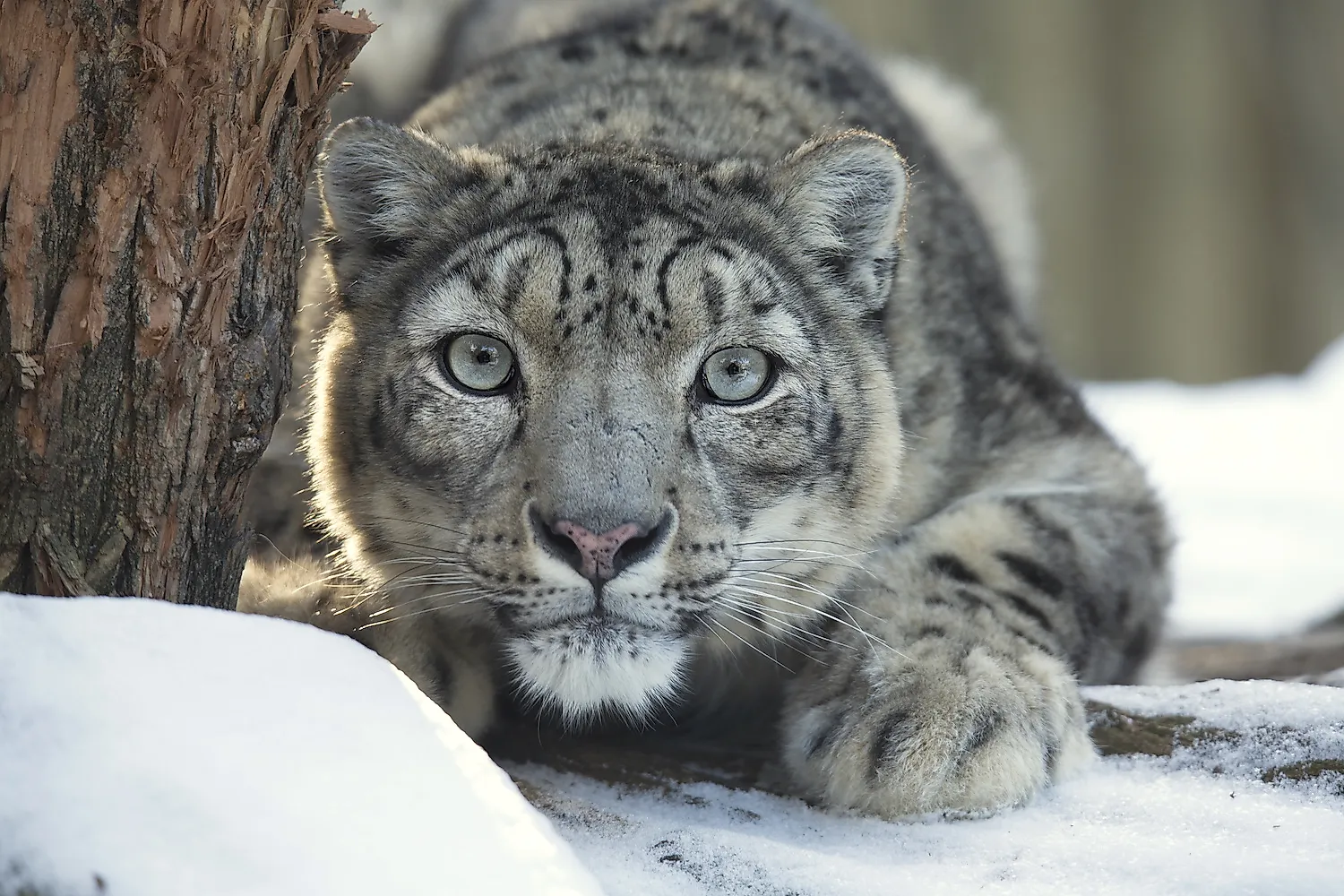
The stocky snow leopard, slightly smaller than the common leopard (Panthera pardus), has a luxuriant coat that is whitish to gray, sometimes with a yellow tinge. Males are larger than females, and both sexes have distinctive adaptive features that enable them to survive in harsh mountainous environments. The long, thick fur serves as an insulating blanket, providing warmth against the chilly mountain climate. The neck and head of snow leopards have solid black spots, while the rest of the body, including the back, flanks, and furry tail, have larger, dark gray rosettes. The rosettes, whose centers are pale, form a ring enclosing smaller spots, and each animal features a unique pattern of rosettes, further helping in their proper identification. The combination of a smoky gray coat and dark gray rosettes makes snow leopards well camouflaged against their surroundings, helping them avoid detection during hunting.

The short, rounded ears minimize heat dissipation, and flattening the ears against the head helps snow leopards stay hidden while stalking prey. Snow leopards have long, muscular limbs, with the forelimbs shorter than the hind limbs. The sturdy legs are why snow leopards can easily maneuver rocky terrain and jump distances of up to 45 feet. The massive paws distribute body weight, while their undersides have very thick fur, which enhances the snow leopard's grip on unstable surfaces. The tail is long, well-furred, and thick, helping maintain balance when running or walking across rocks or through deep snow (up to 85 cm deep). The animal also uses its tail as a muffler to keep warm during freezing nights when temperatures dip to -40°C.
Furthermore, the strong shoulders, large claws, and robust chest muscles help the snow leopard bring down prey larger than itself. The skull of the snow leopard is broad and domed to accommodate the enlarged nasal cavities, which in turn warms the cold air that it breathes in. The snow leopard cannot roar because its vocal folds lack the fibro-elastic tissue needed for deep roars, but it can meow, grunt, moan, purr, and prusten.
Range and Habitat

Snow leopards are known to inhabit the mountainous regions of South and Central Asia. They prefer living in the montane habitats of the Altai, Kunlun, Hindu Kush, Tian Shan, Pamir, Karakorum, Tibetan Plateau, and the Himalayan mountain ranges, at elevations of 9,800 to 14,800 ft above sea level. During winter, they descend to elevations of 3,900-6,600 ft. The 12 countries in which the snow leopard's habitat extends include: Russia, Mongolia, Tajikistan, Uzbekistan, Kyrgyzstan, Kazakhstan, Afghanistan, Pakistan, China, India, Nepal, and Bhutan.
In India, snow leopards live at high elevations in the Himalayas, in Jammu & Kashmir, Ladakh, the Lahaul-Spiti district of Himachal Pradesh, Uttarakhand, Sikkim, and Arunachal Pradesh. Their distribution closely follows the geographical range of their large prey, the Himalayan Blue Sheep and the Siberian ibex.
Diet and Hunting

The snow leopard preys on Himalayan blue sheep, wild goat, Himalayan tahr, markhor, and Tibetan argali. The snow leopard typically makes a kill every 10-15 days and has been estimated to consume approximately 20-30 adult Himalayan blue sheep (locally called Bharal) annually. The treacherous terrain and harsh climate in which it lives force the snow leopard to maintain a broad diet. In the lean season, small alpine mammals such as the Himalayan marmot, pika, vole, and woolly hare make up a significant share of its diet. Research has shown that, especially during its peak breeding months, snow leopards feed on Myricaria spp. shrubs that grow in high-altitude regions.
Behavior

Snow leopards are solitary and secretive, making them among the most difficult species to spot in the wild. They are crepuscular, mostly active at dawn and dusk, hunting and patrolling their territories. Snow leopards use scent marks to mark their territories and stay close to cliffs and ridges that provide shade and serve as vantage points. Snow leopards' individual home ranges vary widely, from about 30-65 km² where prey is abundant to over 1,000 km² where prey is sparse, and male home ranges have been observed overlapping with those of both males and females.
Reproduction

Snow leopards live in the wild for about 10 to 12 years and become sexually mature at about 2 to 3 years of age. The mating season is usually between January and mid-March, and females give birth to two or three cubs after a gestation period of around 93-110 days. Female snow leopards move to a sheltered rocky den or crevice lined with fur shed from the mother's underside. Born blind and with a thick coat of fur, the snow leopard cubs remain with their mother for up to 18 to 22 months, after which they become independent.
Threats to Snow Leopards

It is estimated that currently fewer than 10,000 mature snow leopards exist in the wild, and the global population is expected to decline by 10% around 2040. Some of the major threats to the snow leopard population worldwide include habitat loss caused by increased human expansion in alpine regions. Habitat degradation from agro-pastoral use, mining, infrastructure development, livestock grazing, climate change, and increased commercial cashmere goat rearing continues to fragment snow leopard territories. Snow leopards are illegally hunted to meet the high demand and price of their fur for illegal trade and status symbols, and bones and other body parts for traditional Asian medicine and the international wildlife trade network.
Climate Change is also a major threat to the snow leopard population. Rising temperatures across the snow leopard's range threaten alpine ecosystems, causing glaciers to retreat, treelines to shift upward, seeps and springs to decline, extreme weather events to become more frequent, and alpine meadows to convert into dry alpine steppe grasslands. According to a World Wildlife Fund study, up to 30% of snow leopard habitat in the Himalayas alone could vanish due to climate change.
Additionally, owing to changes in herding practices driven by glacial melting that affect water supplies, snow leopards are increasingly coming into conflict with humans. With a decrease in the number of natural prey species, snow leopards are forced to prey on domestic livestock (sheep, horses, goats, and yak calves) in their habitat, and angry herders often kill the predator in retaliation to protect their livelihoods.
Ecological Role and Conservation
As apex predators, snow leopards play a crucial role in maintaining the ecological balance of high-altitude mountain ecosystems by regulating herbivore populations and preserving plant community structure. Snow leopards are also an indicator species, and healthy snow leopard populations signal thriving mountain ecosystems and freshwater sources that millions of people downstream depend upon. Nevertheless, the snow leopard population continues to face serious threats and has therefore been listed as Vulnerable in the IUCN Red List of Threatened Species.
In India, the snow leopard receives the highest level of protection under Schedule I, Part I, of the Wildlife (Protection) Act, 1972. Several protected areas, such as the Great Himalayan National Park, have also been created to conserve snow leopard habitats. Protecting snow leopards thus requires transnational collaboration, scientific research, and close cooperation between governments and indigenous mountain communities. As coordinated conservation efforts expand across snow leopard habitats, the long-term survival of the species will depend on sustained protection of the upland areas it shares with people.