The Causes And Effects Of Ocean Pollution
- More than 70% of the Earth is covered with water bodies that play an important role in our day-to-day life and form an indispensable part of our existence.
- Ocean pollution is caused by the introduction of toxic materials and harmful pollutants such as agricultural and industrial waste, chemicals, oil spills, and plastic litter into the ocean waters.
- Careless human activity has posed a serious threat to the ocean ecosystem, thereby affecting several species of marine flora and fauna as well as humans that are dependent on it.
About 71% of the Earth's surface is covered by ocean, and the ocean absorbs roughly 25-30% of human carbon emissions and the majority of excess heat from anthropogenic warming. It is also where most of the world's plastic waste ends up. Recent estimates put the annual flow of mismanaged plastic into the ocean at around 8 to 12 million metric tonnes, and that figure is projected to keep rising under current policies. Ocean pollution refers to the introduction of toxic materials and other harmful pollutants (agricultural and industrial waste, chemicals, oil spills, plastic litter, sewage, and excess nutrients) into ocean waters. Most of it traces back to mismanagement of land-based waste streams, and the cumulative effect on marine ecosystems and human health is now measurable across nearly every part of the global ocean.
Causes of Ocean Pollution
Sewage and Wastewater
Dumping untreated or partially treated sewage into the ocean has long been the cheapest disposal method for coastal communities and remains common in much of the world. The 2021 UNEP report on marine pollution estimated that around 80% of wastewater released globally is untreated, and a significant share reaches coastal waters carrying pathogens, pharmaceuticals, personal-care-product residues, and excess nutrients. The effects on local marine flora and fauna range from oxygen depletion to bioaccumulation of contaminants up the food chain.
Land Runoff
Non-point pollution from land runoff occurs when soil is saturated and excess water flows into streams, rivers, and ultimately the ocean. The runoff carries litter from urban areas, fertilizer-derived nitrogen and phosphorus from agriculture, pesticides, hydrocarbons from roadways, and assorted soil contaminants. Coastal nutrient loading from agricultural runoff is the primary driver of the world's coastal dead zones.
Industrial Chemicals

Untreated effluent from fossil-fuel, plastic-manufacturing, agrochemical, and pharmaceutical industries carries mercury, persistent organic pollutants such as DDT, phthalates, bisphenol A (BPA), and PFAS ("forever chemicals") into marine waters. These compounds accumulate in the fatty tissue of marine animals and biomagnify up the food chain, where the concentration in apex predators (large tuna, swordfish, marine mammals, seabirds) can exceed background seawater levels by factors of thousands to millions. Humans consuming the same species inherit a share of the load. Mercury contamination in Pacific tuna has been the longest-running case study in this category.
Eutrophication
Nitrogen-rich fertilizers, animal-waste runoff, and human sewage feeding into coastal waters cause eutrophication: rapid growth of marine algae that consume dissolved oxygen as they die and decompose. The resulting oxygen-depleted zones (hypoxic or "dead" zones) suffocate fish, shellfish, and bottom-dwelling species. The Gulf of Mexico dead zone, fed primarily by Mississippi River agricultural runoff, has averaged about 13,000 square kilometres each summer since 2017, with peak years exceeding 22,000 square kilometres. NOAA counted more than 700 coastal areas worldwide experiencing eutrophication-driven hypoxia as of the mid-2020s, up from about 400 a decade earlier.
Ocean Acidification and Thermal Pollution

The ocean is the planet's largest active carbon sink, absorbing roughly 25-30% of anthropogenic CO2 emissions each year. Dissolved CO2 reacts with seawater to form carbonic acid, lowering the ocean's pH in a process called ocean acidification. Surface ocean pH has dropped from about 8.2 in pre-industrial times to about 8.04-8.05 as of the mid-2020s, a roughly 30% increase in hydrogen-ion concentration. The drop reduces the availability of carbonate ions that corals, mollusks, and shell-forming plankton need to build their skeletons. The 2023-2024 global coral bleaching event, the fourth on record, affected more than 80% of the world's coral reef area according to NOAA's Coral Reef Watch, the most extensive recorded.
Thermal pollution refers to the release of warm water from power plants and industrial cooling systems into coastal waters. The localized temperature rise reduces dissolved-oxygen capacity, alters species composition near the discharge, and can trigger algal blooms. The cumulative effect is local but, in aggregated form across many coastal industrial zones, contributes to broader thermal stress.
Oil Spills

Oil spills change the chemical composition of marine ecosystems and kill the photosynthetic plankton and microbes that generate much of the surface ocean's oxygen. The 2010 Deepwater Horizon spill in the Gulf of Mexico released about 4.9 million barrels (210 million US gallons) and remains the largest accidental marine spill in history. More recent significant events include the August 2020 MV Wakashio grounding off Mauritius (about 1,000 tonnes spilled into protected coral lagoon habitat) and several ongoing chronic-leak situations in the Niger Delta and the Black Sea. Oiled habitats can take decades to recover; Prince William Sound, oiled in the 1989 Exxon Valdez spill, still has measurable hydrocarbon residue.
Noise Pollution
Underwater noise from cargo shipping, seismic surveys for oil and gas exploration, naval sonar, and offshore construction interferes with the acoustic communication of marine species. Cetaceans (whales, dolphins, porpoises) rely on echolocation and long-distance acoustic calls for navigation, foraging, and social bonding. Chronic shipping noise has been shown to shift baleen whale calling behavior and increase stress hormones in resident populations. The International Maritime Organization adopted revised noise-reduction guidelines for commercial vessels in 2023.
Plastics
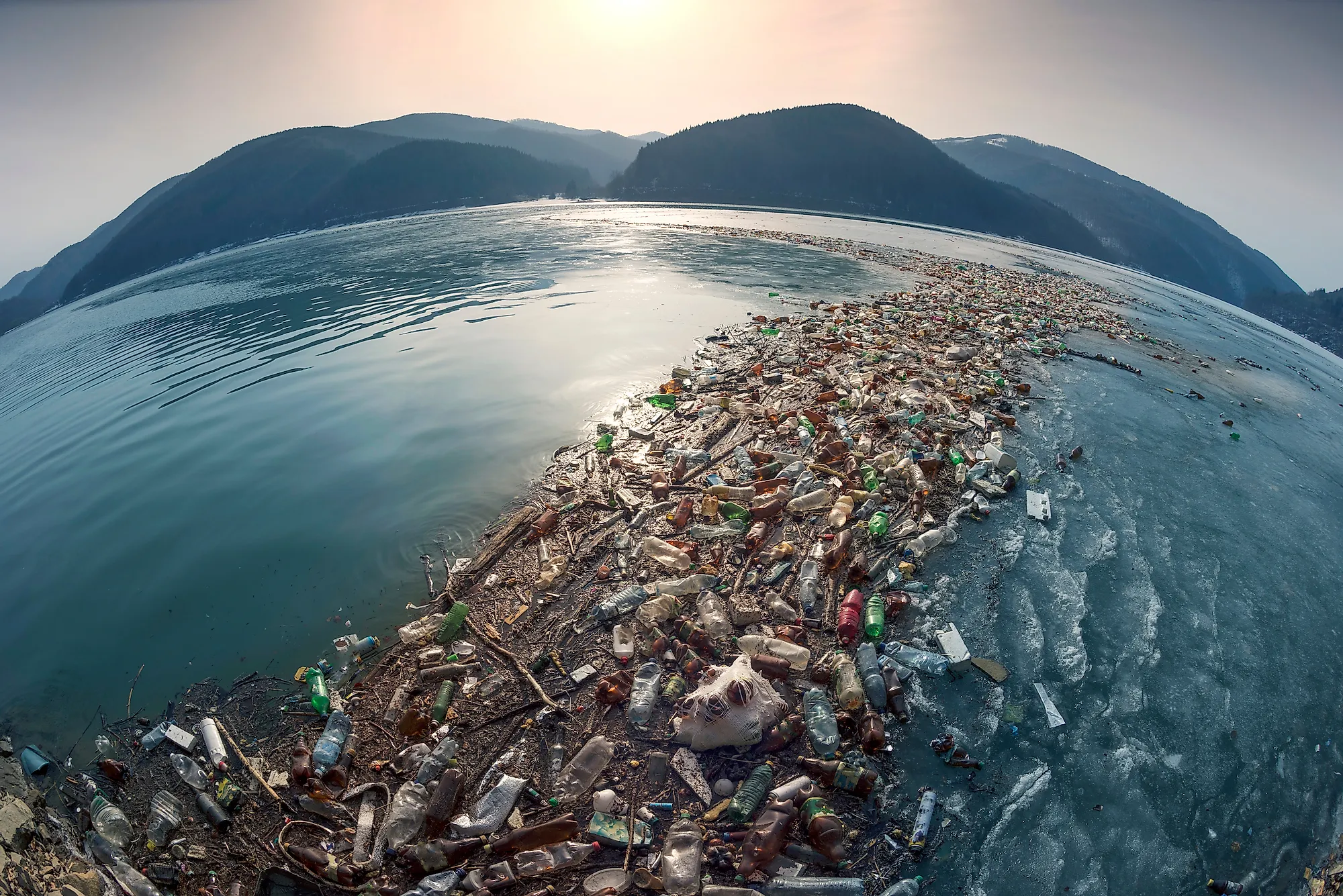
Single-use plastics dumped on land are carried by rain and wind into storm drains, rivers, and ultimately the ocean. Rivers act as conveyor belts, with the most recent published estimates putting the annual riverine input at roughly 0.8 to 2.7 million metric tonnes per year (the upper end was widely cited in 2017 work but more recent modelling suggests the lower end is closer to reality). Sunlight and wave action break macroplastics into microplastics, defined as fragments smaller than 5 mm, which now appear throughout the marine water column. Microplastics have been documented at the bottom of the Mariana Trench and in polar sea ice in both hemispheres. They have also been documented in human blood, lung tissue, placenta, and breast milk in studies published between 2022 and 2025, although the health implications remain under investigation.
Estimates of total annual plastic input to the ocean from all sources sit around 8 to 12 million metric tonnes, with the 2015 Jambeck et al. figure of about 8 million tonnes most commonly cited and more recent OECD modelling projecting roughly a doubling to about 23-37 million tonnes per year by 2040 under current trends. The 2016 Ellen MacArthur Foundation projection that ocean plastic would equal the weight of fish by 2050 is still cited as an extrapolation but is not a firm forecast; the intermediate "1 ton plastic per 3 tons of fish by 2025" milestone in that report has not been precisely tracked. The United Nations Environment Assembly launched negotiations in March 2022 for a binding Global Plastics Treaty, with five rounds of intergovernmental talks held through late 2024 in Busan, South Korea; negotiations remain unresolved as of 2026 on whether the treaty will cap virgin plastic production or focus on waste-management measures alone.

Effects of Ocean Pollution

The cumulative effects of ocean pollution show up in marine ecosystems, human health, and coastal economies. Industrial toxins accumulate in the fatty tissue of marine fauna, damaging reproductive systems and pushing population declines across the food chain. Sea birds dependent on contaminated fish carry the same load. Humans consuming seafood inherit a measurable share. Oil spills block sunlight from reaching photosynthetic plankton and shoreline algae, disrupting oxygen production and food-web foundations. Fertilizer and pesticide runoff contributes to fish population decline and, in agricultural-catchment seas, to documented reproductive effects in coastal human populations through hormonally-active pollutants.

National Geographic and IUCN compilations have identified more than 700 marine species, ranging from tiny corals to large whales, that face direct threat from plastic pollution. About 1 million seabirds and 100,000 marine mammals and sea turtles are estimated to die each year from plastic ingestion or entanglement. Microplastics have now been documented in marine organisms across every trophic level, and studies on oysters have shown reproduction rates cut nearly in half under controlled microplastic exposure. Ghost gear (abandoned, lost, or discarded fishing nets, ropes, and lines) accounts for a disproportionate share of large debris and a documented 46% of the mass of the Great Pacific Garbage Patch. Beach plastic also causes major economic damage to tourism, fishing, and shipping activities for coastal economies that depend on them.
The Great Pacific Garbage Patch, located in the North Pacific Subtropical Gyre between California and Hawaii, covers roughly 1.6 million square kilometres (about 617,000 square miles, three times the size of metropolitan France) and contains an estimated 1.8 trillion pieces of plastic weighing approximately 80,000 to 100,000 metric tonnes. Microplastics make up about 94% of the piece count but only 8% of the mass; nearly half the mass is discarded fishing gear. The Ocean Cleanup's 2018 study remains the most cited measurement, and the patch has continued to grow since.
What Comes Next
The data have steadily worsened across the past decade, but several response tracks are now active. The Global Plastics Treaty negotiations under the United Nations Environment Assembly are still unresolved, with the production-cap question the major sticking point. Active cleanup work by organizations like The Ocean Cleanup has removed measurable but still small fractions of the largest plastic accumulations. Marine protected area coverage has expanded toward the 30-by-30 target adopted at the December 2022 Kunming-Montreal Biodiversity Conference. Coral reef triage and selective breeding for heat tolerance is now operational at several Indo-Pacific and Caribbean sites. None of these on its own reverses the trend, but the pattern of response, both regulatory and ecological, is at least no longer absent from the equation.