How Much Water A Town's Water Tower Actually Holds
Water towers are an overlooked pillar in local communities. Historically, besides being a staple image in a town, they provided opportunities for small towns to combat fires and to prevent diseases. Today, they store clean water for management for peak times and emergency backup.
The amount of water a town's water tower actually holds comes down to two factors: the type of tank used and the water needs of the community. Modern water towers usually keep on hand 500,000 to 1 million gallons of water, but others can hold far larger quantities in their tanks. In this story, we will first examine the history of water towers, what they are used for, and how they work, before diving into just how big these water containers can be.
A Towering Start

The oldest water towers in America date back to the mid 1800s in response to major issues impacting communities across the country. For one, there was a need for clean water, as cholera, typhoid, and other waterborne illnesses impacted large and growing cities such as Chicago and Louisville.
Secondly, water towers provided more convenient access to water to combat fires. The town of Faunsdale, Alabama, for example, built a water tower to fight wildfires.
One of the oldest surviving water towers was constructed in 1859 in Philadelphia, Pennsylvania, and is called the Chestnut Hill Water Tower. It featured a stone tower with a wooden tank on top, which could hold 40,000 gallons at a time. The tower in total measured 125 feet tall.
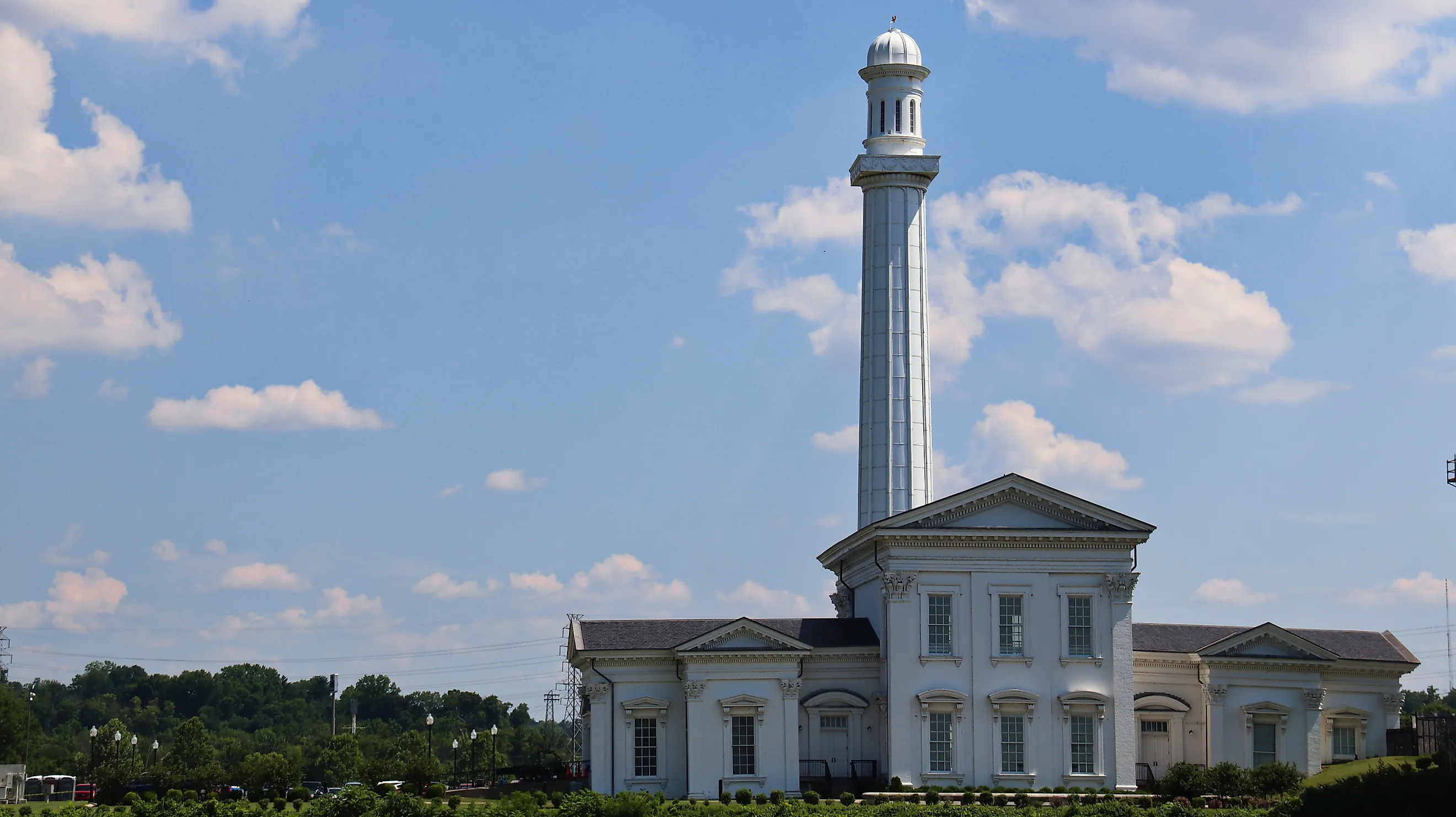
It was closely followed by the Louisville Water Tower, built in 1860 in an ornamental style reminiscent of a Greek temple, and today is the oldest ornamental water tower still standing in the country. It worked alongside a pumping system, which by 1866 was able to prevent much of the city from becoming sick from cholera.
There was a major boom in water tower building in the late 19th to the early 20th century, with more than 6,000 water towers raised in American Towns.
Under Pressure: How Do Water Towers work?

Water towers act as pressurized containers to hold clean drinking water. They are built tall or on top of a hill to keep the water under pressure through the force of gravity.
WaterWorld notes that for every foot in a water tower, it generates a water pressure of near 0.43 PSI, accounting for one PSI every 2.31 feet. Water is treated at a facility and pumped into the tank until it reaches a predetermined level, with an overflow pipe redirecting excess water away from the tank.
As water flows up the riser pipe, it can also be sent down towards outlet pipes, connecting to residential and commercial areas. The primary purpose of the water tower is to act as a backup during times of high water demand, such as in the evening when families return home from work and school. It, along with water treatment and pumping facilities, ensures a constant water pressure, which in most cases is somewhere between 50 and 100 PSI.
Since these tanks rely on gravity, they can operate even when a power grid shuts down, making them a very important element of maintaining water pressure and access to communities.
Not All Tanks are Created Equal

Not all water tanks are made in the same style, and as a result they vary significantly in the amount of water they can hold, especially older water towers.
For example, cone top water towers are a very common style, such as the West Water Tower in Orion, Illinois. They are recognizable with their cone shaped top. The West Water Tower was built in 1928 and can only hold 30,000 gallons of water, and an average cone water tower holds around 61,500 gallons.
Flat top water towers often resemble a can of paint, and hold an average of 170,000 gallons, depending on their design and purpose. Their average age in Minnesota is about 90 years old. Wider tanks, by comparison have an average volume of 458,500 gallons.
The water towers that stand out because of their volume are known as One Big Leg (or Single Pedestal Water Towers), which can hold millions of gallons of water. But in recent decades, another water tower style has emerged that has been able to handle even more water: the CET.
A Big Gulp: The Largest Tanks in the US

The largest tanks in the US are composite elevated storage tanks (CET). The largest one ever built was the CET in Rogers, Arkansas, maintained by the Benton Washington Regional Public Water Authority. This tank holds 4 million gallons of water at a time. Designed by Landmark, it required 70 tons of steel reinforcement to stand, along with stone columns in the soil.
This is not the only large water tank deployed by Landmark. It also completed a 3.66 million-gallon CET with a 69-foot diameter pedestal in Spokane, Washington, to serve the needs of its airport.
CETs are made of carbon steel and are elevated by a singular support pedestal. The pedestal is made of reinforced concrete. Their capacity depends directly on the overall size of the tank itself. Caldwell Tanks notes that it constructs CETs that range in capacity from 250,000 gallons at the lowest to 3 million at the highest.
The tallest CET currently in operation is the Lewis and Clark Regional Water System water tower. Located in Beresford, South Dakota, this 220-foot-tall tower contains 2.5 million gallons of water. It serves multiple communities in South Dakota and Sheldon, Iowa. It was built so high to be able to deliver water 33 miles away to Sioux Center.
Caldwell constructed this water tower, while Landmark Structures built the 85th Street Water Tower, operated by Lewis & Clark Regional Water System. This one holds 3 million gallons, and was placed in the southern part of Sioux Falls to serve larger Lincoln County.
A Day's Worth of Water
As discussed, water capacities for water towers vary from as little as 30,000 gallons to as much as 4 million gallons, although modern tanks tend to hold anywhere from 250,000 to 2 million. There is a guiding principle that determines that amount: how much water the community needs for one day.
However, this amount can change as towns grow either in population, commercial enterprises, or both. By having a water tower as a backup, if there are times of high water use demands or issues with the water treatment facilities, water system managers have more time to fix the issue without impacting water pressure or safety.
A Tank Half Full
It is worth discussing that water towers are not perfect, and cannot always handle peak water demands. In addition, they must be placed strategically, as they can only serve areas at a lower elevation than they are. They cannot reach up to higher hills that stand above them. Lastly, as a town changes, or its water tower grows outdated, they will have to invest in building ever larger water towers, in both height and width.
And there is always the question of what to do with older, defunct water towers which have grown to serve as a historic symbol of the community: whether to tear them down completely or find some way to preserve them. Water towers are not just practical pieces of infrastructure, they, in many ways, define the character and culture of small towns across the U.S.