The National Forests With The Most Timber Rattlesnakes
There is one road on Earth that closes every year so snakes can cross it, and it runs through a national forest in southern Illinois. Forest Service Road 345 in the Shawnee National Forest, universally called Snake Road, shuts to vehicles from March 15 to May 15 and again from September 1 to October 30 while timber rattlesnakes, copperheads and cottonmouths migrate between a swamp and a line of limestone bluffs. Twenty-three snake species use that 2.5-mile strip. No other national forest has a feature like it. Several hold more timber rattlesnakes, though, and the reasons come down to rock, slope and how much of the ground was never cleared.
Shawnee National Forest, Illinois

Shawnee holds only three venomous species, and it has enough of them to shut part of itself down twice a year for their convenience.
The LaRue-Pine Hills area sits between the LaRue Swamp on one side and limestone cliffs rising about 150 feet on the other, with the road running down the middle. In spring the snakes move from the bluffs to the swamp, and in autumn they return to the cliffs to overwinter. Timber rattlesnakes prefer the mature hardwood forest, rock outcrops and steep slopes above.
The Forest Service first closed the road for three weeks each season in 1972, then extended the closure to two months after research by herpetologist Scott Ballard showed the migration ran longer than anybody had assumed.
The Attitude Shift Is Part Of The Story

What makes the Snake Road closure remarkable is not the gate itself. It is that people agreed to it.
A district wildlife biologist with the Mississippi Bluffs Ranger District described the earlier local attitude plainly: it used to be sport around here to see how many snakes you could run over with your car. That changed over several decades, and the closure now has broad local support.
Foot traffic is still welcome during the closure, so the road functions as one of the best places in North America to see a timber rattlesnake without looking for one. Collecting or handling anything is prohibited.
Ouachita National Forest, Arkansas And Oklahoma

By area this is the heavyweight, sprawling 1.8 million acres across central Arkansas into southeastern Oklahoma, and its timber rattlesnakes do something unexpected.
In these pine-hardwood stands the snakes sometimes climb rough-barked trees to ambush squirrels and birds, which is not behavior most people associate with a heavy-bodied ground viper. The forest supports a robust population alongside the western pygmy rattlesnake in damper pine flatwoods.
Sightings concentrate on south-facing slopes where the snakes take the morning heat, with the Denby Bay Trail near Lake Ouachita noted as a high-probability stretch.
Why Timber Rattlesnakes Need Forests Specifically

The species has a narrower habitat requirement than most rattlesnakes, which is exactly why national forests matter so much to it.
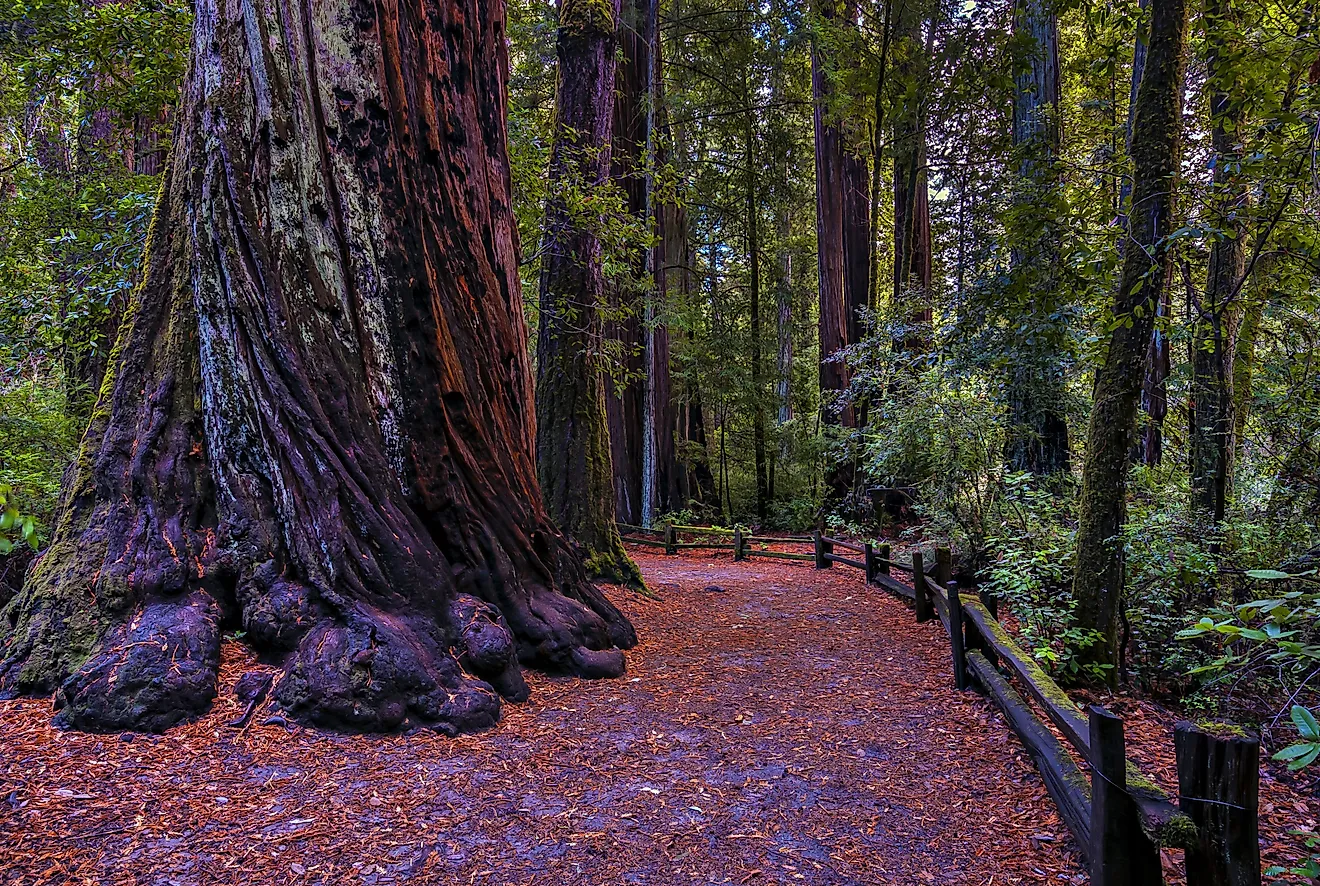
Timber rattlesnakes want mature hardwood forest with rock outcrops and steep slopes, because they need canopy cover for hunting, open rock for basking and deep crevices for communal winter dens. Remove any one of those three and the population cannot persist.
That combination tends to survive on steep ground nobody wanted to farm, which is precisely the land that ended up in the national forest system. The forests hold the snakes because the forests hold the terrain.
Public Land Is Where They Are Left

The reason this list is national forests rather than counties is a conservation story rather than a coincidence. Development and agriculture eliminated much of the original habitat across the species' range, and remaining rattlesnake populations are now frequently confined to preserved public land. In heavily cleared states the national forest is not one habitat among many. It is the habitat.
That concentration explains why a state can list the timber rattlesnake as endangered while a single forest inside it still supports a healthy population.
The Southern Appalachian Forests

The mountain forests of the mid-Atlantic and southern Appalachians hold the species across a long continuous band of suitable ground.
George Washington and Jefferson National Forests in Virginia, the Monongahela in West Virginia, Daniel Boone in Kentucky and the Nantahala and Pisgah in North Carolina all run the same arrangement: hardwood slopes, talus fields, and south-facing rock where snakes den communally and return every year.
The Sumter National Forest in South Carolina, which carries part of the Chattooga River, lists the timber rattlesnake and the southern copperhead as its most common venomous species.
The Ozark Forests

Missouri's Mark Twain National Forest and the Ozark-St. Francis in Arkansas cover the other great stronghold, and the geology does the work.
Ozark karst produces an abundance of what the species needs for winter: limestone bluffs, rock crevices, talus and cave entrances, all of it on steep slopes that stayed wooded. Mark Twain is scattered across the Missouri Ozarks in separate units rather than one block, which spreads the habitat widely.
These are the forests where timber rattlesnakes share dens with copperheads and black rat snakes, an arrangement documented repeatedly through the region.
Kisatchie National Forest, Louisiana

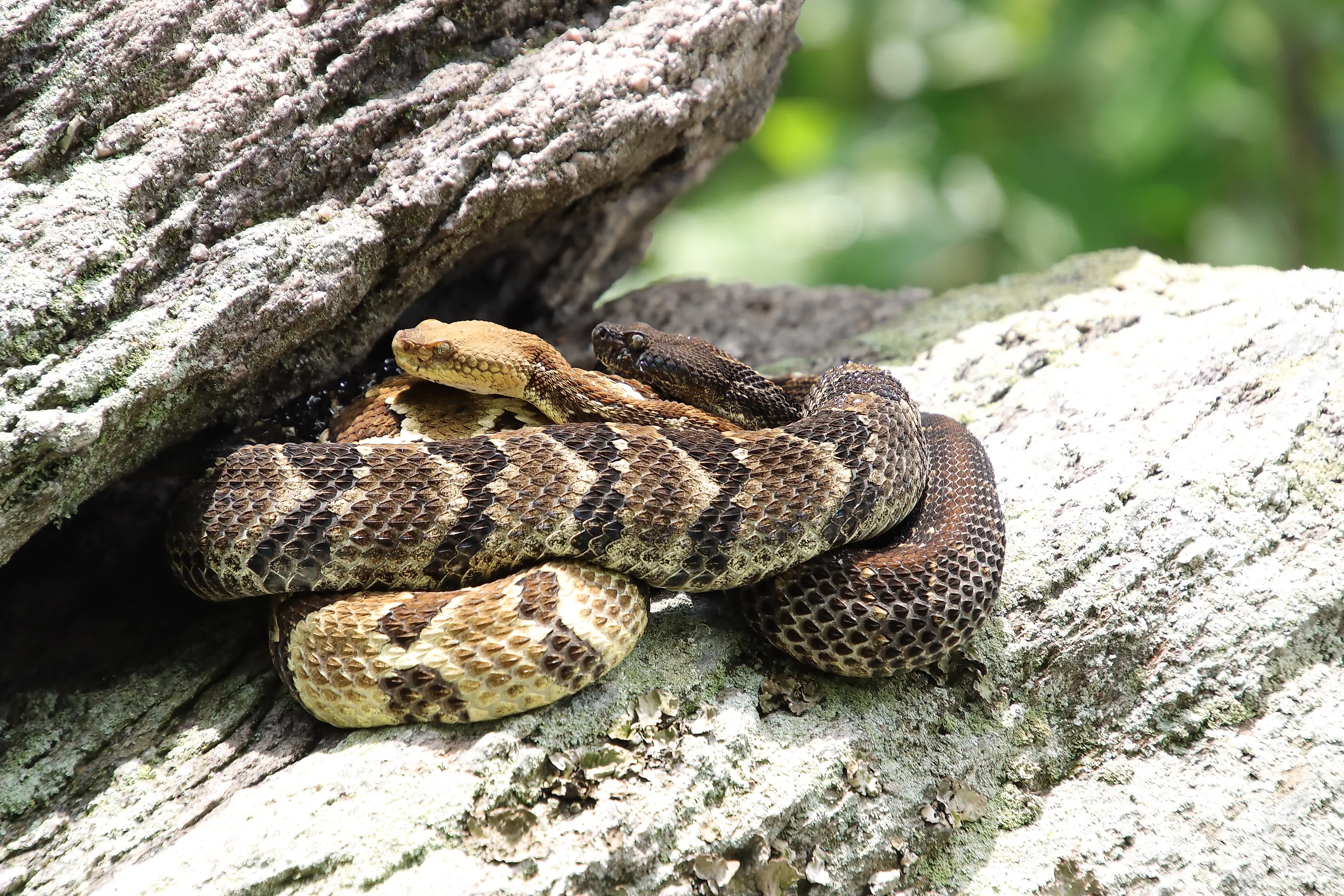
The southern outlier on this list holds an unusually complete set of venomous species. Kisatchie, the only national forest in Louisiana, carries timber rattlesnakes alongside pygmy rattlesnakes, eastern copperheads and northern cottonmouths. In the southern part of the range the timber rattlesnake is often called the canebrake, a variation distinguished by a pinkish-gray ground color and dark V-shaped crossbands.
Floodplain populations of canebrakes can reach high densities, which is why bottomland forest shows up on this list alongside mountain talus.
Dens Are What Actually Limit Them
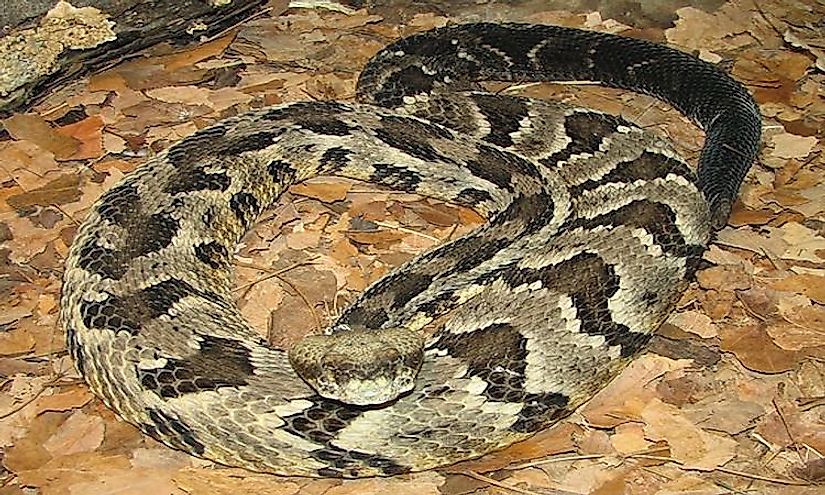
Across every forest here the constraint is not summer range but winter quarters. Timber rattlesnakes den communally in rock crevices with southerly exposure, returning to the same site year after year, with a single den holding anywhere from 15 to 60 animals drawn from an extended family. Those sites are rare pieces of geology rather than general habitat.
Which means a forest's rattlesnake population is capped by how many good hibernacula it contains, not by how much woodland it has. Destroying one outcrop can remove a local population permanently.
What To Do About It

The practical guidance for these forests is short, because the hazard is predictable. Watch hands and feet around rock outcrops, talus and ledges, which is where the snakes are. Step onto logs rather than over them. Keep to trails where the ground is visible, and give any snake you hear a wide berth rather than trying to locate it precisely.
Several of these forests protect the species by state law, and at Snake Road handling or collecting anything is explicitly prohibited.
The Short List
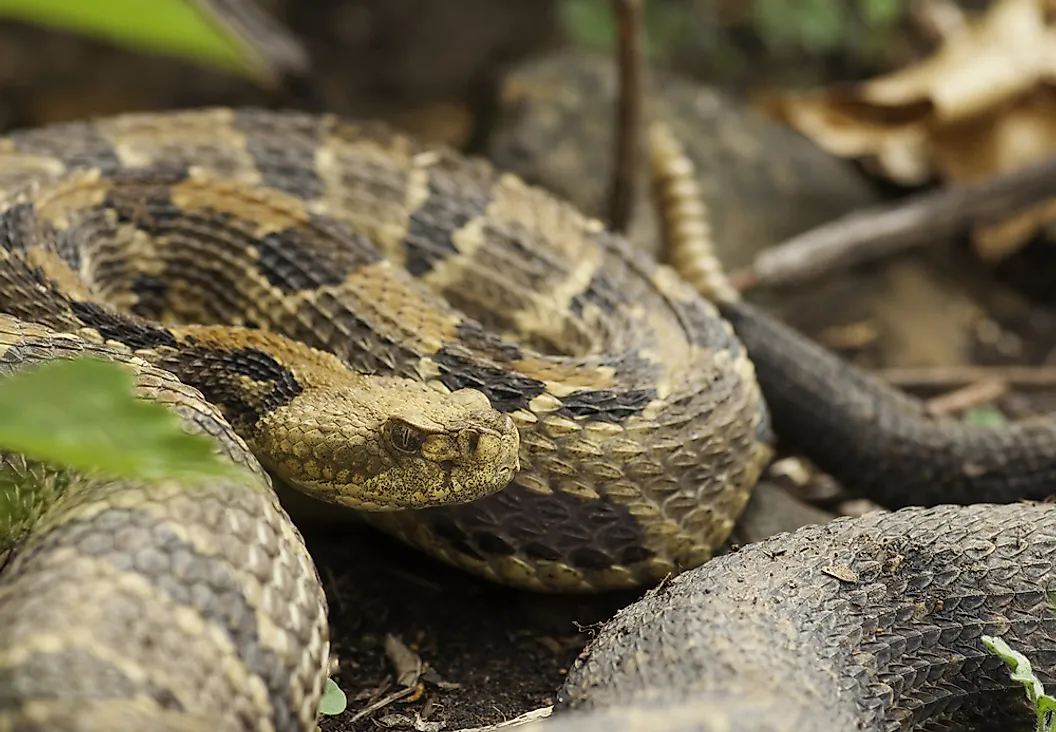
Shawnee earns the top spot for sheer visibility, holding the only road in the world closed annually for snake migration. Ouachita leads on area at 1.8 million acres with tree-climbing rattlesnakes. Mark Twain and Ozark-St. Francis hold the Ozark strongholds, the Appalachian forests run a long continuous band, and Kisatchie carries the canebrakes.
What unites them is steep wooded ground with rock in it, which is the land nobody could plow. The timber rattlesnake survives in national forests because national forests are mostly made of the terrain that defeated agriculture.