Portuguese Man o' War
The Portuguese man o' war (Physalia physalis) is not a jellyfish. It is a siphonophore: a colonial organism in the class Hydrozoa, order Siphonophorae. True jellyfish belong to a different class entirely (Scyphozoa). The man o' war is composed of four types of specialized polyps that grow from a single fertilized egg, function together as a single animal, and cannot survive separately. The name comes from the resemblance of the gas-filled float to the sails of 15th- and 16th-century Portuguese warships.
The Colony: Four Types of Polyps

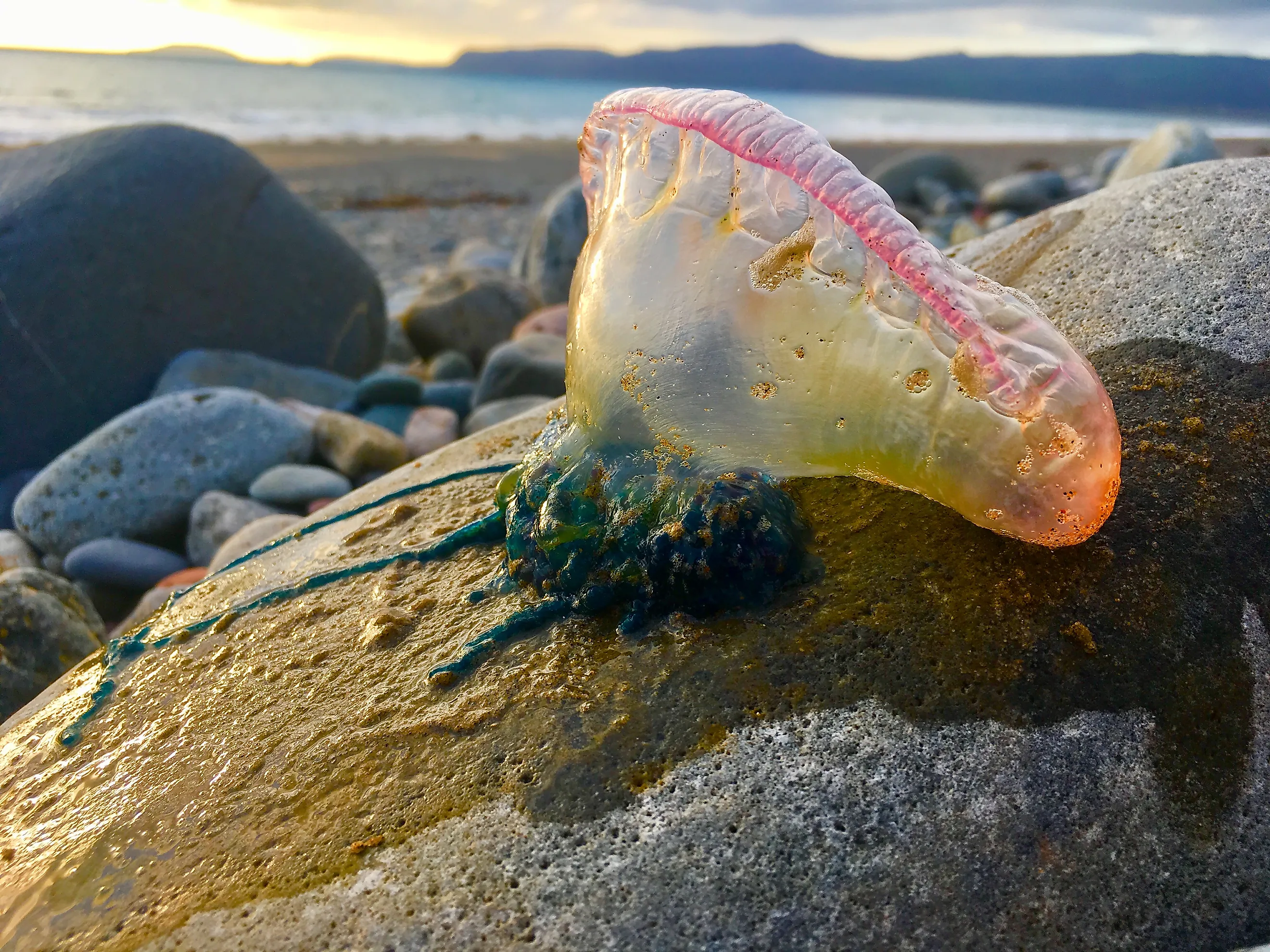
Each man o' war is technically a colony of four polyp types (called zooids), all genetically identical clones of one another, all morphologically and functionally specialized for different tasks. The pneumatophore is the gas-filled float, the part visible above the water, which can reach 30 centimeters (about 12 inches) long and sits up to 15 centimeters above the surface. The dactylozooids are the long fishing tentacles that hang below the float, trailing as much as 30 meters (100 feet) in some specimens. The gastrozooids are the digestive polyps, bag-like structures with mouths that handle feeding. The gonozooids are the reproductive polyps. No zooid can live alone. The colony as a whole is what we recognize as the man o' war.
Physical Description
The pneumatophore is translucent and colored in shades of blue, pink, or violet, with a curved crest that gives the float its sail-like profile. Colonies are either left-sailed or right-sailed (the crest curves one way or the other), which causes them to drift at different angles to the prevailing wind and disperses the population across the ocean. The tentacles below match the float's colors. Each tentacle is studded with hundreds of thousands of nematocysts: microscopic stinging capsules that fire a barbed harpoon coated in neurotoxin when triggered by contact. The venom is potent enough to kill fish on contact and to cause severe pain, welts, and (rarely) more serious reactions in humans.
Behavior and Locomotion

The man o' war is a pleuston, an organism that lives at the interface of air and water. It has no means of self-propulsion. The pneumatophore acts as a sail, and the colony drifts wherever wind and surface currents carry it. The animal can adjust its position only by partially deflating the float to submerge briefly, which it does to escape surface threats such as seabirds. This deflation also reduces dehydration when the float is exposed to direct sun. Otherwise the colony is at the mercy of conditions: strong onshore winds regularly drive large numbers of man o' wars onto beaches, where the stranded colonies dry out and die.
Range and Habitat

Physalia physalis occurs in tropical and subtropical waters of the Atlantic, Pacific, and Indian Oceans. The species is most common in the Gulf Stream and surrounding warm-water systems, with frequent strandings along the U.S. Gulf Coast, the Florida Keys, the southeastern Atlantic seaboard up to North Carolina, and the Caribbean. Indo-Pacific populations occur off the coasts of Australia, southern Japan, Hawaii, and New Zealand. Outlier strandings have been recorded as far north as the British Isles and as far south as southern Argentina, carried there by warm-water current intrusions.
Recent genetic work suggests the genus Physalia may contain multiple species rather than a single global one, with regional Atlantic and Pacific populations potentially representing separate lineages. The taxonomy is under active revision.
Feeding

The man o' war is a carnivore. The dactylozooids hang into the water column, where they intercept small fish, larval fish, crustaceans, and other plankton. Contact triggers the nematocysts to fire, which both paralyzes the prey and grips it with the barbed thread. The dactylozooid then contracts, shortening to bring the prey up to the gastrozooids on the underside of the float. The gastrozooids open their mouths and secrete digestive enzymes directly onto the prey, breaking it down externally and absorbing the nutrients. The entire colony shares the nutritional uptake through a connected gastrovascular system.
Reproduction

Each colony is either entirely male or entirely female (the species is dioecious at the colony level). Reproduction proceeds through broadcast spawning: the gonozooids release gametes directly into the water in autumn in the Northern Hemisphere, and fertilization occurs in the open sea. The fertilized egg develops into a single primary polyp, which then buds asexually to produce the three other zooid types and grow into a full colony. Larger aggregations of colonies in the same area increase the odds of successful fertilization, so spawning is most productive in calm warm-water conditions where colonies concentrate.
Predators and Defenses

The man o' war's nematocyst defense fails against several specialized predators. Loggerhead sea turtles (Caretta caretta) eat man o' wars regularly; their thickly keratinized mouths and esophagi resist the stings. Ocean sunfish (Mola mola) and blanket octopuses (Tremoctopus) also feed on them. The blanket octopus is known for actively tearing off man o' war tentacles and wielding them as a weapon for its own defense. The blue sea slug (Glaucus atlanticus) is the most specialized predator: it stores undischarged nematocysts from its prey in its own cerata, recycling them as its own defense system. Violet sea snails (Janthina janthina) feed on man o' wars from below by floating upside down on rafts of mucus bubbles.
Ecological Role

The man o' war is both a predator (of small fish, larvae, and plankton) and a prey item (for the predators above), placing it as a connector species in surface-zone food webs. It also serves as habitat for the man o' war fish (Nomeus gronovii), a small carangid that lives among the tentacles. The fish is not fully immune to the nematocyst stings, but it is agile enough to navigate the tentacle thicket without triggering them, and it appears to benefit from a protective microhabitat that few other fish can enter. Juveniles reach about 10 centimeters; adults can grow to around 39 centimeters. The relationship is sometimes described as commensalism, though the man o' war fish does occasionally feed on the colony's gonozooids and dactylozooid tissue, which makes the relationship closer to facultative parasitism.
Conservation Status
The species is not assessed by the IUCN as threatened, and populations remain abundant throughout the global tropical and subtropical surface ocean. Mass strandings on beaches are routine and indicate large pelagic populations rather than ecological stress. Ocean warming may extend the species' range polewards over coming decades, with implications for beachgoer safety in regions that have not historically dealt with stranded colonies.