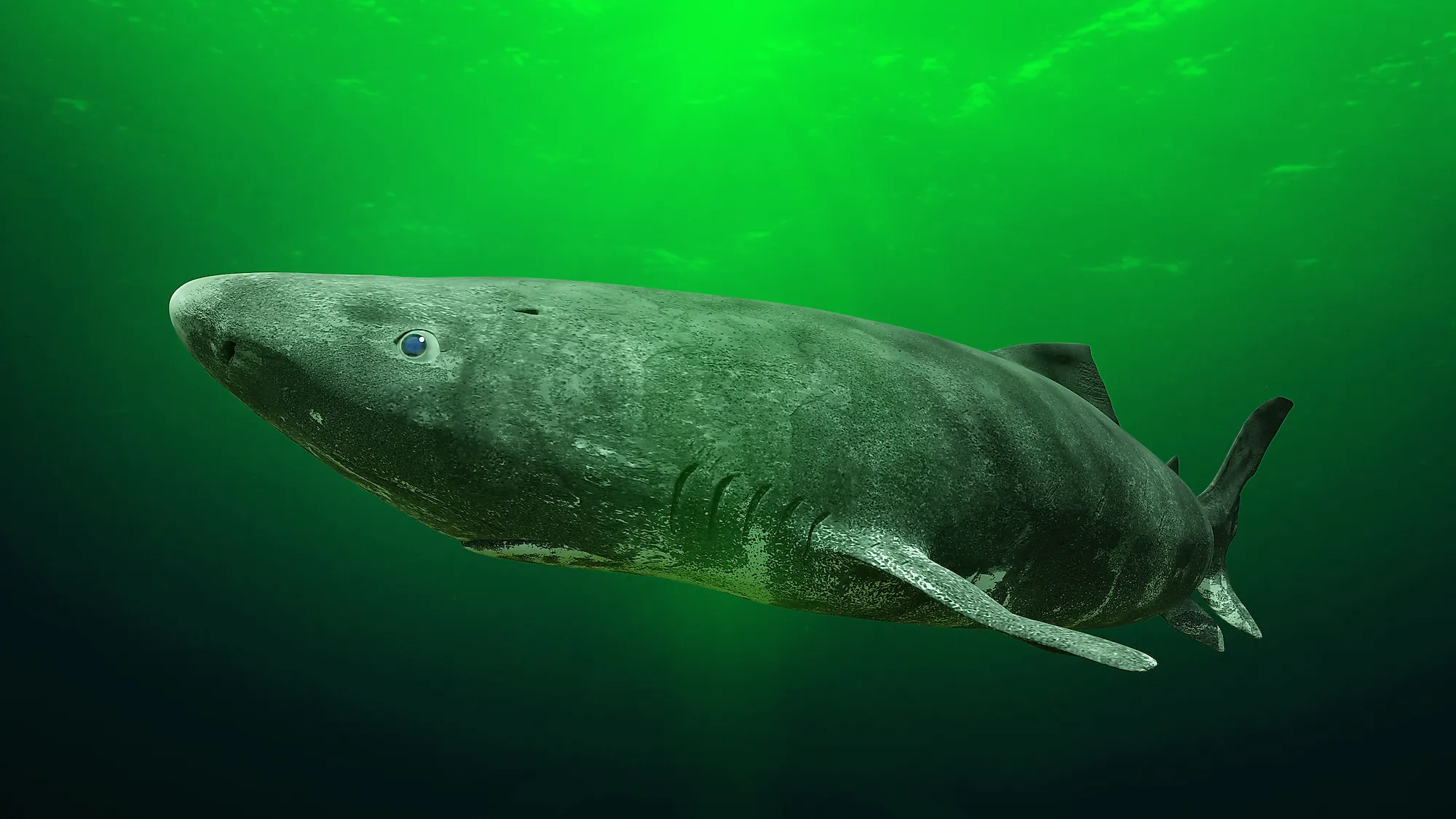
Greenland Shark
The Greenland shark may be the longest-living vertebrate on Earth. A 2016 study in Science dated 28 sharks at between 272 and 512 years old, with a most likely lifespan around 392 years. The species reaches sexual maturity at around age 150. It cruises the Arctic Ocean at walking pace, is usually partially blind from a parasite chewing on its corneas, and has been found with whole polar bears, reindeer, and moose in its stomach. Its scientific name, Somniosus microcephalus, translates loosely as "small-headed sleeper."

Also called the "gurry shark," the Greenland shark sits in the sleeper shark family Somniosidae, in the order Squaliformes. Its closest relatives are the Pacific and Southern sleeper sharks. The species lives in the cold, deep waters of the Arctic Ocean and the North Atlantic Ocean and is the only shark that tolerates Arctic temperatures year-round. The taxonomic context: modern sharks fall in the superorder Selachimorpha, subclass Elasmobranchii, class Chondrichthyes (the cartilaginous fishes), and currently include over 540 species across eight orders.
Size And Body
Greenland sharks rank among the world's largest predatory sharks. Fully grown adults reach 6.4 meters and weigh roughly 1,000 kilograms. A typical adult runs 2.44 to 4.8 meters long and weighs about 400 kilograms. Females are larger than males, and the species is ovoviviparous, producing litters of around 10 pups. The body is heavy-set with small eyes, a short blunt snout, and pectoral and dorsal fins that look undersized against the bulk. Coloration runs the range between pale creamy-gray and dark blackish-brown.
The teeth tell the story of how the shark feeds. Narrow, pointed upper teeth anchor the prey. Broad, squared lower teeth do the cutting. The shark grips with the upper jaw, then rotates its entire body in a circular motion so the lower teeth saw through flesh. Marine biologists call this "anchor and twist."
Range

The Greenland shark is the largest fish that lives year-round in the Arctic Ocean. Its North Atlantic range covers Baffin Bay, the waters off Greenland and Iceland, the Norwegian Sea, and east into the Barents Sea. Occasional sightings reach as far south as the North Sea and the Atlantic seaboard of the United States.
The species lives in water between about -2 °C and 7 °C and has been recorded as deep as 2,200 meters. It rarely visits the surface. Summer sends the sharks deep; winter brings them up closer to the surface, an annual vertical migration that tracks the prey base and the cold layer.
Walking Pace In The Ocean

The Greenland shark is the slowest-swimming shark known. Average cruise speed is about 1.22 kilometers per hour, slower than a person walking on the sidewalk. Top speed reaches only 2.6 kilometers per hour. The slow pace tracks the species' low metabolism and probably explains the extreme lifespan: slower cellular processes, slower aging, longer life.
The Eye Parasite
Most Greenland sharks are partially blind, and the cause is the parasitic copepod Ommatokoita elongata. The copepod latches onto the shark's cornea and feeds on the eye tissue, creating lesions that damage vision over time. Usually only one eye is affected. The shark does not appear to suffer functionally, because it relies on smell, electroreception, and the lateral line system to navigate and hunt in dark deep water rather than on vision.
Diet
Greenland sharks are apex predators and opportunistic scavengers. Known prey includes other sharks, eels, squid, and bony fishes such as cod, herring, Arctic char, flounder, and sculpins. Despite the slow swim speed, the sharks ambush prey at rest, including sleeping seals at the ice edge, which is how a 1.22-kilometer-per-hour predator catches mobile prey.
Stomach contents tell the scavenger half of the story. Researchers have pulled the remains of polar bears, reindeer, and an entire drowned moose out of the digestive tracts of Greenland sharks. None of these animals were hunted in the water; the sharks fed on carcasses that fell or were washed into the ocean. The species sits as both apex predator and Arctic clean-up crew, a dual role rare among large sharks.
The Longest-Living Vertebrate
In 2016, a Danish-led research team published the result that rewrote what scientists thought possible. Julius Nielsen and colleagues, publishing in Science, radiocarbon-dated the protein crystals at the center of the eye lenses of 28 Greenland sharks. The lens nucleus forms before birth and never gets replaced, so it acts as a biological time capsule. The largest shark in the study, measuring 5.02 meters, came back at an estimated 392 years old, with a possible range of 272 to 512 years. The minimum age for the species moved up to about 272 years. The team also calculated that females reach sexual maturity around age 150.
Standard shark aging by counting growth bands in vertebrae does not work for Greenland sharks because their soft, weakly calcified vertebrae do not lay down clear bands. The eye lens method was developed specifically for the species.
Toxic Flesh, Iceland's National Dish

Fresh Greenland shark meat will make a person sick. The flesh holds extremely high concentrations of urea and trimethylamine N-oxide (TMAO), compounds the shark uses to osmoregulate in cold deep water and to stabilize its proteins under pressure. Eating the untreated meat causes vomiting, diarrhea, convulsions, and intoxication-like neurological symptoms. The classic way to eat Greenland shark is the Icelandic method: bury the meat for six to twelve weeks to ferment out the toxins, then hang the pieces in an open-air shed for several more months to dry. The finished product is kæstur hákarl, an Icelandic national dish typically eaten in small cubes with a shot of Brennivín.
Threats
The Greenland shark has been commercially fished since at least the early 19th century. The peak liver-oil fishery ran from the late 19th century through the early 20th century, yielding up to 30 gallons of oil per large shark for use as lamp fuel and industrial lubricant. Petroleum and synthetic alternatives killed off the directed fishery after World War II. An estimated 3,500 Greenland sharks are still taken each year as bycatch, mostly in the Barents Sea and the wider Arctic and North Atlantic, where commercial trawling and longlining for other species pulls them in.
Anthropogenic climate change compounds the pressure. Global warming has driven the retreat of Arctic sea ice, which shifts the prey base and is expected to open new commercial fisheries in formerly ice-covered Arctic waters. The biology that makes the species remarkable (extreme longevity, slow growth, late maturity, low fecundity) is exactly what makes it most vulnerable to that pressure. The International Union for Conservation of Nature reassessed the Greenland shark as Vulnerable on its Red List in 2020.
An Arctic Original
The Greenland shark holds a position no other shark holds. Year-round Arctic resident, longest-living vertebrate on Earth, slow enough to be passed by a person on foot, and large enough to swallow a moose. The same combination of traits that defines the species also makes it among the most vulnerable to commercial fishing and Arctic warming. The biology will outlast most of what humans do; whether the species itself does is the open question.