Quokka
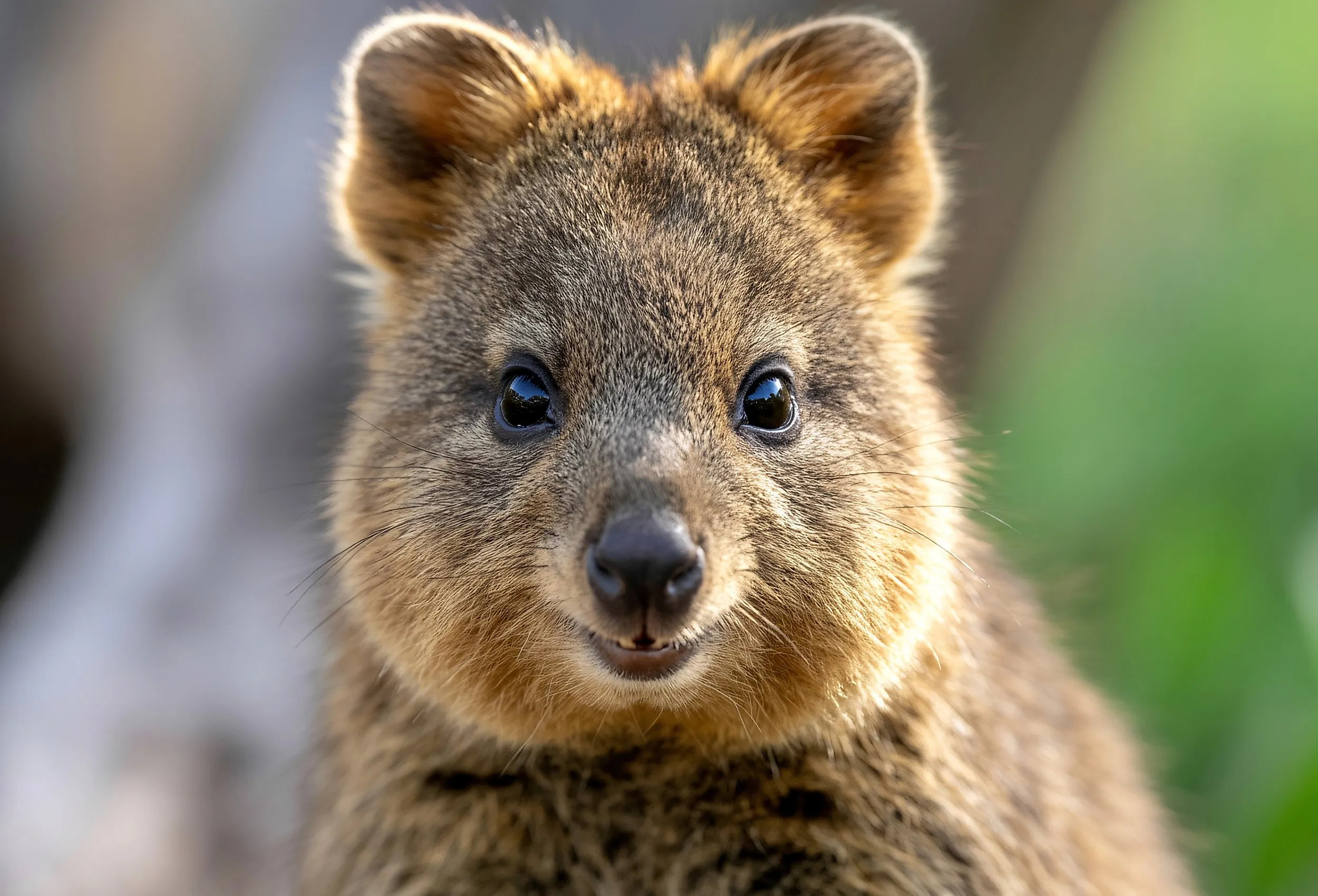
If you are lucky enough to see a quokka, it is easy to understand why these small marsupials have become one of Western Australia’s most beloved animals. Their rounded faces give them the appearance of a constant smile, making them especially popular with visitors and photographers. On Rottnest Island, many quokkas are habituated to people and may even approach visitors. They are still wild animals and should never be touched or fed. Behind the cheerful expression is a hardy, adaptable species with a unique role in Australia’s ecosystems and an important place in local conservation efforts.
Taxonomy and Physical Description

Quokkas (Setonix brachyurus) belong to the class Mammalia, order Diprotodontia, family Macropodidae, genus Setonix, and species brachyurus. They are one of the smallest wallabies, according to the Australian Museum. They have short, coarse hair that appears dark brown on top with a lighter undercoat. Quokkas are typically stocky with short, rounded ears and a hairless nose. They have a short, dark brown tail. Picture a small wallaby about the size of a domestic cat, and you have a quokka.
Quokkas move by bipedal jumping with their long, strong back legs. They have a bounding or hopping gait and can also climb low trees and shrubs to reach food. Quokkas live roughly 10 years in the wild and several years longer in captivity, such as zoos or wildlife refuges.
Habitat and Range

Quokkas are endemic to south-western Western Australia, with populations on Rottnest Island near Perth, Bald Island near Albany, and a few mainland areas. According to The Nature Conservancy, quokkas can be found on the mainland near Northcliffe, and Rottnest Island holds the largest known group of wild quokkas in the world. Rottnest Island is a short ferry ride from the Western Australian port city of Fremantle.
Rottnest was connected to the mainland during the last ice age, when sea levels were lower, and was separated by rising seas around 6,500 to 7,000 years ago. The Whadjuk Noongar people called it Wadjemup, meaning a place across the water where the spirits live.
Rottnest Island has a Mediterranean climate and includes semi-arid habitats with limited seasonal freshwater. Quokkas obtain much of their moisture from vegetation and may survive long periods without drinking. Quokkas prefer dense vegetation or shrubs in a warm, moist environment, but have adapted to the more arid and dry conditions of Rottnest Island, according to the Australian Museum.
Food

Quokkas are herbivores that forage at night. They eat a wide variety of plants, including succulents, shrubs, forbs, grasses, and sedges. Quokkas also enjoy edible berries, seeds, and fruit. They prefer plants with leaves that contain water and access to freshwater, but if not, they can live for a month with minimal water. An adult quokka eats an average of 32 to 45 grams of food each day.
Quokkas can climb to forage, scaling trees and scrub up to about 1.5 meters (about 5 feet). Quokkas eat similarly to sheep and some cattle. According to the San Diego Zoo, quokkas swallow their food, then regurgitate it and chew it as cud. Quokkas can store fat in their tails for hard times when food is scarce.
Behavior and Reproduction

Quokkas are often seen as prey, so they prefer flight over fight and will run when threatened. On Rottnest Island, however, the quokkas are quite friendly to humans and have become a tourist attraction. They are frequently the subject of selfies. They are not pets, and people should use caution around them. Giving them water or food is prohibited as it can be detrimental to their health.
Female quokkas can produce one to two litters per year with one joey, or baby quokka, in each. Females start having babies as soon as they are roughly a year old. A female mates with a male usually up to twice a year. Female quokkas have a reproductive adaptation called embryonic diapause, which helps ensure they usually have only one joey developing in the pouch at a time. Shortly after giving birth, a female may mate again, but the new embryo can pause development for about five months. If the pouch young dies, or once the pouch becomes available again, the paused embryo may resume development.

On Rottnest Island, the quokkas live in small family groups controlled by dominant males. Quokkas may feed alone or in small groups, and males can compete for access to females, with larger males often holding higher dominance status. An adult male will defend a female with a joey if it is their offspring. Quokkas may couple for two years at a time and then switch or find new mates. Females tend to hang around the nest and support their joeys, while the males will congregate together and fight or find a new mate.
Ecological Importance

Quokkas are highly adaptive to often harsh Australian conditions and are an important part of the ecosystem. When they graze, they help other animals that also depend on seeds and vegetation regrowth for survival. By grazing and browsing on vegetation, quokkas influence the structure of the dense habitats they use and help create trails through scrub. Grazing also encourages new growth and spreads seeds near the trails.
Threats
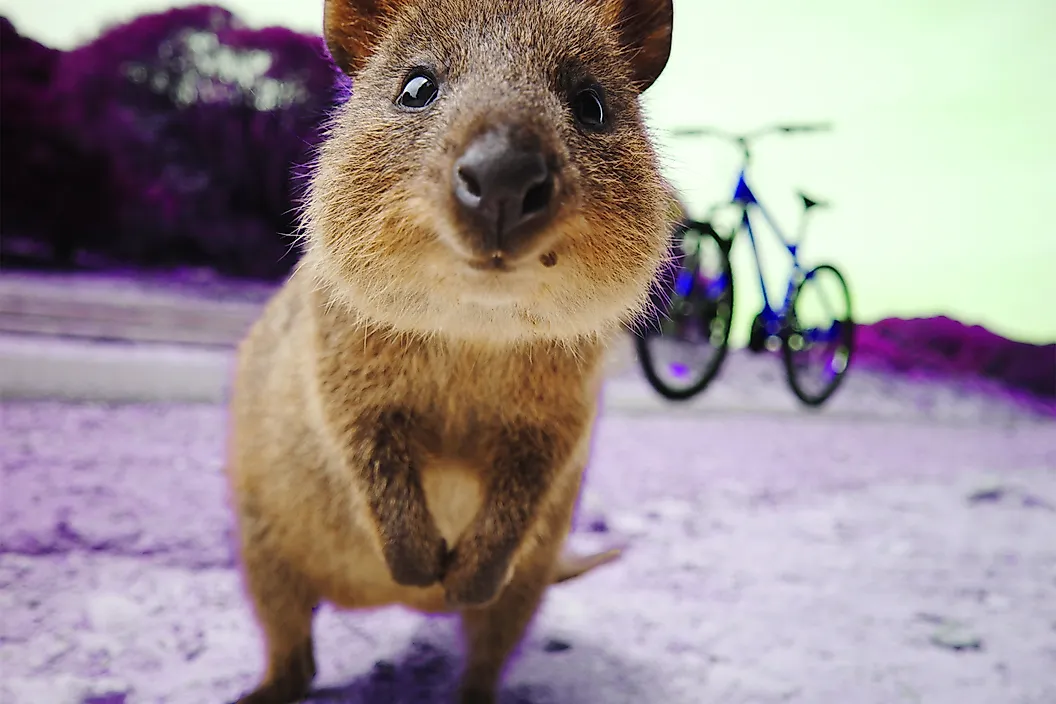
Quokkas are currently listed as a vulnerable species due to predation by feral cats and foxes, altered fire patterns, and habitat loss.
Since quokkas are generally considered prey, they first faced serious losses starting around 4,000 years ago with the introduction of the dingo, and later with the spread of the European red fox into Western Australia in the early 20th century, according to the Australian Museum. The Rottnest Island community was not affected because neither foxes nor dingoes cross the water.
Quokkas on Rottnest are threatened by their popularity with humans and ongoing development that is reducing the quokka habitat. Visitors often feed the quokkas, which harms their health. Climate change may also be a factor as rainfall decreases and the Australian summer becomes hotter and drier. Without aggressive conservation and amid ongoing climate change, the quokka species may become extinct by 2070, according to research published in 2010.
Several zoos in Australia currently have quokkas, including the Perth Zoo, Taronga Zoo in Sydney, Adelaide Zoo, Australia Zoo, and Featherdale Wildlife Park in western Sydney. Small colonies can also be found on Bald Island near Albany and at the Two Peoples Bay Nature Reserve, also near Albany. The Saitama Children’s Zoo in Japan supports a small colony and is the only location outside of Australia.
Small Marsupials With a Big Role
Quokkas may be best known for their “smiling” faces and popularity with visitors on Rottnest Island, but they are more than a tourist attraction. These small marsupials are uniquely adapted to their environment, from storing extra fat in their tails to surviving on moisture from vegetation when freshwater is limited. They have also contributed to scientific research because they can develop a muscular dystrophy-like condition that has helped researchers better understand muscle disease. Today, quokkas remain an important symbol of Western Australia, celebrated each September on Rottnest Island through quokka-themed events and conservation-focused activities.