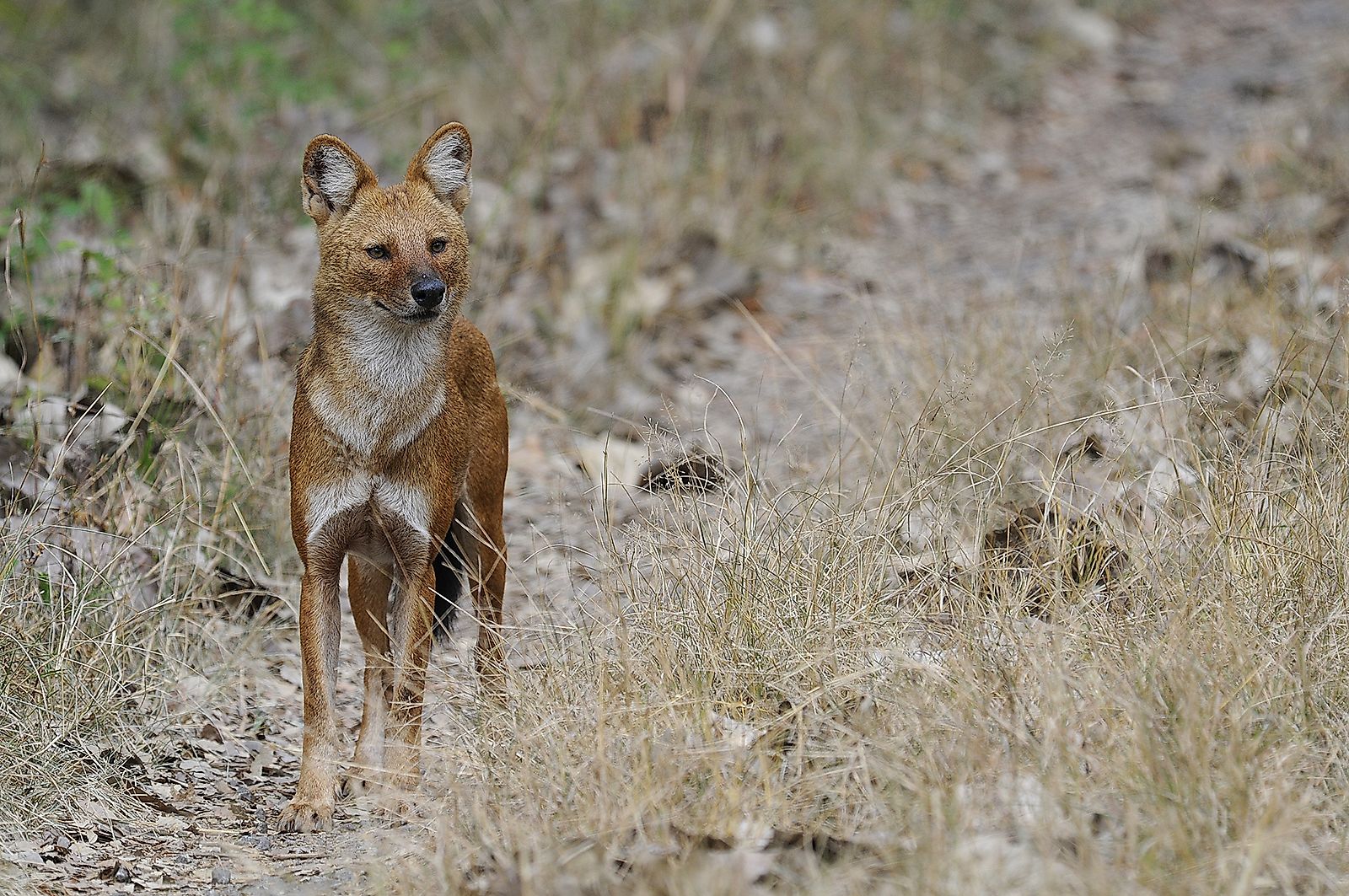
Asia's Dhole Populations At Risk Of Extinction
The dhole (Cuon alpinus) is one of Asia's most threatened large carnivores, with fewer than 2,500 mature adults left in the wild. India holds the largest national population and is the species' best long-term hope. Even so, dholes have already disappeared from about 60% of their historic Indian range. Small populations cling to fragments of habitat in Nepal and Bhutan and across Southeast Asia. The species is on the verge of extinction in China and possibly already gone in Vietnam. Six conservation scientists and field researchers walked us through the status of the species across its range.

The species currently survives only in fragments of the Indian subcontinent, Central Asia, and Southeast Asia. The sections below cover the dhole's current conservation status across its range, the main threats, and what the experts say it will take to reverse the decline.
Experts Interviewed
- Dr. Anish Andheria: President, Wildlife Conservation Trust (India); one of India's leading conservationists; recipient of the Carl Zeiss Conservation Award (2015); large-carnivore specialist
- Dr. Arjun Srivathsa: Research Associate, Dhole Project, Wildlife Conservation Society-India; IUCN SSC Canid Specialist Group, and IUCN Dhole Working Group
- Dr. Jan F. Kamler: Researcher at Wildlife Conservation Research Unit (WildCRU), University of Oxford, UK
- Dr. Martin Gilbert: Senior Research Associate at the Department of Population Medicine and Diagnostic Sciences at Cornell University College of Veterinary Medicine, USA
- Ambika Pd. Khatiwada: Conservation Officer at National Trust for Nature Conservation, Nepal
- Priya Singh: Independent wildlife researcher; a member of the Wild Canids-India Project
Dholes: Status And Threats Across Their Range

Dholes In The Indian Subcontinent
India, the country with the world's largest population of wild tigers, is the dhole's safest stronghold. The country reportedly hosts the largest population of dholes anywhere. Even so, the species has disappeared from about 60% of its historic Indian range over the past 100 years, and research on the species remains sparse.
"When we look at the conversion rate of hunting attempts to kills, the dhole is by far the most successful hunter in the Indian jungle. It has a much higher conversion rate compared to a tiger. However, its highly evolved hunting abilities are not enough to save its populations from a steady decline. Anthropogenic reasons leading to forest degradation, fragmentation and persecution have decimated dhole populations in several historical dhole habitats of India. Transfer of disease from feral and domestic dogs is also a huge threat," said Dr. Anish Andheria, one of India's leading wildlife conservationists. He is also the President of Wildlife Conservation Trust (WCT), India, an NGO that works across several states to help preserve and protect India's wildlife.
"Being highly social, dholes show high levels of intraspecific interactions, and hence there is never a dull moment while observing a dhole pack, whether it constitutes three or 20 animals. Yet, they have been relatively less studied than tigers and leopards. The familiarity of humans with dogs and hence them taking dholes for granted could be one reason. Also, they are small-sized animals - an adult male dhole is just under 20 kg and an adult female under 15 kg. In general, small-sized mammals have not been studied enough, the same is true about small cats, jackals, badgers, and civets - not much research on these species," he continued.

The Wild Canids-India Project was launched in 2018 by researchers affiliated with various organizations and universities, to address how grossly understudied dholes and other wild canids in the country are. The project conducts research to better understand wild canids and to formulate science-based conservation strategies that include citizen-science components.
"We recently mapped dhole distribution across India as part of our Wild Canids-India Project," said Dr. Arjun Srivathsa, Research Associate at the Dhole Project, Wildlife Conservation Society-India. He is also a member of the Wild Canids-India Project, IUCN SSC Canid Specialist Group, and IUCN Dhole Working Group.
"Dholes currently occur across 249,606 sq. km area in the country, which is ~49% of their potential habitat. Most populations are found in the Western Ghats, Central India, and Northeast Indian landscapes. We do not have a countrywide estimate of their population size. But our research from Kerala in 2019 showed that Wayanad Wildlife Sanctuary has a population of around 50 dholes (a density of ~14 dholes per 100 sq. km)," he said.
Dr. Srivathsa's research also found that public perception of dholes varies by region, which directly affects the survival of dholes outside protected areas.
"In south and central India, and in southeast Asia, people are rather indifferent to dholes. There's not much conflict as there are only occasional events of dholes attacking and killing domestic animals. The situation is starkly different in Nepal, Bhutan, and Northeast India, where people view dholes with a lot more animosity and negative interactions are commonplace," said Dr. Srivathsa.

Priya Singh, an independent wildlife researcher and a member of the Wild Canids-India Project, explained the situation in Northeast India.
"Mithun (a form of cattle) and pigs are commonly reared by local people in the hill states of northeast India such as Arunachal Pradesh, Nagaland, and Mizoram. While pigs may be kept in captivity, mithun are free-ranging. And with low natural prey availability in the region due to a cultural prevalence of hunting, livestock becomes easy prey for carnivores such as the dhole who are known to frequently hunt mithun, and sometimes domesticated pigs. Hence, retributive killing of dhole is commonly reported from northeast India," she said.
Such killings are also common in neighboring Bhutan. Mass poisoning campaigns drove dholes to near-extinction in Bhutan in the 1970s and 80s, after they were held responsible for persistent livestock losses. The dhole's removal had a cascading effect: wild pig (Sus scrofa) populations exploded without the predators that had kept them in check, and crop damage from wild pigs increased sharply. The Bhutanese dhole population began recovering in the late 1990s and now occurs in most of the country's protected areas, although numbers remain low. The species is still not listed under Schedule I of Bhutan's Forests and Nature Conservation Act.

In Bangladesh, dholes occur in parts of the Chittagong Hill Tracts in the southeast, with recent verification in mixed evergreen mid-hill forests of the northeast as well.
In Nepal, dhole populations occur in several protected areas and outside them. The Department of National Parks and Wildlife Conservation Act of 1973 protects the species, but numbers remain low and populations highly threatened.
"Dholes are distributed from lowland protected areas to high altitude protected areas in Nepal. In high altitudes, communities practice rotational herding as a means of livelihood. Being a pack hunter, dholes kill livestock (yak, sheep, cow) in the pastureland of these communities. In retaliation, herders poison the carcasses of dhole's prey to eliminate dholes from their area. Few cases of poisoning were also observed in buffer zone areas of lowland protected areas," said Ambika Pd. Khatiwada, Conservation Officer at the National Trust for Nature Conservation, Nepal.
"Other threats to the species in Nepal include loss of prey due to illegal hunting, habitat loss, fragmentation, and competition with large predators like leopards and wolves in high altitude protected areas, and tigers in low altitude protected areas. A low level of awareness among local communities about the ecological significance of dholes also contributes to their demise. There is also the possibility of disease transmission by domestic dogs," he added.
Dholes Outside The Subcontinent

Outside the Indian subcontinent the dhole's situation is worse. In Southeast Asia, populations are known to survive in Malaysia, Laos, Cambodia, Thailand, and Myanmar. The species is possibly extinct in Vietnam.
"In Southeast Asia, dholes are restricted to small isolated populations, mostly concentrated in and around protected areas that are scattered throughout the region. The major threats to the species are depletion of their prey due to poaching, habitat loss, and disease transmission from free-ranging dogs," said Dr. Jan F. Kamler, researcher at the Wildlife Conservation Research Unit (WildCRU), University of Oxford.
"Local people in Southeast Asia tend to not think very highly of dholes. In general, dholes are just considered to be a type of forest dog, so not much thought is given to them. In places where dholes might attack livestock, they can be persecuted and poisoned by the local people," he added.
In China, dholes are on the verge of extinction. On February 5, 2021, the Chinese government upgraded the species from Class II to Class I on the National Key Protected Species List, which makes the species eligible for the highest level of legal protection in the country.
Little is known about dhole distribution in Central Asian countries. A 2015 IUCN report finds the species regionally extinct in most countries of the region.
Dholes And Infectious Disease
Among the many threats to the dhole is the threat of disease transmission from domestic animals. As forest cover shrinks and natural prey is depleted, dholes are forced to feed on livestock and to move through human-dominated landscapes. The closer contact makes the wild dogs susceptible to a range of pathogens carried by domestic animals, particularly domestic dogs, but the actual impact on wild populations is poorly understood. Dr. Martin Gilbert, Senior Research Associate at Cornell University's College of Veterinary Medicine, walked us through the issue.
"Considering the threats faced by other endangered social canid species, particularly African wild dogs and Ethiopian wolves, it is likely that infectious disease does represent an important threat for dhole populations. Such diseases could even be capable of causing local extinctions," said Dr. Gilbert.
"Anecdotally, there have been reports of sick dholes in the wild, but these are rarely investigated. Based on outbreaks in zoos, we know that dholes are highly susceptible to canine distemper virus, with outbreaks causing high levels of mortality. They are also vulnerable to the rabies virus, which is also common in many countries where dholes live. As in other species, the death of dholes infected with the rabies virus is likely to be inevitable. The skin mite that causes sarcoptic mange has also been devastating to some wild canid populations. Reports of hair loss in some wild dhole populations could relate to this infection and deserves further study. Most of the pathogens of greatest concern to dholes require close contact with an infected host, which pass on the infection either through a bite (as in the case of rabies) or via respiratory droplets (as in the case of distemper). It is believed that some of these infections (particularly distemper) may be passed on when carnivores feed on infected prey, but the evidence for this is mostly circumstantial," he continued.
Dr. Gilbert also flagged a structural concern: dholes are social animals and infections can sweep entire packs.
"Once an individual dhole is infected it is likely to pass on the pathogen to other members of its pack during normal social interactions. In this way, pathogens like rabies could be responsible for the loss of whole packs. Distemper outbreaks have also been responsible for local extinctions of other threatened carnivores, but more usually we'd expect a few infected animals to survive and could potentially repopulate an area. Of course for a pack-living species that work as a group to bring down prey and defend a territory life becomes much more difficult when numbers are depleted by disease. In these cases packs might disband and become incorporated into neighboring dhole packs, bringing with it the chance of further disease transmission if these interlopers are still infectious," he said.
Mitigation Measures

The pattern across the dhole's range is consistent: small, fragmented populations under multiple pressures, with the constant risk that an infectious-disease outbreak could wipe out a local population overnight. The experts pointed to several practical levers.
India's Project Tiger, launched in 1973 to protect the country's national animal, covers many of the same forest landscapes where dholes still survive. Whether the tiger-conservation infrastructure has helped or hurt dhole numbers depends on how it is run.
Dr. Andheria answered the question directly: "Tiger conservation, depending on the context, has both helped and depleted dhole populations. The protection awarded in the name of the tiger by the declaration of tiger reserves is definitely beneficial to dholes, especially in woodland habitats. But the urge to increase tiger densities in all kinds of habitats by adding more waterholes and modifying habitat has increased tiger numbers but affected dhole numbers negatively because of interspecific competition between tigers and dholes. A large dhole pack of over 10 individuals can hold its ground against an adult tiger that can be between 7 to 12 times heavier than an adult dhole. However, smaller packs can easily be decimated by tigers through predation of adults and more so of pups. More studies on interspecific interactions of dhole and other predators inside Protected Areas and the interaction of dhole with people and their livestock outside PAs will definitely shed more light on how important dhole-specific conservation strategies will be. My guess is that such dhole-specific strategies may be required in several locations," he said.

Dr. Srivathsa pointed to a different problem: dholes are hard to fundraise for compared to tigers.
"Although the dhole is in the same threat level category ("Endangered") as the tiger as per the IUCN, there's very little we know about dholes from large parts of their distribution range. There has been some increase in scientific focus on the species in the past 5-8 years or so but we are just scratching the surface at this point. India has still produced the highest number of peer-reviewed papers on dholes compared to other dhole-range countries. Across most parts of their range, dholes are not prone to conflict with people, nor are they poached for meat or fur. Since there is nothing seemingly "sensational" about them, we have found it very hard to raise funds to study and conserve the species," he said.
"Recently we have been trying our best to synthesize conservation research work on dholes at different levels across India in our attempts at creating a countrywide conservation plan. The purpose of the plan should not just be to direct conservation action, but also to highlight research and knowledge gaps and appeal for explicating these gaps," he continued.
From Nepal, Khatiwada proposed community-level interventions: awareness programs and community-based livestock insurance schemes where human-dhole conflict is most acute. The insurance scheme already running in the Kangchenjunga Conservation Area in eastern Nepal has measurably reduced retaliatory poisoning by herders.
"There are very few dhole conservation projects on the ground in Nepal. We need to understand more about their specific habitat requirements, population, food, and diseases. Research on these topics may help for better management interventions in the future. As dholes are wide-ranging species, corridors and bottlenecks should be maintained and conserved. Community engagement outside the protected area network is also necessary for their conservation. There is no dhole conservation action plan for Nepal. This plan should be prepared and government authorities, conservation organizations should also invest in dhole conservation. Up to now, conservation is focused more on charismatic and large-bodied species which is important but also should consider dhole-like species to address the pressing issues of their conservation," Khatiwada said.

Dr. Kamler flagged poaching as the urgent Southeast Asia priority.
"Dholes definitely need some better publicity, especially given their endangered status and their importance in Asian ecosystems as one of the few apex carnivores. So I think education campaigns are needed to educate people in the region about dholes and raise their profile. Southeast Asia is in the midst of a poaching epidemic, which is devastating not only dholes but also the prey on which they depend. Most of the poaching is the result of increased demand for wild meat and other animal products by people at all levels of society. So if dholes are to have any future in Southeast Asia, then poaching levels need to be reduced, however, this won't be easy and there is no single solution. I think a three-pronged strategy is needed to address the poaching problem. It should involve increased law enforcement in protected areas, engagement with local people to stop snaring and other forms of poaching, and education campaigns to reduce demand for wild meat and other animal products by the public," Dr. Kamler said.
On the disease front, Dr. Gilbert outlined how the risk can be reduced.
"It is important to realize that domestic animals are only one potential source of infection for dholes, as all of these pathogens can also be found in other wildlife species (particularly other carnivores). Therefore it is important to understand how these pathogens are being maintained locally, identifying which species (or group of species - domestic or wild) are acting as reservoirs and sources of infection for dholes. In situations where domestic dogs are the most important source of infection, it is possible to reduce the risk through vaccination programs. Good vaccines exist for both distemper and rabies, with the added benefit that this helps protect local people from infections of the latter. In areas where wildlife plays a role as a disease reservoir, the options are more limited. The most effective approach would be to vaccinate the dholes themselves, but captive trials would be required to be sure that this is a safe and effective method of protecting them. Oral vaccines for rabies are widely used in other wildlife species and so could potentially be used to protect dholes, but at least at present we don't have an equivalent oral vaccine for distemper and so developing such a vaccine could be a game-changer for protecting dholes or other threatened carnivores from this serious disease," he said.
The pattern across these experts is consistent: region-specific strategies, more research on the species, and direct engagement with the communities that live alongside dholes. Dholes remain under-funded and under-studied relative to the larger Asian carnivores they share habitat with.

"The dog is considered as our best friend since eons. While this camaraderie between dogs and us has resulted in them being our most favored pets, the same affection is seldom extended to wild canids. Wolves, jackals, coyotes, and dholes have all suffered at the hands of rapid urbanization and persecution. Being an efficient predator, the dhole occupies an important niche in tropical forests. Intuitively speaking, the gradual disappearance of dhole from their historic range would have definitely impacted the composition of wild herbivores, and thus the way these herbivores interact with plants. Unfortunately, in the absence of any long-term study, we are unlikely to realize the true value of these master hunters in stabilizing hundreds of thousands of square kilometers of tropical ecosystems. While I have spent decades studying tigers and leopards, my respect for these whistling hunters has grown with every observation. I only hope that in the coming times, these indefatigable red dogs will fill the hearts of countless global citizens with the perkiness that they so beautifully epitomize," said Dr. Andheria.
What Comes Next for the Dhole
The species is not yet lost. India still holds a meaningful breeding population across the Western Ghats and central forests, Bhutan has come back from the 1970s low, and Nepal's protected-area network covers core habitat. The constraints are funding, research, and community engagement on the human-dhole conflict line. A targeted conservation plan that addresses each one, the way Project Tiger did for tigers in 1973, is what the experts above keep pointing to.