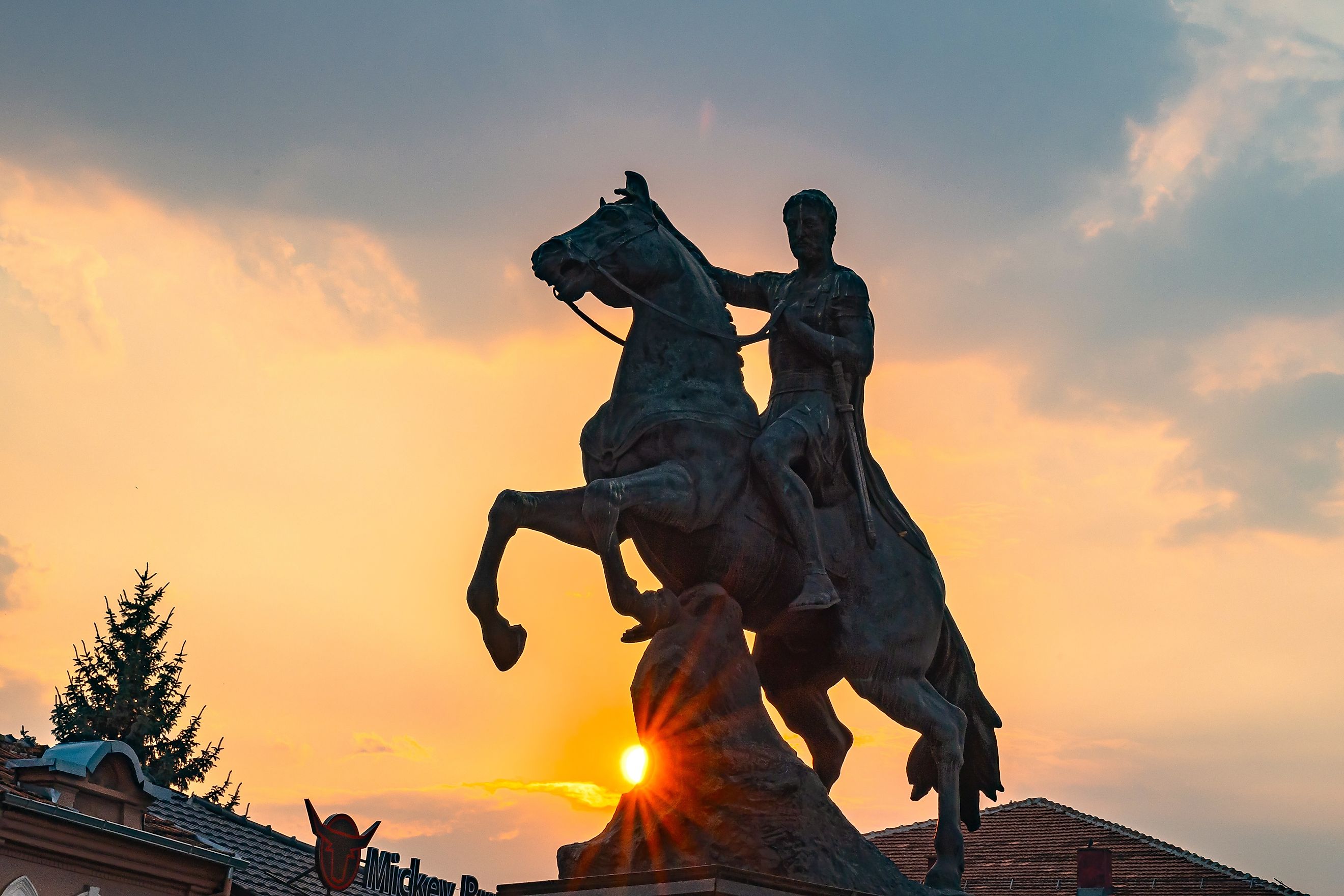
Who Were The Most Underrated Ancient Greek Generals?
Ancient Greek warfare is often remembered through a short list of familiar: Leonisas, Themistocles, Alexander The Great. Yet some of the commanders who most decisively altered the balance of power in the ancient Greek world are less readily associated with military success. Nicias was instrumental in securing success during numerous campaigns of the Pelponnesian War before being unwillingly caught in Athens' disastrous campaign in Sicily. Philip II of Macedon quietly built the military system that made his son's later conquests possible. This article will therefore explore some of the most underrated Greek generals, hoping to paint a more holistic picture of one of history's most important civilizations.
Nicias (470 to 413 BCE)

Born to an aristocratic family, Nicias rose to power in Athenian politics during the Peloponnesian War, a nearly thirty-year conflict between Athens and Sparta. In particular, he became popular after the death of longstanding Athenian leader Pericles in 429 BCE. While most other figures who emerged during this time promoted an aggressive strategy, Nicias urged caution. Rather than winning in a decisive battle, he instead argued that Athens should preserve its resources, avoid unnecessary risks, and gradually weaken Sparta.
Nicias oversaw numerous successful campaigns during the Peloponnesian War. He led an expedition to capture the island of Cythera in 424 BCE and also weakened Melos in a raid two years earlier. However, perhaps his most important achievement came in 421 BCE. By this point, both Athens and Sparta were exhausted. Nicias was instrumental in negotiating the appropriately named Peace of Nicias in 421 BCE, which resulted in about six years of uneasy peace.

Nicias' reputation fell apart with the disastrous Sicilian Expedition (415 to 413 BCE). He cautioned against it but was overruled and made one of the expedition's main commanders. His failure to withdraw when everything was going wrong was a major reason why Athens’ fleet was destroyed, leading to a permanent weakening of its navy. Nicias was subsequently executed, but it seems unfair for his legacy to be purely shaped by the Sicilian Expedition. After all, he opposed it, and his career up to that point was characterized by thoughtful and purposeful decision-making.
Brasidas (Died 422 BCE)

Brasidas was another important general in the Peloponnesian War. However, he’s sometimes forgotten due to his relatively short career. He first gained prominence by defending Spartan territory from Athens, overseeing an attack on an Athenian fort in Pylos in 425 BCE. While he was unsuccessful, the affair nevertheless demonstrated Brasidas’ personal bravery and courage. The next year, he turned his attention to northern Greece and took the Athenian-allied city of Amphipolis. A major source of timber and the site of key strategic routes, losing Amphipolis was a major blow to Athens. Cleon was thus sent to recover it, leading to the Battle of Amphipolis in 422 BCE. Sparta won, and Cleon was killed, but Brasidas was also mortally wounded. Nevertheless, in just three years, the Spartan general showed that Athens was beatable, and his and Cleon’s deaths were major contributing factors to the aforementioned Peace of Nicias.
Epaminondas (419 or 411 to 362 BCE)

Little is known about Epaminondas’ early life, since the main sources detailing it have been lost. We do know that he rose to prominence in Theban politics in the 370s BCE, as Thebes was fighting against Spartan domination. This culminated in 371 BCE with the Battle of Leuctra. Traditionally, Greek generals deployed their troops in a fairly uniform line. Epaminondas instead created an extremely deep formation on his left flank. This deployment became known as the oblique order and allowed the Thebans to smash through part of the Spartan formation. When one part collapsed, so did the entire army.

The victory of Leuctra led to roughly ten years of Theban hegemony in Greece. During this period, Epaminondas oversaw several campaigns into Spartan territory and liberated its slaves, known as helots. Doing so eliminated a major source of Spartan economic strength. Even though Epaminondas was killed at the Battle of Mantinea in 362 BCE, his legacy persisted. By disrupting the traditional balance of power in Greece, he paved the way for other states, like Macedonia, to dominate the region. Generals like Philip II and Alexander the Great also learned from Epaminondas’ oblique order and used it to achieve unprecedented military success.
Philip II (382 to 336 BCE)

While Alexander the Great is one of, if not the, most famous people in history, he could not have achieved what he did without his father, Philip II. As King of Macedonia from 359 to 336 BCE, Philip transformed its military. First, he created a professional standing army. Second, he introduced the sarissa, a long spear that made it easy for Macedonian troops to hold their enemies in place. Third, Philip utilized a combined arms approach. While the Macedonian enemies were pinned down, cavalry smashed through them. Known as the hammer and anvil tactic, it built on the logic of Epaminondas ' oblique order, which Philip likely learned about as a teenager when he was sent to Thebes as a hostage.

All these factors (along with smart diplomacy) allowed Macedonia to gain power during Philip's reign. This culminated in the Battle of Chaeronea in 338 BCE, in which Philip (and his son, Alexander) defeated an Athenian and Theban coalition. In the aftermath, Philip created the League of Corinth, formally establishing Macedonian hegemony over Greece. Even though Philip was ultimately assassinated in 336 BCE on the eve of his planned invasion of Persia, Alexander saw these plans through to completion and went on to build one of the largest empires in world history. Crucially, none of this would have been possible without Philip’s military reforms.
Impact And Legacy
Several underrated generals shaped Greek history. Nicias was instrumental in ending the first stage of the Peloponnesian War. Brasidas was also important in the early part of the conflict by showing that Athens could, in fact, be beaten. Epaminondas’ oblique order laid the foundation for Greek military strategy for centuries to come. Finally, Philip II built the army that his son, Alexander the Great, used to conquer much of the known world.