The US Rivers Where Bull Sharks Swim Upstream
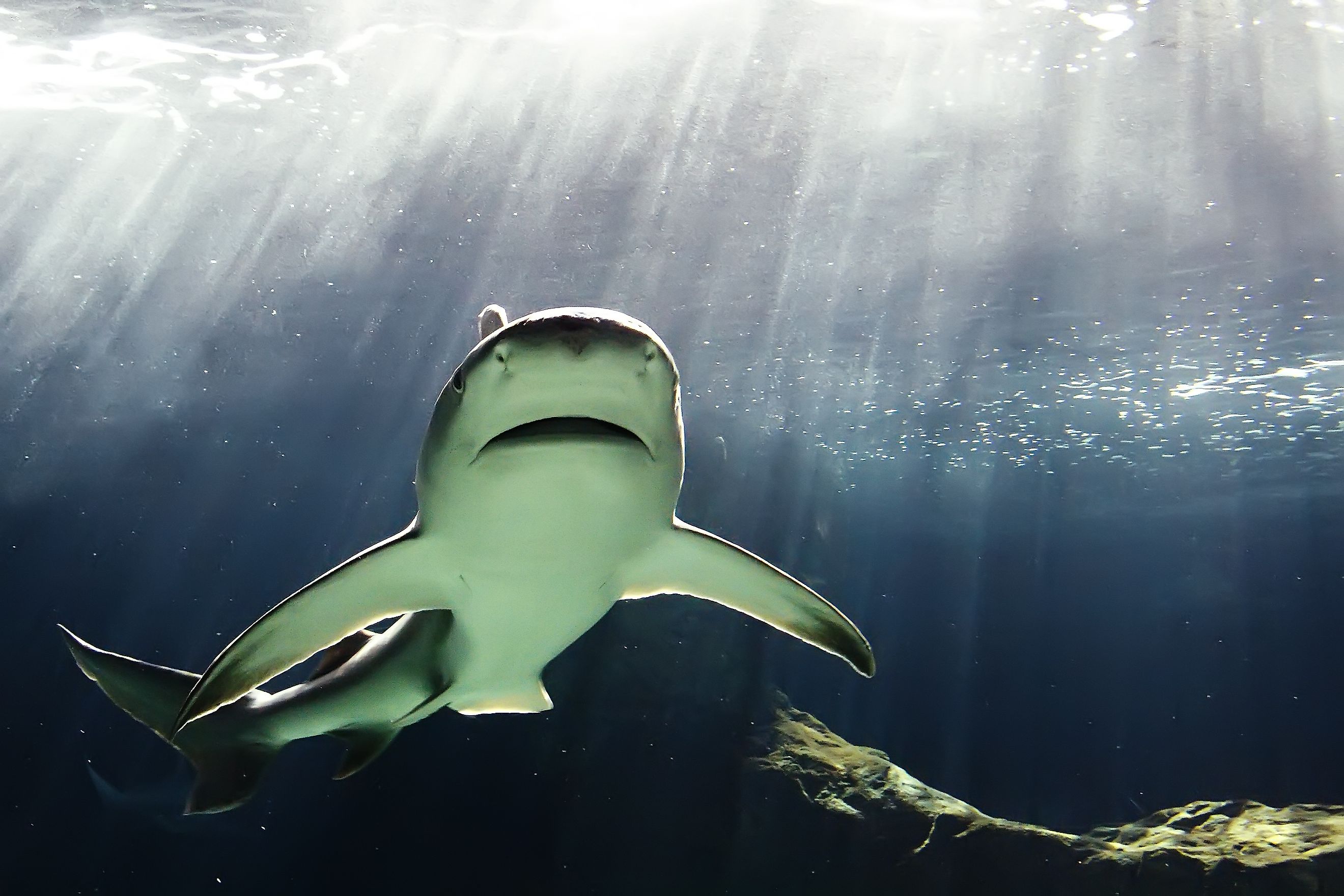
Imagine going for a swim in the Mississippi River near St. Louis, Missouri, more than a thousand miles from the Gulf of Mexico, when a steel-gray dorsal fin breaches the water's surface nearby. A shark sounds impossible, but maybe not, since there have been at least two documented sightings of bull sharks traveling this far up the Mississippi, one in 1937 and another in 1995. These aggressive and feisty sharks, which have been recorded as far as 2,500 miles up the Amazon River in Peru, have made their way up several other US rivers as well thanks to a special osmoregulatory ability that allows them to transition from saltwater oceans into freshwater rivers and survive for long periods of time. Widely considered one of the most aggressive shark species in the world, bull sharks have high testosterone levels that trigger bold and unpredictable actions, guard their territory closely during breeding season, and hunt in shallow and murky surf zones where they can't see well and bite first and identify the potential prey later. That bite, one of the strongest pound-for-pound of any shark, is not good news for unsuspecting swimmers. Fortunately, scientists have determined these long-distance forays into fresh water by bull sharks are rare, and attacks are even rarer as humans are not part of a bull shark's normal diet.
Mississippi River System

In 1937 near Alton, Illinois, about 25 miles upstream from St. Louis, two fishermen caught a five-foot, 84-pound bull shark. In 1995, another bull shark turned up near the Rush Island Power Station south of St. Louis. A published study by researchers Ryan Shell and Nicholas Gardner verified these two historical events after reviewing hundreds of scattered claims and comparing them with environmental data. The researchers noted that while bull sharks can tolerate fresh water for long periods of time, traveling this far up the Mississippi River basin remains a rare anomaly and extremely rare migratory behavior. However, because bull sharks enter the Mississippi from the Gulf of Mexico, they often inhabit lower stretches of the river and are regularly found in the Mississippi River delta in Louisiana, around its brackish estuaries, coastal marshes, and mouth.
Potomac River

Bull sharks have been documented repeatedly in the Potomac River, and unlike the rare instances near St. Louis, their visits here recur. Most reports come between late July and September, when water temperatures rise, salinity levels change, and bull sharks move up the Potomac from Chesapeake Bay to hunt. While most sightings happen where the river opens up into the bay, several large bull sharks have been pulled from waters further up the Potomac. In 2013 and 2015, local fishermen caught multiple eight-foot-long bull sharks weighing more than 200 pounds in commercial fishing nets. Some of these catches occurred just 200 yards away from public swimming beaches at Point Lookout State Park. In 2018, an angler made headlines by pulling an 8.6-foot, 310-pound bull shark from the nearby Patuxent River. References to bull sharks in the Potomac date back more than a century. In the summer of 1911, fishermen near Alexandria, Virginia, became so rattled by large sharks circling their boats that they half-jokingly founded the "Society for the Suppression of Man-eating Fish." There have never been any documented shark attacks in the river.
Loxahatchee River, Florida

Florida's Loxahatchee River on the Atlantic coast via the Jupiter Inlet serves as a highly active ecosystem for bull sharks, especially as a nursery ground for young bull sharks, which rely heavily on the brackish and freshwater waterways during the early part of their lives. As a result, the Loxahatchee has become a hotspot for marine biologists to track bull shark habits. Young bull sharks use estuaries and coastal rivers during their first two to four years of life, away from larger ocean predators. Researchers have tracked their movements in the Loxahatchee using acoustic receivers extending six miles upstream from Jupiter Inlet. Recently, drone and aerial photographers have captured footage of adult and juvenile bull sharks swimming through the shallow, murky waters of the North Fork of the Loxahatchee, cruising very close to docks, seawalls, and moored boats in residential neighborhoods like Tequesta.
Caloosahatchee River, Florida

Flowing past Fort Myers and Cape Coral into San Carlos Bay on the Gulf Coast, the Caloosahatchee is much larger and heavier flowing than the Loxahatchee but also acts as a calving territory for bull sharks. In the spring, female bull sharks swim deep into the Caloosahatchee and its canal systems between April and May to give birth. A single litter can produce up to 13 pups. Newborn bull sharks use the Caloosahatchee River as nursery habitat, although researchers have found that individuals move in and out of the estuary as they grow. The bull sharks in this water system are reportedly more aggressive than those in the Loxahatchee, as kayakers have reported intense encounters where sharks have bumped their kayaks repeatedly. Anglers have also reportedly hooked large bull sharks, some as long as eight feet and weighing more than 200 pounds, right off the shores of Cape Coral or near the Cape Coral Bridge. Bull sharks can be legally caught and harvested, but Florida Fish and Wildlife officials enforce strict rules to keep the harvest sustainable.
Atchafalaya River, Louisiana

Unlike the temporary anomalies of bull sharks deep in the Mississippi or Potomac rivers, the Atchafalaya River serves as a regular seasonal habitat where bull sharks live in fully fresh water. Reproduction is the main reason why bull sharks flock to this Louisiana river basin. Pregnant females migrate out of the Gulf of Mexico, traveling inland through the bays and the intracoastal waterways into the river to create a nursery ground. The sharks are drawn to shallow, warm, and murky water to give birth in the summer months, and the dense cypress swamps and complex bayous provide an ideal nursery. The pups remain in the freshwater for months or even years, safely protected from larger ocean sharks like tiger sharks or great whites that prey on them. While sightings are often recorded in the lower parts of the river, Louisiana Department of Wildlife and Fisheries officials have confirmed reports of bull sharks as far upstream as Simmesport, about 140 miles from the Gulf. Commercial and recreational fishers have reported increasing encounters with bull sharks in Louisiana waters, although scientists have not established whether the Atchafalaya's bull shark population has increased. Despite their aggressive reputation and close proximity to human activity, there has never been a reported inland bull shark attack in Louisiana's history.
No Bull, There Are Sharks In These Rivers
If bull sharks are found in river estuaries, bayous, and canal systems in Louisiana and deep into the Potomac, it is no surprise that shallow sound systems up the East Coast in places like North Carolina, South Carolina, and Georgia also see bull sharks. In fact, there are anecdotes and even evidence of bull sharks populating brackish waterways along the entire Eastern Seaboard. With the Mississippi, however, the documentation of two bull sharks more than 1,000 miles from the Gulf Coast is astonishing, as is the presence of these apex predators in the lower Potomac, downstream from Washington, D.C., one of the US's most densely populated urban areas. While bull sharks use these areas mostly as nursing grounds to avoid large ocean predators, they run into a different and perhaps more dangerous kind of threat in human populations. The very evolutionary strategy that has kept bull sharks safe for millions of years is now driving them into human backyards, where sharks and people increasingly overlap.