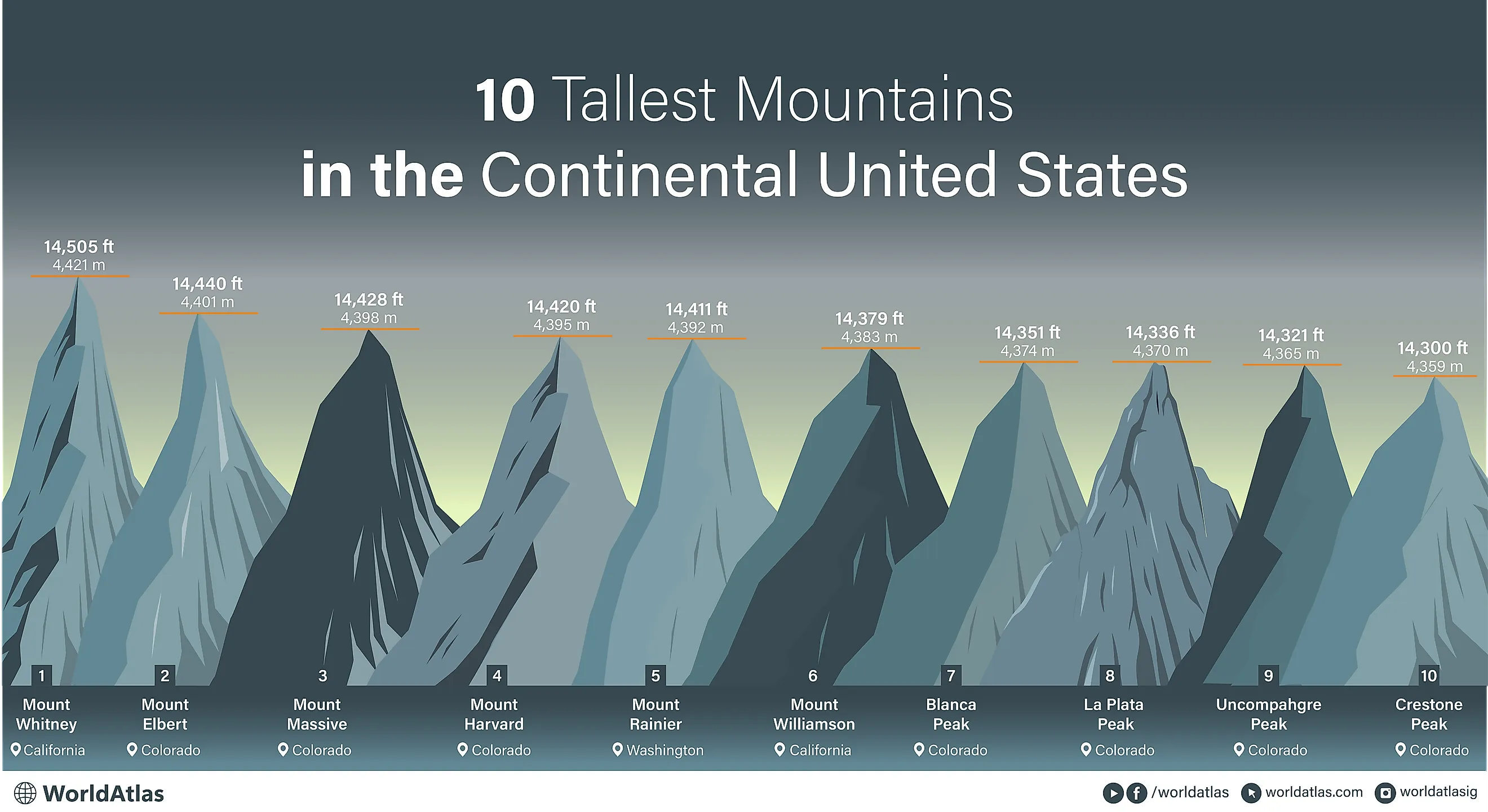
10 Tallest Mountains In The Contiguous United States
Alaska hoards the giants. Alaska alone claims the tallest peaks in the country, crowned by Denali (Mount McKinley) at over 20,310 feet, the highest point in North America. The catch is that most mountain lovers will never make it that far north.
Good news for the rest of us: the Lower 48 has plenty of its own monsters. Here are its 10 highest peaks, ranked from the tallest on down, with the names, geology, and history behind each one.
1. Mount Whitney, California - 14,505 Feet

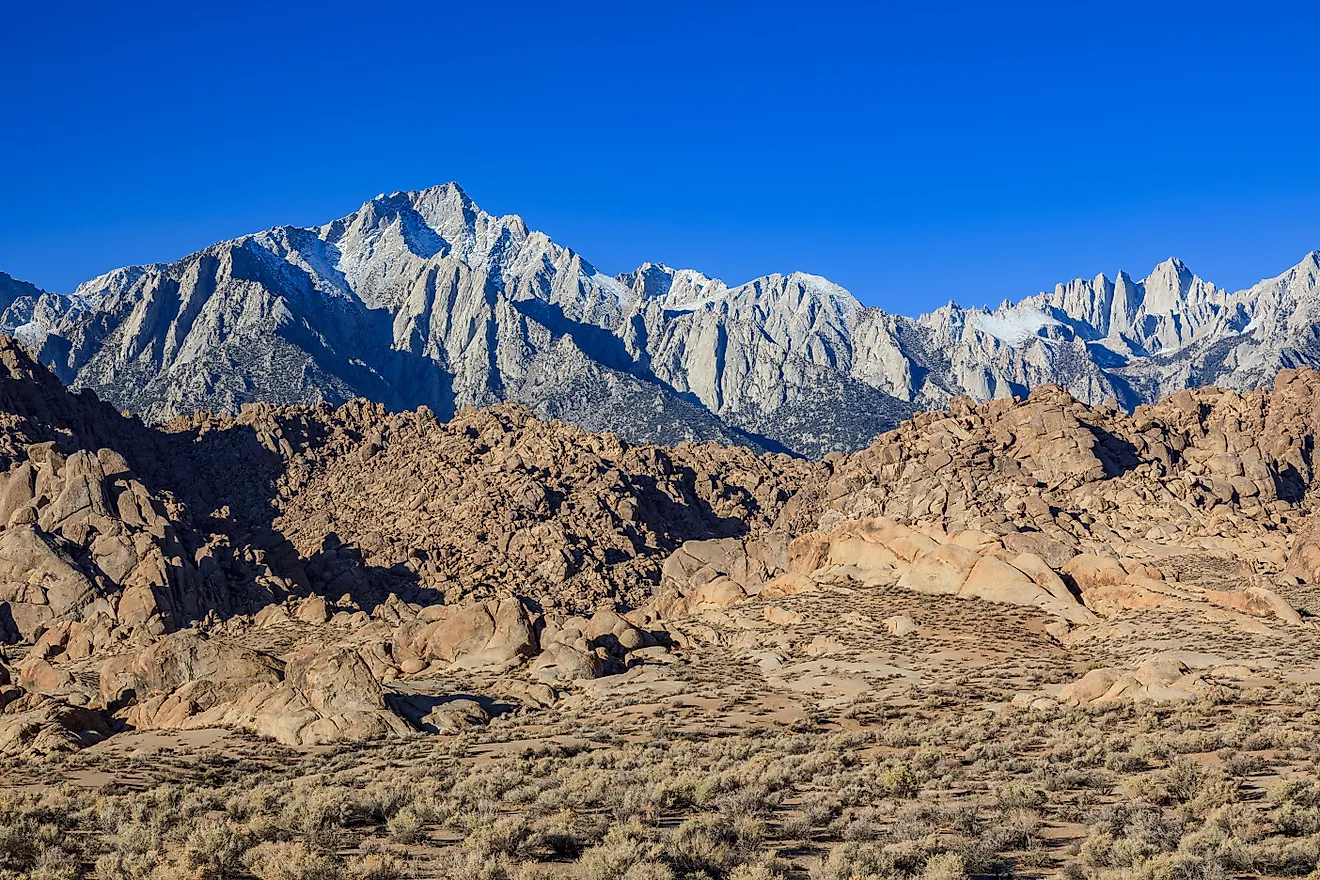
At 14,505 feet, Mount Whitney is the rooftop of the contiguous United States. It rises off the eastern edge of California's Sierra Nevada just west of Lone Pine, and it took its name in 1864 from Josiah Whitney, then the state geologist.
The mountain is a slab of Cretaceous granite that glaciers carved into sheer walls and dizzying drops. Its eastern face is the showstopper: more than 10,000 vertical feet of rise packed into under 15 miles, one of the most dramatic ascents in the country. Whitney sits within the Inyo National Forest and borders Sequoia National Park along the western rim of the Great Basin.
Here is the kicker: the highest point in the Lower 48 stands less than 90 miles from the lowest. Summit views sweep across Kings Canyon, the high Sierra crest, and the Mojave Desert, and just to the east lies Death Valley, whose Badwater Basin bottoms out at 282 feet below sea level.
2. Mount Elbert, Colorado - 14,440 Feet

Colorado's high point is Mount Elbert, and at 14,440 feet it tops the entire Rocky Mountain range as well. It is another headliner of the Sawatch Range, named for Samuel Hitt Elbert, a 19th-century territorial governor.
For the tallest peak in the Rockies, Elbert is surprisingly approachable. Its profile is broad and gradual rather than jagged, so the summit takes stamina rather than technical skill, by way of the roughly 10-mile North Elbert Trail. The Northeast Ridge route runs a little over 12 miles, and a southern approach stretches past 15.
3. Mount Massive, Colorado - 14,428 Feet

Mount Massive earns its name. At 14,428 feet it is the third-highest peak in the contiguous US, and it covers more ground above 14,000 feet than any other peak, stringing together five separate summits along one long, high ridge.
That bulk once fueled a rivalry. Locals piled stones on Massive's summit to try to nudge it past nearby Mount Elbert, which held onto the crown by a slim margin anyway. Today the mountain rises west of Leadville inside the Mount Massive Wilderness, a magnet for hikers, climbers, and mountain bikers.
4. Mount Harvard, Colorado - 14,420 Feet

Mount Harvard stands 14,420 feet tall, the third-highest peak in Colorado and the anchor of the northern Sawatch Range. A Harvard Mining School expedition tagged it in 1869 and named neighboring Mount Yale on the same trip.
Its upper slopes are granite, broken by wide tundra benches and steep headwalls that Pleistocene ice ground into shape. As with most peaks on this list, glacial valleys and alpine basins ring its base and feed the waterways below, in this case the Arkansas River.
5. Mount Rainier, Washington - 14,411 Feet

Mount Rainier is the giant of the Cascade Range, a 14,411-foot stratovolcano that lords over western Washington from a base spanning some 30 square miles. On a clear day it floats on the horizon above Seattle, Tacoma, and much of the Pacific Northwest.
Rainier carries more glacial ice than any other peak in the Lower 48. Over two dozen major glaciers pour off its summit, feeding rivers that run toward Puget Sound and the Columbia Basin. And it is no relic: the volcano is still active, venting steam and shuddering with the occasional quake. It even brews its own weather, hiding in cloud while the lowlands stay clear.
British explorer George Vancouver named it in 1792, and it became the heart of Mount Rainier National Park in 1899. The Puyallup people knew it first as Tahoma, or Tacoma, the mother of waters.
6. Mount Williamson, California - 14,379 Feet

Mount Williamson is California's second-highest summit, behind only Whitney, and the sixth-highest in the Lower 48 at 14,379 feet. It throws up one of the most savage vertical reliefs in the state, rising more than 9,000 feet straight out of the Owens Valley.
The mountain's mass is angular and raw, scored with granite slabs and steep couloirs cut by glaciers. It sits in the Inyo National Forest within the John Muir Wilderness, and though it hides from the main roads better than its famous neighbor Mount Whitney, its sheer rise out of the arid valley to alpine heights is among the most striking in North America.
7. Blanca Peak, Colorado - 14,351 Feet

Blanca Peak crowns the Sangre de Cristo Mountains, shooting up sharply from the San Luis Valley and visible for miles across southern Colorado. It heads the Sierra Blanca Massif, a tight cluster of Fourteeners that also takes in Ellingwood Point and Mount Lindsey.
Its granite upper slopes are pocked with cirques and lakes left by ancient glaciers, while moraines and bristlecone pine groves below mark the seam between high desert and subalpine country.
The peak is sacred to several Native American tribes. The Navajo call it Sisnaajini and treat it as the eastern boundary of their traditional homeland.
8. La Plata Peak, Colorado - 14,336 Feet

La Plata Peak rises to 14,336 feet among the Collegiate Peaks of the Sawatch Range, inside the San Isabel National Forest. The name is Spanish for "silver," a nod to the region's centuries of mining.
The peak dominates the skyline west of Twin Lakes and sends its meltwater into both the Arkansas and Roaring Fork river systems; on a clear day you can pick it out from the plains near Buena Vista. Steep ridgelines and glacial cirques seam its broad flanks, and the usual way up, the Northwest Ridge, is a grind of long switchbacks and loose scree.
9. Uncompahgre Peak, Colorado - 14,321 Feet

Uncompahgre Peak is the high point of the San Juan Mountains and the ninth-tallest in the Lower 48 at 14,321 feet. It breaks the Fourteener mold with a broad, flat top, a legacy of ancient volcanism rather than uplifted granite, and sheer cliffs falling away on several sides make it easy to pick out.
Set in the Uncompahgre Wilderness of western Colorado, it is reached by most via the Nellie Creek Trailhead, a non-technical 7.4-mile hike well within reach of anyone with decent endurance. The remoteness keeps the crowds thin, and the summit pays out with views of jagged San Juan ridgelines, alpine basins, and glacier-carved valleys in every direction.
10. Crestone Peak, Colorado - 14,300 Feet

Rounding out the list, Crestone Peak is the tenth-highest in the contiguous US, topping out near 14,300 feet in southern Colorado's Sangre de Cristo Range.
Sitting within the Rio Grande National Forest, Crestone is one of the state's more rugged Fourteeners, yet it still draws a steady stream of hikers and climbers. Remote and far less trafficked than the peaks near Denver, it asks for real preparation and stamina and repays it with views that escape the usual crowds.
The summit is a genuine climb. The standard South Face route earns a Class 3 rating, demanding careful scrambling and route-finding, and the neighboring Crestone Needle raises the stakes for mountaineers chasing a tougher alpine line.
How Many Of These Peaks Will You Bag?
There you have it: the 10 highest summits in mainland America. None of them sits as far out of reach as Alaska's giants, so there is little excuse not to get out and tackle one or two (or more) this year. Most are laced with trail networks and backed by national park infrastructure, and beyond their role as landmarks and living ecosystems, they deliver some of the finest high-country views the country has to offer.