Oldest Mountain Ranges Of The World
Mountains, like people, come in all shapes and sizes, and the oldest ones tend to be the shortest. That is not an insult. It is physics. Give a mountain a few billion years of wind, rain, and ice, and even the mightiest peak gets sanded down to a stubborn ridge. The ranges below are the ancient survivors, still standing long after the mountains of their era crumbled to gravel.
Building one takes patience on a geological scale. A small volcano can pile itself up in a few months. A major mountain range, raised by colliding slabs of the planet's crust, takes millions of years to reach its full height.
Ranges like these form where two of Earth's tectonic plates grind into each other. When the plates meet, the crust has nowhere to go but up, buckling like the hood of a car in a head-on collision, the same slow-motion pileup that raised the Rocky Mountains.
Some ranges are still under construction. The Himalayas, the poster child for young mountains, only began rising around 40 to 50 million years ago, which is practically yesterday in mountain time. India is still plowing north into Asia as you read this, shoving the peaks up by roughly a centimeter (0.4 inches) a year. Erosion claws almost exactly that much back off the top, so the Himalayas run hard just to stay the same height.
Big enough to steer weather and draw the borders between nations, mountains look like the planet's most permanent features. They are not. Here are some of the oldest ranges still hanging on, and what makes each one worth the geological respect.
The Barberton Greenstone Belt - 3.6 Billion Years
Generally, South Africa and the Americas hold the oldest mountains on Earth, and South Africa holds the record outright. The Barberton Greenstone Belt, also called the Makhonjwa Mountains, is widely recognized as the oldest mountain range in the world. It straddles South Africa and Eswatini and tops out at about 1,800 m (5,905 ft). Being this ancient keeps it modest in height, because a few billion years of weather do not flatter anyone.
These hills are stuffed with ancient fossils, volcanic rock, and, naturally, gold. This is where South Africa's first gold turned up, back in 1875, and the ore here counts among the oldest known orogenic gold deposits on the planet. The rock is so old and so well preserved that geologists nicknamed the range the "Genesis of Life" and comb it for traces of Earth's earliest microbes.
The Hamersley Range - 3.4 Billion Years

Ever wonder how places get their names? Often it comes down to who happened to be holding the map. Australia's Aboriginal peoples surely had names for this range in the northwest long before 1861, but when explorer and mineral surveyor Francis T. Gregory reached the area that year, he named it after Edward Hamersley, the man who had helped bankroll the expedition.
The range sits on the Pilbara Craton, a slab of crust roughly 3.4 billion years old, which is what earns it a place near the top of this list. Its own banded-iron rocks are younger, closer to 2.5 billion years. Either way, it is staggeringly old and staggeringly rich, one of the great iron-ore provinces on Earth and the source of most of Australia's iron, with a little gold and asbestos in the mix. Its highest point, Mount Meharry, reaches 1,249 m (4,098 ft), making it the tallest peak in Western Australia, though nowhere near the country's overall summit.
The Magaliesberg - 2.3 Billion Years

The Magaliesberg is a modest but well-defined ridge running about 120 km (75 miles) across northern South Africa, curving between Rustenburg in the west and the Bronkhorstspruit area east of Pretoria. Its quartzite and shale began as sediment on the floor of a shallow inland sea, laid down on the ancient Kaapvaal Craton roughly 2.3 billion years ago, long before anything resembling a modern continent existed.
Today those quartzite escarpments and deep, shady kloofs funnel crystal-clear streams into waterfalls, carving the gorges that hikers happily scramble up and that conservationists work to protect.
Guiana Highlands - 2 Billion Years

In northeastern South America, the Guiana Highlands rise north of the Amazon rainforest and south of the Orinoco River. They roll through southern Venezuela and spill into the Guianas, northern Brazil, and a corner of southeastern Colombia. The bedrock beneath them is around 2 billion years old, some of the oldest exposed crust on the continent.
The landscape is a jumble of sandstone-capped plateaus, low mountains, and rolling uplands, draped in savanna and rainforest. It also hides serious treasures: gold, diamonds, and iron ore below ground, and above it, Angel Falls, the highest waterfall in the world, dropping nearly a kilometer in a single plunge.
The Waterberg Mountains - 1.9 Billion Years

The Waterberg is a range of low, flat-topped peaks in Limpopo Province, South Africa, and its rocks tell a Paleoproterozoic story. The Waterberg sandstones were laid down between about 2 and 1.9 billion years ago, not long, in geological terms, after the enormous Bushveld igneous intrusion next door. That puts the range a solid notch younger than many popular lists claim.
The whole area is protected as the Waterberg Biosphere Reserve, one of more than 780 such UNESCO sites worldwide. Wander it and you can turn up Stone Age tools and rock art painted on the cliffs, proof that people have been drawn to these hills for a very long time.
Black Hills, USA - 1.8 Billion Years

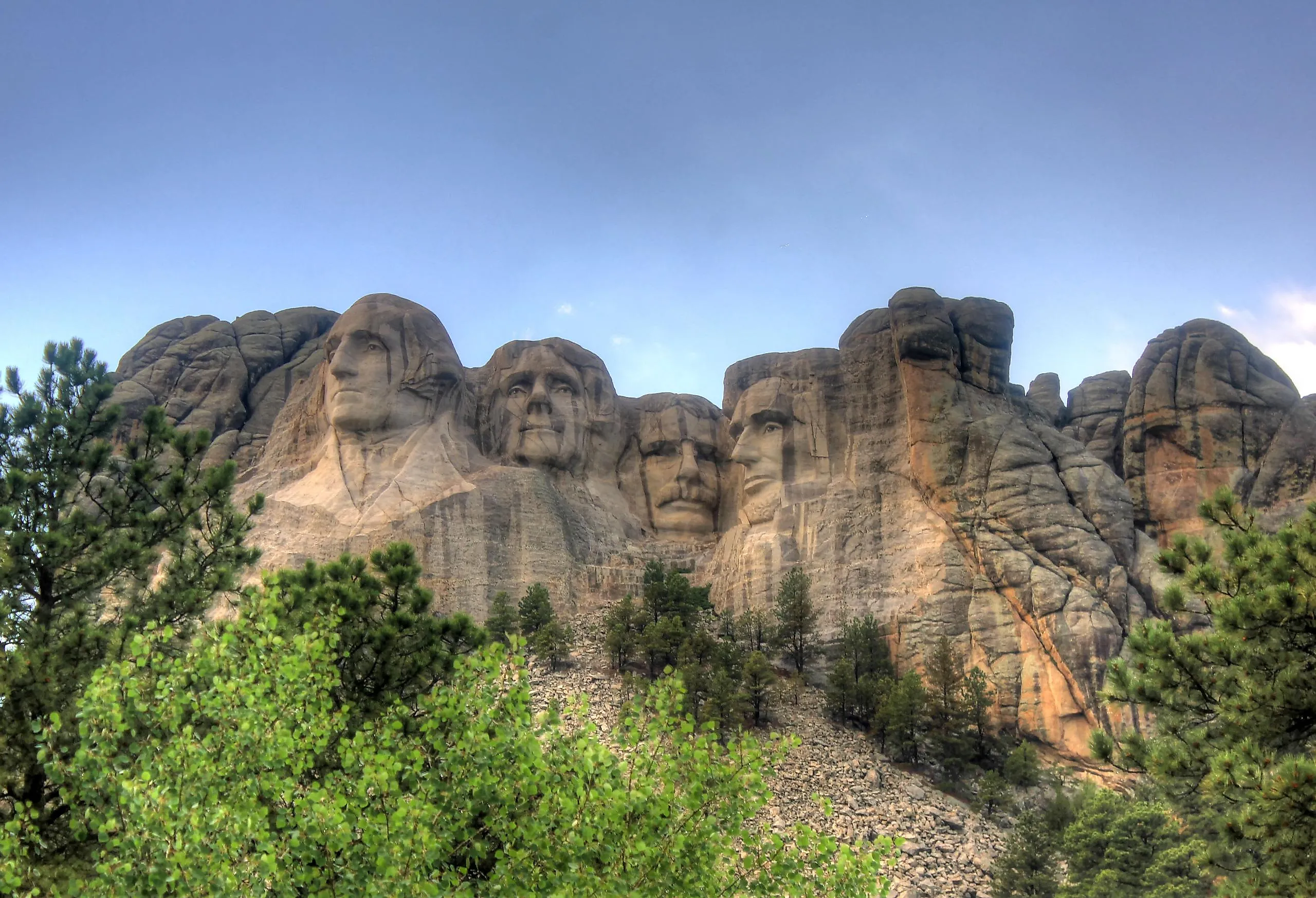
The Black Hills rise from the plains of South Dakota and northeastern Wyoming, an island of forested granite in a sea of prairie. The core rock is about 1.8 billion years old, but here is the twist: the hills themselves are young, pushed up only around 65 to 70 million years ago, when the same forces that built the Rockies domed this ancient rock skyward. They are home to Mount Rushmore, the four presidents carved into a cliff of that old granite.
The Black Hills also held the largest gold mine in the United States, the Homestake, which ran until 2002 and now, nearly a mile and a half underground, houses a physics lab hunting dark matter and neutrinos.
That gold is the root of a hard history. The Black Hills, named for the dark look of their pine-covered slopes from a distance, are sacred to the Lakota and other Plains nations, and an 1868 treaty recognized them as Sioux land. When a US Army expedition confirmed gold there in 1874, prospectors poured in, the treaty was broken, and the Black Hills War of 1876 ended with the United States seizing the land. The Supreme Court later ruled the taking unlawful and awarded compensation, but the Lakota have refused the money and continue to seek the return of the Hills themselves.
Today the region draws visitors to Jewel Cave National Monument, Wind Cave National Park, and Custer State Park in South Dakota, and to Devils Tower National Monument just across the line in Wyoming.
What The Oldest Mountains Still Tell Us
These ranges share a quiet punchline: the mountains we call permanent are simply slow. Every one of them was once a giant, and every one has spent hundreds of millions, even billions, of years being ground back toward the plains. What survives is the toughest rock, the deepest roots, and a record of an Earth almost no one will otherwise see, the age of the first microbes, the first free oxygen, and the first continents. Old mountains are short for a reason, and the reason is time.