The Most Toxic Algae-Affected Lakes in the United States
Every summer, harmful algal blooms (HABs) spread across hundreds of lakes in the United States. Driven by cyanobacteria, these blooms produce toxins that threaten human health, kill wildlife, and devastate local economies. The damage reaches drinking water, tourism, and recreational fishing.
Most lakes experience only occasional blooms. A smaller group stands out for how often they occur, how toxic they get, and how far the damage reaches. The five lakes featured here were chosen on documented bloom frequency, toxin levels, ecological damage, and public health impacts.
Lake Okeechobee (Florida)

Located in south Florida, Lake Okeechobee is Florida’s largest lake and one of the clearest examples of how nutrient pollution fuels toxic algal blooms in the United States. The lake covers roughly 730 square miles (1,890 square kilometers), making it the second-largest freshwater lake wholly within the contiguous United States, and it averages only about 9 feet (2.7 meters) deep. The combination of its large surface area and shallow depth allows sunlight to penetrate easily, accelerating algae growth across wide expanses of water.
Nutrient Pollution
The lake’s watershed spans about 4,600 square miles, with much of it dominated by agriculture, especially cattle ranching and sugar production south of the lake. According to state and federal monitoring data, annual phosphorus loads have historically exceeded 500 metric tons. The target concentration set by regulators is 40 parts per billion (ppb) of phosphorus, but long-term averages have often hovered between 100 and 170 ppb, more than double or triple the goal. Phosphorus is the key limiting nutrient for cyanobacteria in freshwater systems, and when concentrations reach this level, blooms become likely and persistent.
Bloom Frequency and Toxicity
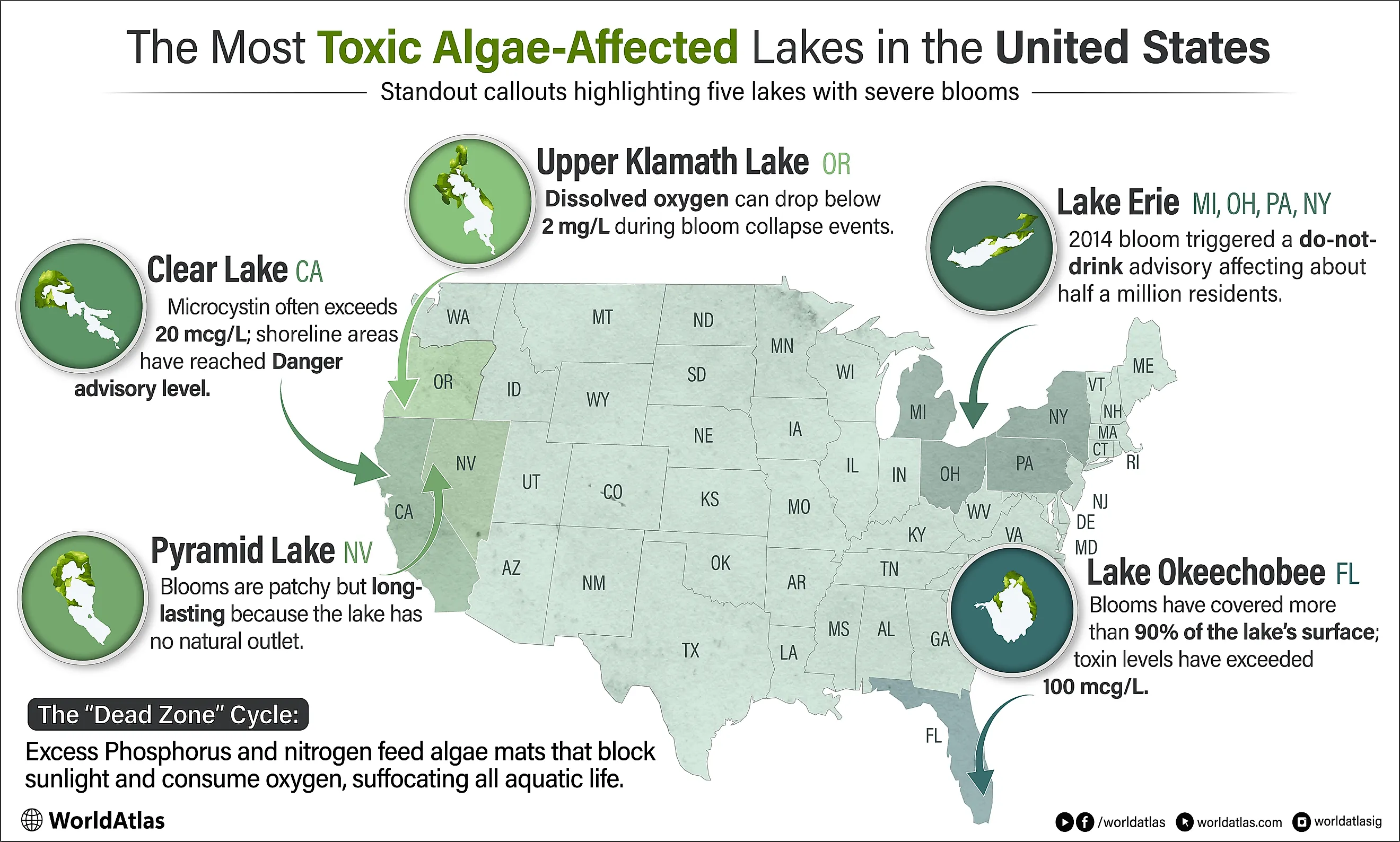
Lake Okeechobee regularly experiences blooms of Microcystis aeruginosa, a cyanobacterium that produces microcystin, a liver toxin. During major bloom years, satellite imagery has shown blooms covering more than 90% of the lake’s surface area.
Toxin levels have sometimes risen above 100 micrograms per liter, far exceeding the EPA’s recommended recreational criterion of 8 micrograms per liter. At that concentration, even brief contact with the water can pose a health risk.
Hydrology and Downstream Spread
Lake Okeechobee is a central hub in south Florida’s engineered water system. When water levels rise, such as during the rainy season or after hurricanes, water is released into the Caloosahatchee and St. Lucie Rivers to prevent flooding. During heavy discharge years, such as 2018, thick cyanobacteria mats were documented along both river systems.
Some coastal areas experienced economic losses in tourism and real estate totaling in the hundreds of millions of dollars, and the governor of Florida declared a state of emergency due to the scale of the bloom.
Environmental and Economic Impact
Seagrass loss due to reduced sunlight, fish kills linked to oxygen depletion, and a decline in the oyster and sport-fishing industries have all been documented, making tourism particularly sensitive. The shallow depth, high nutrient input, subtropical climate, and water management systems make it one of the most predictable and persistent harmful algal bloom systems in the country.
Lake Erie (Great Lakes Region)

Lake Erie’s vulnerability to toxic algae starts with its physical structure. It is the shallowest of the five Great Lakes, with an average depth of about 62 feet and a maximum depth of 210 feet. Its western basin, where most harmful algal blooms occur, is even shallower, averaging just 24 feet. This allows sunlight to penetrate easily and warm the water quickly, creating near-ideal conditions for cyanobacteria growth.
Scale of the Problem
Lake Erie experiences some of the largest freshwater harmful algal blooms on the continent, primarily dominated by Microcystis, which produces the toxin microcystin. Major blooms have covered hundreds to thousands of square miles. In many years since the 2011 bloom, blooms have varied considerably from year to year based on NOAA’s Harmful Algal Bloom Severity Index. These blooms are most intense in the western basin near Toledo, but can spread eastward depending on wind and water circulation.
Nutrient Inputs
The primary driver is nutrient runoff, especially phosphorus. The lake’s watershed spans parts of several U.S. states and Canada, but a large share of nutrient loading comes from agriculture in Ohio, Indiana, and Michigan. Studies estimate that non-point sources account for up to 90% of the total estimated load. Unlike earlier decades when pollution came largely from sewage and industry, today’s problem is driven by nonpoint source pollution, runoff that is harder to regulate and control.
The 2014 Toledo Water Crisis
A bloom near the Toledo water intake exceeded safe drinking water thresholds for microcystin. The city issued a “do not drink” advisory affecting about half a million residents that lasted nearly three days, shutting down restaurants, hospitals, and businesses. This event became a national wake-up call about the risks harmful algal blooms pose to urban water supplies.
Oxygen Depletion and “Dead Zones”
Beyond toxins, algal blooms also contribute to hypoxia, or low-oxygen conditions, particularly in the central basin. When algae die and decompose, they consume oxygen in the water. This impacts Lake Erie’s ecology and fisheries, even in areas not directly impacted by surface blooms.
Why Lake Erie Stays Vulnerable to Toxic Blooms
Agencies like the National Oceanic and Atmospheric Administration and the Environmental Protection Agency track bloom size, toxicity, and nutrient levels in real time. The lake’s algae problem is driven by a combination of shallow water, heavy nutrient inputs, and warming temperatures, producing blooms that can span thousands of square miles and directly affect drinking water for hundreds of thousands of people.
Clear Lake (California)

Clear Lake is often described as one of the oldest lakes in North America, with estimates suggesting it has existed in some form for at least 475,000 years. It covers about 68 square miles, making it the largest natural freshwater lake entirely within California, and has an average depth of roughly 27 feet. Its relatively shallow depth also helps it warm quickly in summer.
Naturally Nutrient Rich
Unlike some lakes, where pollution is the primary cause of nutrient overload, Clear Lake is naturally eutrophic, meaning it has high baseline nutrient levels that support abundant plant and algal life.
Modern land use has intensified the problem. The watershed includes agriculture, vineyards, and rural development, all of which contribute additional phosphorus and nitrogen. Sediments at the lake bottom also act as a long-term internal nutrient source, releasing phosphorus back into the water during warm, low-oxygen conditions. This combination of natural fertility and human-driven nutrient loading creates conditions for recurring blooms.
Bloom Frequency and Coverage
Clear Lake experiences harmful algal blooms almost every year, often dominated by cyanobacteria such as Microcystis and Dolichospermum that produce toxins. Blooms can cover large portions of the lake surface during peak summer conditions. Satellite observations have repeatedly documented dense, bright green swirls across most of the lake’s area visible from space. Because the lake is relatively shallow and wind-mixed, blooms can shift quickly, accumulating along shorelines and in bays.
These blooms can reduce water clarity to just a few inches in severe cases and block the sunlight needed by aquatic plants. This can lead to oxygen depletion when algae die and decompose, impacting fish habitat and contributing to long-term ecological stress.
Toxin Levels and Health Risk
The primary toxin of concern in Clear Lake is microcystin, which affects the liver. Monitoring by the California State Water Resources Control Board and local agencies has found that microcystin concentrations during blooms often exceed 20 micrograms per liter, the threshold for high-risk recreational exposure. Under these conditions, health advisories may warn against contact with water, including swimming, and against consuming fish from affected areas.
Clear Lake is part of California’s statewide harmful algal bloom monitoring program, which uses a tiered advisory system. Levels run from “Caution” to “Warning” to “Danger,” and large sections of the shoreline have been placed under “Danger” advisories, the highest level. Because blooms can vary within short distances, advisories are often location-specific and frequently updated.
Why Clear Lake Faces Recurring Blooms
Clear Lake shows how harmful algal blooms can become a long-term problem when natural fertility combines with modern nutrient inputs. Its ancient, nutrient-rich waters create a strong baseline for algal growth, and ongoing runoff keeps adding fuel.
Pyramid Lake (Nevada)

Pyramid Lake is one of the most unusual large lakes in the United States, both geographically and chemically. Located about 35 miles northeast of Reno, the lake covers about 112,000 acres and reaches depths of over 350 feet. Despite that depth, its surface waters can warm significantly in summer, which creates favorable conditions for algae growth.
A Closed-Basin System
What sets Pyramid Lake apart is that it is a closed-basin lake with no natural outlet. Water flows in primarily from the Truckee River, but leaves only through evaporation or sub-surface seepage.
This has several consequences. Salinity levels are elevated, typically around 5 to 6 grams per liter, making the lake much saltier than most freshwater systems. Nutrients such as nitrogen and phosphorus accumulate over time rather than being flushed downstream. Contaminants, including algal toxins, can persist longer in the system.
Bloom Characteristics and Duration
Blooms in Pyramid Lake tend to differ from those in shallow, nutrient-rich lakes because they often involve Nodularia spumigena, a cyanobacterium that can produce nodularin, a potent liver toxin. It can accumulate in aquatic organisms, posing risks to wildlife and potentially humans through exposure.
These blooms are often patchy but long-lasting, rather than spreading as a single uniform surface scum. They can also linger because the lake has no outflow to flush or dilute them. Wind can then push algae toward certain shorelines, creating localized high-risk areas.
Ecological and Cultural Importance
Pyramid Lake is located within the Pyramid Lake Paiute Tribe Reservation and is central to the region’s ecology and heritage. It is home to the endangered cui-ui and the threatened Lahontan cutthroat trout. Algal blooms impact ecosystems by altering food web dynamics, reducing oxygen levels, and introducing toxins into aquatic habitats.
Why Pyramid Lake Behaves Differently
Pyramid Lake’s algae problem is shaped by its identity as a closed-basin, moderately saline lake, where water and dissolved substances tend to stay. The presence of nodularin-producing blooms, combined with limited flushing and strong seasonal variability, makes it one of the more chemically distinctive and persistent harmful algal bloom systems in the United States.
Upper Klamath Lake (Oregon)

Upper Klamath Lake is widely recognized as one of the most consistently algae-impacted lakes in the western United States, and for many years it has experienced near-continuous blooms throughout the summer. The lake covers about 96 square miles, but it is extremely shallow, with an average depth of just 8 to 10 feet. This shallow, wind-mixed structure allows nutrients to circulate easily and keep algae suspended in the sunlit upper water column.
The Naturally Productive, Enriched System
Upper Klamath Lake has long been nutrient-rich, but human activity has intensified that condition. The watershed has been heavily modified by agriculture and wetland drainage, leading to increased nutrient runoff. Total phosphorus concentrations often exceed 100 to 200 micrograms per liter, far above levels associated with eutrophic (algae-prone) conditions. Decades of accumulated nutrients in lake sediments have created a long-term phosphorus source that can be released back into the water during warm, low-oxygen periods. This combination means the lake has a self-reinforcing cycle of nutrient availability, even if external inputs are reduced.
Blooms in Upper Klamath Lake are typically dominated by Aphanizomenon flos-aquae, a cyanobacterium that can reach extremely dense concentrations. Cell densities during peak blooms can reach tens of millions per milliliter, and although Aphanizomenon itself is not always highly toxic, other cyanobacteria in the lake produce microcystin, a liver toxin. Measured microcystin concentrations have at times exceeded 10 to 20 micrograms per liter, surpassing recreational health thresholds set by agencies like the Environmental Protection Agency.
Environmental Impact
Hypoxia, or low dissolved oxygen, happens when dense algae blooms grow rapidly in warm, nutrient-rich water, and then, when algae die, bacteria decompose the organic matter. This process consumes oxygen, sometimes faster than it can be replenished. In Upper Klamath, dissolved oxygen levels can drop below 2 mg/L, a level that is stressful or lethal for many fish. Sudden bloom collapses have triggered large fish die-offs, especially during hot, calm conditions, and can occur multiple times within a single summer season.
Upper Klamath Lake is a critical habitat for two endangered sucker fish species, the Lost River sucker and the shortnose sucker. These fish are particularly vulnerable to poor water quality, as low-oxygen events can cause mass mortality, especially among juveniles. High pH levels associated with blooms (often exceeding 9 to 10) can damage fish physiology, and long-term exposure to degraded conditions can reduce reproductive success.
The lake and surrounding wetlands are part of a major migratory corridor in the Pacific Flyway. This path supports thousands of migratory birds, but the bloom alters food availability, degrades water quality, and increases the risk of toxins entering the food chain.
Monitoring and Seasonal Patterns
Agencies including the U.S. Geological Survey and the Oregon Department of Environmental Quality closely monitor Upper Klamath Lake. Early summer is when peak bloom intensity, high pH, and oxygen swings are observed, and late summer is when bloom collapse events occur, which often trigger hypoxia. Public health advisories are common during peak months, especially in areas with visible blooms or elevated toxin levels.
Why Upper Klamath Lake Remains Vulnerable
Upper Klamath Lake’s algae problem is driven by a mix of extreme shallowness, high nutrient levels, and internal phosphorus recycling, which leads to dense, recurring blooms that can spread across most of the lake. These blooms pose health risks and disrupt the lake’s ecosystem, contributing to oxygen depletion, fish kills, and ongoing pressure on endangered species and migratory wildlife.
What These Lakes Have in Common

Harmful algal blooms (HABs) in lakes across the United States follow a consistent set of environmental and human-driven conditions. Nutrient pollution, especially nitrogen and phosphorus, is one of the biggest drivers. In agricultural watersheds, runoff can contribute 50 to 80% of total phosphorus inputs to lakes. Common sources include agricultural fertilizer runoff, livestock manure, leaking septic systems, and urban stormwater and wastewater overflows.
Many U.S. lakes have warmed by 1.8 to 3.6 degrees Fahrenheit over the past several decades. Warmer water extends the bloom season by weeks and even months in some regions because warm water stabilizes surface layers, preventing mixing that would otherwise disperse algae, and heat stress reduces competition from other aquatic plants and algae.
Stagnant or slow-moving water plays a major role in whether nutrients are diluted or concentrated. Reservoirs and slow rivers can have water residence times from weeks to over a year. Fast-flowing rivers may flush nutrients in days, reducing bloom persistence. This is why many high-risk systems include shallow bays and closed lakes.
Shallow lakes are especially vulnerable because sunlight reaches the entire water column. In shallow systems with an average depth of less than 10 to 15 meters, light penetrates to the bottom over large areas. This allows algae to photosynthesize throughout much of the water body. Deep lakes often have limited blooms confined to surface layers or nearshore zones, but shallow lakes release nutrients from sediments. Phosphorus stored in lakebed mud can be released back into the water during warm, low-oxygen conditions.
The EPA identifies cyanobacterial blooms as a public health concern because they can produce toxins affecting multiple organ systems. These blooms can produce cyanotoxins that may affect the liver, nervous system, kidneys, and skin. Exposure pathways can be as simple as swallowing contaminated water, skin contact, inhaling water droplets near wave action, or consuming contaminated fish or shellfish. These same physical and chemical drivers explain why lakes as different as Lake Okeechobee and Pyramid Lake can both experience similar bloom behavior.