The Largest Ships Ever Lost on the Great Lakes
The Great Lakes are the largest system of freshwater lakes on Earth and hold roughly 21 percent of the world's surface fresh water. For nearly four centuries the system has served as a backbone of North American commerce by carrying bulk cargo out of the industrial heartland. That commerce came at a serious cost in life and ship alike. Estimates from the Great Lakes Shipwreck Museum suggest at least 6,000 ships and approximately 30,000 lives have been lost. Historian Mark Thompson in his 2004 book Graveyard of the Lakes puts the wreck count even higher at possibly more than 25,000 vessels.
The five lakes collectively span parts of eight U.S. states and one Canadian province. November has earned a particular reputation as the deadliest month for mariners. Arctic cold fronts collide with still-warm lake surfaces in late autumn and produce storms of oceanic proportions. The largest ships ever lost on the Great Lakes were five bulk freighters built to haul raw materials in enormous quantities. All five were lost to the same ruthless combination of November storms and aging steel and the lakes' capacity to generate waves that rival open-ocean swells.
SS Edmund Fitzgerald

The SS Edmund Fitzgerald measured 729 feet (222 m) in length with a beam of 75 feet (23 m), a depth of 39 feet (12 m), and a deadweight capacity of 26,000 long tons. When she was launched on June 7, 1958, at Great Lakes Engineering Works in River Rouge, Michigan, she was the largest ship on North America's Great Lakes. She remains the largest vessel ever to sink there.

An expensive freighter at the time of her launch, the Fitzgerald was commissioned to haul taconite iron ore pellets from the Minnesota Iron Range to steel mills near Detroit and Toledo. She set seasonal haul records six times, once carrying 27,402 tons in a single load. Captain Peter Pulcer was known for piping music over the ship's intercom as the freighter passed through the Soo Locks, drawing crowds along the banks.

On November 9, 1975, the Fitzgerald departed Superior, Wisconsin, with 26,116 tons of taconite bound for Zug Island near Detroit. By the following afternoon she was battling hurricane-force conditions on eastern Lake Superior with winds reaching 50 knots, waves topping 35 feet (10.7 m), and a rapidly intensifying low-pressure system. At 7:10 p.m. on November 10, Captain Ernest McSorley radioed the nearby SS Arthur M. Anderson: "We are holding our own."

Those were the last words ever transmitted from the Fitzgerald. Within minutes she vanished from radar. She was found on November 14 by a U.S. Navy aircraft, lying in two large pieces at a depth of 530 feet (161 m) in Canadian waters, approximately 17 miles (27 km) north-northwest of Whitefish Point, Michigan. All 29 crew members perished, and no bodies were ever recovered. The official cause was never determined.

In 1976 Gordon Lightfoot recorded the ship and its crew in his ballad "The Wreck of the Edmund Fitzgerald." Today the wreck is protected under the Ontario Heritage Act, with a 500-meter (1,640-ft) exclusion zone and potential fines of $1 million for unauthorized access. The recovered bell of the Fitzgerald, salvaged in 1995, sits at the Great Lakes Shipwreck Museum at Whitefish Point.
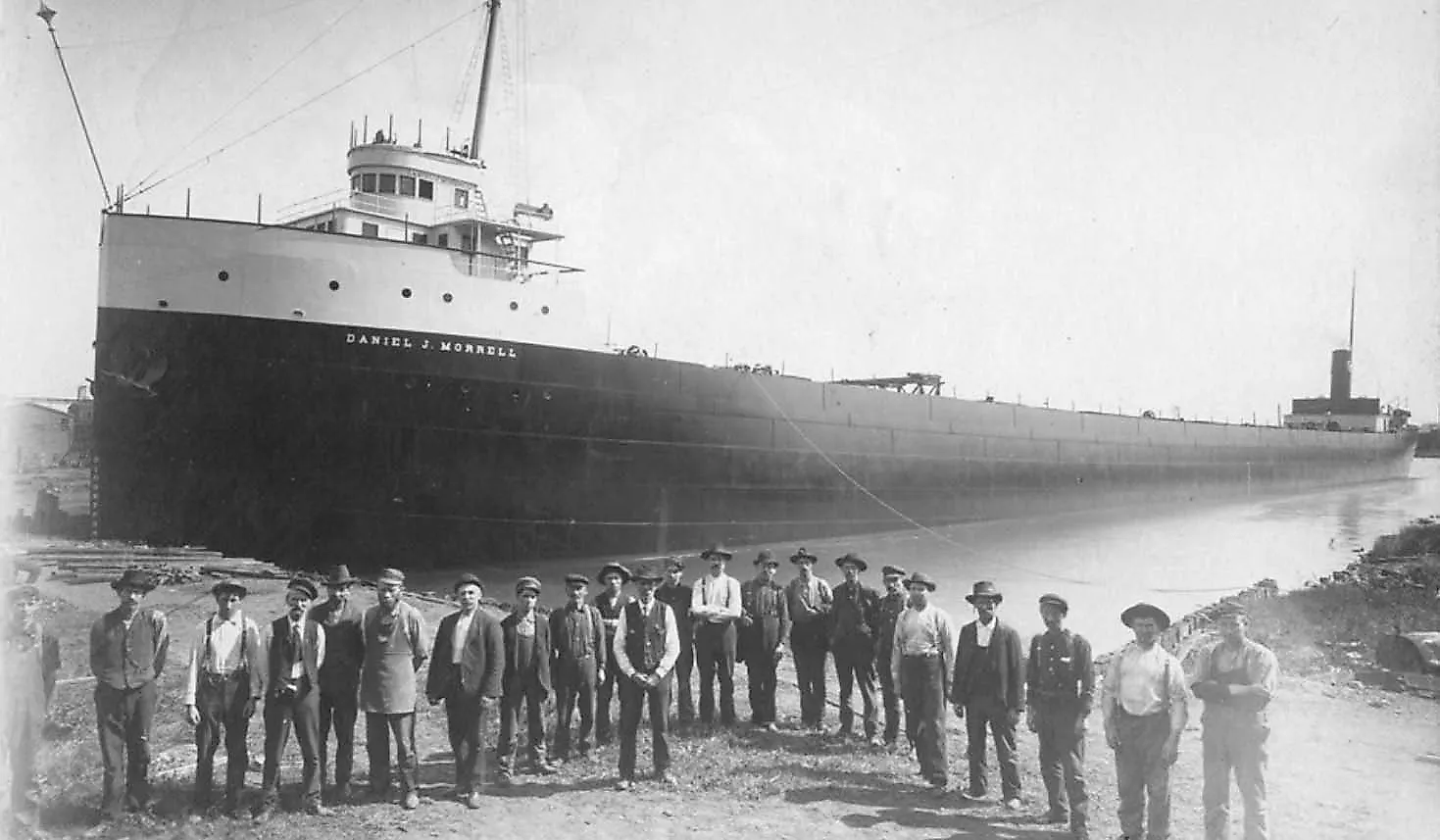
SS Daniel J. Morrell
Nine years before the Fitzgerald made headlines, a different kind of maritime disaster unfolded on Lake Huron. The SS Daniel J. Morrell stretched 603 feet (184 m) in length with a beam of 58 feet (18 m). When she was built in 1906 at West Bay City, Michigan, she held the title of "Queen of the Lakes" as the longest ship in service on the Great Lakes at that time. By 1966 the Morrell was 60 years old, hauling limestone, coal, and iron ore on a hull built from pre-1948 steel. On November 28, making her last run of the season, she and her sister ship the SS Edward Y. Townsend encountered a severe storm north of Pointe Aux Barques, Michigan, with winds exceeding 70 mph (110 km/h) and waves of 20 to 25 feet (6 to 7.6 m).

The Townsend turned for shelter in the St. Clair River while the Morrell pressed on. At 2:00 a.m. on November 29, the Morrell's hull fractured and the ship broke in two. No distress signal was ever sent. Crew members scrambled onto the deck in 34°F (1°C) water. Within minutes the bow sank. The stern, still powered, continued under its own momentum for nearly two hours before it too went under, leaving a single life raft afloat.
Only one man, deck watchman Dennis Hale, survived by clinging to the raft in sub-freezing temperatures for nearly 40 hours before rescue. He was in his underwear and a peacoat, having been off watch when the ship broke apart. Of the 28 men lost, the remains of 26 were eventually recovered. The U.S. Coast Guard Marine Board concluded the ship broke apart due to a brittle fracture in its aging steel hull.
SS Carl D. Bradley

The SS Carl D. Bradley held the title of "Queen of the Lakes" for 22 years, longer than any other ship in Great Lakes history. Built in 1927 by the American Ship Building Company in Lorain, Ohio, she measured 639 feet (194 m) in length with a beam of 65 feet (20 m) and a gross tonnage of 10,028 tons. She was designed as a self-unloading limestone carrier serving the Michigan Limestone division of U.S. Steel, hauling crushed stone from quarries in Rogers City, Michigan, to cement plants in Gary, Indiana, and other Great Lakes ports.

On November 18, 1958, the Bradley was returning northbound on Lake Michigan without cargo when she was struck by a powerful late-season gale with winds of 65 mph (105 km/h) and waves of 25 feet (7.6 m). At 5:31 p.m., First Mate Elmer Fleming radioed a Mayday: "Mayday! Mayday! This is the Carl D. Bradley. We are in serious trouble." The transmission lasted just seconds before contact was lost.
The ship broke in two and sank in approximately 370 feet (113 m) of water near Boulder Reef in northern Lake Michigan. Of the 35 crew members, 33 died. Only two men, Fleming and seaman Frank Mays, survived. They clung to a life raft for over 15 hours in near-freezing water before a Coast Guard vessel reached them. Twenty-three of the dead were from Rogers City, Michigan, population 3,873 at the time. The loss was devastating to the community as almost every family in town was affected. The U.S. Coast Guard concluded the Bradley likely broke apart due to structural failure in the brittle steel of her construction. Frank Mays, the last survivor of the Bradley, lived to dive to the wreck in 1995 aboard a two-man submarine, finally seeing the ship that had nearly taken his life.
SS Henry B. Smith

The SS Henry B. Smith was a 545-foot (166 m) steel-hulled lake freighter built in 1906 at Lorain, Ohio, with a gross tonnage of 6,631 tons. She was owned by the Acme Transit Company and hauled iron ore across the Great Lakes. By any measure she was a capable mid-sized freighter of her era. The Great Lakes Storm of 1913, known in maritime history as the "White Hurricane," was the most destructive in recorded Great Lakes history.
From November 7 to 10 the storm produced hurricane-force winds of up to 100 mph (160 km/h), waves exceeding 35 feet (10.7 m), and blinding snow across four of the five lakes. It sank or destroyed 19 ships and killed more than 250 mariners. The Henry B. Smith was the largest of the vessels lost. The Smith had docked in Marquette, Michigan, but a cold snap had frozen the ore inside the railroad hopper cars, requiring laborers to knock the cargo loose by hand. Rumors circulated later that Captain James Owen had been pressured by the ship's owners to make the final trip on time despite the weather. At approximately 5:00 p.m. on November 9, as the storm briefly lulled, the Smith backed away from the dock and headed out of Marquette Harbor, where she simply vanished into the storm. No distress signal was ever received. Debris washed ashore two days later along Chocolay Bay. Only two bodies were ever recovered. For a century the wreck remained undiscovered.
In May 2013, exactly 100 years after the sinking, a team of shipwreck hunters located the Henry B. Smith in 535 feet (163 m) of water approximately 30 miles (48 km) north of Marquette. Video confirmed the ship was broken in two near the middle, her iron ore cargo scattered across the lake floor.
SS Mataafa

The SS Mataafa is the oldest ship on this list and in some ways the most haunting, not because she vanished without a trace but because she was wrecked within a short distance of shore while an estimated 10,000 people watched helplessly from the Duluth waterfront. Built in 1899 as the SS Pennsylvania by the Cleveland Shipbuilding Company, she was 430 feet (131 m) long with a beam of 50 feet (15 m) and a gross tonnage of 4,840 tons. The Mataafa Storm of November 27-28, 1905, was Lake Superior's worst storm on record to that date, destroying or severely damaging more than 20 vessels, killing 36 sailors, and producing winds that peaked at 68 mph (109 km/h) at Duluth with lake levels rising 2.3 feet (0.7 m) above normal.
On the afternoon of November 27, the Mataafa departed Duluth loaded with iron ore, towing the barge James Nasmyth, bound for Two Harbors. Captain R. F. Humble had sailed the lakes for 16 years and had full confidence in his ship. As conditions deteriorated through the night, Humble turned back toward Duluth. What followed was a catastrophe played out in full public view.
Two other vessels had already attempted to enter Duluth's ship canal and wrecked. Humble, unaware of their fate, charged the canal at full speed. A massive surge of water drove the Mataafa into the north pier, tore off her rudder, and smashed her against the south pier. She grounded and broke in two in shallow water, her stern settling into the lake just 700 feet (213 m) from shore. Twelve men were trapped in the after section. Nine of them died of exposure overnight in temperatures near 13 degrees below zero Fahrenheit (-25°C). Three managed to cross the broken hull to the forward section, while the 15 men there were rescued the following day. The Mataafa herself was eventually salvaged, rebuilt for nearly $100,000, and returned to service for another 60 years before being scrapped in Hamburg, Germany, in 1965. The storm named for her permanently transformed Great Lakes maritime safety. It led directly to the construction of the Split Rock Lighthouse on Lake Superior's north shore, which stands today as one of the most photographed landmarks in Minnesota.
A Pattern Across Decades
Reading these five stories together, a clear pattern emerges. Four of the five ships were lost in November, the month Great Lakes sailors call the "Witch of November," when cold Arctic air collides with still-warm lake water and generates storm conditions that maritime meteorologists have compared to North Atlantic gales. The lakes are shallow enough to produce short, steep, breaking waves that can overwhelm a vessel before it has time to alter course. Lake Superior alone, at 350 miles (563 km) long, gives storms enough fetch to build 35-foot (10.7 m) waves from scratch. Three of the five ships, the Fitzgerald, the Morrell, and the Bradley, broke apart in the water, snapping at the hull amidships under the combined stress of a loaded or ballasted ship riding over wave crests.
Each of those disasters contributed to changes in U.S. Coast Guard regulations, inspection standards for aging steel, and eventually the modern era of continuous welded construction and weather routing systems that have made Great Lakes freighters dramatically safer. The last major freighter lost on the lakes was the Edmund Fitzgerald in 1975. The lakes themselves have not changed. They remain capable of producing the same conditions that sank these ships.