Tobermory, Ontario
Perched at the tip of the stunning Bruce Peninsula, the waterfront village of Tobermory is quiet for much of the year, but teeming with life during the summer months. This sliver of southern Ontario stands in stark contrast to the populous centers that spill forth from the Greater Toronto Area, but also, thanks to its tourist-drawing infrastructure, differs from the one-horse towns further to the north. With two national parks, a plethora of trails, enriching boat tours, some of the best scuba diving in the world and a smattering of cool local businesses, Tobermory strikes a rare balance. Because of this synergy between natural and social, my recent one-day, "passing through" trip turned into a delightful three-day adventure.
Geography: Getting Here

Tobermory is situated at the northernmost point of the Bruce Peninsula, within the municipality of Northern Bruce Peninsula, in southern Ontario, Canada. This terrestrial break in the famous Niagara Escarpment marks the transition point between Lake Huron (i.e., the fourth-largest lake in the world and the second-biggest Great Lake) and the waters of Georgian Bay (i.e., the largest freshwater archipelago in the world). Tobermory is also adjacent to two pristine national parks: Bruce Peninsula National Park, which sprawls to the southeast, and Fathom Five Marine National Park, which protects the underwater treasures and islands near the apex of the peninsula. The vital and stunning ecosystems surrounding Tobermory constitute (arguably) the best part of the 725-kilometer-long UNESCO Niagara Escarpment Biosphere Reserve.
The heart of the village is predominantly based around Little Tub and Big Tub Harbours and acts as a terminus (in a way) to northbound Highway 6. During the fair-weather season, the Owen Sound Transportation Company operates a regular ferry known as the MS Chi-Cheemaun (meaning "Big Canoe" in Ojibway), which connects Tobermory with Manitoulin Island (i.e., the largest freshwater island in the world) in a little less than two hours.
Tobermory sits roughly 300 kilometers northwest of Toronto and 325 kilometers from the Michigan border city of Sarnia, Ontario (be sure to smell the roses throughout Lambton Shores on your up the Lake Huron coastline). If the ferry is running, Tobermory is separated from Sudbury, Ontario, by about 230 kilometers of land and water. However, that distance is more than double if you take the long way around via Highway 400 through the city of Barrie. The most adventurous visitors may be interested to know that you can even hike to Tobermory from Niagara Falls via the Bruce Trail (the longest and oldest marked trail in Canada).
History

The beauty and abundance of the Bruce Peninsula (aka Saugeen Peninsula) attracted ancestors of the Saugeen Ojibway Nation and other indigenous peoples as early as 7,500 years ago. For this reason, the various agencies that operate out of Tobermory are quick to offer the following land acknowledgment:
We acknowledge the Territory of the Anishinabek Nation: The People of the Three Fires known as Ojibway, Odawa, and Pottawatomie Nations. Further, we give thanks to the Chippewas of Saugeen and the Chippewas of Nawash, collectively known as the Saugeen Ojibway Nation, who are the traditional keepers of this land.
European settlers began to take notice of the region in the mid-late 19th century, first for fishing purposes and then for lumber (with some unsuccessful agricultural developments thrown in for good measure). The site was initially called "Port Collins Harbour" by British naval officer/surveyor, Henry Wolsey Bayfield (1795-1885), before switching to "Bury," and then finally settling on Tobermory, in honor of the Scottish settlement on the Isle of Mull.
A short tour around Big Tub Harbour (the deepest natural freshwater harbour in Canada) brings history to life. Big Tub Lighthouse's crisp white body and red trim catch the eye first. This vital (past and present) beacon was constructed in 1885. In the preceding four-year stretch, one of Tobermory's first modern settlers, James Earl, hung a lantern atop a pole in precisely this spot to guide vessels safely to shore…for the most part (more on this in a moment). Abraham Davis then assumed the role of first lighthouse keeper for an annual salary of $100. Come 1952, Big Tub had become fully electric and automated, but otherwise, it exudes its authentic form, along with the other three Canadian-themed lighthouses in the area, for present-day visitors to enjoy.
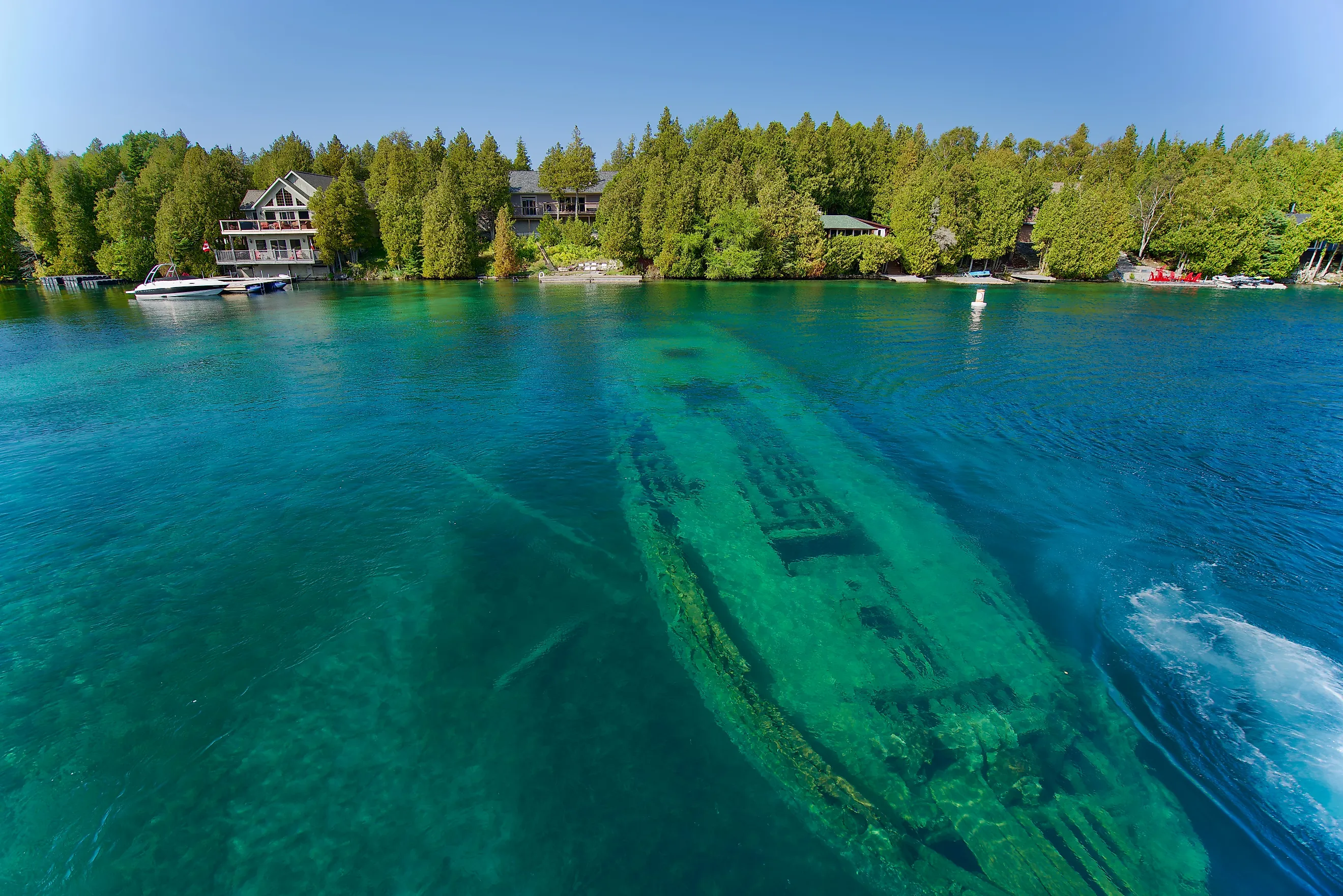
Thanks to the harbour's crystal-clear waters, two other historical artifacts present themselves to paddlers, scuba divers, and patrons of the locally-operated glass-bottom boat tours: sunken ships. There are 22 identified shipwrecks within the boundary of what is now Fathom Five Marine National Park, two of which sit at the bottom of Big Tub Harbour. The first is a 36.3-meter-long, two-masted, center-board schooner called The Sweepstakes. She was built in 1867 in Burlington, ON, and ran ashore in 1885. Thankfully, the whole crew was saved by the lightkeeper at Cove Island. The vessel was then dragged into Big Tub Harbour to salvage cargo before ultimately succumbing to its catastrophic damage. The City of Grand Rapids sits right next to it. This 37.3-meter-long steamship was built in 1879 in Grand Haven, Michigan. It caught fire in Little Tub Harbour in 1907 and was dragged into deeper waters to prevent the flames from spreading into town. It then drifted into the adjacent Big Tub Harbour where its steam engine, fire box, and scorched hull are still visible today.
The development of roads, in conjunction with the MS Chi-Cheemaun, which celebrates 50 years of ferry crossings this summer, helped turn tourism into the backbone of Tobermory's economy. The draw was further enhanced by the establishment of Fathom Five Marine National Park (i.e. Canada's first underwater park) and Bruce Peninsula National Park in 1987 - both of which make up part of the Niagara Escarpment World Biosphere Reserve (ratified by the United Nations Educational, Scientific, and Cultural Organization just three years later).
Climate: When to Visit

Tobermory experiences a humid continental climate (Dfb). And though the scenery is complemented by all weather conditions, most vacationers will want to aim for June through September. The winters are long, cold, snowy, and windy, and much of the town closes during this time. Furthermore, the Chi-Cheemaun ferry only runs from early May to late October, meaning the only way to get in and out of Tobermory during the off-season is by driving the entire Bruce Peninsula via Highway 6. Summers may still be somewhat wet (the precipitation curve is spread evenly across the year) and windy (especially if boating out on Georgian Bay). Still, the temperatures are likely to be mild (high teens to low 20s Celcius), and all the local eateries will be there to bail you out on particularly capricious days.
Irina and I entered town the last few days of May and were greeted by generally comfortable conditions (and a stark lack of crowds). Dressing warm allowed us to enjoy two nights of camping in Bruce Peninsula National Park and a half-capacity glass-bottom boat tour around Fathom Five National Marine Park.
Attractions
Bruce Peninsula National Park

At 155 square kilometers, Bruce Peninsula National Park covers not only a substantial swath of the northern peninsula but also a remarkable variety of habitats and wildlife (from black bears to rattlesnakes). Here, the craggy, tree-covered, and cave-riddled limestone cliffs meet the turquoise waters of Georgian Bay. Well-blazed trails lead to famous formations, such as The Grotto cave system, and connect to the Bruce Trail, which undulates along the rugged coastline for the entirety of the park's length (and, as previously mentioned, all the way down to Niagara Falls). The park maintains several substantial campsites, ranging from backcountry tent platforms to drive-in sites to luxurious yurts.
Fathom Five National Marine Park

With 19 islands, over 22 shipwrecks, and extraordinarily clear waters, this 112-square-mile, mostly submerged park continues the adventure across new mediums. The best way to get an overview of Canada's first National Marine Conservation Area is by taking a boat tour from Tobermory. I went with Blue Heron Cruises and couldn't have been happier with the half-day experience. We visited the shipwrecks of Big Tub Harbour, which were just as visible from the top deck as through the glass-bottom floor, and then headed out to Flowerpot Island to see the famous pillars and lighthouse, as well as hike the modest trail network. Throughout the trip, our friendly and knowledgeable guide shared the history and ecological importance of the region. Even though I haven't yet taken up the hobby, I can see why this area, or rather, part of the pond, is called "The Scuba Diving Capital of Canada," and in some circles, "The Freshwater Scuba Diving Capital of the World." If this interests you, then the Divers Den, right in the center of town, is a great place to start.
Dark Sky Preserves
The Northern Bruce Peninsula was designated a Dark Sky Community in 2004, and five years later, the nearby national parks gained Dark Sky Preserve status. While the area offers stunning daytime views, visitors also have the chance to gaze at the expansive cosmos free from light pollution. Although clouds sometimes obscure the sky, multiple-night visits increase the likelihood of experiencing a breathtaking stargazing opportunity.
The Community

Little Tub Harbour is lined with just the right number of shops, eateries, and novelties. Visitors can gear up for their wilderness adventures, enjoy a pint at Tobermory Brewing Company or a cup of joe at Tobermory Coffee Company, satisfy their sweet tooth at The Sweet Shop, indulge in freshly caught fish n' chips from various places, browse through books at Reader's Haven, sign up for different tours, touch the Bruce Trail Northern Terminus Cairn (and maybe even high-five an excited thru-hiker), or relax and watch the busy activity at the marina. Visit the main attractions, but also take some time for a casual in-town experience.
Final Thoughts

Growing up in nearby Sarnia, Ontario, Tobermory was a special, once-a-summer destination for me. It will forever ignite childhood nostalgia while simultaneously stoking my reverence for nature. Even though this fishing village has morphed into an adventure basecamp/tourist hotspot over the past century, it has never sacrificed its isolated, laid-back identity. May you never change, Tobermory.