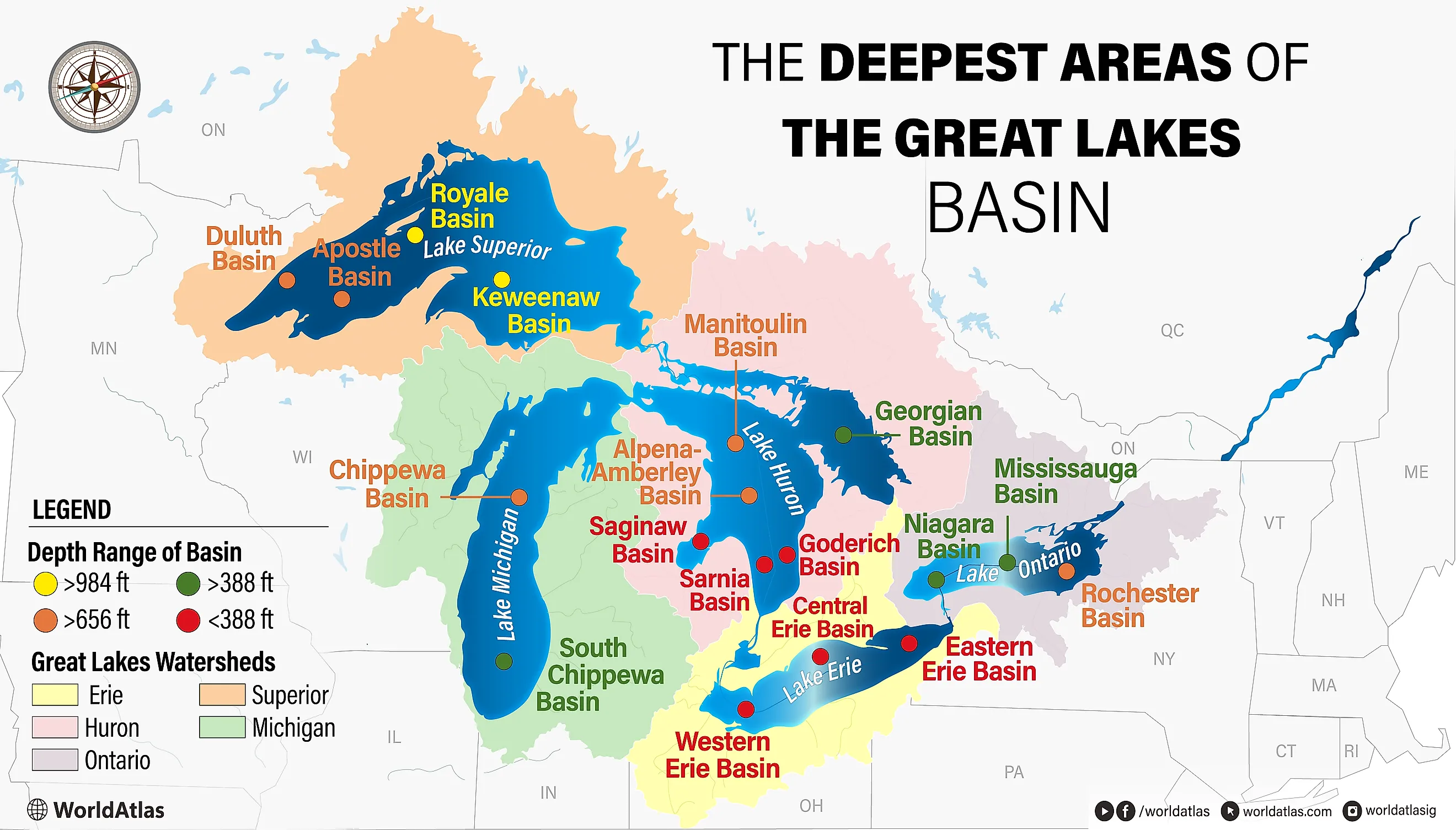
The Deepest Areas Of The Great Lakes Basin
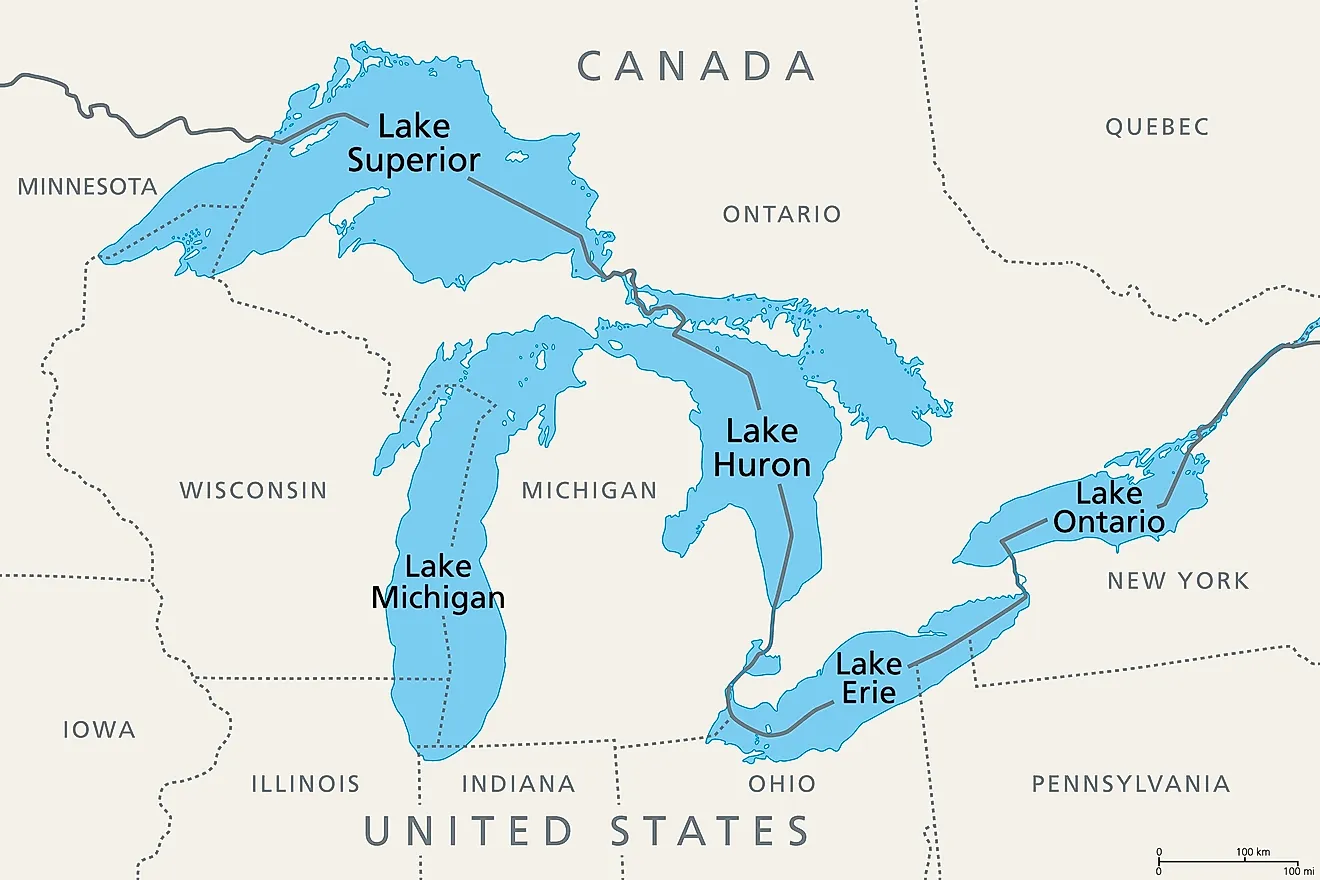
The Great Lakes of the United States and Canada form the largest freshwater lake system on Earth in both surface area and volume. Together they hold about 20% of the world's surface freshwater. Lake Superior alone holds more water than the other four lakes combined and is by far the deepest. The deepest point in the entire system reaches 1,333 feet down in the Keweenaw Basin of eastern Lake Superior. Lake Michigan, Ontario, and Huron all have basins reaching 656 feet or more. This article ranks the named basins in the Great Lakes by depth and highlights the deepest point in each of the five lakes.
Depths of Named Basins
The basins listed here are those labeled on the National Oceanic and Atmospheric Administration (NOAA) "Great Lakes Basin Regional Bathymetry Map." Basins marked with an asterisk (*) include the deepest point in the given lake.
| Depth Range | Basin Name | Lake Name |
|---|---|---|
| > 984 ft (300 m) | Keweenaw Basin* | Lake Superior |
| Royale Basin | Lake Superior | |
| > 656 ft (200 m) | Alpena-Amberly Basin* | Lake Huron |
| Apostle Basin | Lake Superior | |
| Chippewa Basin* | Lake Michigan | |
| Duluth Basin | Lake Superior | |
| Manitoulin Basin | Lake Huron | |
| Rochester Basin* | Lake Ontario | |
| > 328 ft (100 m) | Georgian Basin | Lake Huron |
| Mississauga Basin | Lake Ontario | |
| Niagara Basin | Lake Ontario | |
| South Chippewa Basin | Lake Michigan | |
| < 328 ft (100 m) | Central Erie Basin | Lake Erie |
| Eastern Erie Basin* | Lake Erie | |
| Goderich Basin | Lake Huron | |
| Western Erie Basin | Lake Erie | |
| Saginaw Basin | Lake Huron | |
| Sarnia Basin | Lake Huron |
Lake Superior

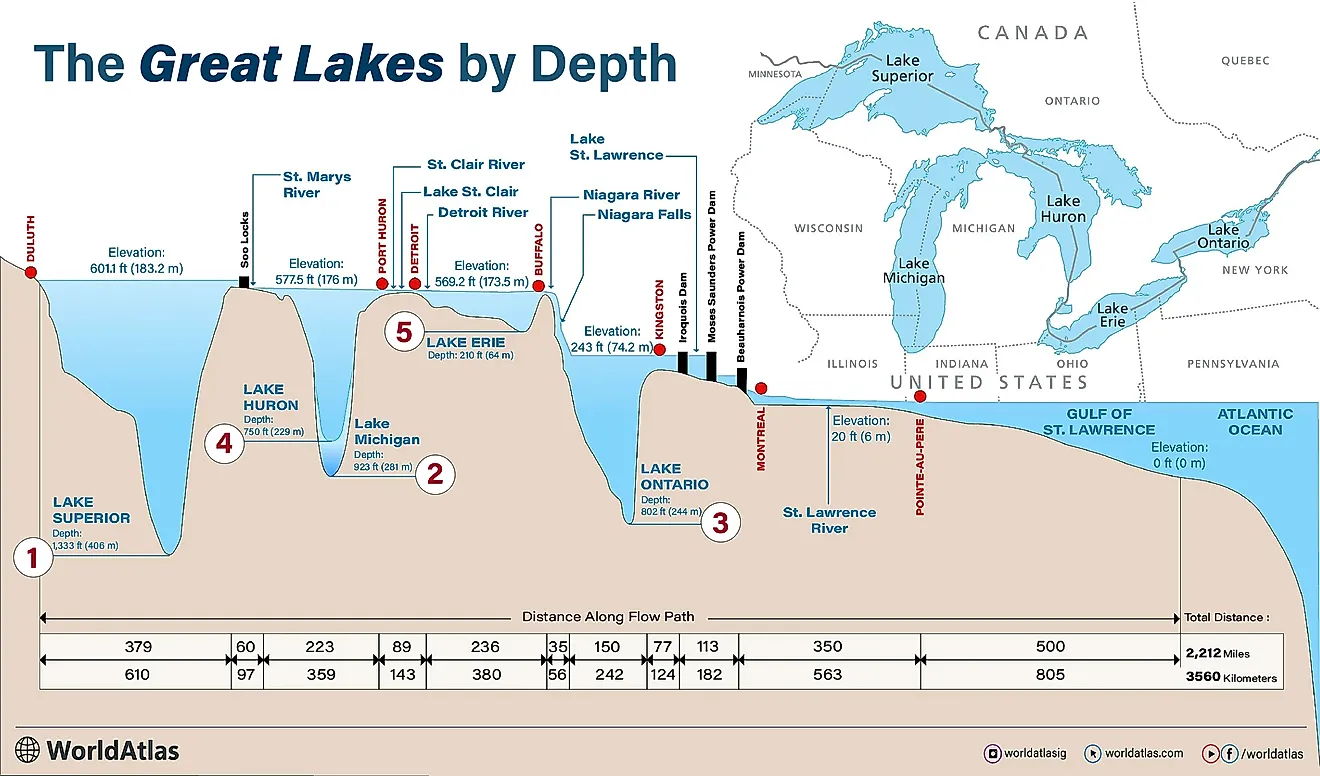
Although it is fed by more than 200 rivers, Lake Superior is so deep that its residence time, the average time water spends in the lake, is nearly 200 years. Carved out by retreating glaciers and shaped by tectonic activity, Lake Superior has an average depth of 483 ft (147 m) and several areas more than 1,000 ft (305 m) deep. The deepest point in Lake Superior, and in all the Great Lakes, extends 1,333 ft (406 m) below the surface in the Keweenaw Basin north of Munising, Michigan. The countless shipwrecks at the bottom of Lake Superior can remain well preserved for decades or even centuries in the cold and highly oxygenated water found at such depths.
Lake Michigan

Created primarily by retreating glaciers, Lake Michigan is the second deepest of the Great Lakes with an average depth of 279 ft (85 m) and a residence time of nearly 100 years. The lake floor drops off quickly from the shoreline in several areas, contributing to layered water-temperature changes, strong currents, and lake-effect snowfall in winter. The deepest point sits east of Forestville, Wisconsin, in the Chippewa Basin, reaching a depth of 923 ft (281 m). The lake is somewhat shallower in its southern half, although portions of the South Chippewa Basin reach more than 500 ft (152 m) in depth.
Lake Ontario

Lake Ontario is the smallest of the Great Lakes by surface area, and its water, fed primarily by the Niagara River and drained by the St. Lawrence River, has a residence time of only about 6 years. It is surprisingly deep for a relatively small lake, ranking third in maximum depth and second in average depth among the five lakes, edging out Lake Michigan by about four feet on the average measure. Located west of Oswego, New York, the deepest point of Lake Ontario's Rochester Basin is 802 ft (244 m) below the surface. Like Lake Michigan, Lake Ontario's narrow shape and deep water, averaging 283 ft (86 m), contribute to the lake-effect snowstorms that frequently hit Rochester and other points along the New York coastline.
Lake Huron

Lake Huron has a similar water profile to Lake Michigan, which makes sense because hydrologically the two are a single lake that surrounds the state of Michigan's lower peninsula on three sides. Huron has greater depth variation than Michigan, with thousands of islands rising above the surface and basins that plunge hundreds of feet below it. Southwest of Tobermory, Ontario, in the Alpena-Amberley Basin, the floor of Lake Huron reaches 750 ft (229 m). The lake's average depth is 195 ft (59 m). The irregular water depth of Lake Huron gives it greater water-temperature variability than the other lakes, with warmer and cooler areas in close proximity.
Lake Erie

While it looks similar on the surface, Lake Erie is an outlier among the Great Lakes due to its significantly shallower waters. The deepest point of Lake Erie is only 210 ft (64 m) below the surface in the Eastern Erie Basin, southeast of Long Point, Ontario, and the average depth is just 62 ft (19 m). To put the difference in perspective, Lake Superior is a bit more than three times larger than Lake Erie in surface area, but it holds more than 25 times as much water. With a water residence time of less than 3 years, compared to nearly 200 years for Lake Superior, Lake Erie's shallow, fast-circulating water is more prone to temperature changes, algae blooms, invasive aquatic species, and industrial pollution.
Great Lakes, Great Depths
The Great Lakes are impressive on the surface, covering some 94,250 square miles (244,106 square km) and spanning eight American states and one Canadian province. Below the surface, the lake system's scale is harder to grasp. Lake Superior's deepest point in the Keweenaw Basin plunges more than 1,000 ft (305 m) lower than Lake Erie's deepest point, which is part of why Superior preserves shipwrecks so well and why Erie is so prone to algae blooms. The depths have been mapped in detail, but there is still geology and aquatic life waiting to be cataloged in the system's lower reaches.