Which County Has The Most Cities Inside It?
Cook County, Illinois, contains 134 incorporated municipalities. Chicago is one of them. The other 133 are separate governments with their own mayors, police budgets, and zoning maps, all stacked inside a single county. The national pattern is far tamer. The 2022 Census of Governments counted 19,491 municipal governments across the United States, spread over roughly 3,143 counties and county equivalents. That county total is itself approximate, shifting depending on whether territories and independent cities get folded in. That averages out to about ten incorporated places per county, and hundreds of Western and Southern counties hold only a handful. The ten counties below are the outliers, and each of them got there by a different route.
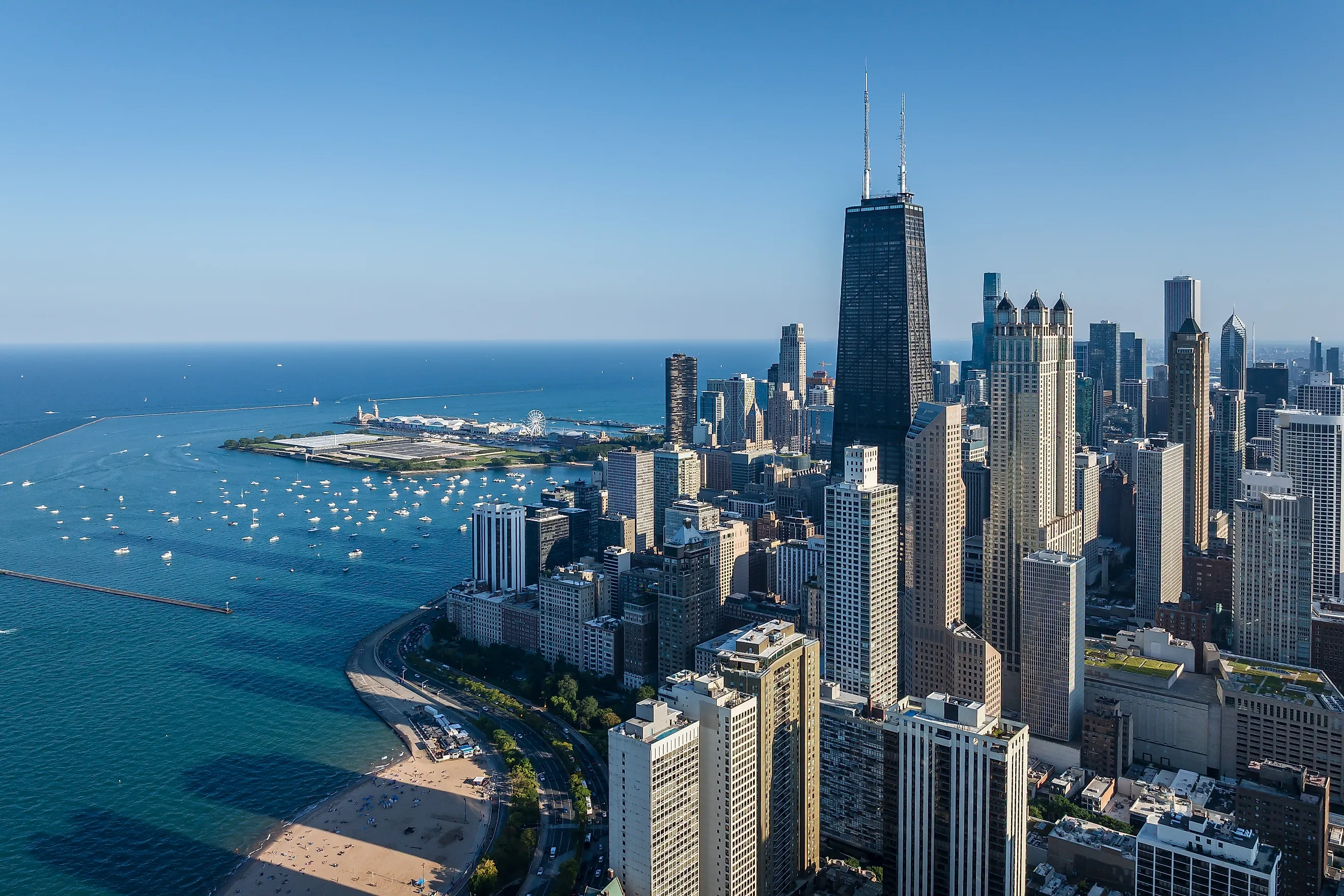
Cook County, Illinois

The Cook County Government Data Portal lists 134 incorporated municipalities inside the county's borders, more than any other county in the country. Illinois leads the nation in municipalities overall, with roughly 1,300, and it leads by a much wider margin in local governments of every kind. The 2022 Census of Governments put the state near 6,900, once townships, school districts, and special districts are counted alongside cities and villages. Illinois homeowners also carry some of the highest effective property tax rates in the nation, a bill that reflects all of that layering.
The density of governments traces to the outward push of Chicago's suburbs through the 19th and early 20th centuries. As population and industry moved beyond the city limits, emerging communities incorporated independently rather than being absorbed, keeping control of schools, zoning, police, and local services. About 5.19 million people live in the county today, roughly 2.7 million of them in Chicago itself. The remainder spread across suburbs including Evanston, Berwyn, and Cicero, which holds a small distinction of its own: it is the only place in Cook County that is legally an incorporated town rather than a city or a village.
Allegheny County, Pennsylvania

Allegheny County comes second with 130 municipalities, the figure used by both the county's economic development office and its GIS boundary data. Sorting them turns out to be harder than counting them. The mix includes four cities, dozens of boroughs, and first- and second-class townships. It also includes home rule municipalities such as Mount Lebanon, which now governs under its own charter rather than as the first-class township it once was. Published breakdowns of how many fall into each category disagree with one another, which is itself a fair summary of how tangled Pennsylvania's municipal classes have become.
Pennsylvania ranks third nationally in total local governments, behind Illinois and Texas. The state holds about 2,560 municipalities and, unusually, no unincorporated territory at all. Every square foot belongs to some municipality. Exactly one of them, Bloomsburg in Columbia County, is legally a town rather than a borough or city. State law historically made it simple for small settlements to break away, and the terrain around Pittsburgh, cut by rivers and steep valleys, reinforced that separation on the ground. Roughly 1.2 million people live in the county, about a quarter of them in Pittsburgh, with the balance spread across places like McKeesport, Clairton, and Duquesne.
St. Louis County, Missouri

St. Louis County holds 88 municipalities, and it used to hold more. The count peaked at 98 in 1959 and has been drifting down ever since, most visibly when the village of Mackenzie, home to about 130 people, voted itself out of existence in 2018 and handed its dozen acres back to the unincorporated county. Nineteen of the survivors have fewer than 1,000 residents. Two of the county's larger population centers, Oakville and Mehlville, are not municipalities at all but unincorporated census-designated places, so they add nothing to the total.
The county is also completely separate from the independent city of St. Louis, which belongs to no county at all. Missouri's 1875 constitutional convention authorized the split. City and county voters cast ballots on it in August 1876 in a contested election remembered since as the Great Divorce, and the city formally declared independence the following year. Reunification has been floated repeatedly and has failed every time, most recently when backers of a statewide ballot measure withdrew the plan in 2019. About 991,000 people live in the county, against roughly 280,000 in the city, with Florissant, Chesterfield, and University City the largest municipalities.
Los Angeles County, California

Los Angeles County ties St. Louis County at 88, though the two look nothing alike on the ground. Every one of LA's 88 is a city, and they sit alongside more than 100 unincorporated California communities that the county governs directly, among them Altadena, Baldwin Hills, and Agoura. Because those unincorporated pockets interleave with the incorporated ones, the map feels more fragmented to a resident than the count alone suggests.
Geography set the pattern before policy did. Early development followed the boundaries of former Spanish and Mexican ranchos and the reach of the interurban rail lines. The postwar suburban boom then gave those lines a legal form, as community after community incorporated to escape annexation by the City of Los Angeles and to hold on to lower local taxes and its own zoning and municipal services. About 9.7 million people live in the county, more than in any other in the country. The largest of the 88 are Los Angeles, Long Beach, Santa Clarita, and Glendale.
Jefferson County, Kentucky

Jefferson County's 83 municipalities are known locally as satellite cities, and they survive because a merger deliberately left them alone. Voters approved consolidating Louisville with Jefferson County in a 2000 referendum, and the merger took effect in 2003. The new Louisville Metro absorbed the old City of Louisville along with the unincorporated county, but Kentucky law explicitly preserved every other incorporated city inside the boundary.
Those cities had incorporated in the first place to head off annexation by Louisville and to keep local control of tax rates and zoning, and they still run their own elected councils, property tax structures, and municipal services. For two decades after the merger, state law barred the creation of any new ones inside the county; the legislature lifted that ban in 2022, leaving the door open for the number to climb again. About 795,000 people live in the county, nearly all of them under Louisville Metro, with Jeffersontown, St. Matthews, and Shively the largest of the satellites.
Bergen County, New Jersey

Bergen County packs 70 municipalities into 247 square miles in New Jersey, including 56 boroughs, 9 townships, 3 cities, and 2 villages. New Jersey townships have the same administrative powers as cities, so all 70 are incorporated municipalities. Bergen is the most populous county in the state and still has no large city in it. Its largest municipality is the county seat, Hackensack, which has a population in the mid-40,000s. Nothing else approaches 50,000.
The fragmentation has both a name and a date. In 1872, the county was divided into just 12 sprawling townships. An 1894 state school law let a cluster of property owners secede by referendum and form their own borough, keeping local school taxes at home and shedding the parent township's debts, and 26 new boroughs formed in Bergen County that year alone. The condition was called boroughitis. The legislature spent the next two years trying to switch it off, tightening petition requirements and finally ending referendum-based incorporation in 1896, but the splitting continued in smaller waves until the county reached 70 municipalities in 1924, and the number has stayed there. Roughly 977,000 residents live across them, concentrated in Hackensack, Teaneck, and Fort Lee.
Nassau County, New York

Nassau County's 69 incorporated municipalities break down into 64 villages, three towns, and two cities, a structure that only makes sense under New York law. Towns here are broad county subdivisions rather than urban centers. Incorporated villages sit inside them with their own governments, and the two cities, Long Beach and Glen Cove, operate under charters granted by the State Legislature. A further 63 hamlets are unincorporated and administered directly by the three towns.
Most of those villages date to a 20th-century scramble for direct control over zoning, public services, and taxation, which produced dozens of municipalities measured in blocks rather than miles. The result is that a Nassau resident can live in a village, a town, or the county and pay all three. About 1.4 million people live on the county's share of Long Island, and the Town of Hempstead alone accounts for well over half of them, ahead of Oyster Bay and North Hempstead.
Cuyahoga County, Ohio

Cuyahoga County counts 59 cities, villages, and townships. Fifty-seven are incorporated municipalities, 38 cities, and 19 villages, with two surviving townships making up the rest. Ohio draws the line by headcount. Any municipality that reaches 5,000 residents automatically becomes a city, and anything below that threshold is a village, so the roster shifts categories from one census to the next.
The county started as a grid of rural civil townships. As the Cleveland region urbanized, the surrounding land was incorporated or annexed piece by piece until all but two of those original townships had been hollowed out into inactive paper townships with no real governing function left. Ohio's strong constitutional home rule provisions made the alternative straightforward, letting a pocket of suburbia incorporate as a village and take charge of its own zoning, schools, and services. About 1.2 million people live in the county, with Cleveland, Parma, and Lakewood being the largest cities.
Lake County, Illinois

Lake County sits directly north of Cook County and contains 52 incorporated cities and villages, according to the county's own municipal boundaries data. It is also divided into 18 civil townships, but those operate as administrative and taxing districts rather than municipalities, so they do not add to the count. The mechanism was the same one that fragmented its neighbor, namely, permissive Illinois incorporation statutes, which set a low bar for forming a village and no real ceiling on how many could exist side by side. As metropolitan Chicago pushed northward through the postwar decades, residential developers and established communities used those statutes to form independent villages and hold on to control over land use and municipal services rather than let a larger neighbor absorb them. More than 700,000 people live in the county, with Waukegan, Buffalo Grove, and North Chicago among the largest.
Hennepin County, Minnesota

Hennepin County closes out the top ten with 45 incorporated municipalities, and every one of them carries the same legal title. Minnesota eliminated the distinctions between villages, boroughs, and cities in the 1970s, reclassifying every incorporated place in the state as a city, which is why Hennepin has no villages to tally separately.
After World War II, farmland and lakeside settlements across the western half of the county turned into commuter suburbs, and the lakes, bays, and peninsulas around Lake Minnetonka kept those settlements physically distinct as they filled in. Each one incorporated on its own rather than merging with a neighbor across the water. About 1.2 million people live in the county, with the largest cities being Minneapolis, Bloomington, Brooklyn Park, and Plymouth.
Why the Lines Stay Put
What these ten counties share is not just a high count but an inability to bring it down. St. Louis County has shed ten municipalities since 1959 and still has 88. Its city and county have rejected reunification for nearly 150 years. Louisville pulled off the one genuine merger on this list only by exempting 83 cities from it, and Kentucky reopened the door to new ones in 2022. The pressures that drew these boundaries were specific and local: a school tax here, an annexation fight there, and most of those arguments were settled generations ago. The governments they produced outlasted them. On the ground, the borders have gone nearly invisible, marked by little more than a change in the street signs. On a tax bill, they are as sharp as the day they were drawn.