The Oldest Forts Still Standing In America
The oldest surviving forts in America were built before the United States even existed, when European powers fought over harbors, river routes, and territory. Their builders worked with materials ranging from Florida's shellstone to Maine's abundant timber, creating defenses suited to different threats and surroundings. Some sheltered entire communities during sieges, whereas others supplied distant garrisons or hosted diplomatic meetings. While many sites are remembered today for their former fortifications, a select few still have some or all of their original walls and buildings. The five we will highlight showcase how colonial settlements were defended and how military posts later became homes, prisons, and then museums open to tourists. Their histories also trace the changing powers that controlled them, and thus, the cultures that formed America into what it is now.
Castillo de San Marcos, St. Augustine, Florida - 1695

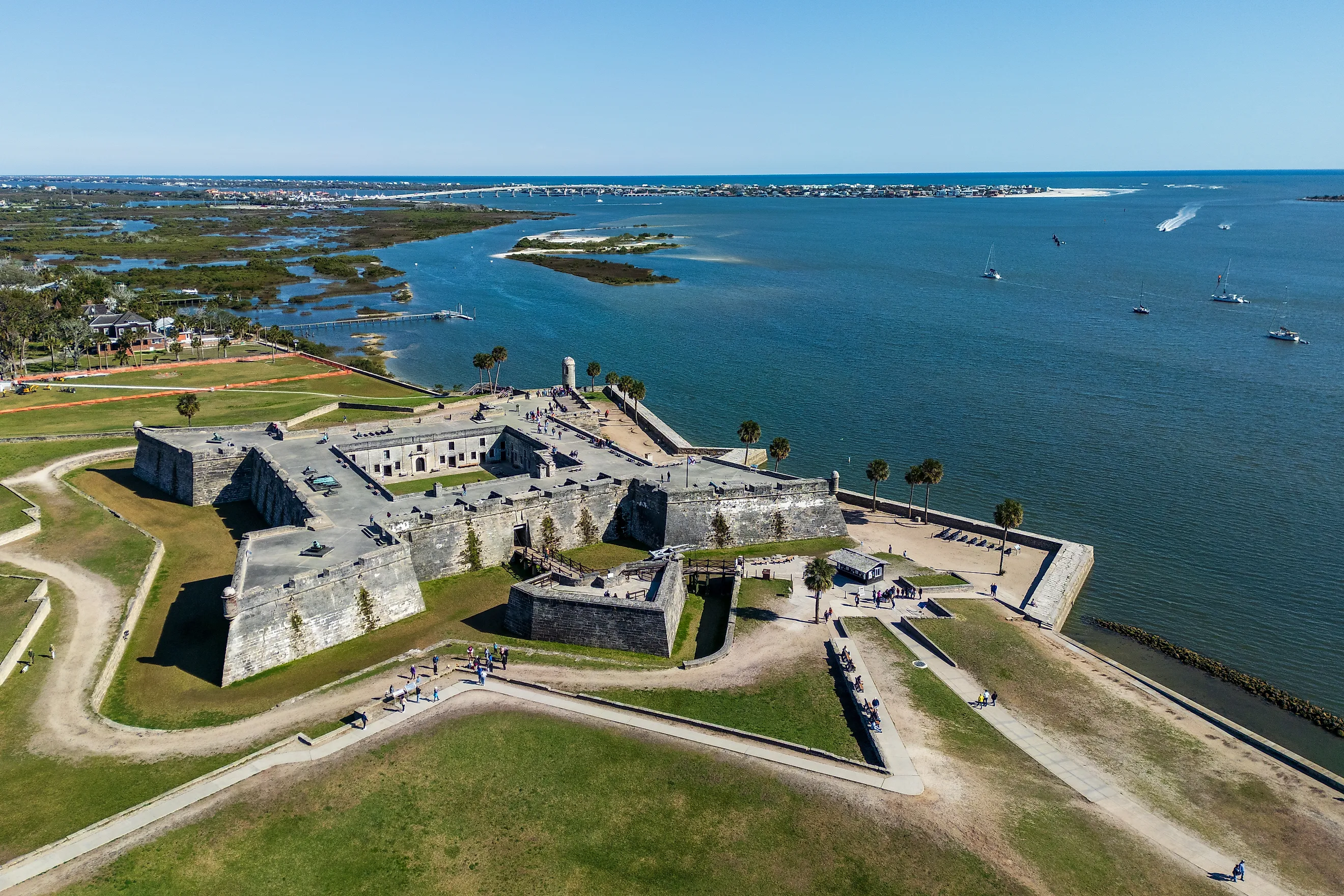
Construction of Castillo de San Marcos began in 1672, when Spain replaced St. Augustine's vulnerable wooden defenses with a masonry fortress overlooking Matanzas Bay. Finally completed in 1695, it remains the oldest surviving fort in the continental United States. The town itself, still thriving to this day, is also the oldest town in the country, having originally been established all the way back in 1565.
Four projecting bastions allowed defenders to cover the surrounding approaches, and its walls were built from coquina, a locally quarried stone composed of shell fragments that helped absorb cannon fire without shattering. That same material proved valuable during the British siege of 1702, when townspeople sheltered inside while much of the rest of St. Augustine burned.
The fortress later passed between Spanish, British, and American control, serving both as a military post and a prison. Today, you can explore its courtyard, former storerooms, and gun deck, where the relationship between the harbor, defensive walls, and surrounding town remains easy to understand from above.
Old Fort Niagara, Youngstown, New York - 1726

The "French Castle", built in 1726, is the oldest structure at Old Fort Niagara, where the Niagara River meets Lake Ontario. This was at a time when France was feuding with both the British and various Indigenous tribes for control over the continent, and the fort's substantial stone walls gave French troops a defensible position overlooking the strategically important water route.
Seeing the setting up close helps explain why competing powers wanted the spot, as soldiers stationed here could monitor movement between the lake and the river, a crucial connection in the broader Great Lakes to Atlantic Ocean network.
Although earlier French posts occupied this site, the castle provides the clearest starting point for its surviving architectural history. British forces captured the fort in 1759 during the French and Indian War (also known as the "Seven Years' War"). It subsequently served under British and then American control, leaving a complex of buildings and defenses developed across many different military periods.
Visitors can now enter the French Castle area, examine the powder magazine, and explore the parade ground between the surrounding fortifications.
Fort Matanzas, St. Augustine, Florida - 1742

Fort Matanzas guarded a vulnerable back entrance to St. Augustine rather than the city's main waterfront. Spanish forces built this coquina watchtower between 1740 and 1742 to prevent enemy ships from approaching through Matanzas Inlet, and its value became clear almost immediately when cannon fire from the newly completed fort drove off British longboats.
This somewhat unassuming structure measures just 50 feet (15 meters) on each side and stands 30 feet (9 meters) high, making it considerably smaller than the older Castillo de San Marcos. Regardless, its combination of a raised gun platform and sheltered quarters allowed a small but effective garrison to watch the waterway and respond to hostile approaching vessels for many decades to come.
Preservation work during the twentieth century stabilized the deteriorating tower, retaining a rare surviving example of the Spanish Empire's coastal defenses in Florida. Its shellstone construction is yet another spot that ties the destination directly to the building traditions of Spanish St. Augustine, one that many curious tourists come to appreciate these days.
Old Fort Johnson, Fort Johnson, New York - 1749

William Johnson's 1749 limestone home became Old Fort Johnson when defenses were added during the French and Indian War. Built in a time when things really had to last, the house still stands beside the Mohawk River in upstate New York, although its surrounding fortifications were removed long ago. As Britain's Superintendent of Indian Affairs for the Northern Department, Johnson held conferences here with Native American representatives, making the property a center of diplomacy as well as military use.
Johnson moved to Johnson Hall in Johnstown in 1763, leaving his son John at the older residence. John was the one who removed the remaining fortifications while preparing the house for his marriage in 1773, but the remaining home still maintained its own solid limestone walls. Unfortunately for him, his family's loyalty to Britain during the American Revolution cost them their property, which American patriots promptly seized.
Opened as a museum in 1906, the house is maintained by the Montgomery County Historical Society and does a fantastic job of preserving the domestic side of a colonial leader's life.
Old Fort Western, Augusta, Maine - 1754

Old Fort Western's original 1754 garrison building has survived centuries of military service, trade, housing, and later use for tourism. Built near the banks of the Kennebec River, it supplied Fort Halifax farther upstream during the French and Indian War. This position at the head of the tide also just made it a logical transfer point for supplies moving into Maine's interior.
The fort's military role ended in 1767, when Captain James Howard purchased the property. In 1775, Benedict Arnold's expedition stopped here for supplies before continuing toward the Quebec border.
Much more recently, the main timber building, which is currently America's oldest surviving wooden fort, has become the centerpiece of a restored complex. While here, you should distinguish the eighteenth-century structure from the reconstructed defenses around it: the stockade and blockhouses date to the 1920 restoration, with the watchboxes added later. Together, they still accurately show the arrangement of a typical frontier post in America, while the original garrison preserves the building where soldiers lived, and supplies were stored.
Experience these Surviving Pieces of American History for Yourself
The survival of these landmarks owes as much to continued use and preservation as to their original construction/purposes. What's left of these places, whether it be a stone wall or a timber barracks, can hold just as much history as a complete fortress, and visiting their storied rooms and defenses brings the scale of colonial warfare into a tangible focus, from the often tight quarters soldiers shared to the surrounding lands and waterways they were assigned to protect.