Do Water Moccasins Really Chase People?
A hiker spots a cottonmouth on the trail. The snake gapes, flashing the white of its mouth, then quickly slithers to the hiker's boots. To the hiker, that's a chase. But to the snake, it's an escape. The nearest hiding spot happens to be behind the hiker, and the person is in the way.
Stories of water moccasins chasing down people are a dime a dozen. But in reality, these stories are what happens when a cottonmouth (another name for a water moccasin) are trying to find the nearest place to hide. Water moccasins don't chase people; They run from them, and sometimes right past them.
Meet the Cottonmouth

A cottonmouth's scientific name is Agkistrodon piscivorus. The Agkistrodon genus features several types of snakes, including the eastern copperhead and two varieties of cottonmouths: the northern (A. piscivorus) and the Florida (A. conanti).
Although there are reports of cottonmouths everywhere, most northern cottonmouths only live in the American South, in states such as Texas, Oklahoma, Arkansas, Alabama, Tennessee, Missouri, and Kentucky. There are small pockets of cottonmouths in Illinois and Indiana as well. Florida cottonmouths, meanwhile, are found in Florida and southern Georgia, although they can interbreed with northern cottonmouths, meaning one can find hybrid populations in the southeastern US.

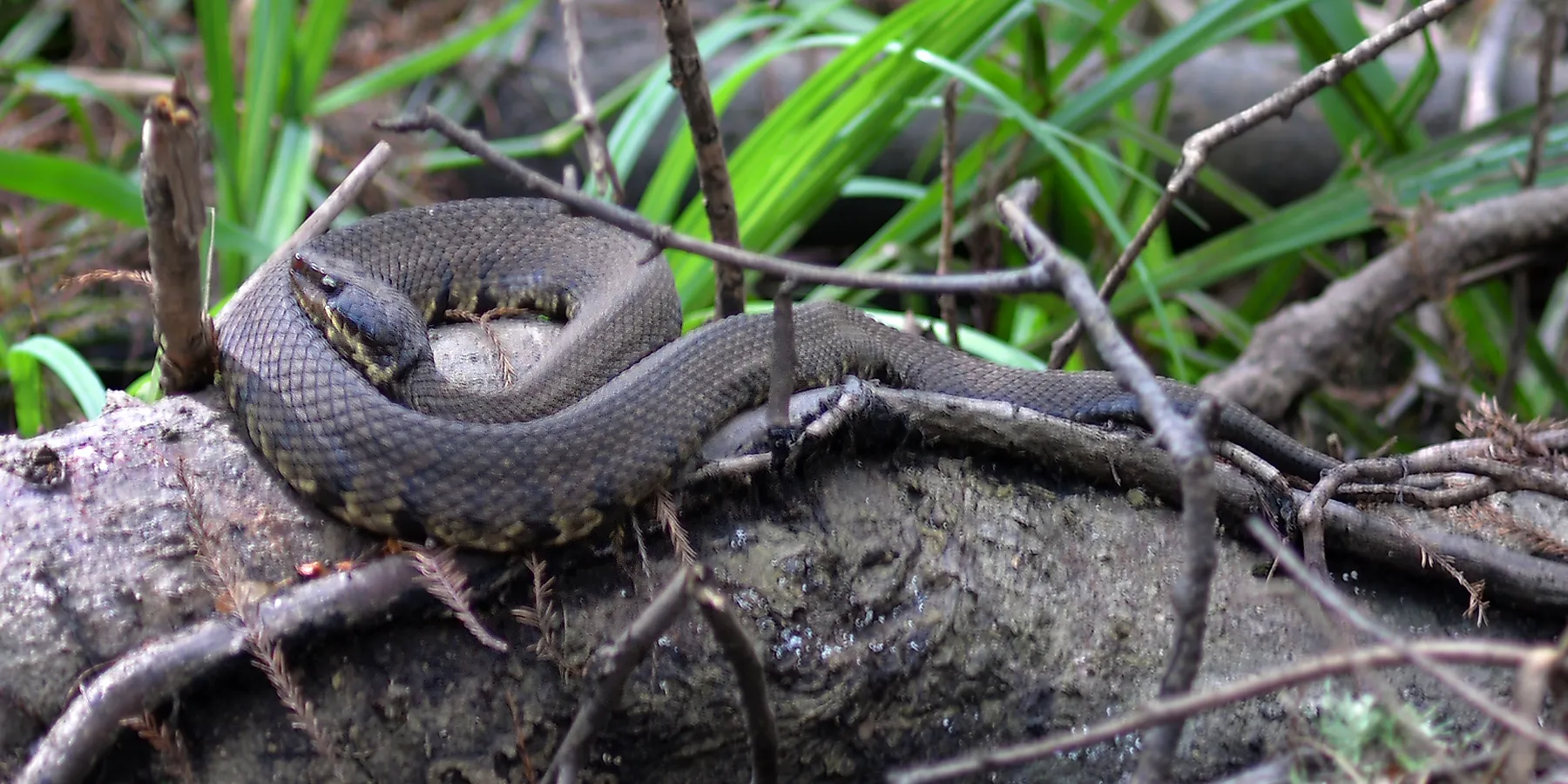
Cottonmouths are semi-aquatic pit vipers that are typically dark olive, brown, or black, although Florida cottonmouths have lighter coloring. They aren't particularly long, only growing 2 to 4 feet in length on average. As semi-aquatic animals, they can hunt in and out of water. They aren't picky eaters either, as they feed on fish such as bass, lizards, rodents, birds, and even other smaller snakes.
Their venom profile is hemotoxic, meaning it targets and disrupts prey's bloodstream. The venom itself has enzymes that break down prey's tissue, making it easier for the cottonmouth to swallow their prey whole.
Defensive vs Aggressive Behavior

One of the most common mistakes people make when observing cottonmouths or any snake, for that matter, is confusing aggressive behavior for defensive behavior. Cottonmouths are not aggressive, but they are defensive.
To explain this behavior, a cottonmouth sees a human intruding on their space, and they view them as a threat. This is, of course, not without reason, as humans can and do kill snakes. Not to mention, to a snake, a large upright human could be a potential predator.

In response to a threat, a cottonmouth has several tools at their disposal, including their white mouth. By opening their mouth and revealing their fangs, they are identifying themselves as a venomous cottonmouth. This can also be accompanied by a hiss. They can also make movements that will help them appear larger, such as flattening their bodies against the ground. Many animals do this behavior, including house cats who arch their backs and hiss.
The cottonmouth can further try to get predators and humans to go away by releasing a bad smell from glands in their tail, along with vibrating their tail against the ground in mimicry of a rattlesnake. A cottonmouth will only bite as an absolute last resort, such as if they are cornered or if someone tries to step on, attack, or grab them.
What Influences this Myth?

There are several factors that influence the myth of the aggressive cottonmouth. The first is their tendency to turn their heads around to face a human directly and reveal their mouth. However, this behavior is defensive as well. The snake is attempting to protect the back of its neck, as that is the most vulnerable part of the body, and the snake wants to avoid being grabbed there by any potential predator, including a human.
The biggest reason behind the dashing cottonmouth myth is that at times cottonmouths may move towards someone, but this is actually not meant as aggression. The snake is trying to get away!
The Orianne Society notes that when cottonmouths do move towards humans, they want to reach the closest hiding spot, and sometimes that's right past the person. There are several videos online of cottonmouths slithering right between the legs of hikers, while showing no signs of biting.
Chasing People Takes up too Much Energy

Beyond all these reasons, cottonmouths have a very practical reason not to chase or bite people, and it comes down to their energy levels.
Cottonmouths are ectotherms, otherwise known as cold-blooded. Unlike warm-blooded animals, which can generate heat through their metabolism, cold-blooded animals need outside heat sources to keep their body temperature regulated. This is why snakes spend so much time basking in the sunlight and retreat into dens in the winter. If the temperatures get too hot, snakes can go into water sources, including non-aquatic snakes such as copperheads or rattlesnakes.
What this means for cottonmouths is that their energy reserves are precious. They don't have the speedy metabolism of warm-blooded creatures, so they must choose how they use their energy. One easy way to see this energy difference in action is to watch how a pet puppy behaves compared to a pet lizard. The lizard will move slowly and methodically, save for short bursts of energy such as using their tongue to eat an insect, while the puppy will run, bark, and play.

For a cottonmouth, the best use of energy is to bite and eat prey. They need to be able to strike quickly at prey. Most estimates put its strike speed at close to 7 miles per hour. Cottonmouths are also faster in the water than on land, due to their buoyancy enabling them to swim faster than slithering on the ground.
What that all means is that cottonmouths would be wasting energy by chasing humans, as their cold-blooded nature prevents them from long chases in the first place.
The Cottonmouth's Perspective

Let's take a moment to see what a cottonmouth sees when a human walks up to it. From the snake's perspective, a human is a massive upright creature that is longer than it and much heavier and faster. A human could stomp on its head or pick up a rock and smash it with it. For the cottonmouth, its only defense is the threat of its venomous bite.
Unfortunately, this defensive behavior can trigger the opposite reaction in humans and inspire them to take risky actions such as attacking the snake directly, which makes the snake more likely to bite in a desperate attempt to defend itself.
Cottonmouths are so feared that any snake that even looks like them, such as nonvenomous water snakes, is also targeted by humans. Despite their reputation, cottonmouth bites are very rare. In 2017, poison centers recorded 255 cottonmouth bites, compared with 2,035 from copperheads.
There are an estimated 7,000 to 8,000 snakebites per year, and the species responsible for the most bites is the copperhead, not the cottonmouth.
The best way to protect oneself and others is to give cottonmouths space and raise awareness about this snake. Not only will this protect others from cottonmouth bites, but it will also keep the snake safe as well. If a cottonmouth could speak with its white mouth, it would thank you for giving it space.