Where Water Moccasins And Northern Water Snakes Overlap
Georgia's wildlife agency gives one piece of advice that contradicts almost everything people repeat about telling these two apart: the shape of the head is not a reliable way to identify them. Northern watersnakes flatten and flare their heads when threatened, producing exactly the triangular outline everybody is taught to watch for. Which is unfortunate, because the harmless one is killed constantly on the strength of it. The two species share a wide band of the eastern United States, and in most of the watersnake's range there is no cottonmouth to confuse it with at all.
The Watersnake Range Is Far Larger

The two ranges overlap substantially and are nowhere near the same size.
The northern watersnake runs from Maine through the Midwest, south to western South Carolina and Georgia, and west into central Texas. The cottonmouth covers southeastern Virginia to south Florida, west to central Texas and north only as far as southern Illinois.
The shared band is roughly the Carolinas, Georgia, Alabama, Mississippi, Louisiana, Arkansas, Tennessee, Kentucky, Missouri, eastern Texas and the southern tips of Illinois and Indiana.
Everywhere North Of That Is Clear

This is the single most useful fact in the subject and it is rarely stated plainly.
Across the northern and eastern United States, from New England through the Great Lakes states and the upper Midwest, there are no cottonmouths. A thick banded snake in the water in Ohio, Michigan, Pennsylvania or New York is a watersnake, every time.
There is no judgment call to make. The range map has already made it.
Virginia Shows The Line

One state demonstrates the boundary better than any map, because both situations exist inside it.
The northern watersnake occurs statewide in Virginia, near virtually any body of fresh water. The cottonmouth occurs only in the southeastern coastal plain.
So across most of Virginia, a watersnake is always a watersnake. In the southeastern corner, the question becomes real.
The Bands Run The Opposite Way

Where both occur, the pattern tell is the most reliable one and it is specific enough to use.
Georgia's agency puts it simply: on a cottonmouth, if banded, the bands are widest on the sides and narrow on top. On a watersnake, the bands are widest on top and narrow on the sides.
Look down at a snake from above. Broad bands across the spine narrowing toward the flanks means watersnake. Bands pinched across the spine and flaring down the sides means cottonmouth.
Count The Scales Under The Tail

There is a definitive anatomical difference, though it requires a closer look than most people want.
Cottonmouths have a single row of scales on the underside of the tail. Watersnakes have a double row.
This is diagnostic and unambiguous. It is also only practical on a dead snake or a photograph, which is why the behavioral tells matter more in the field.
Swimming Posture Is The Field Tell
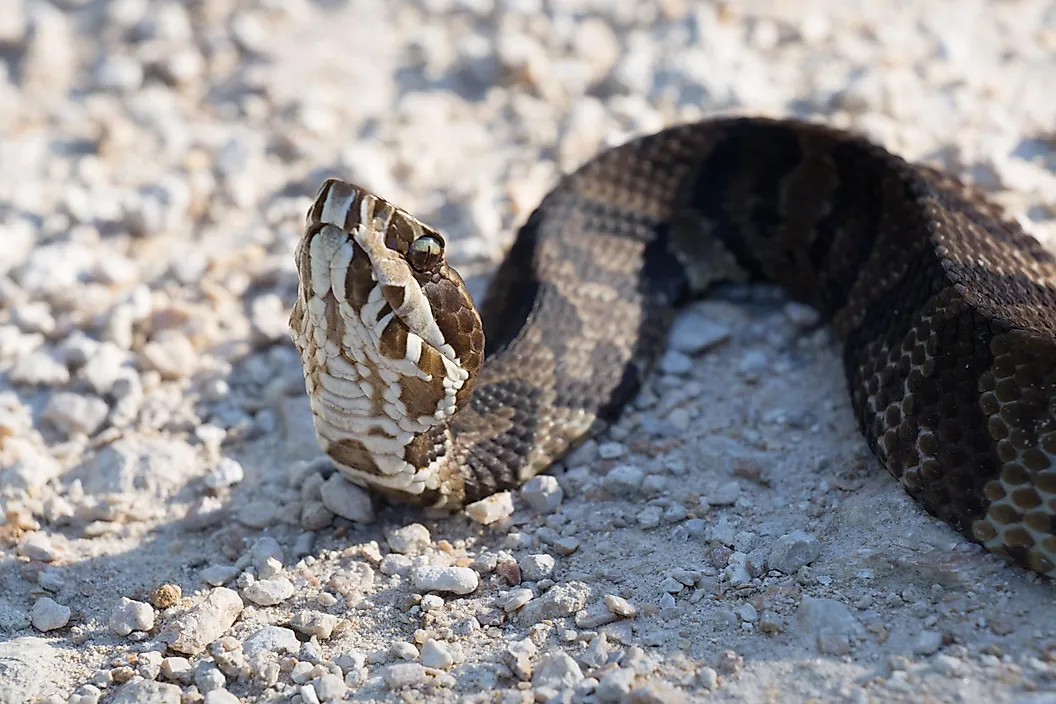
The distinction that works from a distance comes down to buoyancy rather than markings.
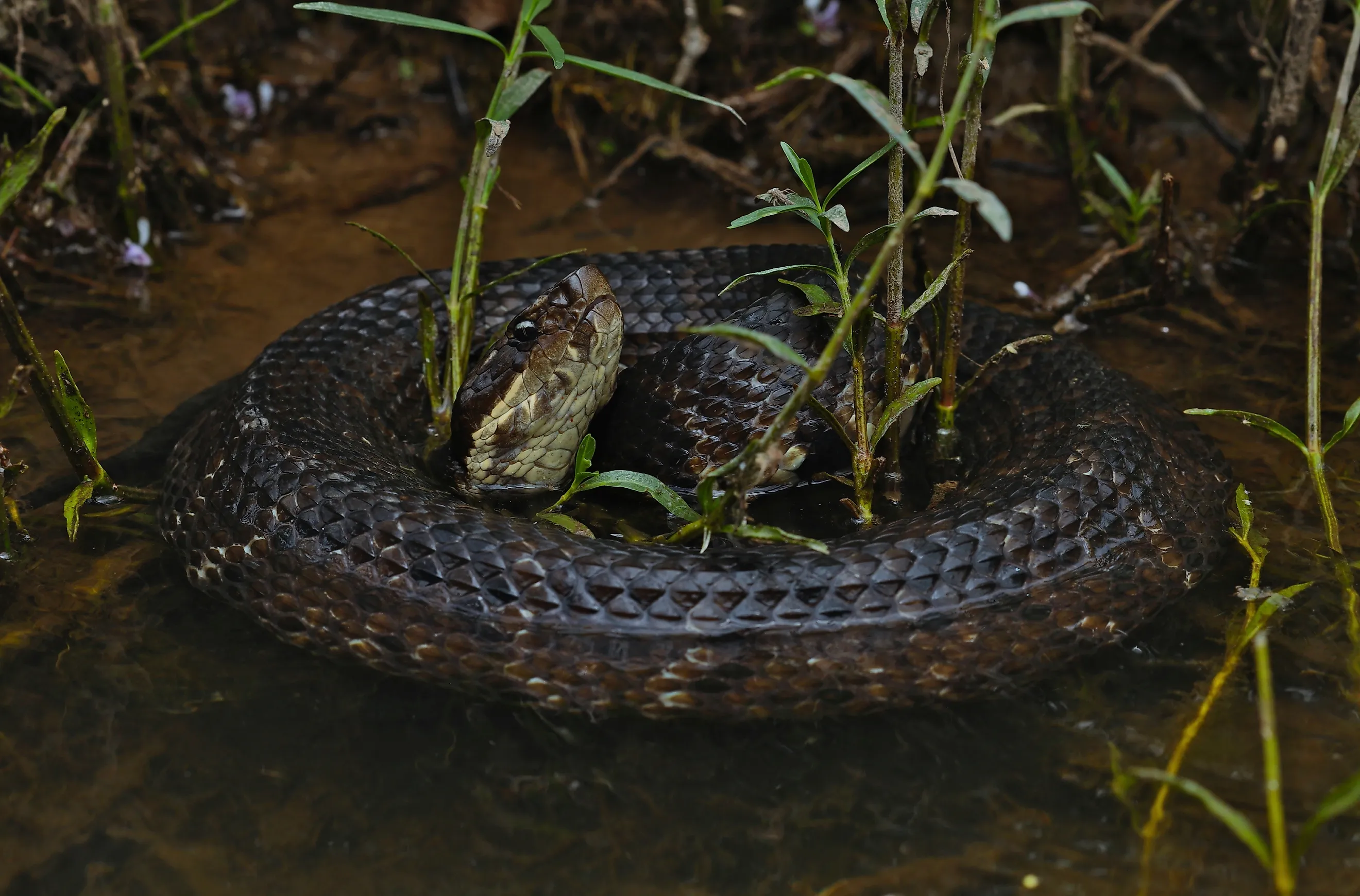
Cottonmouths swim with the head elevated and the body riding on the water surface. Watersnakes swim with most of the body below the surface and only the head showing.
A snake crossing open water with its body visibly submerged is a watersnake. One floating high with its head cocked upward is not.
Height Is The Other One

Where the snake is basking separates them as cleanly as how it swims.
Watersnakes bask in limbs overhanging the water and climb readily. Cottonmouths bask on land, on logs and stumps near the surface, and rarely climb.
A snake in a branch above a boat is a watersnake. Anything at eye level and above is almost certainly harmless.
Only One Of Them Gapes

Behavior under threat is the most decisive signal of all, and it is the one the venomous species is named for.
The white-mouthed open-jaw display is the cottonmouth's signature and watersnakes do not do it. A cornered watersnake flattens its body and head, strikes repeatedly and releases foul musk, but it does not gape.
It also usually runs. A watersnake approached on a bank drops into the water and leaves. A cottonmouth holds its ground.
The Flattening Is The Problem

Everything above is undermined by one defensive behaviour, which is why the head-shape rule fails.
A threatened northern watersnake flattens its head and neck, producing a broad triangular profile that looks exactly like a pit viper. Researchers have suggested the resemblance may be an evolutionary adaptation, mimicry that deters predators.
It works on everything except humans with shovels, for whom it is counterproductive in the extreme.
Most Killed Snakes Are The Wrong Species

The practical consequence of the confusion is a great many dead harmless animals.
Northern watersnakes are killed in large numbers each year because they are mistaken for venomous species. Connecticut records the species as secure while noting that many are killed annually for this reason, and Virginia's own guidance calls the misidentification frequent and dangerous.
Attempting to kill a snake is also the single most common way people get bitten, which makes the mistake expensive in both directions.
The Short Answer

Cottonmouths and northern watersnakes overlap across the Southeast and lower Midwest, roughly the Carolinas to east Texas and north to southern Illinois. Outside that band, which includes all of New England, the Great Lakes states and most of the Midwest, every thick banded snake in the water is harmless.
Inside it, ignore the head shape, because the watersnake fakes it. Use the bands, which run wide across the spine on a watersnake and wide down the flanks on a cottonmouth, the swimming posture, the height off the ground, and whether the animal opens its mouth at you. Only one of them does that, and it is the one the name refers to.